


09 Aug Karnataka HC Upholds Royal Estate Succession Protection Despite Privy Purse Abolition
✎ Section 5(ii) of the Hindu Succession Act, 1956, exempts certain royal estates from partition under the Act, provided they descend to a single heir under pre-Independence agreements or enactments, and this exemption remains valid…
Subject Relevance — Where This Topic Fits
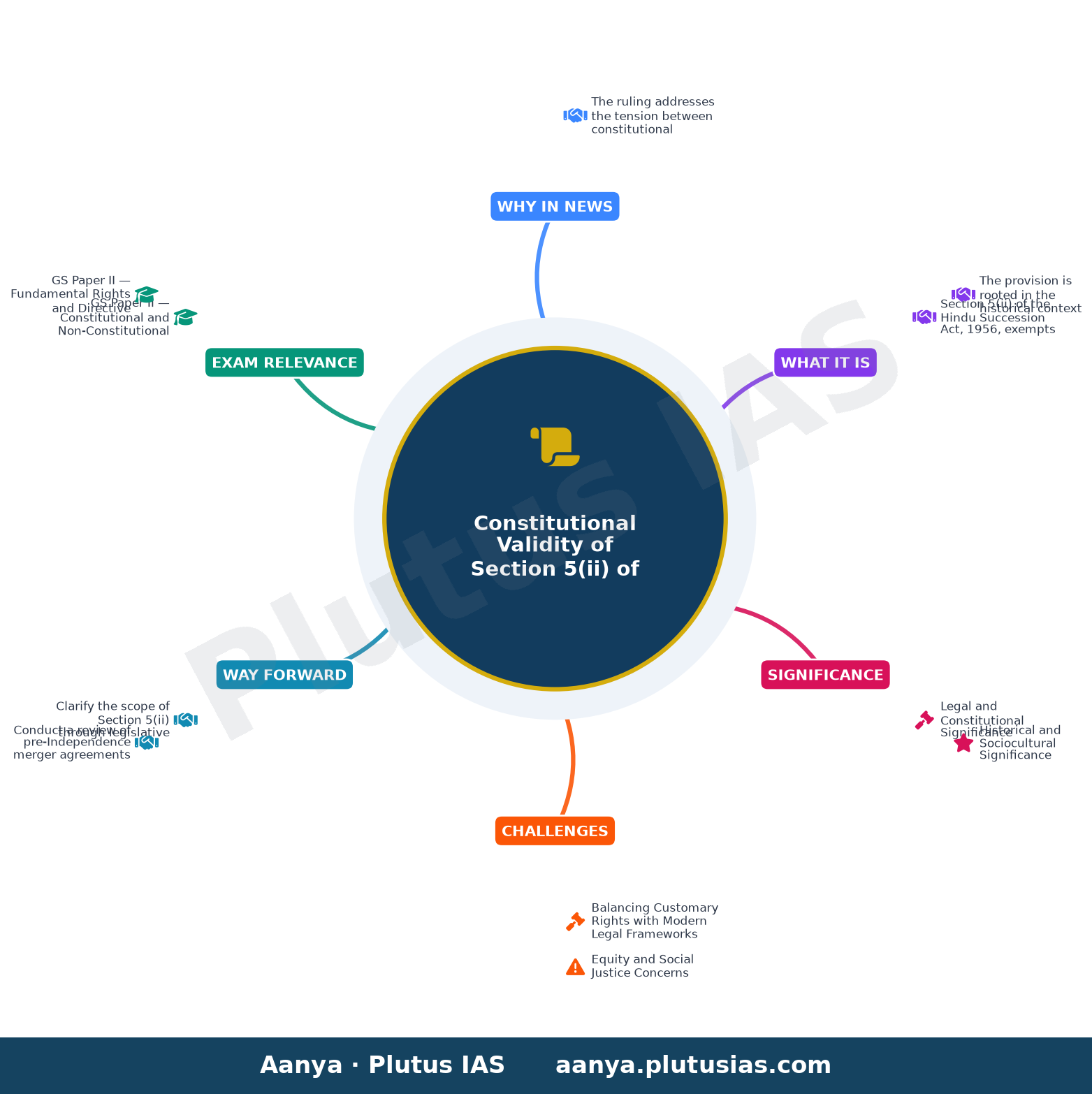
- GS Paper II — Constitutional and Non-Constitutional Bodies (Judiciary) | GS Paper II — Fundamental Rights and Directive Principles of State Policy | GS Paper III — Land Reforms and Agrarian Structure | GS Paper IV — Ethics and Integrity in Governance (Customary Practices and Legal Pluralism)
- Prelims: Hindu Succession Act, 1956, Article 291 and 362 of the Constitution, Article 363-A (26th Amendment Act, 1971), Impartible estate, Gaddi (ceremonial throne), Princely States of India, Land Reforms in India, Constitutional validity of customs
- Essay: The interplay between constitutional morality and customary practices in India’s post-colonial legal framework, Land reforms and the preservation of historical privileges: A balance between equity and tradition
Quick Revision: Section 5(ii) of the Hindu Succession Act, 1956, exempts certain royal estates from partition under the Act, provided they descend to a single heir under pre-Independence agreements or enactments, and this exemption remains valid despite the abolition of privy purses and royal privileges.
Why is this in the news?
The ruling addresses the tension between constitutional guarantees for former rulers and the statutory framework governing succession in private properties, particularly in the context of the Gaddi (ceremonial throne) and impartible estates. This decision has significant implications for the interpretation of customary rights, land reforms, and the legal status of pre-Independence agreements in contemporary India.
Background
- The Hindu Succession Act, 1956, was enacted to codify and reform inheritance laws among Hindus, replacing diverse customary practices with a uniform statutory framework. However, Section 5(ii) of the Act carves out an exception for estates that descend to a single heir under pre-Independence agreements or covenants with the Government of India.
- The princely States of India were integrated into the Indian Union post-Independence through Instruments of Accession and subsequent merger agreements. These agreements often included provisions for the protection of private properties, succession to the Gaddi, and the payment of privy purses to former rulers.
- The 26th Amendment to the Constitution (1971) abolished privy purses and certain privileges of former rulers under Articles 291 and 362, replacing them with Article 363-A. This amendment sought to eliminate feudal privileges but did not explicitly address the status of private properties or the Gaddi.
- The abolition of privy purses and privileges led to disputes over the interpretation of Section 5(ii), particularly regarding whether the provision remained valid in the absence of constitutional guarantees for privy purses.
- The case arose from civil suits between members of the erstwhile royal families of Mysore and Sandur over the partition of inherited estates. The petitioners argued that Section 5(ii) had lost its relevance due to the abolition of privy purses and the irrelevance of the Gaddi in modern India.
- The court examined the merger agreements of the former States of Mysore and Sandur with the Government of India, which separately dealt with privy purses, private properties, and succession to the Gaddi.
What is Section 5(ii) of the Hindu Succession Act, 1956?
- Section 5(ii) of the Hindu Succession Act, 1956, exempts certain estates from the purview of the Act’s partition provisions. It applies to estates that descend to a single heir under the terms of any covenant or agreement entered into by the ruler of an Indian State with the Government of India or under any enactment passed before the commencement of the Act (17 June 1956).
- The provision is rooted in the historical context of princely States, where certain estates were governed by pre-Independence agreements that recognized the principle of impartible succession—i.e., descent to a single heir to preserve the estate’s integrity.
- The exemption under Section 5(ii) is not absolute; it applies only to estates that meet the criteria of being governed by pre-Independence agreements or enactments. It does not extend to all properties of erstwhile rulers.
- The provision reflects a legislative recognition of customary practices and contractual agreements that predate the Hindu Succession Act. It balances the need for legal uniformity with the preservation of historical agreements.
- The validity of Section 5(ii) has been tested in courts, particularly after the abolition of privy purses and royal privileges.
- The Gaddi (ceremonial throne) is a symbolic and practical institution in certain princely States, often tied to the succession of the estate. While its ceremonial significance may have diminished, its practical role in succession disputes remains relevant under Section 5(ii).
- The provision does not confer any new rights or privileges; it merely preserves the legal status of estates that were already governed by impartible succession under pre-Independence agreements.
- The exemption under Section 5(ii) is distinct from the abolition of privy purses and royal privileges. The latter were constitutional guarantees, while the former pertains to the legal recognition of private property rights and succession agreements.
Key Features
| Feature | Significance |
|---|---|
| Section 5(ii) of the Hindu Succession Act, 1956 | Excludes certain royal estates from partition under the Act, preserving their impartible status based on pre-Independence agreements or covenants. |
| Impartible Estate | A property that descends to a single heir, preventing division among multiple heirs, historically linked to royal families and their customs. |
| Gaddi (Ceremonial Throne) | Symbolic seat of authority in princely states; while its political relevance has diminished, the court recognised its continued customary and practical significance in succession disputes. |
| Articles 291 and 362 of the Constitution (pre-26th Amendment) | Guaranteed privy purses, privileges, and dignities to erstwhile rulers; their abolition did not invalidate Section 5(ii) as they pertained to personal rights, not private properties or Gaddi. |
| 26th Constitutional Amendment (1971) | Removed Articles 291 and 362, inserting Article 363-A to abolish privy purses and privileges; the court ruled this did not affect the validity of Section 5(ii). |
Why it Matters
Legal and Constitutional Significance
- The judgment reaffirms the distinction between the abolition of political privileges (privy purses, titles) and the preservation of customary property rights under Section 5(ii) of the Hindu Succession Act.
- It clarifies that the constitutional amendments of 1971 did not invalidate pre-existing legal provisions governing the succession of royal estates, ensuring continuity in property laws for certain communities.
- The ruling underscores the role of historical agreements (e.g., merger agreements of Mysore and Sandur) in shaping contemporary legal rights, even decades after their formal recognition.
Historical and Sociocultural Significance
- The decision acknowledges the enduring cultural and customary relevance of the Gaddi in royal families, despite the loss of its political authority post-Independence.
- It highlights the unique legal status of royal estates, which are governed by pre-Independence covenants rather than general succession laws, reflecting India’s pluralistic legal framework.
- The judgment preserves the continuity of customary practices in succession, which may hold symbolic or social importance for affected communities.
Judicial Precedent and Legal Doctrine
- The court’s interpretation reinforces the principle that constitutional amendments targeting specific political privileges do not automatically invalidate unrelated legal provisions, provided they are not expressly repealed.
- The ruling aligns with the doctrine of harmonious construction, where different legal provisions are interpreted to coexist without conflict unless explicitly overridden.
Challenges
1. Balancing Customary Rights with Modern Legal Frameworks
- The tension between preserving historical customs (e.g., impartible estates) and ensuring equitable property rights under modern laws like the Hindu Succession Act.
- The challenge of interpreting pre-Independence agreements in contemporary legal disputes, where the original intent may be ambiguous or contested.
- Potential for prolonged litigation as family members dispute the interpretation of merger agreements and succession rights.
UPSC Link: GS-II: Indian Constitution—Historical underpinnings, evolution, features, amendments, significant provisions and basic structure.
2. Equity and Social Justice Concerns
- Criticism that impartible estates perpetuate feudal practices, limiting inheritance rights for women and other heirs, contrary to the spirit of equality enshrined in the Constitution.
- The risk of such legal provisions being used to exclude marginalised members of royal families from property rights, raising questions about justice and fairness.
UPSC Link: GS-II: Welfare schemes for vulnerable sections of the population by the Centre and States and the performance of these schemes; mechanisms, laws, institutions and bodies constituted for the protection and betterment of these vulnerable sections.
3. Legal Ambiguity and Interpretative Challenges
- The need for clarity in distinguishing between political privileges (abolished) and property rights (preserved) under Section 5(ii), which may lead to further litigation.
- The challenge of determining the relevance of the Gaddi in modern legal contexts, where its symbolic value may not align with contemporary governance or social norms.
UPSC Link: GS-II: Judiciary in India—Structure, organization and functioning, including issues relating to the independence of the judiciary.
Challenges — UPSC Perspective
| Issue | Concern |
|---|---|
| Preservation of Customary Rights vs. Modern Equity | Impartible estates may perpetuate feudal practices, conflicting with the constitutional guarantee of equality (Article 14). |
| Interpretation of Pre-Independence Agreements | Ambiguity in merger agreements or covenants may lead to prolonged legal disputes over property rights. |
| Gender Bias in Succession Laws | Impartible estates often exclude women from inheritance, raising concerns under Article 15 and the Hindu Succession Act’s gender-neutral provisions. |
| Judicial Consistency in Constitutional Amendments | The ruling highlights the need for clear judicial guidance on how constitutional amendments affect unrelated legal provisions. |
| Cultural Symbolism vs. Legal Relevance | The continued recognition of the Gaddi as a relevant subject in succession disputes may conflict with its diminished political significance. |
Way Forward
- Clarify the scope of Section 5(ii) through legislative amendments or judicial guidelines to address ambiguities in its application to modern disputes.
- Conduct a review of pre-Independence merger agreements and covenants to ensure their provisions align with contemporary legal and social norms.
- Strengthen legal literacy among affected communities to ensure awareness of rights and remedies under both customary and statutory laws.
- Encourage alternative dispute resolution mechanisms (e.g., mediation) to resolve succession disputes within royal families efficiently.
- Explore gender-neutral reforms in succession laws to address biases in impartible estates, ensuring compliance with constitutional principles.
- Document and preserve the cultural and historical significance of the Gaddi and other royal customs to inform future legal interpretations.
- Promote research on the socio-economic impact of impartible estates to assess their relevance in contemporary society.
UPSC Value Addition
Keywords for Mains Answer-Writing
Hindu Succession Act, 1956 · Section 5(ii) of Hindu Succession Act · privy purses · Article 291 and 362 of Constitution · Gaddi (ceremonial throne) · impartible estate · Karnataka High Court judgment 2026 · merger agreements of princely States · 26th Constitutional Amendment · Article 363-A · customary succession laws · succession to royal properties
Constitutional & Policy Linkages
- Article 14: Equality before law and equal protection of laws.
- Article 15: Prohibition of discrimination on grounds of religion, race, caste, sex, or place of birth.
- Article 363-A: Abolition of privy purses and privileges (26th Amendment).
- Article 372: Continuance in force of pre-Constitution laws and their adaptation.
Concept Flow
Abolition of privy purses and privileges (Articles 291, 362) via the 26th Amendment (1971) → → Petitioners challenge Section 5(ii) of the Hindu Succession Act, 1956, arguing its irrelevance post-abolition → → Karnataka High Court examines the distinction between abolished privileges and preserved property rights → → Court rules that Section 5(ii) remains valid as it pertains to pre-Independence agreements, not abolished privileges → → Judgment reaffirms the legal continuity of impartible estates and customary succession practices → → Potential for further litigation on gender bias and equity in succession laws.
Prelims Practice Questions
Q1. Consider the following statements regarding the Hindu Succession Act, 1956:
1. Section 5(ii) of the Act excludes certain estates from the purview of partition under the Act.
2. The provision applies to estates that descend to a single heir by terms of a covenant or agreement entered into by the ruler of an Indian State with the Government of India.
3. The provision was introduced to abolish the concept of privy purses.
4. The provision remains valid even after the abolition of Articles 291 and 362 of the Constitution.
How many of the above statements are correct?
- Only one
- Only two
- Only three
- All four
Answer: Only three — Statements 1, 2, and 4 are correct. Statement 3 is incorrect as Section 5(ii) pertains to succession to certain estates, not the abolition of privy purses, which was addressed separately through constitutional amendments.
Q2. Assertion (A): The 26th Constitutional Amendment, 1971, abolished the privy purses and privileges of erstwhile rulers of princely States.
Reason (R): The amendment inserted Article 363-A to remove the constitutional guarantees provided under Articles 291 and 362.
Options:
A. Both A and R are true, and R is the correct explanation of A.
B. Both A and R are true, but R is not the correct explanation of A.
C. A is true, but R is false.
D. A is false, but R is true.
Answer: ? — Both A and R are true, and R correctly explains A as the 26th Amendment abolished privy purses and inserted Article 363-A to nullify Articles 291 and 362.
Q3. Match the following provisions of the Constitution of India with their respective descriptions:
Column I
1. Article 291
2. Article 362
3. Article 363-A
4. Section 5(ii) of the Hindu Succession Act, 1956
Column II
A. Guaranteed privy purse sums to rulers of erstwhile princely States
B. Rights and privileges of rulers of Indian States
C. Abolished constitutional guarantees relating to privy purses and privileges
D. Excludes certain estates from partition under Hindu Succession Act
- 1-A, 2-B, 3-C, 4-D; 1-B, 2-A, 3-C, 4-D; 1-A, 2-C, 3-B, 4-D; 1-D, 2-B, 3-A, 4-C
- answer_texts_are_in_options
Answer: 1-A, 2-B, 3-C, 4-D; 1-B, 2-A, 3-C, 4-D; 1-A, 2-C, 3-B, 4-D; 1-D, 2-B, 3-A, 4-C — The correct pairing is: Article 291 (A), Article 362 (B), Article 363-A (C), and Section 5(ii) of the Hindu Succession Act (D).
Mains Practice Question
✍ Critically examine the constitutional and legal validity of Section 5(ii) of the Hindu Succession Act, 1956, in the context of the recent Karnataka High Court judgment (2026) affirming its continued relevance despite the abolition of privy purses and privileges. Also, discuss the implications of this provision for the customary succession laws governing royal estates in India. (15 Marks)
Approach: MODEL-ANSWER SKELETON:
1. **Introduction (2 marks)**: Define Section 5(ii) of the Hindu Succession Act, 1956, and its objective to exclude certain estates from partition under the Act. Briefly state the context of the Karnataka High Court judgment (2026) affirming its validity despite the abolition of privy purses and privileges.
2. **Constitutional and Legal Framework (5 marks)**:
– Explain Articles 291 and 362 of the Constitution, which guaranteed privy purses and privileges to erstwhile rulers.
– Discuss the 26th Constitutional Amendment (1971) and the insertion of Article 363-A, which abolished these guarantees.
– Clarify that Section 5(ii) of the Hindu Succession Act is distinct and pertains to succession to certain estates, not privy purses or privileges.
– Reference the merger agreements of princely States (e.g., Mysore and Sandur) with the Government of India, which separately dealt with privy purses, private properties, and succession to the Gaddi.
3. **Judicial Reasoning and Precedents (4 marks)**:
– Summarize the Karnataka High Court’s reasoning in dismissing the petitions challenging Section 5(ii).
– Highlight the distinction drawn by the court between the Gaddi (ceremonial throne) and private properties.
– Reference relevant judicial precedents or constitutional principles supporting the court’s stance.
4. **Implications for Customary Succession Laws (3 marks)**:
– Discuss the importance of Section 5(ii) in preserving the customary succession laws governing royal estates.
– Explain how the provision balances the need for legal uniformity with the preservation of historical and cultural practices.
– Address potential conflicts between customary laws and the Hindu Succession Act, and the role of the judiciary in resolving such conflicts.
5. **Conclusion (1 mark)**: Summarize the findings and emphasize the continued relevance of Section 5(ii) in the context of India’s pluralistic legal system.
Source: The Hindu
Generated by AanyaAi for educational purpose.

- महाराष्ट्र में त्योहार जुलूसों पर बॉम्बे हाईकोर्ट का बड़ा फैसला: पटाखे, लेजर और संगीत पर रोक - September 24, 2026
- Bombay HC Bans Firecrackers, Music in Maharashtra Processions: Key UPSC Analysis - September 24, 2026
- तमिलनाडु में महिला कर्मचारियों के लिए सवैतनिक माहवारी अवकाश नीति पर HC का आदेश - September 24, 2026

No Comments