


15 Sep Karnataka Opposes Kasturirangan Report: Farmers’ Protests & CM’s Shivamogga Visit
✎ Eco-Sensitive Areas in the Western Ghats are designated under the Environment Protection Act, 1986, to regulate activities that may harm biodiversity, balancing conservation with sustainable livelihoods as per the Kasturirangan…
Subject Relevance — Where This Topic Fits
- GS Paper II — Governance, Constitution and Polity | GS Paper III — Environment and Biodiversity
- Prelims: Eco-Sensitive Areas (ESA), Western Ghats, Kasturirangan Report, Environment Protection Act 1986, Forest Rights Act 2006, Gadgil Committee Report, National Green Tribunal (NGT)
- Essay: Environmental conservation vs. livelihood security: Balancing developmental imperatives with ecological sustainability
Quick Revision: Eco-Sensitive Areas in the Western Ghats are designated under the Environment Protection Act, 1986, to regulate activities that may harm biodiversity, balancing conservation with sustainable livelihoods as per the Kasturirangan Report.
Why is this in the news?
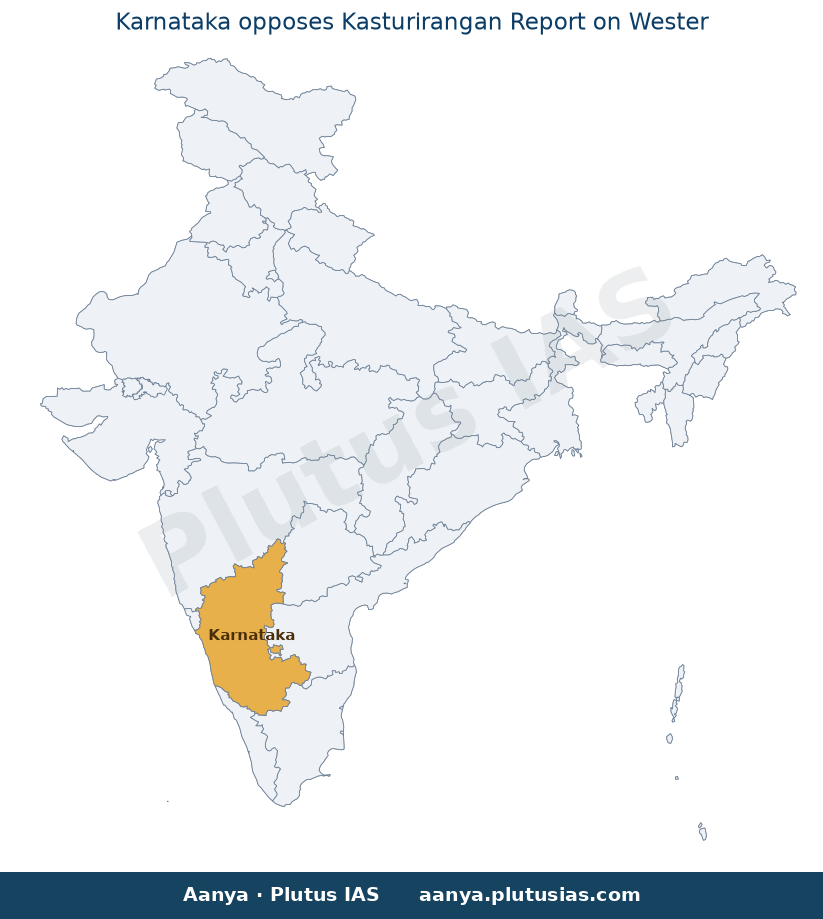
The Karnataka government has opposed the implementation of the Kasturirangan Report’s recommendations for designating Eco-Sensitive Areas (ESAs) in the Western Ghats, citing concerns over its impact on agricultural communities. The state’s decision to conduct consultations with affected farmers in Shivamogga district underscores the governance challenge of reconciling conservation objectives with livelihood protection in ecologically sensitive regions.
Background
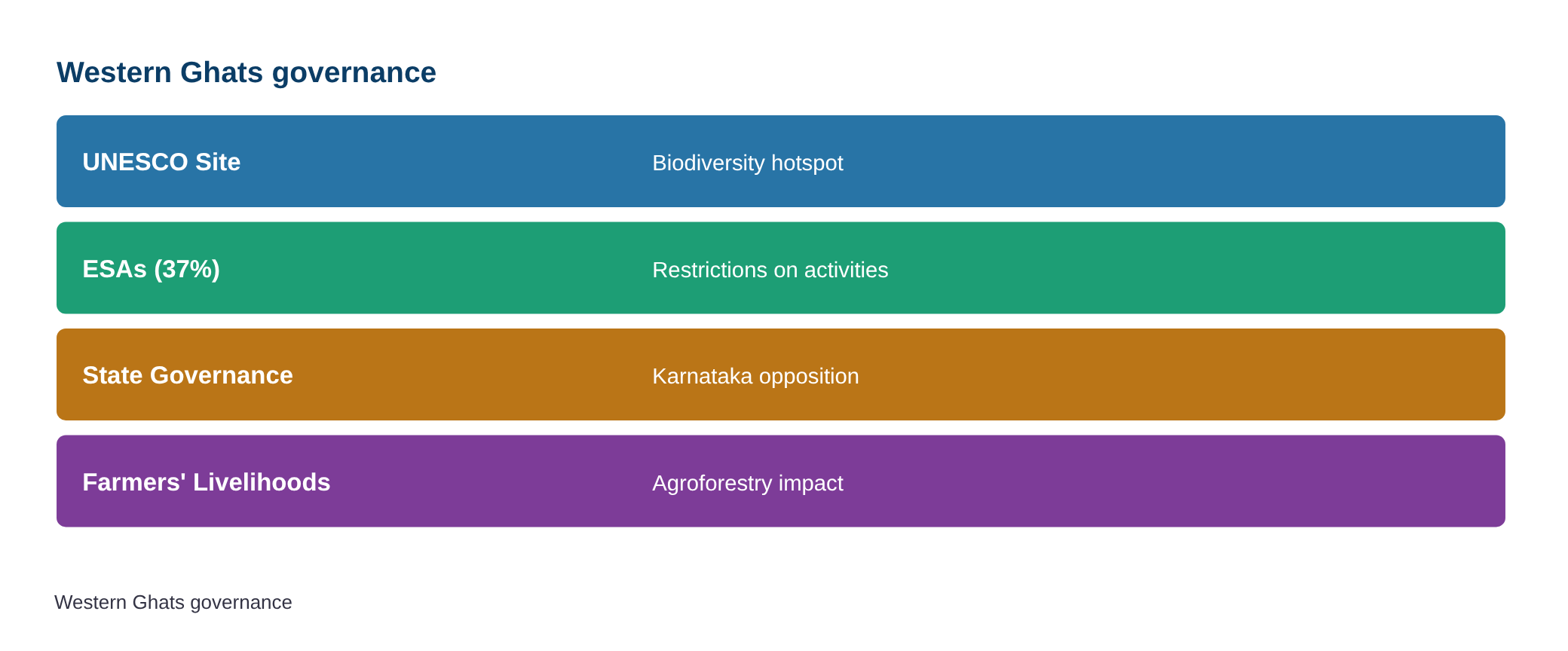
- The Western Ghats, a UNESCO World Heritage Site, is a biodiversity hotspot spanning six states, including Karnataka, and is crucial for ecological balance and monsoon patterns.
- The Gadgil Committee (2011) and Kasturirangan Committee (2013) were constituted by the Ministry of Environment, Forest and Climate Change (MoEFCC) to recommend conservation measures for the Western Ghats.
- The Kasturirangan Report proposed the designation of 37% of the Western Ghats as ESA, where developmental activities would be restricted to protect ecological integrity.
- The Environment Protection Act, 1986 empowers the Central Government to declare ESAs under Section 3(2)(v) to regulate activities that may adversely affect the environment.
- The Forest Rights Act, 2006 recognises the rights of forest-dwelling communities, including their access to forest resources, which intersects with ESA regulations.
- The MoEFCC has issued seven draft notifications for ESAs in the Western Ghats, with Karnataka and other states expressing reservations over their implementation.
What is the Kasturirangan Report and Eco-Sensitive Areas (ESAs)?
- The Kasturirangan Report (2013), titled ‘Western Ghats: An Ecological Atlas’, was commissioned by the MoEFCC to address gaps in the Gadgil Committee’s recommendations and propose a balanced conservation framework.
- The report identified 37% of the Western Ghats (59,940 sq km) as ESA, where activities such as mining, quarrying, and red-category industries would be prohibited to safeguard biodiversity.
- ESAs are designated under the Environment Protection Act, 1986, to regulate human activities in ecologically fragile regions while allowing sustainable livelihood practices like agriculture and plantation.
- The report’s recommendations are based on the principle of ‘ecological continuity’—protecting core forest areas while permitting regulated human activities in buffer zones.
- Draft notifications for ESAs in the Western Ghats have been issued multiple times (seventh draft in July 2026), with Karnataka and other states raising concerns over their socio-economic impact.
- The Forest Rights Act, 2006, and the Panchayats (Extension to Scheduled Areas) Act, 1996, are critical legal frameworks that intersect with ESA regulations, ensuring community participation in conservation decisions.
- The National Green Tribunal (NGT) has jurisdiction over disputes related to ESA notifications, and its rulings often shape the implementation of conservation policies.
- The debate over ESAs in the Western Ghats reflects a broader tension between environmental conservation and the livelihood security of local communities, particularly farmers in Malnad regions.
Key Features
| Feature | Significance |
|---|---|
| Kasturirangan Report (Western Ghats Ecology Expert Panel, WGEEP) | A high-level committee constituted by the Union Ministry of Environment, Forest and Climate Change to recommend measures for the conservation of the ecologically sensitive Western Ghats region. |
| Eco-Sensitive Areas (ESA) Notification | A legal instrument under the Environment (Protection) Act, 1986, to regulate developmental activities in areas identified for their ecological importance to prevent environmental degradation. |
| Draft ESA Notification (7th Edition) | The latest iteration of the proposed notification for ESAs in the Western Ghats, expanding the scope of regulated zones and imposing restrictions on mining, quarrying, and certain industries. |
| Malnad Region (Shivamogga District) | A hilly, agriculturally significant sub-region of Karnataka within the Western Ghats, known for its high rainfall, biodiversity, and dependence on traditional farming practices. |
| Public Consultation Mechanism | A constitutional and statutory process requiring authorities to solicit and incorporate local stakeholder opinions before finalizing environmental regulations affecting their livelihoods. |
Why it Matters
Ecological Conservation
- The Western Ghats is a UNESCO World Heritage Site and one of the eight ‘hottest hotspots’ of biological diversity globally, housing endemic flora and fauna.
- The Kasturirangan Report aims to balance conservation with sustainable development by identifying ESAs to mitigate anthropogenic pressures such as deforestation, mining, and unregulated construction.
- The draft ESA notification seeks to enforce a moratorium on ecologically destructive activities while preserving traditional livelihoods like agriculture and plantation activities.
Economic and Livelihood Dimensions
- The Western Ghats region supports millions of small and marginal farmers whose livelihoods depend on agroforestry, horticulture, and plantation crops such as coffee, cardamom, and areca nut.
- Restrictions on mining and quarrying could impact local economies reliant on these industries, necessitating alternative livelihood strategies.
- The proposed ESA framework includes safeguards for agricultural and plantation activities, indicating an attempt to reconcile conservation with economic sustenance.
Federalism and Governance
- The implementation of the Kasturirangan Report involves a conflict between central environmental mandates and state-level priorities, particularly in resource-rich regions like Karnataka.
- The Karnataka government’s opposition reflects the broader challenge of aligning national conservation goals with regional developmental aspirations and electoral politics.
- The dispute highlights the need for robust intergovernmental coordination mechanisms to resolve conflicts between environmental policy and local governance.
Legal and Procedural Framework
- The Environment (Protection) Act, 1986 empowers the Union government to declare ESAs and impose restrictions on activities detrimental to the environment.
- The draft ESA notification process involves multiple rounds of public consultations, expert reviews, and inter-ministerial deliberations to ensure transparency and inclusivity.
- The 7th draft notification indicates iterative refinement based on stakeholder feedback, demonstrating the procedural rigor required in environmental policymaking.
Challenges
1. Balancing Conservation with Livelihood Security
- The delineation of ESAs often leads to tensions between environmental imperatives and the economic needs of local communities dependent on natural resources.
- Farmers in the Malnad region fear that ESA notifications may restrict their access to land, water, and forest resources, thereby undermining their livelihoods.
- The challenge lies in designing conservation policies that are participatory, equitable, and capable of generating alternative livelihood opportunities.
UPSC Link: GS3: Environmental Conservation
2. Intergovernmental Coordination and Policy Conflicts
- The implementation of the Kasturirangan Report requires alignment between the Union government’s environmental mandates and state governments’ developmental priorities.
- Karnataka’s opposition to the ESA notification underscores the federal tensions inherent in environmental governance, where states may resist perceived encroachment on their autonomy.
- Effective resolution demands structured mechanisms for dialogue, negotiation, and consensus-building between central and state authorities.
UPSC Link: GS2: Federalism
3. Public Participation and Stakeholder Engagement
- The success of ESA notifications hinges on meaningful public consultation, which is often constrained by inadequate awareness, logistical barriers, or distrust among affected communities.
- The Karnataka government’s decision to conduct village-level consultations reflects an attempt to address these gaps, but implementation challenges remain.
- Ensuring that marginalized groups, including tribal communities and small farmers, have a voice in the process is critical for legitimacy and effectiveness.
UPSC Link: GS2: Governance
4. Legal Ambiguity and Implementation Gaps
- The Environment (Protection) Act, 1986 provides broad powers for declaring ESAs, but the criteria for delineation and the scope of restrictions are often subject to interpretation.
- The iterative nature of the draft ESA notifications suggests persistent challenges in reconciling scientific recommendations with ground realities.
- Clarifying the legal framework and ensuring consistent enforcement across states is essential to avoid ad-hocism and legal disputes.
UPSC Link: GS3: Environmental Legislation
5. Economic Trade-offs and Alternative Livelihoods
- Restrictions on mining, quarrying, and certain industries in ESAs may lead to job losses and economic stagnation in regions heavily dependent on these sectors.
- Developing viable alternative livelihoods, such as eco-tourism, organic farming, or non-timber forest product-based enterprises, is a long-term challenge.
- The economic viability of these alternatives must be assessed in consultation with local communities to ensure sustainability and acceptance.
UPSC Link: GS3: Inclusive Growth
Challenges — UPSC Perspective
| Issue | Concern |
|---|---|
| Delineation of ESAs | Potential overreach or underreach in identifying ecologically sensitive zones, leading to disputes over land use and livelihood impacts. |
| Restrictions on Economic Activities | Fear of job losses and economic stagnation in regions dependent on mining, quarrying, and related industries. |
| Public Consultation Gaps | Inadequate awareness, logistical barriers, or distrust among stakeholders, undermining the legitimacy of the ESA notification process. |
| Federalism Tensions | Conflict between central environmental mandates and state-level developmental priorities, complicating policy implementation. |
| Legal Ambiguity | Unclear criteria for delineation and enforcement of ESAs, leading to legal disputes and inconsistent application. |
| Alternative Livelihoods | Challenges in developing and sustaining viable economic alternatives for communities affected by conservation restrictions. |
Way Forward
- Conduct structured, multi-stage public consultations in all affected villages to gather comprehensive stakeholder feedback on the draft ESA notification.
- Develop a detailed livelihood impact assessment for the Malnad region, identifying vulnerable groups and designing targeted mitigation measures.
- Establish a joint task force comprising central and state government representatives, environmental experts, and local stakeholders to resolve conflicts and align conservation goals with developmental needs.
- Formulate a phased implementation plan for the ESA notification, incorporating flexibility to address local concerns and adjust restrictions based on ground realities.
- Promote research and pilot projects on alternative livelihoods, such as eco-tourism, organic farming, and non-timber forest product-based enterprises, in consultation with local communities.
- Strengthen inter-state coordination mechanisms to harmonize environmental policies across the Western Ghats, ensuring consistency and reducing federal tensions.
- Enhance transparency in the ESA notification process by publishing detailed rationale for delineation, restrictions, and exemptions, along with regular progress updates.
UPSC Value Addition
Keywords for Mains Answer-Writing
Western Ghats · Eco-Sensitive Areas (ESA) · Kasturirangan Report · environmental conservation · farmers’ livelihood · Western Ghats Ecology Expert Panel (WGEEP) · environmental governance · sustainable development · Western Ghats biodiversity hotspot · seventh draft notification · Western Ghats conservation · eco-sensitive zones · Malnad region · environmental policy · forest rights · environmental impact assessment
Constitutional & Policy Linkages
- [“Article 253: Parliament’s power to legislate on matters of international concern (environmental treaties).”]
- [‘Article 256: Duty of States to ensure compliance with Union laws (environmental regulations).’]
- [‘Seventh Schedule: Division of subjects between Union and State Lists (environmental protection under Concurrent List).’]
Concept Flow
Identification of Western Ghats as a biodiversity hotspot and UNESCO World Heritage Site → → Constitution of Kasturirangan Committee (WGEEP) by Union Ministry of Environment, Forest and Climate Change → → Submission of Kasturirangan Report recommending ESAs and restrictions on ecologically destructive activities → → Issuance of draft ESA notification under Environment (Protection) Act, 1986 → → Public consultations and stakeholder feedback → → State-level opposition (e.g., Karnataka) citing livelihood concerns → → Revised draft notifications and iterative refinement → → Final notification and implementation, balancing conservation with sustainable development.
Prelims Practice Questions
Q1. Consider the following statements regarding the Kasturirangan Report and its recommendations for the Western Ghats:
1. The report recommends a complete ban on mining, quarrying, and red-category industries in the Eco-Sensitive Areas (ESA).
2. The report clarifies that agriculture, plantation activities, and daily livelihood of local communities will not be affected within the ESA.
3. The report was first submitted in 2013 and has been revised seven times by the Union Ministry of Environment, Forest and Climate Change.
How many of the above statements are correct?
- Only one
- Only two
- All three
- None
Answer: All three — Statements 1 and 2 are correct as per the report’s recommendations. Statement 3 is incorrect because the report was submitted in 2013, but the seventh draft notification was reissued in 2026, not revised seven times.
Q2. Assertion (A): The Kasturirangan Report classifies certain villages in the Western Ghats as Eco-Sensitive Areas (ESA) despite their existing human habitation.
Reason (R): The report aims to balance environmental conservation with the livelihood concerns of local communities, particularly farmers in the Malnad region.
In the context of the above two statements, which one of the following is correct?
- Both A and R are true, and R is the correct explanation of A.
- Both A and R are true, but R is not the correct explanation of A.
- A is true, but R is false.
- A is false, but R is true.
Answer: A is true, but R is false. — Assertion (A) is true as the report does classify villages with human habitation as ESA. Reason (R) is also true but does not directly explain the classification of villages as ESA; it addresses the broader aim of balancing conservation and livelihoods.
Q3. Match the following committees/panels with their respective recommendations or reports related to the Western Ghats:
Column I (Committee/Panel) | Column II (Report/Recommendation)
1. Kasturirangan Committee | A. Gadgil Committee Report
2. Madhav Gadgil | B. Western Ghats Ecology Expert Panel (WGEEP) Report
3. Union Ministry of Environment, Forest and Climate Change | C. Kasturirangan Report on Western Ghats
4. High-Level Working Group on Western Ghats | D. Seventh Draft Notification on ESA
Select the correct match:
- 1-C, 2-B, 3-D, 4-A
- 1-B, 2-A, 3-C, 4-D
- 1-C, 2-B, 3-A, 4-D
- 1-A, 2-C, 3-D, 4-B
Answer: 1-C, 2-B, 3-D, 4-A — The correct matches are: 1-C (Kasturirangan Committee submitted the Kasturirangan Report), 2-B (Madhav Gadgil chaired the Western Ghats Ecology Expert Panel), 3-D (Union Ministry reissued the seventh draft notification on ESA), 4-A (High-Level Working Group on Western Ghats was formed to address concerns post-Gadgil Report).
Mains Practice Question
✍ Critically examine the rationale behind the classification of villages as Eco-Sensitive Areas (ESA) under the Kasturirangan Report, and analyse the tensions between environmental conservation and local livelihoods in the Western Ghats region. (15 Marks)
Approach: MODEL-ANSWER SKELETON:
1. **Introduction (2 Marks)**
– Briefly define the Western Ghats as a biodiversity hotspot and its ecological significance.
– Mention the Kasturirangan Report (2013) and its mandate to identify Eco-Sensitive Areas (ESA) for conservation.
2. **Rationale for ESA Classification (4 Marks)**
– **Ecological Imperative**: Highlight the Western Ghats’ role in climate regulation, water security, and biodiversity conservation (e.g., endemic species, Western Ghats as a UNESCO World Heritage Site).
– **Threats**: Discuss anthropogenic pressures such as mining, deforestation, and industrial activities.
– **Legal Framework**: Reference the Environment (Protection) Act, 1986, and the National Forest Policy, 1988, which empower the Union government to declare ESAs.
3. **Tensions with Local Livelihoods (5 Marks)**
– **Farmers’ Concerns**: Explain the dependence of local communities (e.g., Malnad region) on agriculture, plantations, and forest-based livelihoods.
– **Report’s Stance**: Note the report’s clarification that agriculture and daily livelihoods are not restricted in ESAs, but mining, quarrying, and red-category industries are banned.
– **Perceived Conflict**: Discuss why farmers perceive the ESA classification as a threat to their livelihoods, citing examples from Karnataka’s Shivamogga district.
4. **Balancing Conservation and Livelihoods (4 Marks)**
– **Sustainable Development**: Argue for a balanced approach, integrating conservation with community-based resource management (e.g., Joint Forest Management, Scheduled Tribes and Other Traditional Forest Dwellers (Recognition of Forest Rights) Act, 2006).
– **Alternative Models**: Cite examples of successful conservation models (e.g., Sacred Groves in Kerala, Community Conservancies in Africa).
– **Policy Recommendations**: Suggest measures like participatory mapping, livelihood diversification, and compensatory afforestation to mitigate conflicts.
Source: The Indian Express
Karnataka PCS (KPSC) — State PCS Practice
Prelims: Which of the following is the primary reason for Karnataka’s opposition to the implementation of the Kasturirangan report?
- Fear of displacement and loss of livelihood for farmers in Western Ghats
- Increased financial burden on the state exchequer
- Conflict with existing state forest policies
- Opposition from urban development authorities
Answer: Fear of displacement and loss of livelihood for farmers in Western Ghats — The Karnataka government opposes the Kasturirangan report due to concerns over the displacement of farmers and the potential loss of livelihoods in the Western Ghats region.
Mains: Critically analyze the socio-economic and environmental implications of the Kasturirangan report for Karnataka, with a focus on the concerns raised by farmers and the state government’s response.
Generated by AanyaAi for educational purpose.
Related guides on our sites
- Best PSIR optional coaching for upsc
- Best economics optional coaching for upsc
- Best PSIR optional teacher for upsc
- Best teacher of PSIR optional for upsc

- Karnataka Opposes Kasturirangan Report: Farmers’ Protests & CM’s Shivamogga Visit - September 15, 2026
- डीआरडीओ-उद्योग सहयोग: एमएसएमई-स्टार्टअप को सशक्त बनाने की नई पहल - September 15, 2026
- भोपाल के रहवासी क्षेत्रों में 62,500 व्यावसायिक प्रतिष्ठानों की सुप्रीम कोर्ट सुनवाई टली - September 15, 2026

No Comments