


19 Sep Karnataka Third in NITI Aayog’s Electric Mobility Index 2025: Key Insights for UPSC
✎ Karnataka’s third-place ranking in IEMI 2025 is driven by its leadership in charging infrastructure (score: 97), early adoption of a dedicated EV policy (2017), and institutional mechanisms like BESCOM EV Mithra and the EV…
Subject Relevance — Where This Topic Fits
- GS Paper III — Environment, Ecology, Bio-diversity and Climate Change | GS Paper III — Infrastructure: Energy, Transport and Digital Connectivity | GS Paper III — Science and Technology — Developments and their Applications and Effects in Everyday Life
- Prelims: India Electric Mobility Index (IEMI), NITI Aayog, Electric Vehicle (EV) charging infrastructure, State EV policy, BESCOM EV Mithra, Single-window clearance for EV projects, EV Accelerator Cell, EV penetration rate, e-bus registrations
- Essay: The role of sub-national governments in India’s climate transition: A case study of Karnataka’s electric mobility leadership, Infrastructure as a public good: Balancing equity, efficiency and sustainability in India’s energy transition
Quick Revision: Karnataka’s third-place ranking in IEMI 2025 is driven by its leadership in charging infrastructure (score: 97), early adoption of a dedicated EV policy (2017), and institutional mechanisms like BESCOM EV Mithra and the EV Accelerator Cell.
Why is this in the news?
The India Electric Mobility Index (IEMI) 2025, released by NITI Aayog, has placed Karnataka in the third position nationally with a score of 73, highlighting its sustained progress in electric mobility. This recognition underscores Karnataka’s institutional preparedness, policy innovation, and robust charging infrastructure, positioning it as a model for other States in India’s transition to electric vehicles.
Background
- The IEMI evaluates jurisdictions across multiple dimensions, including policy frameworks, infrastructure readiness, market maturity, and institutional capacity, to identify best practices and areas for improvement.
- Karnataka has consistently featured among the top performers in IEMI, ranking fourth in 2024 with a score of 64 and now securing the third position in 2025 with a score of 73.
- The index classifies jurisdictions scoring 65 and above as ‘top performers,’ reflecting their leadership in electric mobility adoption and infrastructure development.
- Karnataka’s progress aligns with national objectives under the Faster Adoption and Manufacturing of Hybrid and Electric Vehicles (FAME) scheme.
- The State’s initiatives are part of a broader trend of sub-national governments in India taking proactive steps to address climate change and urban air pollution through sustainable mobility solutions.
What is the India Electric Mobility Index (IEMI)?
- IEMI is a composite index developed by NITI Aayog in partnership with WRI India to evaluate the progress of Indian States and Union Territories in transitioning to electric mobility.
- The index assesses jurisdictions across four key dimensions: Policy Framework, Infrastructure Readiness, Market Maturity, and Institutional Capacity, using a weighted scoring system.
- Policy Framework evaluates the existence and quality of State-level EV policies, including incentives, regulatory support, and institutional mechanisms such as single-window clearances.
- Infrastructure Readiness measures the availability and accessibility of EV charging stations, grid integration, and the preparedness of distribution utilities to support EV adoption.
- Market Maturity assesses the penetration of electric vehicles in the State, including sales volumes, registrations, and the share of EVs in total vehicle sales.
- Institutional Capacity evaluates the presence of dedicated agencies, such as EV Accelerator Cells, and the effectiveness of governance structures in implementing EV initiatives.
- The index uses a scoring system from 0 to 100, with jurisdictions scoring 65 and above classified as ‘top performers,’ indicating leadership in electric mobility.
- IEMI serves as a diagnostic tool to identify best practices, facilitate peer learning, and guide policy interventions at the State level to accelerate India’s transition to electric mobility.
Key Features
| Feature | Significance |
|---|---|
| India Electric Mobility Index (IEMI) 2025 | A composite metric developed by NITI Aayog in collaboration with WRI India to evaluate States and Union Territories on electric mobility progress, covering policy frameworks and implementation outcomes. |
| Charging Infrastructure Readiness (CIR) | Karnataka achieved the highest CIR score (97) nationally, indicating robust development of EV charging infrastructure, a critical enabler for electric vehicle adoption. |
| Dedicated EV Policy (2017) | Karnataka was the first State to introduce a comprehensive electric vehicle policy, covering vehicle sales, charging infrastructure, and dedicated manufacturing zones, setting a precedent for other States. |
| Bescom EV Mithra App | A unified platform for EV charging station discovery, booking, and payment, enhancing user convenience and accelerating EV adoption through digital integration. |
| Single-Window Clearance System | Streamlines approvals for EV-related projects, reducing bureaucratic delays and fostering a conducive environment for private investment in electric mobility. |
Why it Matters
Economic
- Karnataka’s leadership in EV adoption and charging infrastructure positions the State as a hub for electric mobility, attracting investments in EV manufacturing, battery production, and ancillary industries.
- Rising EV penetration (15% in FY 2026–27) indicates a shift toward sustainable mobility, reducing long-term fuel import dependence and lowering operational costs for consumers.
- Higher EV registrations (8.81% of India’s total) contribute to the growth of the automotive sector, which is a key component of Karnataka’s industrial economy.
Environmental
- Increased EV adoption reduces greenhouse gas emissions and particulate matter, aligning with Karnataka’s climate commitments under the National Mission for Electric Mobility and the Paris Agreement.
- The State’s focus on e-buses (ranked 3rd nationally) supports decarbonisation of public transport, a critical sector for urban air quality improvement.
Governance and Policy
- The IEMI 2025 ranking validates Karnataka’s policy interventions, demonstrating the effectiveness of state-led initiatives in driving systemic change in transport electrification.
- The EV Accelerator Cell and single-window clearance system exemplify institutional mechanisms that enhance policy implementation efficiency and stakeholder coordination.
Technological and Industrial
- Development of charging infrastructure (6,979 stations, 4,896 in Bengaluru) supports the scalability of EVs, addressing range anxiety and accelerating market penetration.
- Karnataka’s EV policy includes provisions for dedicated manufacturing zones, fostering innovation in battery technology, vehicle assembly, and associated supply chains.
Social and Urban Planning
- Wider EV adoption in two-wheelers and four-wheelers (ranked 2nd nationally) reflects growing consumer acceptance, particularly in urban and peri-urban areas where mobility demand is highest.
- Integration of EV infrastructure in public transport (e-buses) enhances accessibility and equity, particularly for low-income commuters.
Challenges
1. Grid Integration and Power Demand Management
- Rapid EV adoption may strain the State’s power distribution infrastructure, necessitating grid modernisation, demand-side management, and integration with renewable energy sources.
- Peak load management challenges arise from concentrated EV charging, requiring smart grid solutions and time-of-use tariffs to balance supply and demand.
UPSC Link: GS3: Energy, Infrastructure
2. Battery Waste Management and Recycling
- Increased EV adoption will generate significant lithium-ion battery waste, requiring robust recycling frameworks to mitigate environmental risks and recover critical minerals.
- Karnataka lacks a dedicated battery waste policy, posing a regulatory gap that could hinder sustainable EV growth.
UPSC Link: GS3: Environment, Pollution
3. Affordability and Consumer Incentives
- Despite rising EV penetration, high upfront costs (batteries account for ~40% of vehicle cost) remain a barrier for mass adoption, particularly for low-income households.
- Dependence on central subsidies (FAME-II) exposes the State to fiscal risks if central funding is reduced or discontinued.
UPSC Link: GS3: Inclusive Growth, Subsidies
4. Urban Congestion and Land Use Constraints
- Limited urban space for charging infrastructure in Bengaluru and other cities may impede the expansion of EV networks, requiring innovative solutions like rooftop solar charging and underground stations.
- Retrofitting existing parking and transport hubs for EV charging poses logistical and financial challenges.
UPSC Link: GS2: Urban Planning, GS3: Infrastructure
5. Supply Chain and Raw Material Dependence
- India’s reliance on imported lithium, cobalt, and nickel for batteries creates vulnerabilities in supply chains, necessitating domestic mining, recycling, and strategic partnerships.
- Karnataka’s EV policy does not explicitly address supply chain resilience, leaving the State exposed to global price volatility.
UPSC Link: GS3: Industrial Policy, GS2: International Relations
6. Skilling and Workforce Transition
- The shift from internal combustion engine (ICE) vehicles to EVs disrupts traditional automotive jobs, requiring reskilling initiatives for mechanics, technicians, and manufacturing workers.
- Karnataka’s vocational training institutions must align curricula with EV technology to meet industry demands.
UPSC Link: GS3: Employment, Education
Challenges — UPSC Perspective
| Issue | Concern |
|---|---|
| Grid Stability | Risk of overloading distribution networks due to concentrated EV charging, necessitating smart grid solutions. |
| Battery Waste | Lack of formal recycling infrastructure for lithium-ion batteries, leading to environmental hazards. |
| Affordability | High upfront costs of EVs deter mass adoption, particularly among lower-income groups. |
| Urban Space | Limited land availability in cities for charging infrastructure, requiring innovative retrofitting solutions. |
| Supply Chain | Dependence on imported battery materials exposes the State to global price fluctuations and geopolitical risks. |
| Workforce Transition | Disruption in traditional automotive jobs requires proactive reskilling and vocational training. |
Government Initiatives — Must-Memorise for Prelims
- Karnataka Electric Vehicle Policy, 2017
- FAME-II (Faster Adoption and Manufacturing of Hybrid and Electric Vehicles) – Central Scheme
- Bescom EV Mithra App
Way Forward
- Strengthen grid integration by investing in smart metering, demand response systems, and renewable energy-powered charging stations to ensure sustainable power supply for EVs.
- Develop a State-specific battery waste management policy, including extended producer responsibility (EPR) frameworks and public-private partnerships for recycling infrastructure.
- Expand consumer incentives beyond subsidies, such as low-interest loans, tax rebates, and bulk procurement of EVs for public and commercial fleets.
- Accelerate urban planning reforms to allocate dedicated spaces for EV charging in residential, commercial, and public transport hubs, leveraging public-private partnerships.
- Enhance supply chain resilience by promoting domestic battery manufacturing, exploring lithium mining in Karnataka, and fostering R&D in alternative battery chemistries.
- Launch targeted skilling programs in collaboration with industry partners to transition automotive workforce from ICE to EV technologies, including certification courses for technicians.
- Integrate EV adoption goals with Karnataka’s renewable energy targets, ensuring that charging infrastructure is powered by clean energy sources to maximise environmental benefits.
UPSC Value Addition
Keywords for Mains Answer-Writing
Electric Mobility Index (IEMI) 2025 · NITI Aayog · State-level electric mobility policies · Charging Infrastructure Readiness (CIR) · EV Accelerator Cell · Bescom EV Mithra · Karnataka Electric Vehicle Policy 2017 · EV penetration in India · Union Territories performance in electric mobility · Sustainable transport transition · Decarbonisation of transport sector · Urban mobility governance · Sub-national policy frameworks for climate action · WRI India collaboration in policy evaluation
Concept Flow
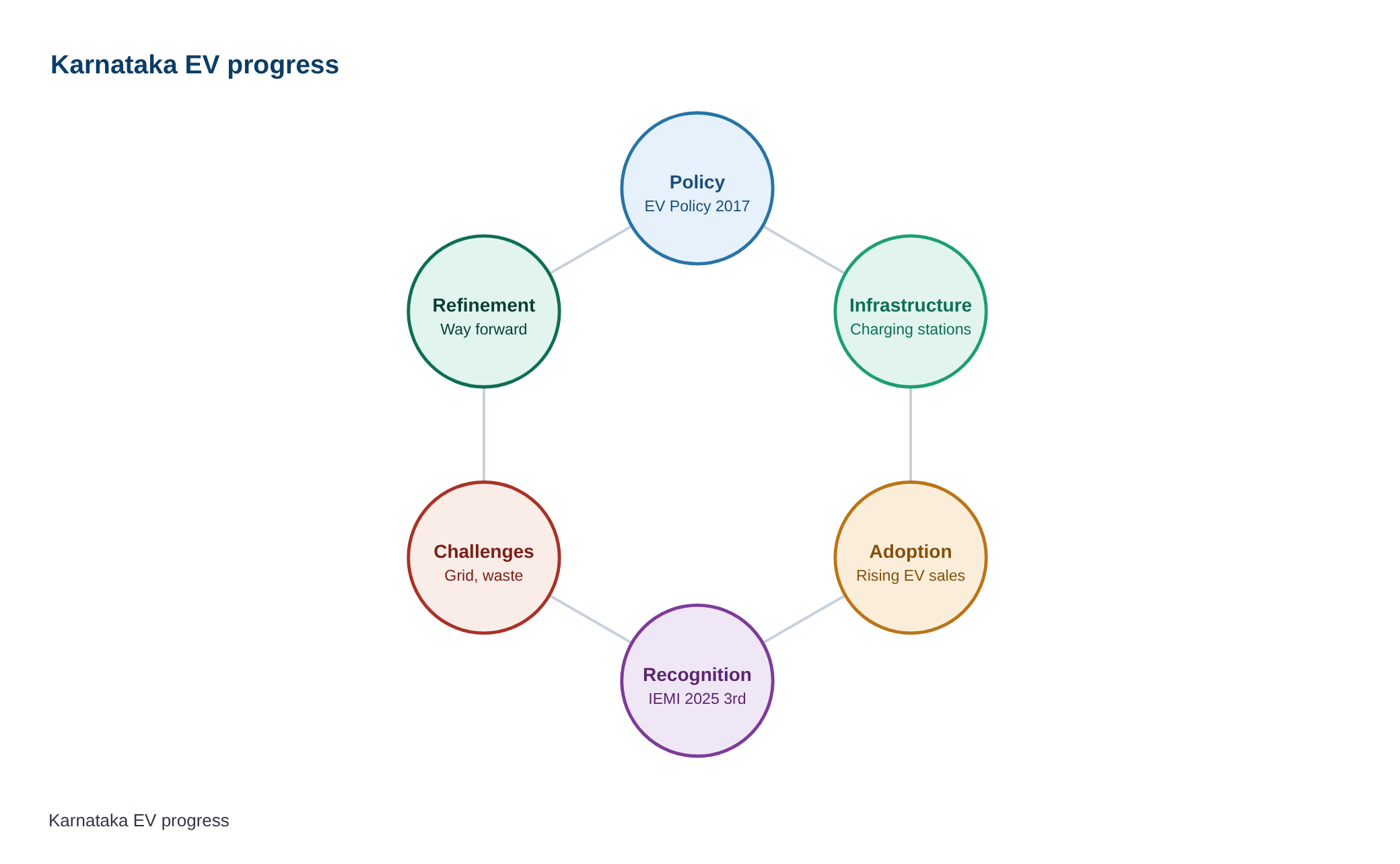
Policy Initiation (Karnataka EV Policy, 2017) -> Infrastructure Development (Charging Stations, Bescom EV Mithra) -> Market Adoption (Rising EV Sales, Penetration) -> Performance Recognition (IEMI 2025 Ranking) -> Systemic Challenges (Grid, Waste, Affordability) -> Policy Refinement (Way Forward, Incentives, Skilling)
Prelims Practice Questions
Q1. Consider the following statements regarding the India Electric Mobility Index (IEMI) 2025 released by NITI Aayog:
1. The IEMI 2025 evaluates States and Union Territories based solely on the number of electric vehicles registered.
2. Karnataka secured the third position in IEMI 2025 with a score of 73.
3. Delhi topped the overall rankings with a score of 84.
4. The index classifies jurisdictions scoring 60 and above as top performers.
How many of the above statements are correct?
- Only one
- Only two
- Only three
- All four
Answer: Only three — Statements 2 and 3 are correct. Statement 1 is incorrect because IEMI evaluates both policy frameworks and implementation outcomes, not just EV registrations. Statement 4 is incorrect as jurisdictions scoring 65 and above are classified as top performers.
Q2. Assertion (A): Karnataka’s Electric Vehicle Policy 2017 was India’s first dedicated EV policy.
Reason (R): The policy covers vehicle sales, charging infrastructure, and dedicated manufacturing zones.
In the context of the above two statements, which one of the following is correct?
- Both A and R are true, and R is the correct explanation of A
- Both A and R are true, but R is not the correct explanation of A
- A is true, but R is false
- A is false, but R is true
Answer: Both A and R are true, but R is not the correct explanation of A — Both the assertion and reason are true. Karnataka’s EV Policy 2017 was indeed the first dedicated EV policy in India, and it comprehensively addresses vehicle sales, charging infrastructure, and manufacturing zones.
Q3. Match the following States/UTs with their respective scores in the India Electric Mobility Index (IEMI) 2025:
Column I (State/UT) | Column II (Score)
———————|——————-
A. Delhi | 1. 73
B. Maharashtra | 2. 84
C. Karnataka | 3. 78
D. Goa | 4. 65
- A-2, B-3, C-1, D-4; A-1, B-2, C-3, D-4; A-3, B-1, C-2, D-4; A-4, B-3, C-2, D-1
- answer_string_array_indexed_answer_key_0
- explain_match_pairs_briefly
- format_match
- A-2, B-3, C-1, D-4
Answer: A-2, B-3, C-1, D-4; A-1, B-2, C-3, D-4; A-3, B-1, C-2, D-4; A-4, B-3, C-2, D-1 — Delhi scored 84, Maharashtra 78, Karnataka 73, and Goa 65 in IEMI 2025.
Mains Practice Question
✍ The India Electric Mobility Index (IEMI) 2025, released by NITI Aayog, ranks Karnataka third in electric mobility performance among States. Critically examine the significance of sub-national policy frameworks in accelerating India’s transition to sustainable transport. Also, analyse how Karnataka’s initiatives, such as the EV Accelerator Cell and Bescom EV Mithra, exemplify effective governance in this domain. (15 Marks)
Approach: MODEL-ANSWER SKELETON:
1. **Introduction (2 marks)**
– Define IEMI 2025 and its purpose: evaluating States/UTs on electric mobility progress (policy + implementation).
– Mention Karnataka’s rank (3rd) and score (73) in IEMI 2025, highlighting its leadership in Charging Infrastructure Readiness (CIR) with a score of 97.
2. **Significance of Sub-National Policy Frameworks (5 marks)**
– **Federalism and Decentralisation**: Explain how sub-national policies (State/UT-level) complement national frameworks (e.g., Faster Adoption and Manufacturing of Hybrid and Electric Vehicles – FAME-II) by tailoring solutions to local contexts.
– **Policy Innovation**: Cite Karnataka’s EV Policy 2017 as India’s first dedicated EV policy, covering sales, charging infrastructure, and manufacturing zones.
– **Implementation Outcomes**: Link policy to measurable outcomes (e.g., Karnataka’s 6,979 EV charging stations, 15% EV penetration in FY 2026–27).
– **Comparative Advantage**: Contrast Karnataka’s performance with other top performers (Delhi, Maharashtra) to highlight how sub-national competition drives progress.
3. **Karnataka’s Initiatives as Governance Models (5 marks)**
– **EV Accelerator Cell**: Explain its role in streamlining approvals, incentives, and sector-specific support.
– **Bescom EV Mithra**: Discuss the unified EV charging app’s role in enhancing user accessibility and reducing fragmentation.
– **Single-Window Clearance System**: Highlight its efficiency in reducing bureaucratic delays for EV infrastructure projects.
– **Data-Driven Governance**: Reference Karnataka’s 8.81% share in India’s EV registrations and its leadership in two-wheeler and four-wheeler registrations.
4. **Challenges and Way Forward (3 marks)**
– **Gaps**: Acknowledge challenges like inter-State disparities, need for grid integration, and battery recycling infrastructure.
– **Collaborative Governance**: Emphasise the role of partnerships (e.g., NITI Aayog-WRI India collaboration in IEMI) in fostering evidence-based policymaking.
– **Future Directions**: Suggest measures like expanding public EV fleets, incentivizing battery swapping, and integrating mobility with urban planning.
Source: The Hindu
Karnataka PCS (KPSC) — State PCS Practice
Prelims: According to NITI Aayog’s Electric Mobility Index 2025, Karnataka has secured which rank among Indian states?
- 1st
- 2nd
- 3rd
- 4th
Answer: 3rd — Karnataka ranked third in NITI Aayog’s Electric Mobility Index 2025, highlighting its progress in electric vehicle adoption and infrastructure.
Mains: Analyze Karnataka’s performance in NITI Aayog’s Electric Mobility Index 2025. Discuss the key factors contributing to its third-place ranking and suggest measures to further enhance the state’s electric mobility ecosystem.
Generated by AanyaAi for educational purpose.
Related guides on our sites
- Current affairs for upsc 2026
- Best PSIR optional coaching for upsc
- Best economics optional coaching for upsc
- Best PSIR optional teacher for upsc

- यूपी हाईकोर्ट ने स्कूल बस सुरक्षा पर दिया सख्त आदेश, डीएम को 1 माह में रिपोर्ट देने का निर्देश - September 22, 2026
- UP High Court Directs DM & Chief Secretary on School Vehicle Safety: Key Facts for UPSC/PCS - September 22, 2026
- पेरियार टाइगर रिजर्व में 6 नई प्रजातियाँ खोजी गईं, जानिए क्या हैं विशेषताएँ - September 22, 2026

No Comments