


28 Sep Karnataka to Discuss Women’s Ministerial Representation in Delhi
✎ The Constitution does not mandate gender quotas for ministerial appointments, but Article 15(3) allows for special provisions to advance women’s representation in the executive, aligning with the broader principle of proportional…
Subject Relevance — Where This Topic Fits
- GS Paper II — Polity and Governance (Constitutional Provisions, Executive, Representation) | GS Paper IV — Ethics, Integrity and Aptitude (Gender Sensitivity in Governance)
- Prelims: Article 75(1) of the Constitution, Cabinet Secretariat, Minister of State, Women’s Reservation Bill (108th Constitutional Amendment Bill), Article 15(3) — Special Provisions for Women, Gender Budgeting, Committee on Empowerment of Women (Standing Committee), 15th Finance Commission recommendations on gender-responsive governance
- Essay: The imperative of gender-inclusive governance in India: balancing representation with meritocracy, Constitutional morality and the executive: ensuring proportional representation in the Council of Ministers
Quick Revision: The Constitution does not mandate gender quotas for ministerial appointments, but Article 15(3) allows for special provisions to advance women’s representation in the executive, aligning with the broader principle of proportional inclusion in governance.
Why is this in the news?
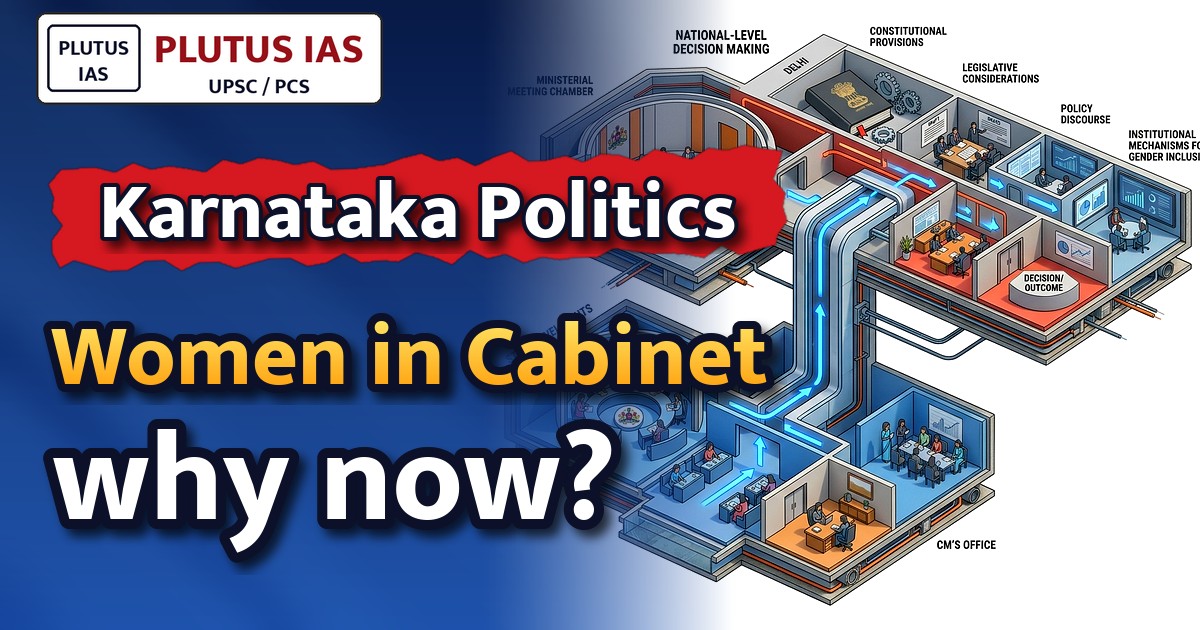
The announcement by the Chief Minister of Karnataka regarding the inclusion of a woman legislator in the state cabinet, to be discussed during a high-level meeting in Delhi, underscores the ongoing policy discourse on gender representation in executive governance. While framed as a political development, the issue intersects with constitutional provisions on ministerial appointments, institutional mechanisms for gender inclusion, and the broader debate on proportional representation in India’s Council of Ministers.
Background
- The Constitution of India, under Article 75(1), empowers the Prime Minister to appoint ministers, subject to the President’s advice, without specifying gender-based quotas for ministerial positions.
- The 108th Constitutional Amendment Bill (Women’s Reservation Bill), introduced in 2008 and pending ratification, seeks to reserve one-third of seats in the Lok Sabha and State Legislative Assemblies for women, but does not mandate ministerial representation.
- The Supreme Court, in *Union of India v. Association for Democratic Reforms (2002)*, upheld the constitutional validity of the 91st Amendment Act, 2003, which capped the Council of Ministers at 15% of the total strength of the Lok Sabha, but did not address gender-specific representation.
- The Committee on Empowerment of Women (Standing Committee) has, in multiple reports, recommended the inclusion of women in decision-making roles in the executive, citing global benchmarks such as the UN Sustainable Development Goal 5 (Gender Equality).
- State governments, including Karnataka, have periodically expanded cabinets to reflect political alliances, demographic diversity, and governance priorities, with gender representation emerging as a salient criterion in recent years.
- The Election Commission of India, as part of its Special Intensive Revision exercise, has been mandated to ensure inclusivity in electoral rolls, indirectly influencing the composition of legislatures and, by extension, ministerial appointments.
What is ministerial representation for women in the executive?
- Ministerial representation refers to the inclusion of women legislators in the Council of Ministers at the Union or state level, ensuring their participation in executive decision-making processes.
- The Constitution does not mandate a fixed quota for women in ministerial roles, but Article 15(3) empowers the state to make special provisions for women’s advancement, which can be interpreted to include executive representation.
- The principle of proportional representation in governance is rooted in democratic ideals, aiming to reflect societal diversity in policymaking. Gender is one such dimension, alongside caste, region, and community.
- The inclusion of women in the executive is often justified on grounds of equity, role modeling, and the need to address structural gender imbalances in public life. Empirical studies suggest that gender-diverse cabinets enhance policy outcomes in areas such as education, health, and social welfare.
- The 73rd and 74th Constitutional Amendments (1992) mandated one-third reservation for women in local self-government bodies (Panchayats and Municipalities), demonstrating a precedent for gender-inclusive governance at the grassroots level.
- At the Union level, the Council of Ministers has historically included women ministers, with notable examples such as Indira Gandhi, Sushma Swaraj, and Nirmala Sitharaman holding key portfolios. However, their representation has remained below 15% of the total ministerial strength.
- The concept of ‘critical mass’ in gender representation theory suggests that a threshold of 30% women in decision-making bodies is necessary to influence policy outcomes substantively. This principle is often cited in debates on ministerial representation.
- The appointment of women ministers is typically a political decision, influenced by party ideology, electoral compulsions, and the need to project inclusivity. However, it also reflects the executive’s commitment to constitutional values of equality and non-discrimination.
Key Features
| Feature | Significance |
|---|---|
| Cabinet Expansion Process | Represents a routine governance function where the executive branch adjusts its composition to reflect political priorities, administrative needs, or representation gaps. |
| Ministerial Representation of Women | Highlights the policy objective of gender inclusivity in governance, aligning with constitutional directives and national commitments to women’s empowerment. |
| Deliberative Consensus-Building | Demonstrates the iterative process of political negotiation within a party to finalize appointments, ensuring legitimacy and party cohesion. |
| Leadership Coordination Across Levels | Shows the interaction between state-level executive decisions and national-level party strategy, particularly in a federal polity. |
| Institutional Role of Congress Working Committee | Illustrates the functioning of a key decision-making body in a national party, which influences governance at the state level. |
Why it Matters
Governance and Representation
- The inclusion of women in ministerial roles underscores the constitutional principle of equality (Article 14) and the state’s obligation to promote gender justice under Article 15(3).
- Such appointments can enhance policy responsiveness to gender-specific issues, including health, education, and economic participation.
- Cabinet expansion serves as a mechanism to address representation deficits, ensuring diverse societal segments are reflected in policymaking.
- The process reflects the dynamic nature of executive formation, where political expediency and governance needs intersect.
Federalism and Party Dynamics
- The interaction between state-level decisions (Karnataka) and national party structures (Congress Working Committee) exemplifies the federal character of Indian governance.
- Party-level negotiations highlight the role of internal democracy in decision-making, which can influence public trust in political institutions.
- State-Centre coordination in executive appointments demonstrates the interplay between regional autonomy and national party priorities.
Policy Implementation and Accountability
- The appointment of women to ministerial positions can serve as a symbolic and substantive step toward fulfilling the Sustainable Development Goal 5 (Gender Equality).
- Such appointments may strengthen accountability mechanisms by diversifying perspectives in governance, particularly on issues affecting marginalized groups.
- The process also underscores the importance of transparent and participatory decision-making in executive appointments.
Challenges
1. Consensus-Building in Political Appointments
- Achieving unanimity among party stakeholders on ministerial selections can delay governance actions, affecting administrative efficiency.
- Potential conflicts between ideological alignment and representational quotas may arise, requiring delicate negotiation.
- The need for consensus can sometimes lead to suboptimal choices, where competence is secondary to political balance.
UPSC Link: GS-II: Role of Parties and Pressure Groups
2. Balancing Representation and Competence
- Ensuring that ministerial appointments meet both representational and functional criteria poses a governance challenge.
- Overemphasis on gender representation without due consideration of administrative acumen may undermine governance quality.
- The risk of tokenism exists, where appointments are made primarily for symbolic purposes rather than substantive impact.
UPSC Link: GS-II: Constitutional and Non-Constitutional Bodies
3. Federal Coordination in Executive Appointments
- Divergent priorities between state governments and national party leadership can create friction in appointment processes.
- Ensuring that state-level decisions align with national party strategies requires robust institutional mechanisms.
- Lack of coordination may lead to perceptions of centralization or interference, affecting federal trust.
UPSC Link: GS-II: Federalism and Centre-State Relations
4. Public Perception and Legitimacy of Appointments
- Perceived lack of transparency in selection processes can erode public confidence in political institutions.
- Allegations of favoritism or nepotism, even if unfounded, may tarnish the legitimacy of the executive branch.
- The need for visible representation may conflict with the principle of meritocracy in governance.
UPSC Link: GS-II: Role of Civil Services in Governance
Challenges — UPSC Perspective
| Issue | Concern |
|---|---|
| Delay in Appointments | Prolonged consensus-building may hinder timely governance actions and policy implementation. |
| Tokenism in Representation | Risk of appointments being perceived as symbolic rather than substantive, undermining credibility. |
| Federal-State Tensions | Potential conflicts between state priorities and national party strategies in appointment decisions. |
| Merit vs. Representation Trade-off | Balancing administrative competence with representational quotas without compromising governance quality. |
| Public Trust Erosion | Lack of transparency in selection processes may lead to skepticism about the legitimacy of appointments. |
Way Forward
- Constitute a transparent and structured process for identifying and selecting women candidates for ministerial roles, including public criteria for eligibility.
- Strengthen intra-party consultation mechanisms to expedite consensus-building while ensuring representational diversity.
- Establish performance benchmarks for ministerial roles to ensure that representational appointments do not compromise governance efficacy.
- Enhance federal coordination by formalizing channels for state-level inputs in national party decision-making processes.
- Promote gender-sensitive capacity-building programs for women legislators to prepare them for ministerial responsibilities.
- Institutionalize periodic reviews of cabinet composition to assess representation gaps and governance needs.
- Encourage political parties to adopt internal policies for gender-inclusive leadership pipelines, beyond ad-hoc appointments.
UPSC Value Addition
Keywords for Mains Answer-Writing
Women’s Representation in Legislatures · Cabinet Formation · Ministerial Portfolios · Executive-Legislature Interface · Political Consensus · Gender Inclusion in Governance · Cabinet Expansion · State Government Dynamics · Political Party Processes · Decision-Making in State Cabinets
Constitutional & Policy Linkages
- Article 14: Equality before law and equal protection of laws.
- Article 15(3): Special provisions for women and children.
- Article 16: Equality of opportunity in public employment.
Concept Flow
Cabinet Expansion Need → Identification of Representation Gap (Gender) → Intra-Party Negotiations → Consensus on Candidates → Final Appointment → Governance Implementation → Accountability and Review
Prelims Practice Questions
Q1. Consider the following statements regarding the constitutional provisions for women’s representation in Indian legislatures:
1. Article 15(3) empowers the State to make special provisions for women.
2. Article 243D mandates reservation of seats for women in Panchayats.
3. The Constitution does not provide for reservation of seats for women in State Legislatures or Parliament.
How many of the above statements are correct?
- Only one
- Only two
- All three
- None
Answer: Only two — Statement 1 is correct as Article 15(3) allows special provisions for women. Statement 2 is correct as Article 243D provides for reservation of seats for women in Panchayats. Statement 3 is incorrect because the Constitution does not mandate reservation for women in State Legislatures or Parliament, though it does not prohibit it either.
Q2. Assertion (A): The appointment of a woman minister in a State Cabinet is a matter of political consensus rather than a constitutional mandate.
Reason (R): The Constitution of India does not prescribe any specific quota for women in ministerial positions at the State or Union level.
- Both A and R are individually true, and R is the correct explanation of A.
- Both A and R are individually true, but R is not the correct explanation of A.
- A is true but R is false.
- A is false but R is true.
Answer: Both A and R are individually true, but R is not the correct explanation of A. — The assertion is true as the appointment of ministers, including women, is a political decision requiring consensus. The reason is also true and correctly explains the assertion, as the Constitution does not mandate quotas for women in ministerial positions.
Q3. Match the following provisions with their respective constitutional articles:
Column I (Provision) | Column II (Article)
———————————————–|———————-
1. Reservation of seats for women in Panchayats | A. Article 15(3)
2. Special provisions for women | B. Article 243D
3. Reservation of seats for women in Municipalities | C. Article 243T
4. Equality before law | D. Article 14
- {‘1-B, 2-A, 3-C, 4-D’: ‘A’}
- {‘1-A, 2-B, 3-D, 4-C’: ‘B’}
- {‘1-D, 2-C, 3-A, 4-B’: ‘C’}
- {‘1-C, 2-D, 3-B, 4-A’: ‘D’}
Answer: {‘1-B, 2-A, 3-C, 4-D’: ‘A’} — 1-B: Article 243D provides for reservation of seats for women in Panchayats. 2-A: Article 15(3) empowers the State to make special provisions for women. 3-C: Article 243T provides for reservation of seats for women in Municipalities. 4-D: Article 14 guarantees equality before law.
Mains Practice Question
✍ The recent discussions on accommodating women in ministerial positions reflect the broader challenge of achieving gender parity in governance structures. Critically examine the mechanisms available for enhancing women’s representation in executive bodies at the State level. Also, analyse the role of political parties in facilitating or impeding such representation. (15 Marks)
Approach: MODEL-ANSWER SKELETON:
1. **Constitutional and Statutory Mechanisms**:
– Article 15(3): Empowers the State to make special provisions for women, though not mandating quotas in executive bodies.
– Article 243D (Panchayats) and Article 243T (Municipalities): Provide reservation for women in local bodies, demonstrating a model for political representation.
– Absence of constitutional mandate for women in State Cabinets or Parliament: Highlight the gap in formal mechanisms.
– Role of Representation of People Act, 1951: Does not prescribe quotas for women in ministerial appointments.
2. **Political and Institutional Factors**:
– **Political Consensus**: Ministerial appointments are a prerogative of the Chief Minister and party leadership, requiring consensus among legislators (as seen in the Karnataka example).
– **Party Processes**: Internal party mechanisms (e.g., Congress Working Committee, as mentioned in the news) determine candidate selection, often influenced by electoral viability, seniority, and ideological alignment rather than gender parity.
– **Electoral Politics**: Women’s representation in legislatures remains low (14.4% in State Assemblies as of 2023), limiting the pool of candidates for ministerial roles.
– **Structural Barriers**: Patriarchal norms, lack of mentorship, and gender bias in party structures impede women’s ascension to executive positions.
3. **Comparative Perspectives**:
– **Global Models**: Countries like Rwanda (61% women in Parliament) and Nordic nations use quotas or parity laws to ensure women’s representation in executive bodies.
– **India’s Experience**: Limited success in voluntary party quotas (e.g., Congress’s 33% reservation for women in party positions) and state-level experiments (e.g., Bihar’s 50% reservation in Panchayats).
4. **Way Forward**:
– **Legal Reforms**: Advocacy for constitutional amendments or statutory provisions mandating minimum representation for women in State Cabinets (e.g., 33% or 50%).
– **Party Reforms**: Internal party quotas for women in decision-making roles and ministerial candidate selection.
– **Capacity Building**: Training and mentorship programs for women legislators to enhance their political acumen and visibility.
– **Societal Shifts**: Awareness campaigns and electoral reforms to increase women’s participation in politics.
Balance of Views:
– **Pro-Quota Argument**: Quotas ensure proportional representation and challenge structural inequalities.
– **Anti-Quota Argument**: Quotas may lead to tokenism or undermine meritocratic principles, and political consensus is a more organic path to inclusion.
Conclude with a balanced assessment of the feasibility and desirability of formal mechanisms versus organic political processes.
Source: The Hindu
Generated by AanyaAi for educational purpose.
Related guides on our sites
- Current affairs for upsc 2026
- Best PSIR optional coaching in delhi for UPSC
- Best PSIR optional coaching for upsc
- Best sociology optional coaching for upsc

- Women and Transgender Changemakers in Swachhata Mission - September 30, 2026
- चुनाव आयोग ने फॉर्म-6 से SIR घोषणा हटाई: UPSC-PCS के लिए महत्वपूर्ण बदलाव - September 30, 2026
- झारखंड डीजीपी नियुक्ति: सुप्रीम कोर्ट 9 अक्टूबर को सुनवाई, राज्य सरकार से जवाब तलब - September 30, 2026

No Comments