


20 Jul Karnataka’s Agritech Mission 2026 & 15,000 Teacher Recruitment: Key UPSC Polity & Governance Updates
Subject Relevance — Where This Topic Fits
- GS Paper II — Governance, Social Justice and Welfare | GS Paper III — Agriculture, Science and Technology, Infrastructure
- Prelims: Agritech Mission 2026, Karnataka Public Service Commission (KPSC) suspension, Backward Classes and Nomadic Communities Welfare Schemes, AI Centre of Excellence in Raichur, Irrigation and Road Development Projects, Satellite-based agriculture advisory systems
- Essay: Role of technology in transforming India’s agricultural sector: Opportunities and challenges, Inclusive development: Balancing growth with social equity in India
Quick Revision: Karnataka’s Agritech Mission 2026 integrates satellite data, drone surveys, and AI-driven weather forecasting to provide real-time, data-driven advisory services to farmers, aligning with the National Mission on Sustainable Agriculture and the Digital India Land Records Modernisation Programme.
Why is this in the news?
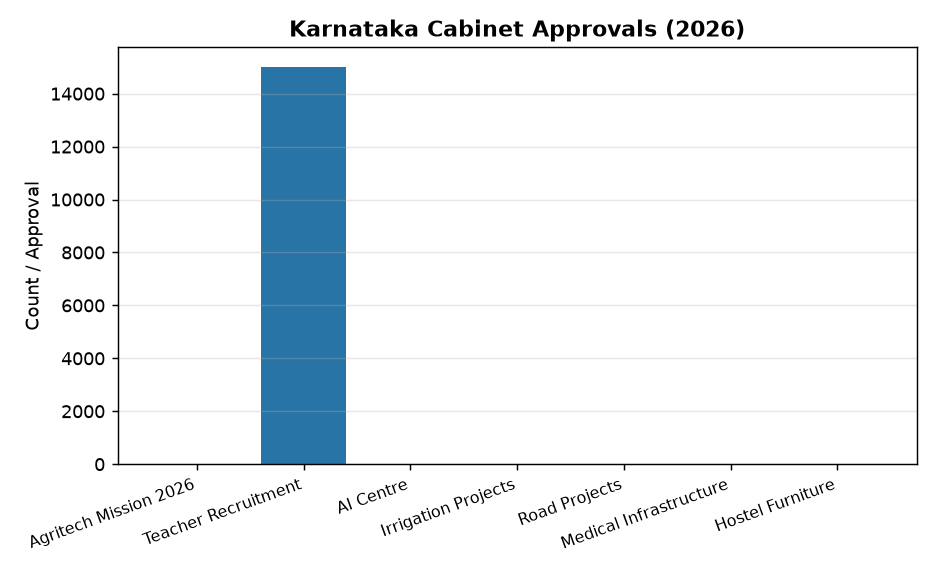
The Karnataka Cabinet’s approval of the Agritech Mission 2026, recruitment of 15,000 teachers, establishment of an AI Centre of Excellence in Raichur, and welfare schemes for backward classes and nomadic communities marks a significant step toward integrating technology-driven agriculture, enhancing human capital, and promoting equitable development. These initiatives are strategically aligned with the state’s broader developmental goals, particularly in the Kalyana Karnataka region, and reflect a commitment to leveraging innovation for inclusive growth while addressing structural challenges in education and social welfare.
Background
- Karnataka, a leading agricultural state in India, faces challenges such as fragmented landholdings, climate variability, and low productivity in certain regions, necessitating technological interventions to enhance farm efficiency and resilience.
- The state has historically been a pioneer in adopting digital governance solutions, exemplified by initiatives like the Bhoomi land records digitisation and the Karnataka State Wide Area Network (KSWAN).
- The Kalyana Karnataka region, comprising districts like Raichur, has lagged behind in infrastructure and human development indices, prompting targeted interventions such as the AI Centre of Excellence.
- The suspension of the KPSC Chairman and the recruitment of 15,000 teachers underscores the state’s focus on strengthening public institutions and addressing teacher shortages in government schools.
- Backward Classes and Nomadic Communities in Karnataka continue to face socio-economic disparities, with inadequate housing and limited access to quality education and healthcare.
- The state’s irrigation projects, including the Upper Krishna Project and the Cauvery Neeravari Yojane, have been critical in addressing water scarcity but require augmentation to meet growing demand.
What is the Karnataka Agritech Mission 2026?
- A state-led initiative aimed at revolutionising agriculture through the integration of advanced technologies such as satellite data, drone surveys, and AI-driven weather forecasting to provide real-time advisory services to farmers.
- The mission seeks to enhance crop planning by providing data-driven recommendations on sowing timings, pest management, and disease control, thereby reducing input costs and improving yield outcomes.
- Agritech Mission 2026 includes a ₹36 crore survey project to map agricultural lands, soil health, and water resources, enabling targeted interventions for sustainable farming practices.
- The initiative aligns with the National Mission on Sustainable Agriculture (NMSA) and the Digital India Land Records Modernisation Programme (DILRMP), emphasising precision agriculture and climate-resilient farming.
- The mission is expected to benefit small and marginal farmers, particularly in drought-prone and rain-fed regions, by providing customised advisory services through mobile applications and community resource centres.
- The Karnataka government’s focus on Agritech reflects a broader trend of leveraging technology to address food security and rural livelihood challenges, as seen in similar programmes like the Telangana Rythu Bandhu scheme and Maharashtra’s AgriStack initiative.
- The mission also includes provisions for capacity-building among farmers, extension workers, and agricultural scientists to ensure effective utilisation of technological tools.
Key Features
| Feature | Significance |
|---|---|
| Karnataka Agritech Mission-2026 | Integrates satellite data, drone surveys, and weather forecasting to enhance agricultural productivity through precision farming techniques, aligning with the National Mission on Sustainable Agriculture (NMSA) and India’s goal of doubling farmer incomes by 2022 (extended targets). |
| Recruitment of 15,000 teachers | Addresses critical shortages in government schools, particularly in rural and tribal areas, to improve Gross Enrolment Ratio (GER) and learning outcomes under the Right to Education (RTE) Act, 2009 and the National Education Policy (NEP) 2020. |
| AI Centre of Excellence in Raichur (Kalyana Karnataka) | Establishes a regional hub for artificial intelligence research and development, fostering skill development in emerging technologies, with potential applications in agriculture, healthcare, and governance. |
| Hostel infrastructure for Backward Classes and Nomadic Communities | Expands residential facilities to enhance access to education for marginalised sections, reducing dropout rates and promoting social inclusion under the Centrally Sponsored Scheme for Development of Particularly Vulnerable Tribal Groups (PVTGs). |
| Irrigation and road development projects | Enhances rural connectivity and agricultural productivity by improving water management and transportation networks, supporting the Pradhan Mantri Krishi Sinchayee Yojana (PMKSY) and Bharatmala Pariyojana. |
Why it Matters
Economic Development
- The Agritech Mission-2026 leverages technology to optimise resource use, reduce input costs, and mitigate climate risks, directly contributing to agricultural GDP growth and rural employment generation.
- Teacher recruitment bolsters human capital formation, a critical driver of economic growth under the demographic dividend framework of India’s development strategy.
- AI Centre in Raichur positions Karnataka as a leader in technology-driven governance and industry 4.0, attracting investment and fostering innovation-led growth in the Kalyana Karnataka region.
Social Equity
- Hostel infrastructure for Backward Classes and Nomadic Communities aligns with constitutional mandates for social justice (Articles 15, 16, and 46) and the National Commission for Scheduled Castes/Tribes’ recommendations for inclusive development.
- Irrigation projects prioritise water-scarce districts, reducing farmer distress and preventing migration to urban centres, thereby addressing agrarian distress and promoting equitable regional development.
Governance and Institutional Reforms
- The establishment of an AI Centre of Excellence reflects Karnataka’s commitment to institutionalising technology adoption in public service delivery, aligning with the National Strategy for Artificial Intelligence (2018).
- The suspension of the KPSC Chairman underscores the government’s emphasis on administrative accountability and electoral integrity, particularly in the context of the Model Code of Conduct and the Representation of the People Act, 1951.
Environmental Sustainability
- Precision agriculture under Agritech Mission-2026 promotes sustainable farming practices, reducing chemical usage and soil degradation, in line with the Sustainable Development Goals (SDG 2 and SDG 13).
- Irrigation projects under PMKSY aim to enhance water-use efficiency, mitigating the impact of climate change on agricultural productivity.
Challenges
1. Implementation Bottlenecks in Agritech Adoption
- Small and marginal farmers may face challenges in accessing and utilising advanced technologies due to high initial costs, lack of digital literacy, and fragmented landholdings.
- Integration of satellite data, drone surveys, and weather forecasting requires robust data infrastructure and inter-departmental coordination, posing governance challenges.
- Resistance to change among traditional farming communities may hinder adoption, necessitating extensive awareness campaigns and capacity-building initiatives.
UPSC Link: GS3: Agricultural Marketing, Technology in Agriculture
2. Teacher Recruitment and Quality Assurance
- Ensuring equitable distribution of 15,000 teachers across rural and tribal areas requires strategic planning to avoid urban-centric deployments, which could exacerbate existing disparities.
- Maintaining teacher quality and accountability is critical to achieving learning outcomes, particularly in the context of the National Achievement Survey (NAS) and the National Initiative for School Heads and Teachers Holistic Advancement (NISHTHA).
- Addressing the shortage of subject specialists in STEM and vocational subjects may require targeted recruitment drives and partnerships with teacher training institutions.
UPSC Link: GS2: Issues Relating to Development and Management of Social Sector/Services
3. AI Centre Sustainability and Regional Equity
- The AI Centre in Raichur must ensure equitable access to its resources for all districts in Kalyana Karnataka to prevent regional disparities in technological advancement.
- Sustaining funding over five years (₹12–15 crore) requires robust budgetary planning and potential public-private partnerships to avoid discontinuation of critical projects.
- Bridging the digital divide in rural areas is essential to ensure that the benefits of AI-driven solutions reach the intended beneficiaries.
UPSC Link: GS3: Science and Technology, Intellectual Property Rights
4. Infrastructure Development and Cost Overruns
- Construction of new hostels and infrastructure projects may face delays due to land acquisition issues, regulatory clearances, or supply chain disruptions, leading to cost overruns.
- Ensuring timely completion of irrigation and road projects is critical to avoid delays in agricultural output and rural connectivity, which could impact livelihoods.
- Monitoring and evaluation mechanisms must be institutionalised to assess the impact of infrastructure projects on intended beneficiaries.
UPSC Link: GS3: Infrastructure, Project Management
5. Inclusivity and Targeted Welfare
- Identifying and reaching the most marginalised sections within Backward Classes and Nomadic Communities requires robust data collection and community engagement to avoid exclusion errors.
- Ensuring that welfare schemes such as housing and hostel facilities are accessible to women and persons with disabilities necessitates gender-sensitive and disability-inclusive design.
- Balancing the allocation of resources between competing demands (e.g., education, healthcare, and infrastructure) requires evidence-based prioritisation to maximise social returns.
UPSC Link: GS1: Social Empowerment, Poverty and Developmental Issues
Challenges — UPSC Perspective
| Issue | Concern |
|---|---|
| Digital Divide in Agritech Adoption | Small farmers lack access to smartphones, internet, and digital literacy, limiting their ability to utilise satellite data and drone surveys. |
| Teacher Deployment Inequities | Risk of urban-centric teacher recruitment, leaving rural and tribal schools understaffed despite the 15,000-teacher initiative. |
| AI Centre’s Regional Reach | Kalyana Karnataka’s hinterland may lack the ecosystem to fully utilise the AI Centre, leading to underutilisation of resources. |
| Land Acquisition for Infrastructure | Delays in land acquisition for hostels and irrigation projects could stall development, increasing project costs. |
| Welfare Scheme Exclusion Errors | Nomadic communities and PVTGs may remain undocumented, leading to incomplete coverage under housing and hostel schemes. |
Government Initiatives — Must-Memorise for Prelims
- Karnataka Agritech Mission-2026
- Pradhan Mantri Krishi Sinchayee Yojana (PMKSY)
- Bharatmala Pariyojana
- Right to Education (RTE) Act, 2009
- National Education Policy (NEP) 2020
- Centally Sponsored Scheme for Development of Particularly Vulnerable Tribal Groups (PVTGs)
Way Forward
- Establish a multi-stakeholder task force comprising farmers, agronomists, and technology providers to pilot the Agritech Mission-2026 in select districts, ensuring real-time feedback and iterative improvements.
- Develop a transparent teacher deployment matrix based on vacancy data and student-teacher ratios, prioritising rural and tribal schools to address equity gaps.
- Partner with IITs, NITs, and private sector entities to operationalise the AI Centre in Raichur, focusing on applied research in agriculture, healthcare, and governance.
- Institute a dedicated monitoring unit under the Karnataka State Remote Sensing Applications Centre (KSRSAC) to track progress in Agritech adoption and address implementation bottlenecks.
- Launch a digital literacy campaign for farmers, including hands-on training in using satellite data and drone surveys, in collaboration with Krishi Vigyan Kendras (KVKs) and agricultural universities.
- Fast-track land acquisition for hostels and irrigation projects by leveraging the Right to Fair Compensation and Transparency in Land Acquisition, Rehabilitation and Resettlement (RFCTLARR) Act, 2013.
- Conduct a socio-economic survey of Nomadic Communities and PVTGs to ensure accurate identification and inclusion in welfare schemes, in line with the National Commission for Scheduled Castes/Tribes’ guidelines.
UPSC Value Addition
Keywords for Mains Answer-Writing
Agritech Mission 2026 · Karnataka Cabinet decisions · digital agriculture · AI in governance · teacher recruitment · irrigation projects · welfare schemes for backward classes · nomadic communities · Kalyana Karnataka region · Public Service Commission autonomy · agricultural technology adoption · state development initiatives
Constitutional & Policy Linkages
- Article 15: Prohibition of discrimination on grounds of religion, race, caste, sex, or place of birth (Social Equity).
- Article 16: Equality of opportunity in public employment (Teacher Recruitment).
- Article 21A: Right to Education for children aged 6–14 years (Teacher Recruitment).
- Article 46: Promotion of educational and economic interests of Scheduled Castes, Scheduled Tribes, and other weaker sections (Welfare Schemes).
Concept Flow
Agrarian distress and climate variability → Need for precision agriculture → Launch of Karnataka Agritech Mission-2026 (Satellite data, drones, weather forecasting) → Enhanced productivity and income for farmers. → Low Gross Enrolment Ratio (GER) in rural Karnataka → Shortage of teachers → Government approves recruitment of 15,000 teachers → Improved student-teacher ratios and learning outcomes. → Limited technological infrastructure in Kalyana Karnataka → Establishment of AI Centre of Excellence in Raichur → Skill development and innovation hub → Regional economic growth and employment generation. → Marginalisation of Nomadic Communities and PVTGs → Lack of access to education and housing → Government approves hostel infrastructure and housing schemes → Social inclusion and empowerment. → Inadequate irrigation and rural connectivity → Low agricultural productivity and migration → Approval of irrigation and road projects → Enhanced rural livelihoods and economic stability.
Prelims Practice Questions
Q1. Which of the following initiatives was approved by the Karnataka Cabinet in July 2026 under the Agritech Mission 2026?
- A. Establishment of a National AI Centre in Bengaluru
- B. Use of satellite data, drone surveys, and weather forecasting for farmer guidance
- C. Mandatory AI curriculum in all state-run schools
- D. Privatisation of agricultural extension services
Answer: B. Use of satellite data, drone surveys, and weather forecasting for farmer guidance — The Karnataka Agritech Mission 2026 explicitly includes the use of satellite data, drone surveys, and weather forecasting to guide farmers on crop planning, pest management, and sowing decisions, as stated in the official announcement.
Q2. The Karnataka Cabinet approved the establishment of an AI Centre of Excellence in which region of the state?
- A. Bengaluru Urban
- B. Kalyana Karnataka
- C. Mysuru
- D. Coastal Karnataka
Answer: B. Kalyana Karnataka — The AI Centre of Excellence is to be established in Raichur, which falls under the Kalyana Karnataka region, marking the first such initiative in this area.
Q3. Which of the following welfare measures was approved by the Karnataka Cabinet for nomadic communities?
- A. Free housing plots in urban areas
- B. Construction of 380-400 sq ft houses at a unit cost of ₹10 lakh
- C. Monthly cash transfers of ₹5,000 per household
- D. Subsidised agricultural loans
Answer: B. Construction of 380-400 sq ft houses at a unit cost of ₹10 lakh — The Cabinet approved the construction of houses measuring 380-400 sq ft for nomadic communities, with a fixed unit cost of ₹10 lakh where such projects are required.
Mains Practice Question
✍ Evaluate the significance of the Karnataka Agritech Mission 2026 in the context of India’s agricultural transformation. Critically analyse the potential challenges in its implementation and suggest measures to ensure its success.
Approach: The answer should begin by contextualising the Agritech Mission 2026 within India’s broader agricultural challenges, such as low productivity, climate vulnerability, and post-harvest losses. Highlight the mission’s key components, including the use of satellite data, drone surveys, and weather forecasting, and link them to the goals of precision agriculture and data-driven decision-making. Critically examine challenges such as digital divide, farmer awareness, infrastructure gaps, and inter-departmental coordination. Conclude with actionable recommendations, such as strengthening last-mile connectivity, farmer training programmes, public-private partnerships for technology deployment, and robust monitoring mechanisms to ensure the mission’s success.
Source: Hindustan Times
Generated by AanyaAi for educational purpose.

- गृह मंत्री ने मध्य प्रदेश में गौपालक सम्मेलन का किया उद्घाटन, नए अपराध कानूनों पर प्रदर्शनी का किया शुभारंभ - October 3, 2026
- Jal Arpan: 1850+ Gram Panchayats Join Hands for Rural Water Supply - October 3, 2026
- भारत ने किया 5.56 किमी मुक्त अंतरिक्ष क्वांटम की वितरण लिंक का सफल परीक्षण - October 3, 2026

No Comments