


26 Sep Karnataka’s District-Level Plan to Reduce Preventable Maternal Deaths for UPSC
✎ Karnataka’s district-level maternal mortality reduction strategy integrates SUMAN programme guidelines with localised governance, high-risk pregnancy tracking, and community participation to achieve SDG 3.1 targets.
Subject Relevance — Where This Topic Fits
- GS Paper II — Governance, Social Justice and Welfare | GS Paper II — Health, Human Resources | GS Paper III — Health, Human Development Indicators
- Prelims: Maternal Mortality Ratio (MMR), Sample Registration System (SRS), Surakshit Matritva Aashwasan (SUMAN), Zero Maternal Death Gram Panchayat campaign, Maternal Death Surveillance and Response (MDSR), High-risk pregnancy tracking, antenatal care, postpartum haemorrhage, obstetric emergencies
- Essay: The role of decentralised governance in achieving Sustainable Development Goals (SDG 3.1), Balancing technological innovation and community participation in public health interventions
Quick Revision: Karnataka’s district-level maternal mortality reduction strategy integrates SUMAN programme guidelines with localised governance, high-risk pregnancy tracking, and community participation to achieve SDG 3.1 targets.
Why is this in the news?
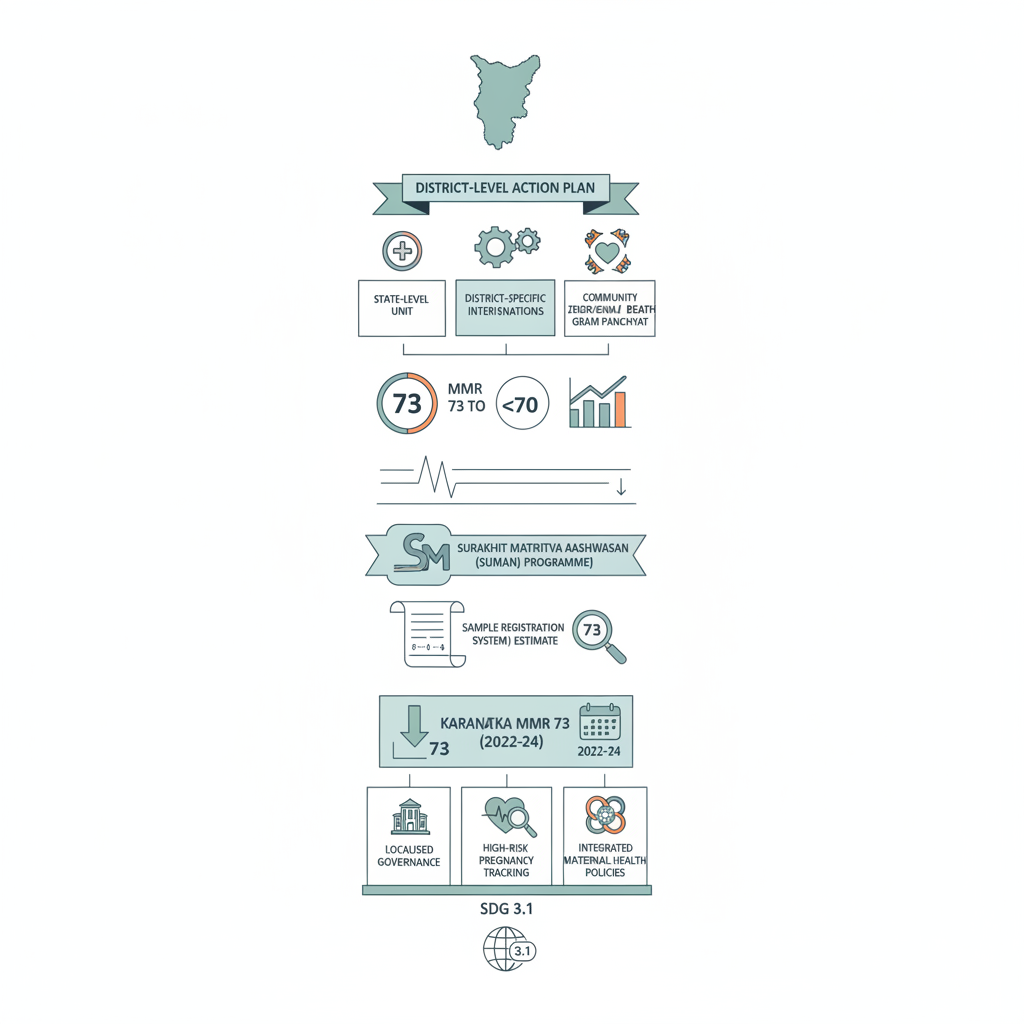
Karnataka has announced a district-level action plan to eliminate preventable maternal deaths, including the establishment of a State-level unit, district-specific interventions, and community engagement through the ‘Zero Maternal Death Gram Panchayat’ campaign. The initiative aligns with the national Surakshit Matritva Aashwasan (SUMAN) programme and targets a reduction in the State’s Maternal Mortality Ratio (MMR) from 73 to below 70 per one lakh live births. The announcement underscores the importance of localised governance, high-risk pregnancy tracking, and integrated maternal health policies in achieving SDG 3.1.
Background
- Karnataka reporting an MMR of 73 per one lakh live births in 2022-24.
- The Sample Registration System (SRS) provides the estimate for Karnataka’s MMR.
- The Surakshit Matritva Aashwasan (SUMAN) programme, launched by the Ministry of Health and Family Welfare in 2019, aims to provide assured, dignified, and respectful maternal healthcare across all public health facilities.
- Preventable maternal deaths are often linked to delays in seeking care, lack of access to emergency obstetric services, and inadequate postpartum monitoring, necessitating a multi-pronged approach.
What is Karnataka’s District-Level Strategy to Eliminate Preventable Maternal Deaths?
- The strategy is anchored in the Surakshit Matritva Aashwasan (SUMAN) Roadmap 2030, which aligns with the Sustainable Development Goal (SDG) 3.1 target of reducing global maternal mortality to less than 70 per one lakh live births by 2030.
- A State-level unit, headed by a designated officer, will oversee the implementation of district-specific interventions, ensuring accountability and coordination across health facilities.
- District-level teams will identify local causes of maternal mortality—such as anaemia, hypertension, or lack of emergency transport—and tailor interventions accordingly, leveraging granular data from the Sample Registration System (SRS).
- High-risk pregnancies will be identified during preconception and antenatal care, with continuous tracking through digital monitoring systems to ensure timely interventions, including extended antepartum care at designated facilities.
- The ‘Zero Maternal Death Gram Panchayat’ campaign integrates community participation by raising awareness, conducting local health surveys, and recognising panchayats that achieve zero preventable maternal deaths, fostering a bottom-up accountability mechanism.
- The Maternal Death Surveillance and Response (MDSR) system will be strengthened to ensure real-time data collection, analysis, and corrective action, enabling evidence-based policymaking.
Key Features
| Feature | Significance |
|---|---|
| District-specific interventions | Enables targeted solutions addressing local socio-economic and healthcare disparities that contribute to maternal mortality. |
| High-risk pregnancy tracking | Facilitates early identification and continuous monitoring of pregnancies with complications, reducing adverse outcomes. |
| Zero Maternal Death Gram Panchayat campaign | Leverages community participation to raise awareness, improve antenatal care, and ensure accountability at the grassroots level. |
| Digital monitoring and accountability | Enhances real-time data collection, analysis, and corrective action to improve maternal health outcomes. |
| State-level dedicated unit for maternal death prevention | Ensures governance focus, resource allocation, and coordination across districts for systematic intervention. |
Why it Matters
Public Health
- Addresses preventable maternal deaths, a critical indicator of healthcare system efficacy and equity.
- Aligns with Sustainable Development Goal 3 (Good Health and Well-being) by reducing maternal mortality.
- Demonstrates a shift from reactive to proactive maternal healthcare through preconception and antenatal care.
Administrative Governance
- Introduces a structured, district-level governance model for maternal health, enhancing local ownership.
- Establishes a dedicated State-level unit, improving institutional accountability and resource utilisation.
- Integrates digital tools for monitoring, ensuring transparency and evidence-based policymaking.
Social Equity
- Prioritises remote and underserved areas, reducing disparities in maternal healthcare access.
- Engages Gram Panchayats to foster community-led solutions, particularly in rural regions.
- Introduces a Women’s Health Policy to address evolving health needs, including lifestyle-related risks.
Challenges
1. Geographical Disparities
- Rural and remote districts may lack infrastructure, skilled personnel, or transportation for timely maternal care.
- Variations in local causes of maternal deaths necessitate tailored interventions, increasing administrative complexity.
UPSC Link: GS2: Health & Human Resource
2. High-risk Pregnancy Management
- Identifying and tracking high-risk pregnancies requires robust data systems and trained healthcare workers.
- Ensuring continuous monitoring post-identification demands significant healthcare resources and coordination.
UPSC Link: GS2: Health Governance
3. Community Participation
- Achieving sustained community engagement is challenging, particularly in areas with low health literacy.
- Cultural and social barriers may impede the adoption of maternal health practices.
UPSC Link: GS1: Social Issues
4. Digital Divide
- Reliable digital infrastructure is essential for monitoring but may be absent in remote areas.
- Data privacy and security concerns must be addressed in digital health records.
UPSC Link: GS3: Science & Technology
5. Policy Implementation
- Introducing a new Women’s Health Policy requires inter-departmental coordination and stakeholder buy-in.
- Ensuring policy longevity beyond political cycles is a persistent governance challenge.
UPSC Link: GS2: Governance
Challenges — UPSC Perspective
| Issue | Concern |
|---|---|
| Infrastructure gaps in rural areas | Limited access to emergency obstetric care and skilled birth attendants. |
| Data collection and analysis | Incomplete or delayed reporting of maternal deaths hinders targeted interventions. |
| Skilled human resource shortage | Insufficient number of obstetricians, gynaecologists, and midwives in public health facilities. |
| Transportation barriers | Delays in reaching healthcare facilities due to lack of ambulances or poor road connectivity. |
| Cultural and social norms | Resistance to antenatal care or institutional deliveries in certain communities. |
Government Initiatives — Must-Memorise for Prelims
- Surakshit Matritva Aashwasan (SUMAN) programme
- Maternal Death Surveillance and Response (MDSR) system
Way Forward
- Strengthen district-level maternal health committees to tailor interventions based on local epidemiological data.
- Expand the network of high-risk pregnancy care units in underserved districts with adequate staffing and equipment.
- Integrate digital health platforms (e.g., HMIS, telemedicine) to enable real-time tracking and decision-making.
- Conduct periodic community awareness campaigns in collaboration with Gram Panchayats to promote antenatal care and institutional deliveries.
- Enhance pre-service and in-service training for healthcare workers on emergency obstetric care and high-risk pregnancy management.
- Establish a State-level maternal health observatory to analyse trends, identify gaps, and recommend policy adjustments.
- Ensure equitable distribution of essential medicines and blood transfusion services in public health facilities.
UPSC Value Addition
Keywords for Mains Answer-Writing
Maternal Mortality Ratio (MMR) · Preventable maternal deaths · Maternal Death Surveillance and Response (MDSR) · Surakshit Matritva Aashwasan (SUMAN) programme · Zero Maternal Death Gram Panchayat campaign · High-risk pregnancy tracking · Sample Registration System (SRS) · Women’s Health Policy · District-level maternal health interventions · Obstetric emergencies management · Postpartum haemorrhage · Community participation in healthcare · Preconception care · Antenatal care quality · Public health governance in Karnataka
Concept Flow
High Maternal Mortality Ratio (MMR) in Karnataka (73 per 1 lakh live births) -> Identification of preventable causes -> District-level interventions -> High-risk pregnancy tracking -> Quality antenatal and delivery care -> Postpartum emergency preparedness -> Maternal Death Surveillance and Response (MDSR) -> Digital monitoring and accountability -> Community participation (Zero Maternal Death Gram Panchayat) -> Policy reinforcement (Women’s Health Policy) -> Reduction in MMR.
Prelims Practice Questions
Q1. Consider the following statements regarding Karnataka’s initiatives to reduce maternal mortality:
1. Karnataka has established a dedicated State-level unit for the prevention of maternal deaths, headed by a designated officer.
2. The State plans to introduce a Women’s Health Policy to address lifestyle-related and hormonal health issues.
3. The Maternal Mortality Ratio (MMR) in Karnataka is currently below 50 per one lakh live births.
How many of the above statements are correct?
- Only one
- Only two
- All
- None
Answer: Only two — Statement 1 is correct as Karnataka plans to establish a dedicated State-level unit for preventing maternal deaths. Statement 2 is correct as the State intends to introduce a Women’s Health Policy. Statement 3 is incorrect as Karnataka’s MMR is 73 per one lakh live births, not below 50.
Q2. Assertion (A): The Maternal Death Surveillance and Response (MDSR) system is a critical component of Karnataka’s strategy to eliminate preventable maternal deaths.
Reason (R): The MDSR system enables real-time tracking and analysis of maternal deaths to identify systemic gaps and implement corrective measures.
- Both A and R are true, and R is the correct explanation of A
- Both A and R are true, but R is not the correct explanation of A
- A is true, but R is false
- A is false, but R is true
Answer: Both A and R are true, and R is the correct explanation of A — The Maternal Death Surveillance and Response (MDSR) system is indeed a critical component of Karnataka’s strategy to reduce maternal mortality. It facilitates real-time tracking and analysis of maternal deaths, thereby enabling targeted interventions. Thus, both the assertion and reason are correct, and the reason correctly explains the assertion.
Q3. Match the following initiatives with their respective objectives under Karnataka’s maternal health strategy:
Column I (Initiative) | Column II (Objective)
— | —
A. Zero Maternal Death Gram Panchayat campaign | 1. Strengthening early identification and continuous tracking of high-risk pregnancies
B. Surakshit Matritva Aashwasan (SUMAN) programme | 2. Recognising and felicitating gram panchayats with zero maternal deaths
C. Preconception care | 3. Ensuring quality antenatal, delivery, and postpartum care
D. Maternal Death Surveillance and Response (MDSR) system | 4. Preventing maternal deaths through health education and screening before pregnancy
- A-2, B-3, C-4, D-1
- A-1, B-2, C-3, D-4
- A-3, B-1, C-2, D-4
- A-4, B-3, C-1, D-2
Answer: A-2, B-3, C-4, D-1 — A matches with 2 (recognising gram panchayats with zero maternal deaths), B matches with 3 (ensuring quality care under SUMAN), C matches with 4 (preventing deaths through preconception care), and D matches with 1 (tracking high-risk pregnancies).
Mains Practice Question
✍ The Government of Karnataka has launched a multi-pronged district-level strategy to eliminate preventable maternal deaths. Critically examine the key components of this strategy, including the role of community participation and digital monitoring, and assess its potential effectiveness in achieving the stated goal of zero maternal deaths. (15 Marks)
Approach: MODEL-ANSWER SKELETON:
1. Introduction (2 marks): Define Maternal Mortality Ratio (MMR) and its significance in public health. Briefly introduce Karnataka’s MMR (73 per one lakh live births) and the objective of reducing it below 70.
2. Key Components of Karnataka’s Strategy (5 marks):
– Preconception care and antenatal care quality: Link to the SUMAN programme and its focus on ensuring comprehensive care from preconception to postpartum.
– High-risk pregnancy tracking: Explain the mechanism of early identification and continuous monitoring, including facility-based care for high-risk women.
– Maternal Death Surveillance and Response (MDSR) system: Highlight its role in real-time data collection and systemic gap identification.
– Zero Maternal Death Gram Panchayat campaign: Emphasise community participation and local governance in achieving zero maternal deaths.
– Digital monitoring and accountability: Discuss the use of technology for tracking and ensuring accountability in maternal health outcomes.
– Women’s Health Policy: Explain its focus on lifestyle and hormonal health issues.
3. Role of Community Participation (3 marks):
– Discuss the importance of gram panchayats in creating awareness and ensuring last-mile delivery of healthcare services.
– Link to the concept of participatory governance in public health (e.g., Janani Suraksha Yojana’s community engagement model).
– Highlight the potential of community-based monitoring to reduce delays in seeking care.
4. Digital Monitoring and Accountability (2 marks):
– Explain how digital tools (e.g., dashboards, mobile applications) can enhance transparency and accountability in maternal health services.
– Discuss the challenges of data quality, interoperability, and digital divide in rural areas.
5. Potential Effectiveness and Challenges (3 marks):
– Assess the likelihood of achieving zero maternal deaths by analysing the strengths of the strategy (e.g., district-specific interventions, high-risk pregnancy tracking).
– Discuss challenges such as resource constraints, healthcare workforce shortages, and socio-cultural barriers.
– Conclude with a balanced view on the strategy’s potential success, citing examples from other states or countries with similar initiatives.
Source: The Hindu
Karnataka PCS (KPSC) — State PCS Practice
Prelims: Which of the following is a key objective of Karnataka’s district-level initiative to eliminate preventable maternal deaths?
- A. Reducing infant mortality rate by 50% within two years
- B. Establishing a real-time monitoring system for maternal health indicators at the district level
- C. Mandating compulsory sterilization for women after two children
- D. Providing free transport for all pregnant women to primary health centers
Answer: B. Establishing a real-time monitoring system for maternal health indicators at the district level — The initiative focuses on real-time monitoring of maternal health indicators to identify and address gaps in care, ensuring timely interventions.
Mains: Discuss the significance of district-level action plans in Karnataka’s strategy to eliminate preventable maternal deaths. Suggest measures to strengthen grassroots healthcare delivery systems for better maternal health outcomes.
Generated by AanyaAi for educational purpose.
Related guides on our sites
- Best sociology optional coaching for upsc
- Which is best sociology optional coaching for upsc
- Best teacher of sociology optional for upsc
- How to prepare for GS paper 1 for UPSC CSE mains exam

- Karnataka’s District-Level Plan to Reduce Preventable Maternal Deaths for UPSC - September 26, 2026
- तमिलनाडु: अनुसूचित जाति/जनजाति आयोग ने मांगा जाति आधारित नाम हटाने का विवरण - September 26, 2026
- Tamil Nadu SC/ST Commission Directs Removal of Caste-Based Place Names - September 26, 2026

No Comments