


20 Aug Karnataka’s Public Space Bill 2026: Key Provisions & UPSC Relevance
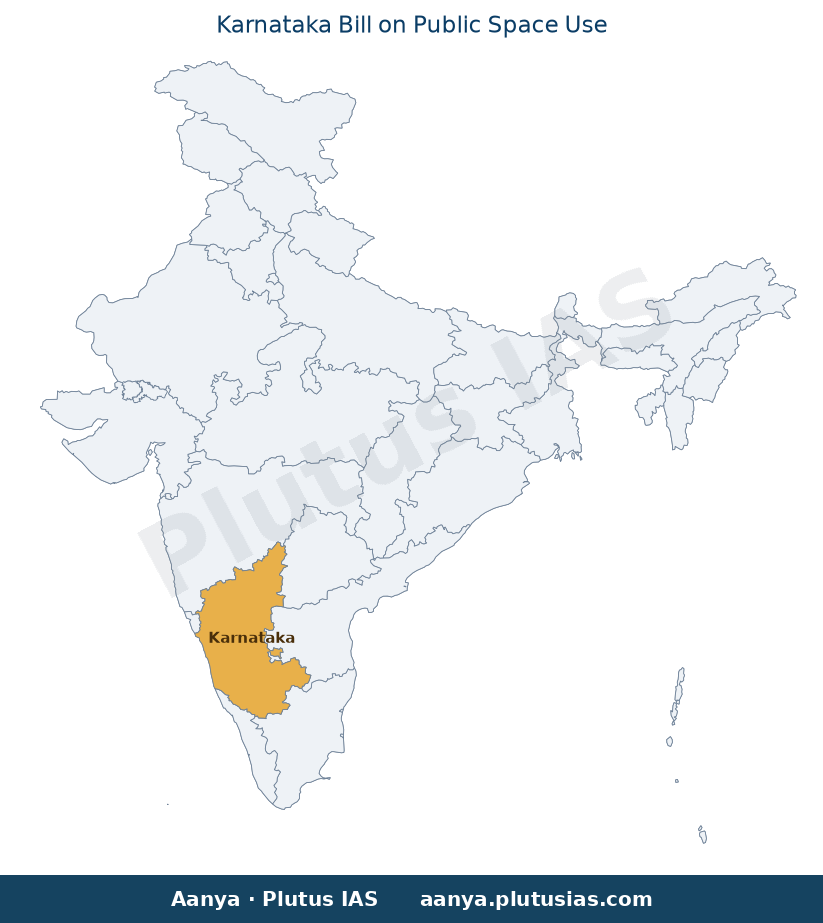
✎ The Karnataka Regulation of Use of Government Premises and Public Property Bill, 2026, seeks to formalise regulatory provisions for the use of public spaces, balancing the right to assembly with public order under constitutional…
Subject Relevance — Where This Topic Fits
- GS Paper II — Functions and Responsibilities of the Union and the States, Issues and Challenges Pertaining to the Federal Structure | GS Paper II — Government Policies and Interventions for Development in various sectors and Issues arising out of their Design and Implementation | GS Paper III — Challenges to Internal Security through Communication Networks, Role of State Agencies
- Prelims: Public Order, Police Administration, Concurrent List, Fundamental Duties, Right to Peaceful Assembly, Bharatiya Nyaya Sanhita, 2023, Government Premises, District Administration, Revenue Administration, Suo Motu Action
- Essay: Balancing Public Order and Democratic Rights: The Role of State Regulation in a Pluralistic Society, The Interface of Governance and Civil Society: Regulating Public Spaces in a Constitutional Democracy
Quick Revision: The Karnataka Regulation of Use of Government Premises and Public Property Bill, 2026, seeks to formalise regulatory provisions for the use of public spaces, balancing the right to assembly with public order under constitutional and statutory frameworks.
Why is this in the news?
The Karnataka Cabinet has approved the Karnataka Regulation of Use of Government Premises and Public Property Bill, 2026, to replace a 2025 government order regulating the use of public spaces for private events. The move follows a controversy over the denial of permission to the Rashtriya Swayamsevak Sangh (RSS) to hold a route march in Chittapur, underscoring the legal and administrative challenges in reconciling public order imperatives with the right to peaceful assembly under the Constitution of India.
Background
- The 2025 government order (GO) was issued shortly after Karnataka Home Minister Priyank Kharge wrote to the then Chief Minister Siddaramaiah seeking curbs on RSS activities.
- The GO required prior permission from police and revenue authorities for any organisation to use public spaces, with applications to be submitted at least three days in advance.
- The denial of permission to the RSS for a route march in Chittapur on 19 October 2025 cited non-compliance with procedural requirements, including lack of prior approval and incomplete documentation.
- The order defined ‘government property’ expansively to include land, buildings, roads, parks, playgrounds, waterbodies and other immovable properties owned or managed by local authorities or departments.
- The GO also stipulated that any unauthorised procession or programme would be deemed unlawful under the Bharatiya Nyaya Sanhita, 2023, with police empowered to register suo motu cases.
- The proposed Bill seeks to formalise and institutionalise these regulatory provisions, replacing the temporary GO with a permanent legislative framework.
What is the Karnataka Regulation of Use of Government Premises and Public Property Bill, 2026?
- The Bill seeks to regulate the use of government premises and public property by private individuals, organisations, associations and societies for events, processions or gatherings.
- It mandates prior permission from competent authorities (police and revenue officials) for the use of such spaces, with applications to be submitted at least three days in advance.
- The competent authority is required to dispose of applications at least one day prior to the event, after providing a reasonable opportunity of hearing to the applicant.
- The Bill defines ‘government property’ broadly to include all immovable assets owned or managed by government departments, local authorities, boards or corporations.
- Unauthorised use of public premises or contravention of the Bill’s provisions may attract legal consequences under the Bharatiya Nyaya Sanhita, 2023, including suo motu police action.
- The Bill aims to balance the right to peaceful assembly (Article 19(1)(b) of the Constitution) with the state’s obligation to maintain public order and safety.
- It replaces the 2025 government order, thereby providing a statutory basis for the regulation of public space usage, enhancing legal certainty and reducing administrative discretion.
- The Bill is expected to streamline the process of granting permissions while ensuring transparency, accountability and adherence to procedural safeguards.
Key Features
| Feature | Significance |
|---|---|
| Prior permission requirement | Ensures systematic utilisation of public spaces, preventing unauthorised occupation or misuse of government and public property. |
| Three-day advance notice | Facilitates administrative preparedness, including police deployment, traffic regulation, and revenue verification to maintain public order. |
| Definition of ‘government property’ | Clarifies the scope of regulation to include all immovable assets owned or managed by local authorities, departments, boards, or corporations. |
| Written order with hearing opportunity | Provides procedural fairness to applicants while ensuring transparency in decision-making. |
| Penal provisions under Bharatiya Nyaya Sanhita | Deters unlawful assemblies or processions, enabling suo motu police action against violations. |
Why it Matters
Administrative Governance
- Standardises the process for public space utilisation, reducing arbitrariness in permissions.
- Enhances inter-departmental coordination between police, revenue, and local authorities for event management.
- Promotes accountability in the use of public resources by requiring detailed disclosures from organisers.
Public Order Maintenance
- Prevents potential conflicts arising from unregulated public gatherings, particularly in sensitive regions.
- Ensures prior assessment of security risks associated with processions or events.
- Facilitates structured crowd management to mitigate risks of stampedes or disorder.
Legal Clarity
- Replaces ad-hoc government orders with a statutory framework, reducing judicial ambiguity.
- Provides a clear legal basis for penal action against violators, strengthening enforcement.
Resource Allocation
- Optimises the use of public infrastructure by prioritising authorised events over ad-hoc or unauthorised ones.
- Reduces strain on public amenities by preventing overcrowding or damage during unregulated activities.
Challenges
1. Balancing Free Assembly with Regulation
- The requirement for prior permission may be perceived as a restriction on the constitutional right to assemble peacefully under Article 19(1)(b).
- Striking a balance between public order and the freedom of expression remains a judicial challenge.
UPSC Link: GS-II: Fundamental Rights
2. Administrative Delays and Transparency
- Three-day notice period may be insufficient for large-scale events requiring extensive coordination.
- Lack of standardised timelines for approvals could lead to discretionary delays or perceived bias.
UPSC Link: GS-II: Governance
3. Enforcement and Compliance Gaps
- Monitoring compliance with conditions post-approval remains a challenge, particularly for spontaneous or unauthorised gatherings.
- Penal provisions under Bharatiya Nyaya Sanhita require robust policing infrastructure for effective implementation.
UPSC Link: GS-III: Internal Security
4. Political and Social Polarisation
- Regulation of public spaces may become entangled in political narratives, affecting public perception of neutrality.
- Differential treatment of organisations based on ideological affiliations risks undermining the law’s objectivity.
UPSC Link: GS-II: Political Theory
5. Funding Disclosures and Organisational Transparency
- Requiring detailed disclosures (e.g., funding sources, organisational registration) may face legal scrutiny under privacy laws.
- Lack of a national framework for NGO registration complicates uniform enforcement.
UPSC Link: GS-II: NGOs and Voluntary Organisations
6. Inter-State Coordination
- Processions or events spanning multiple states require harmonised regulations to avoid jurisdictional conflicts.
- Differences in state-level laws on public assemblies can create operational challenges.
UPSC Link: GS-II: Inter-State Relations
Challenges — UPSC Perspective
| Issue | Concern |
|---|---|
| Constitutional validity | Risk of legal challenge under Article 19(1)(b) for imposing prior restraint on assemblies. |
| Administrative capacity | Limited manpower and infrastructure in police/revenue departments to process applications efficiently. |
| Discretionary powers | Potential for subjective decision-making by authorities in granting or denying permissions. |
| Public perception | Perceived as a tool for political control rather than a governance measure. |
| Data privacy | Requiring sensitive organisational details (e.g., funding) may conflict with privacy rights. |
| Cross-border events | Difficulty in regulating events that span multiple states with differing laws. |
Way Forward
- Conduct capacity-building workshops for police and revenue officials to ensure uniform interpretation and implementation of the Bill.
- Establish a grievance redressal mechanism for applicants to challenge denial of permissions within a stipulated timeline.
- Publish standard operating procedures (SOPs) for processing applications to enhance transparency and reduce discretionary delays.
- Collaborate with state governments to harmonise public assembly regulations, particularly for inter-state events.
- Introduce digital platforms for application submission and tracking to streamline administrative processes.
- Conduct periodic audits of public space utilisation to identify underutilised assets and optimise their use.
- Engage civil society organisations to sensitise the public on the objectives of the Bill and its compliance requirements.
- Monitor enforcement outcomes to assess the Bill’s impact on public order and adjust provisions as needed.
UPSC Value Addition
Keywords for Mains Answer-Writing
Public Order · Freedom of Assembly · Reasonable Restrictions · Right to Protest · Public Premises · Government Property · Regulation of Processions · Constitutional Limitations · Police Powers · Revenue Administration · Public Interest · Procedural Justice
Constitutional & Policy Linkages
- {‘Article 19(1)(b): Freedom of assembly with reasonable restrictions under Article 19(2). The Bill must ensure its provisions do not exceed the scope of permissible restrictions.’: ‘Reasonable restrictions on public assemblies’}
- {‘Article 21: Right to life and personal liberty. The Bill must balance public order with individual freedoms to avoid arbitrary restrictions.’: ‘Balancing freedoms and governance’}
- {‘Article 14: Equality before law. The Bill must apply uniformly to all organisations without discrimination.’: ‘Non-discriminatory application’}
Concept Flow
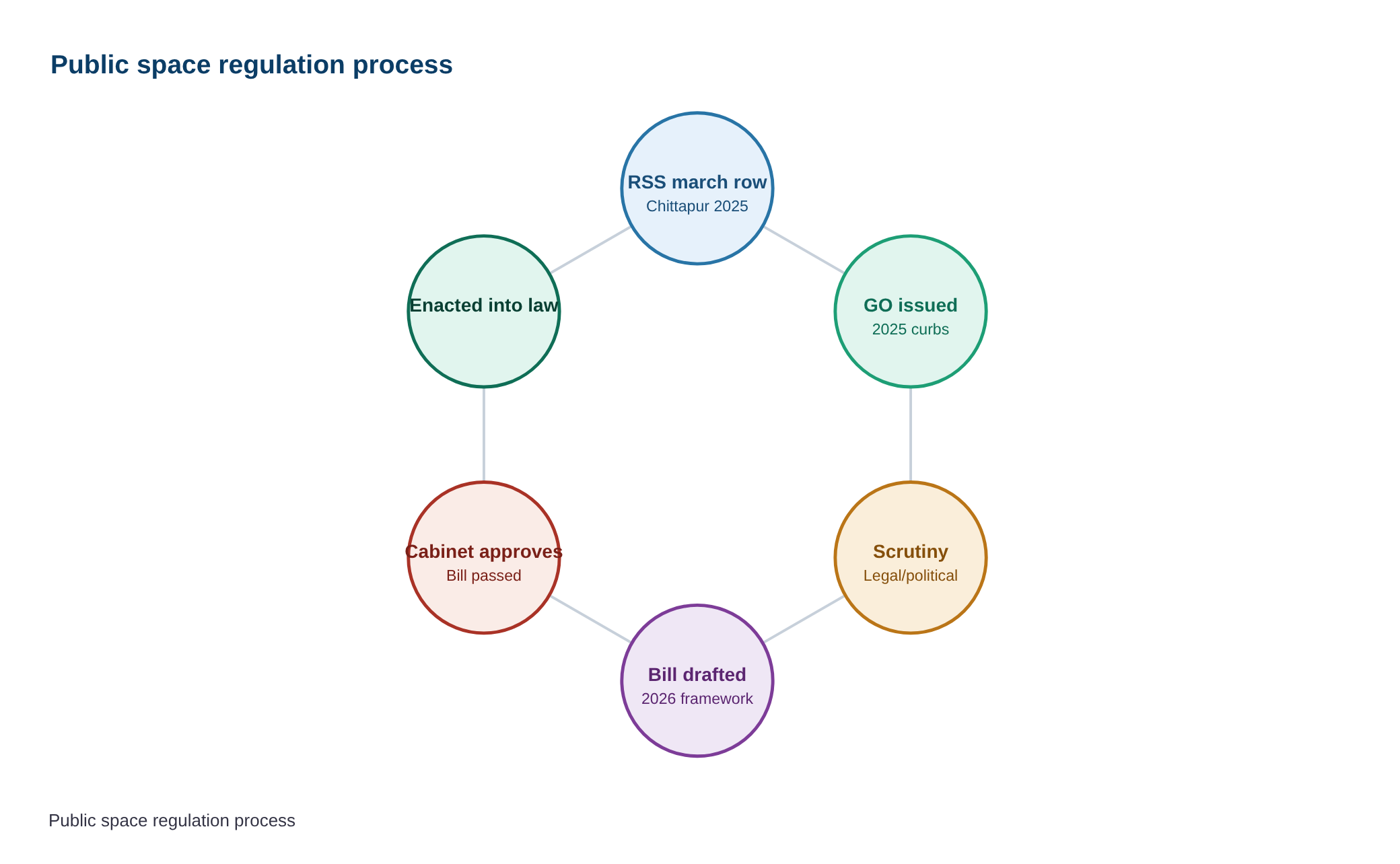
Controversy over denial of permission to RSS march in Chittapur (October 2025) → Karnataka government issues ad-hoc order regulating public space use → Political and legal scrutiny of the order → Drafting of Karnataka Regulation of Use of Government Premises and Public Property Bill, 2026 → Cabinet approval of the Bill → Enactment into law → Implementation and enforcement by police/revenue authorities → Judicial review for constitutional validity → Periodic evaluation and amendments based on outcomes.
Prelims Practice Questions
Q1. Consider the following statements regarding the regulation of public spaces in India:
1. The Constitution of India guarantees an absolute right to assemble peacefully without arms.
2. The power to regulate public assemblies is vested solely with the Union Government under Entry 97 of the Union List.
3. The Supreme Court has held that prior permission for public assemblies can be mandated if such regulation is reasonable and in the interest of public order.
4. The Bharatiya Nyaya Sanhita, 2023, does not provide for penal provisions in case of unlawful assemblies.
How many of the above statements are correct?
- Only one
- Only two
- Only three
- All four
Answer: Only three — Statements 1 and 3 are correct. Statement 2 is incorrect as the power to regulate public assemblies is shared between the Union and State Governments. Statement 4 is incorrect as the Bharatiya Nyaya Sanhita, 2023, includes penal provisions for unlawful assemblies under Sections 144-151.
Q2. Assertion (A): The State Government can impose reasonable restrictions on the use of public premises for private events.
Reason (R): Such restrictions are necessary to maintain public order and prevent misuse of government property.
Options:
A. Both A and R are true, and R is the correct explanation of A.
B. Both A and R are true, but R is not the correct explanation of A.
C. A is true, but R is false.
D. A is false, but R is true.
Answer: ? — Both the Assertion (A) and Reason (R) are true, and the Reason (R) correctly explains the Assertion (A). The State Government has the authority to regulate the use of public premises to ensure public order and prevent misuse, as recognized under the Constitution and statutory frameworks.
Q3. Match the following provisions with their respective legal frameworks:
Column I (Provisions)
1. Regulation of public assemblies
2. Use of government premises
3. Penal provisions for unlawful assemblies
4. Right to peaceful assembly
Column II (Legal Frameworks)
a. Article 19(1)(b) of the Constitution of India
b. The Police Act, 1861
c. The Karnataka Regulation of Use of Government Premises and Public Property Bill, 2026
Options:
A. 1-b, 2-c, 3-(no match), 4-a
B. 1-b, 2-c, 3-(no match), 4-a
C. 1-b, 2-c, 3-(no match), 4-a
D. 1-b, 2-c, 3-(no match), 4-a
Answer: ? — The correct matches are: 1-b (Regulation of public assemblies is governed by the Police Act, 1861), 2-c (Use of government premises is governed by the Karnataka Regulation of Use of Government Premises and Public Property Bill, 2026), 3-(no match as penal provisions are covered under the Bharatiya Nyaya Sanhita, 2023, not listed), and 4-a (Right to peaceful assembly is guaranteed under Article 19(1)(b) of the Constitution of India).
Mains Practice Question
✍ The State’s power to regulate the use of public premises and public spaces for private events is essential to maintain public order and prevent misuse. Critically examine the constitutional and statutory framework governing such regulation, with particular reference to the Karnataka Regulation of Use of Government Premises and Public Property Bill, 2026. Also, analyse the balance between the right to peaceful assembly and the State’s regulatory powers. (15 Marks)
Approach: MODEL-ANSWER SKELETON:
1. **Constitutional Basis**:
– Article 19(1)(b) guarantees the right to assemble peacefully and without arms.
– Article 19(2) permits reasonable restrictions on this right in the interest of public order, morality, and sovereignty.
– The Supreme Court in *Himat Lal K. Shah v. Commissioner of Police, Ahmedabad* (1973) upheld the State’s power to regulate public assemblies.
2. **Statutory Framework**:
– The Police Act, 1861, empowers the police to regulate processions and assemblies.
– The Karnataka Regulation of Use of Government Premises and Public Property Bill, 2026, replaces a 2025 Government Order and mandates prior permission from police and revenue authorities for events on public premises.
– The Bill defines ‘government property’ broadly to include roads, parks, and water bodies.
3. **Procedural Safeguards**:
– The Bill requires prior notice (at least 3 days) and provides for a hearing before refusal.
– The Bharatiya Nyaya Sanhita, 2023, penalizes unlawful assemblies under Sections 144-151.
– The principle of *procedural justice* (audi alteram partem) is embedded in the Bill’s requirement for a written order and reasonable opportunity of hearing.
4. **Balance of Rights and State Powers**:
– The State’s power to regulate is not absolute; it must be reasonable and proportionate (test laid down in *State of Madras v. V.G. Row*, 1952).
– The Bill’s provisions must not be used to stifle legitimate dissent or target specific organizations.
– The judiciary’s role in reviewing the Bill’s constitutionality is critical.
5. **Contemporary Relevance**:
– The Bill addresses gaps in the 2025 Government Order, which was challenged for arbitrary denial of permission to the RSS in Chittapur.
– The Bill’s clarity on ‘government property’ and procedural timelines reduces discretionary powers of authorities.
6. **Critique and Way Forward**:
– Potential for misuse if authorities act arbitrarily or selectively enforce provisions.
– Need for transparency in the decision-making process and appellate mechanisms.
– The Bill must align with the *Sedition Law* judgment (*Kedar Nath Singh v. State of Bihar*, 1962) and *Shreya Singhal v. Union of India* (2015) on free speech.
Source: The Indian Express
Generated by AanyaAi for educational purpose.


No Comments