


31 Aug Karnataka’s Shakti Scheme Boosts Women Pilgrims During Shravan 2026
✎ The Shakti scheme in Karnataka exemplifies a gender-inclusive welfare initiative that enhances women’s mobility but underscores the need for concurrent infrastructure development to sustain its benefits during peak demand periods…
Subject Relevance — Where This Topic Fits
- GS Paper II — Governance, Welfare Schemes for Vulnerable Sections | GS Paper III — Infrastructure, Transport and Services
- Prelims: Shakti Scheme Karnataka, Shravana Masa pilgrimage, NWKRTC, KKRTC, KSRTC, Public transport fare regulation, Women’s mobility under welfare schemes
- Essay: The interplay between welfare schemes and social inclusion: A case study of Karnataka’s Shakti initiative, Balancing public welfare with infrastructure constraints: Lessons from pilgrimage season mobility
Quick Revision: The Shakti scheme in Karnataka exemplifies a gender-inclusive welfare initiative that enhances women’s mobility but underscores the need for concurrent infrastructure development to sustain its benefits during peak demand periods such as Shravana Masa.
Why is this in the news?
The Shakti scheme of Karnataka, which provides free bus travel for women, has significantly increased women’s participation in religious pilgrimages during the auspicious Shravana Masa (month of Shravan), leading to record footfall at temples such as Sri Mailaralingeshwar in Yadgir and Sri Sugureshwar in Raichur. While the scheme has enhanced women’s mobility and socio-religious engagement, it has also exposed critical infrastructure gaps in public transport systems, particularly in rural and semi-urban regions, prompting demands for expanded bus services and regulatory oversight.
Background
- The Shakti scheme was launched by the Government of Karnataka in June 2023 as a flagship welfare initiative aimed at enhancing women’s economic and social mobility by providing free bus travel across the state.
- Shravana Masa, a sacred month in the Hindu lunar calendar, is observed with heightened religious fervour, particularly in Karnataka, where pilgrimages to temples such as Sri Mailaralingeshwar and Sri Sugureshwar are culturally significant.
- Public transport in Karnataka is predominantly operated by state-run corporations—North Western Karnataka Road Transport Corporation (NWKRTC), Karnataka State Road Transport Corporation (KSRTC), and Karnataka State Road Transport Corporation (KKRTC)—which face perennial challenges of capacity constraints, especially during peak seasons.
- The scheme’s implementation has coincided with broader discussions on gender-inclusive governance, public service delivery, and the need for infrastructure augmentation to support welfare initiatives.
- Historically, women’s mobility in India has been constrained by socio-economic and safety concerns, making welfare-driven transport schemes a critical tool for empowerment and inclusion.
What is the Shakti Scheme?
- Launched by the Government of Karnataka in 2023, the Shakti scheme provides free bus travel for all women within the state, irrespective of income or social status, as part of a broader gender-inclusive governance framework.
- The scheme covers all KSRTC, NWKRTC, and KKRTC buses, including ordinary, express, and interstate services, ensuring comprehensive accessibility across urban, semi-urban, and rural areas.
- Funded through state budgetary allocations, the scheme aims to reduce financial barriers to mobility, thereby facilitating women’s participation in education, employment, and socio-cultural activities, including religious pilgrimages.
- The initiative aligns with global best practices in gender-responsive public policy, such as Kerala’s ‘She Taxi’ and Tamil Nadu’s ‘Amma’ transport concessions, though Karnataka’s model is unique in its universality and scale.
- Implementation challenges include ensuring seamless integration with existing transport systems, preventing misuse, and maintaining service quality amid increased demand.
- The scheme has been cited as a model for other states, with its success contingent on robust monitoring, infrastructure readiness, and community engagement.
- Pilgrimage mobility during Shravana Masa has emerged as a key use case, demonstrating the scheme’s impact on women’s socio-religious participation and the resultant strain on public transport systems.
Key Features
| Feature | Significance |
|---|---|
| Free bus travel for women under the Shakti scheme | Enhances accessibility and affordability for women pilgrims, promoting gender-inclusive religious participation. |
| Surge in pilgrim turnout during Shravana Masa | Indicates heightened religious observance and cultural engagement, with implications for local economies and transport infrastructure. |
| Peak demand in KSRTC, NWKRTC, and KKRTC buses | Tests the operational capacity of state transport undertakings, necessitating real-time adjustments in fleet deployment. |
| Congestion and seat scarcity for daily commuters | Highlights the trade-off between welfare schemes and equitable public service delivery during peak periods. |
| Record footfall at temples like Sri Mailaralingeshwar | Reflects the socio-religious significance of Shravana Masa and the role of government schemes in facilitating pilgrimage. |
Why it Matters
Social
- Demonstrates the role of state-led welfare schemes in empowering women through enhanced mobility, aligning with constitutional goals of gender equity (Article 15(3)).
- Amplifies religious and cultural participation, reinforcing community cohesion during auspicious periods.
- Exposes gendered disparities in public transport access, necessitating inclusive urban planning.
Economic
- Stimulates local economies in pilgrimage destinations through increased footfall, benefiting small businesses, vendors, and temple trusts.
- Reduces out-of-pocket expenditure for women pilgrims, potentially increasing disposable income for other household needs.
- Places fiscal pressure on state transport corporations to scale operations during peak demand, requiring budgetary reallocations.
Administrative
- Tests the efficacy of state transport undertakings in managing demand surges, highlighting the need for dynamic resource allocation.
- Underscores the importance of inter-departmental coordination between transport, tourism, and religious institutions.
- Reveals gaps in real-time data analysis for predicting pilgrimage patterns and optimizing bus schedules.
Policy
- Illustrates the impact of targeted welfare schemes on social behavior, demonstrating how policy design can influence cultural practices.
- Raises questions about the sustainability of free transport schemes amid rising operational costs and competing public priorities.
- Provides a case study for evaluating the cost-benefit ratio of gender-specific welfare measures.
Challenges
1. Operational Bottlenecks in Public Transport
- Inability of state transport corporations to scale fleet size instantaneously during peak pilgrimage seasons.
- Overcrowding leading to safety risks, delays, and passenger dissatisfaction among daily commuters.
- Lack of real-time monitoring systems to dynamically adjust bus frequencies based on demand.
UPSC Link: GS-II: Governance, Public Service Delivery
2. Equity vs. Welfare Trade-offs
- Competing demands for public transport resources between welfare beneficiaries and general commuters.
- Potential marginalization of non-pilgrim passengers, including students and daily wage workers.
- Need for policy frameworks to balance inclusive welfare with universal service obligations.
UPSC Link: GS-II: Welfare Schemes, Inclusive Growth
3. Fiscal Sustainability of Free Transport Schemes
- Long-term financial viability of subsidized travel, especially in resource-constrained states.
- Risk of underfunding other critical public services due to prioritization of welfare schemes.
- Dependence on state budgets, which may be vulnerable to economic downturns or revenue shortfalls.
UPSC Link: GS-III: Fiscal Policy, Resource Allocation
4. Infrastructure and Logistics Constraints
- Limited parking facilities and road infrastructure in pilgrimage hubs, exacerbating congestion.
- Inadequate last-mile connectivity from bus stands to temple entrances, causing bottlenecks.
- Seasonal strain on local amenities, including water supply, sanitation, and healthcare.
UPSC Link: GS-II: Infrastructure Development, Urban Planning
Challenges — UPSC Perspective
| Issue | Concern |
|---|---|
| Overcrowding in buses | Safety risks, delays, and passenger dissatisfaction during peak hours. |
| Seat scarcity for non-pilgrims | Disproportionate impact on students, daily commuters, and marginalized groups. |
| Operational inefficiencies in KSRTC/NWKRTC/KKRTC | Inability to dynamically adjust fleet size or routes during surges. |
| Fiscal strain on state exchequer | Potential diversion of funds from other developmental priorities. |
| Infrastructure gaps in pilgrimage sites | Limited parking, poor last-mile connectivity, and strain on local resources. |
| Demand prediction failures | Lack of data-driven planning to anticipate pilgrimage patterns and optimize transport schedules. |
Government Initiatives — Must-Memorise for Prelims
- Karnataka Shakti Scheme (Free bus travel for women)
Way Forward
- Conduct a post-festival audit to assess the Shakti scheme’s impact on pilgrimage patterns and transport utilization.
- Develop a dynamic bus scheduling system using real-time data analytics to predict demand surges and optimize fleet deployment.
- Expand last-mile connectivity solutions, such as shuttle services or e-rickshaws, from bus stands to temple entrances.
- Enhance inter-departmental coordination between transport corporations, tourism boards, and religious institutions to streamline pilgrimage logistics.
- Explore public-private partnerships (PPPs) to augment bus fleet capacity during peak seasons without overburdening state exchequers.
- Introduce staggered pilgrimage timings or reservation systems for high-traffic temples to distribute footfall evenly.
- Invest in infrastructure upgrades, including parking facilities, road widening, and pedestrian pathways, in pilgrimage hubs.
- Evaluate the fiscal sustainability of the Shakti scheme and explore cost-sharing models with beneficiaries or corporate sponsors.
UPSC Value Addition
Keywords for Mains Answer-Writing
Karnataka Shakti Scheme · Women’s mobility and empowerment · Public transport policy · Religious pilgrimage infrastructure · Karnataka State Road Transport Corporation (KSRTC) · North Karnataka districts · Shravana Maas pilgrimage · Gender-inclusive governance · Subsidised public transport · Regional religious tourism
Constitutional & Policy Linkages
- Article 15(3): Special provisions for women to promote gender equity in public services.
Concept Flow
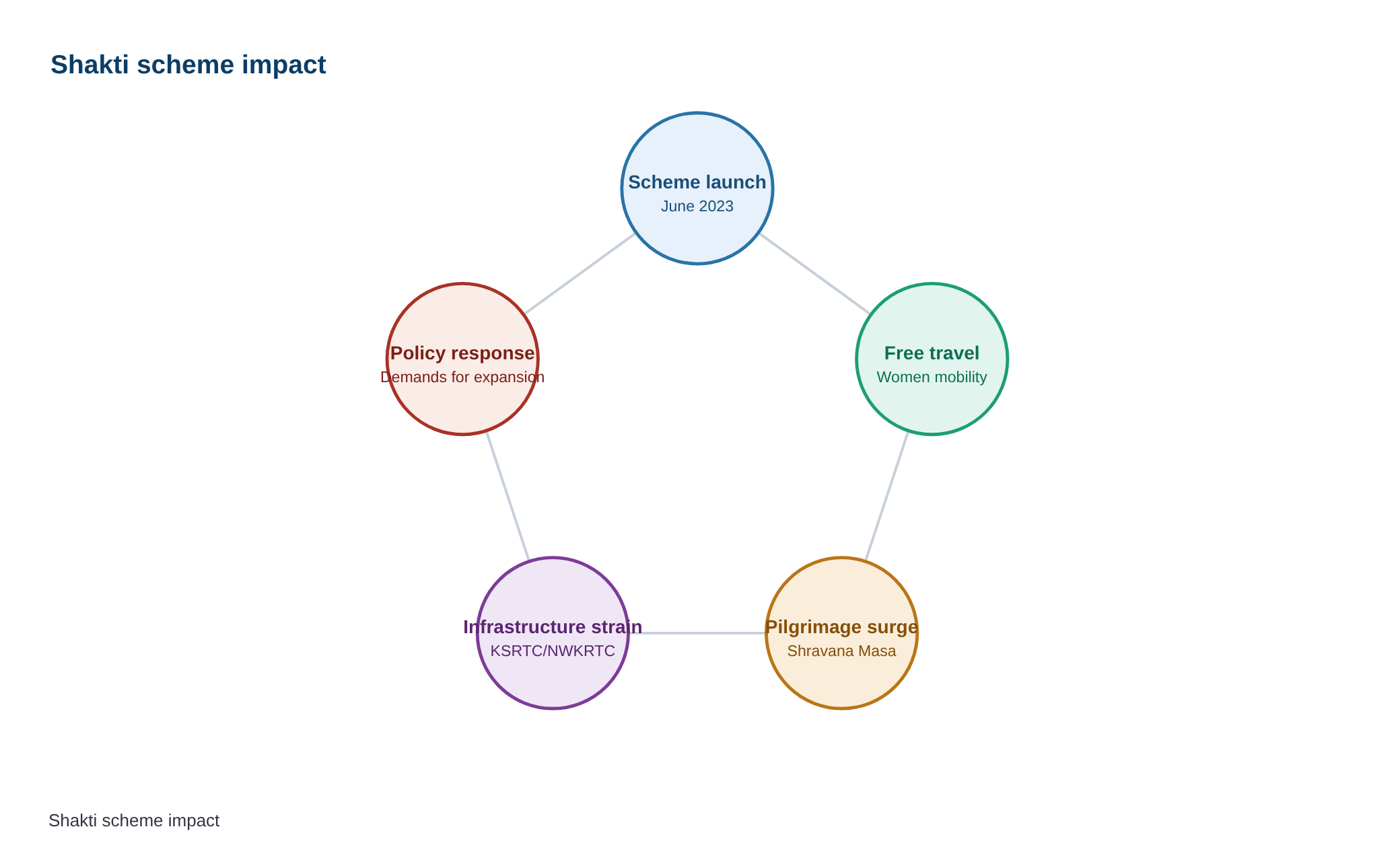
Introduction of the Shakti scheme → Increased affordability for women pilgrims → Surge in demand for bus travel → Operational strain on KSRTC/NWKRTC/KKRTC → Congestion and seat scarcity for non-pilgrims → Policy evaluation for balancing welfare and equity → Need for infrastructure and logistical reforms.
Prelims Practice Questions
Q1. Consider the following statements regarding the Karnataka Shakti Scheme:
1. It provides free bus travel for women pilgrims during Shravana Maas.
2. The scheme is implemented by the Karnataka State Road Transport Corporation (KSRTC).
3. It covers only religious sites within Karnataka.
4. The scheme has led to an increase in pilgrim turnout at temples like Sri Mailaralingeshwar.
How many of the above statements are correct?
- Only one
- Only two
- Only three
- All four
Answer: All four — Statements 1, 2, and 4 are correct. Statement 3 is incorrect as the scheme enables travel to religious sites within and beyond Karnataka.
Q2. Assertion (A): The Karnataka Shakti Scheme aims to enhance women’s participation in religious pilgrimages.
Reason (R): The scheme provides free bus travel, reducing financial barriers for women devotees.
Options:
A. Both A and R are true, and R is the correct explanation of A.
B. Both A and R are true, but R is not the correct explanation of A.
C. A is true, but R is false.
D. A is false, but R is true.
- A
- B
- C
- D
Answer: A — Both A and R are true, and R correctly explains A, as financial accessibility directly enables women’s participation in pilgrimages.
Q3. Match the following districts in Karnataka with the religious sites they host:
Column I (District) Column II (Religious Site)
1. Yadgir A. Sri Sugureshwar Temple
2. Raichur B. Sri Mailaralingeshwar Temple
3. Dharwad C. Sri Vishwaradhya Temple
Options:
A. 1-B, 2-A, 3-C
B. 1-C, 2-A, 3-B
C. 1-B, 2-C, 3-A
D. 1-A, 2-B, 3-C
- A
- B
- C
- D
Answer: A — 1-B (Sri Mailaralingeshwar Temple in Yadgir), 2-A (Sri Sugureshwar Temple in Raichur), 3-C (Sri Vishwaradhya Temple in Abbetumkur, near Dharwad).
Mains Practice Question
✍ The implementation of the Karnataka Shakti Scheme has significantly enhanced women’s mobility during religious pilgrimages. Critically examine the scheme’s impact on gender empowerment, public transport infrastructure, and socio-economic equity. Also, discuss the challenges posed by the scheme’s implementation and suggest measures to address them. (15 Marks)
Approach: MODEL-ANSWER SKELETON:
1. **Introduction (2 marks)**
– Define the Karnataka Shakti Scheme: free bus travel for women pilgrims during Shravana Maas.
– Contextualise within broader gender-inclusive governance policies in India.
2. **Gender Empowerment (4 marks)**
– **Enhanced mobility**: Reduced financial barriers for women devotees, enabling participation in religious and social activities.
– **Autonomy and agency**: Increased decision-making power for women in family and community contexts.
– **Equity considerations**: Focus on economically weaker sections and rural women.
– **Limitations**: Short-term nature of the scheme; lack of year-round accessibility.
3. **Public Transport Infrastructure (4 marks)**
– **Operational challenges**: Overcrowding, insufficient bus deployment, and logistical bottlenecks in districts like Yadgir and Raichur.
– **Stakeholder impact**: Disruptions faced by daily commuters and students.
– **Infrastructure gaps**: Need for additional buses, better scheduling, and crowd management during peak pilgrimage seasons.
– **Long-term sustainability**: Integration with broader public transport reforms (e.g., KSRTC’s fare regulatory mechanisms).
4. **Socio-Economic Equity (3 marks)**
– **Accessibility**: Scheme benefits marginalised women, including those from North Karnataka districts.
– **Economic impact**: Savings on travel expenses, enabling reinvestment in local economies.
– **Digital divide**: Limited awareness among rural women; need for multi-lingual outreach.
5. **Challenges and Recommendations (2 marks)**
– **Challenges**: Over-reliance on bus transport; seasonal demand spikes; lack of gender-sensitive infrastructure.
– **Recommendations**:
– Expand scheme duration beyond Shravana Maas.
– Deploy additional buses and diversify transport modes (e.g., trains, shared cabs).
– Strengthen KSRTC’s capacity for real-time crowd management.
– Partner with local NGOs for awareness campaigns.
**Balanced View Required**: Acknowledge benefits (gender empowerment, socio-economic equity) alongside challenges (infrastructure strain, seasonal limitations).
Source: The Hindu
Karnataka PCS (KPSC) — State PCS Practice
Prelims: Under the ‘Shakti’ scheme of Karnataka, which of the following initiatives has contributed to the significant increase in women pilgrims during Sharavana Masa?
- A. Free travel passes for women pilgrims to religious destinations
- B. Subsidized accommodation and food for women pilgrims
- C. Special women-only darshana timings at temples
- D. Financial assistance for women to perform religious rituals
Answer: A. Free travel passes for women pilgrims to religious destinations — The ‘Shakti’ scheme primarily provides free travel passes for women pilgrims to religious destinations, enabling easier access and boosting participation during Sharavana Masa.
Mains: Analyze the impact of Karnataka’s ‘Shakti’ scheme on women’s participation in religious pilgrimages during Sharavana Masa. Discuss the socio-economic and cultural implications of this surge, with a focus on Karnataka’s policy framework.
Generated by AanyaAi for educational purpose.
Related guides on our sites
- Anthropology VS PSIR
- Best PSIR optional coaching
- Best PSIR optional coaching online
- Best PSIR optional teacher

- India-Australia AUSTRAHIND 2026 Exercise: Key Highlights for UPSC & State PCS - October 22, 2026
- एससीओ बैठक में भारत का आतंकवाद विरोध: क्षेत्रीय सहयोग पर जोर - October 22, 2026
- SEC Directs Strict SC Order Compliance for Andhra ULB Polls - October 22, 2026

No Comments