


31 Aug Karnataka’s Shakti Scheme Boosts Women Pilgrims During Shravan Masa
✎ The Shakti Scheme is a gender-inclusive public transport initiative by Karnataka that provides free travel for women on state-run buses, significantly enhancing religious and socio-economic mobility during Shravana Masa.
Subject Relevance — Where This Topic Fits
- GS Paper II — Governance, Transparency and Accountability | GS Paper III — Infrastructure: Transport and Social Sector Services | GS Paper IV — Social Justice and Inclusive Growth
- Prelims: Shakti Scheme, Karnataka State Road Transport Corporation (KSRTC), North Western Karnataka Road Transport Corporation (NWKRTC), Kalyana Karnataka Road Transport Corporation (KKRTC), Shravana Masa, Darshan, Public Transport Regulatory Framework, Social Inclusion, Subsidised Transport Schemes, Fare Regulatory Mechanisms
- Essay: The role of state-led welfare schemes in enhancing social equity and religious mobility, Balancing inclusive public service delivery with operational challenges in transport infrastructure
Quick Revision: The Shakti Scheme is a gender-inclusive public transport initiative by Karnataka that provides free travel for women on state-run buses, significantly enhancing religious and socio-economic mobility during Shravana Masa.
Why is this in the news?
The Shakti Scheme, a flagship women-centric welfare initiative of the Government of Karnataka, has catalysed a significant surge in women pilgrims undertaking religious journeys during the auspicious Shravana Masa (month of Shravan) in 2026. This development underscores the scheme’s impact on religious mobility, public transport utilisation, and gender-inclusive governance, while also highlighting operational challenges in transport infrastructure management and fare regulation.
Background
- The Shakti Scheme was launched by the Government of Karnataka as part of its welfare agenda, aimed at enhancing women’s mobility, economic independence, and social participation through subsidised or free public transport.
- Shravana Masa is a sacred lunar month in the Hindu calendar, traditionally associated with pilgrimages, fasting, and religious observances, particularly in South India.
- Karnataka’s public transport system is operated by three state-owned corporations: KSRTC (state-wide), NWKRTC (North Western Karnataka), and KKRTC (Kalyana Karnataka), which collectively manage inter-district and intra-district bus services.
- The surge in pilgrimage traffic during Shravana Masa is a recurring phenomenon, with historical precedents for increased demand on transport infrastructure during religious festivals.
- Public transport in Karnataka has faced longstanding challenges, including under-capacity during peak seasons, fare regulation complexities, and the need for gender-sensitive service delivery.
- The scheme’s implementation aligns with broader state policies promoting gender equity, social inclusion, and sustainable mobility solutions.
What is the Shakti Scheme?
- A women-centric welfare initiative launched by the Government of Karnataka to provide free or subsidised travel on state-run buses, aimed at enhancing women’s mobility and economic participation.
- The scheme covers all women residents of Karnataka, irrespective of age or socio-economic status, and is operational across the entire state network of KSRTC, NWKRTC, and KKRTC.
- Eligibility is automatic for all women holding a valid Aadhaar-linked identity, with no additional registration required; the scheme is funded through the state budget.
- The scheme includes provisions for both urban and rural connectivity, with a focus on improving access to education, employment, healthcare, and religious sites.
- Operational guidelines mandate that women passengers are entitled to free travel on all bus services, including express, superfast, and ordinary routes, subject to availability.
- The scheme is designed to address gender disparities in mobility, which historically have limited women’s participation in socio-economic activities, particularly in rural and semi-urban areas.
- Monitoring and grievance redressal mechanisms are embedded within the scheme, with real-time tracking of bus occupancy and passenger feedback systems.
Key Features
| Feature | Significance |
|---|---|
| Karnataka Shakti Scheme | A free bus travel initiative for women, enhancing mobility and socio-economic participation by reducing financial barriers to public transport. |
| Sharavana Masa Pilgrimage | A month-long Hindu observance marked by increased religious travel, particularly to temples, reflecting cultural and spiritual practices in Karnataka. |
| Temple Tourism Surge | Record pilgrim turnout at religious sites such as Sri Vishwaradhya, Sri Mailaralingeshwar, and Sri Sugureshwar temples during Sharavana Masa. |
| Public Transport Congestion | Overcrowding in state-run buses due to high demand from women pilgrims, affecting daily commuters and students. |
| NWKRTC/KKRTC/KSRTC Operations | State transport corporations managing additional demand through existing infrastructure, highlighting operational challenges during peak religious seasons. |
Why it Matters
Socio-Economic Impact
- The Shakti scheme has democratised access to religious and cultural sites for economically disadvantaged women, fostering social inclusion.
- Reduced travel costs have enabled frequent pilgrimages, strengthening community and familial spiritual practices.
- Enhanced mobility supports women’s participation in socio-economic activities beyond domestic spheres, aligning with gender equity goals.
Cultural and Religious Dimensions
- Sharavana Masa pilgrimages are a centuries-old tradition, reinforcing cultural identity and religious tourism in Karnataka.
- The surge in temple visits underscores the role of public infrastructure in preserving and promoting intangible cultural heritage.
- Religious tourism contributes to local economies through temple donations, food stalls, and allied services.
Public Policy and Governance
- The scheme exemplifies Karnataka’s use of welfare policies to address gender-specific mobility barriers in public transport.
- It highlights the intersection of social welfare, infrastructure management, and religious tourism in state governance.
- The operational challenges faced by transport corporations underscore the need for scalable solutions during peak demand periods.
Challenges
1. Public Transport Overcrowding
- Severe congestion in state-run buses during Sharavana Masa, leading to discomfort and safety concerns for passengers.
- Daily commuters and students face displacement, disrupting routine activities and educational schedules.
- Inadequate real-time capacity augmentation exacerbates the problem, despite prior warnings.
UPSC Link: GS-III: Infrastructure
2. Resource Allocation and Logistics
- Limited fleet availability and infrastructure constraints hinder the transport corporations’ ability to meet surging demand.
- High operational costs for deploying additional buses without corresponding revenue increases.
- Maintenance of service quality during peak periods remains a persistent challenge.
UPSC Link: GS-III: Infrastructure
3. Equity in Service Delivery
- The scheme’s success in promoting women’s mobility raises questions about fairness for non-beneficiary groups.
- Balancing welfare objectives with equitable access for all citizens requires nuanced policy adjustments.
- Potential for resentment among non-targeted groups if perceived as preferential treatment.
UPSC Link: GS-II: Governance
4. Sustainability of Welfare Models
- Long-term financial viability of free travel schemes depends on state revenue streams and cost-efficiency measures.
- Risk of over-reliance on such schemes without complementary investments in public transport infrastructure.
- Need for periodic reviews to assess impact and adjust policies based on empirical data.
UPSC Link: GS-III: Economic Development
Challenges — UPSC Perspective
| Issue | Concern |
|---|---|
| Bus Fleet Capacity | Insufficient number of buses to accommodate surging demand during Sharavana Masa, leading to overcrowding. |
| Operational Efficiency | Delays in deploying additional buses and managing schedules, affecting service reliability. |
| Safety and Comfort | Overcrowding compromises passenger safety and comfort, particularly for vulnerable groups like women and students. |
| Revenue Management | Free travel schemes reduce fare-based revenue, necessitating alternative funding mechanisms for transport corporations. |
| Equity in Access | Non-beneficiary groups face displacement, raising questions about fairness in public service delivery. |
| Infrastructure Bottlenecks | Limited terminal facilities and road networks exacerbate congestion around pilgrimage sites. |
Government Initiatives — Must-Memorise for Prelims
- Karnataka Shakti Scheme
Way Forward
- Conduct a pre-emptive capacity assessment for state-run buses during Sharavana Masa and other peak pilgrimage periods.
- Introduce staggered travel timings and dedicated pilgrimage routes to distribute demand evenly.
- Expand fleet size temporarily through partnerships with private operators or leasing arrangements.
- Implement real-time crowd monitoring systems at bus stands and temples to manage passenger flow.
- Develop a tiered travel scheme where subsidised fares are extended to all pilgrims during peak seasons, ensuring broader equity.
- Enhance terminal infrastructure at major pilgrimage sites to improve boarding and deboarding efficiency.
- Launch public awareness campaigns to encourage off-peak travel and reduce congestion during peak hours.
- Establish a feedback mechanism to gather passenger inputs and refine service delivery in subsequent seasons.
UPSC Value Addition
Keywords for Mains Answer-Writing
Karnataka Shakti Scheme · Women’s mobility and empowerment · Public transport policy · Religious pilgrimage governance · Karnataka Road Transport Corporations (KSRTC, KKRTC, NWKRTC) · Shravana Masa pilgrimage · Gender-responsive governance · Subsidised public transport schemes · Religious tourism management · State transport infrastructure
Concept Flow
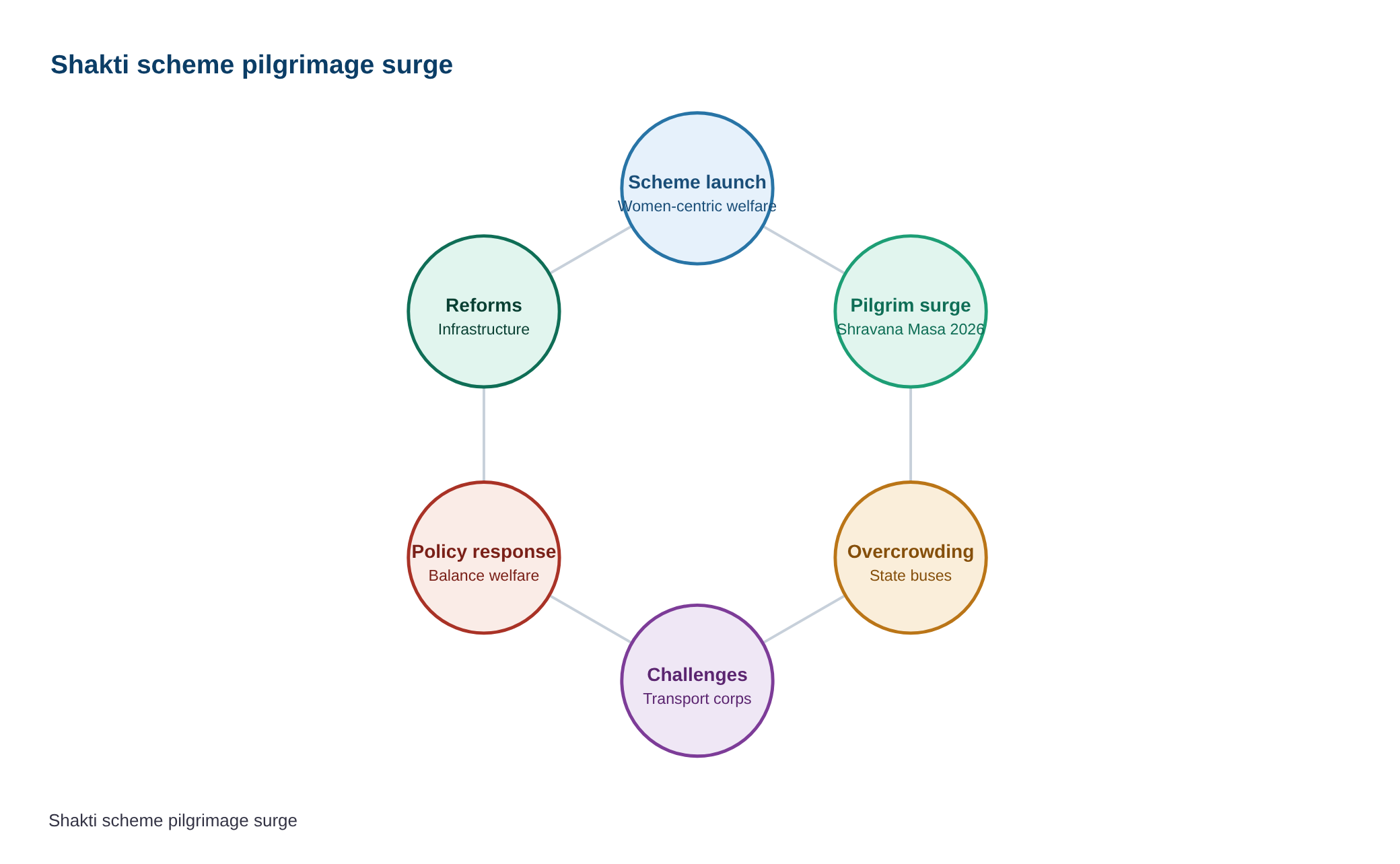
Increased women’s mobility under the Shakti scheme → Surge in pilgrim traffic during Sharavana Masa → Overcrowding in state-run buses → Operational challenges for transport corporations (NWKRTC/KKRTC/KSRTC) → Public dissatisfaction among non-beneficiary groups → Policy response to balance welfare and equity → Long-term infrastructure and governance reforms.
Prelims Practice Questions
Q1. Consider the following statements regarding the Karnataka Shakti Scheme:
1. It provides free bus travel for women pilgrims during Shravana Masa.
2. The scheme is implemented by the Karnataka Road Transport Corporations (KSRTC, KKRTC, NWKRTC).
3. The scheme covers only women traveling to religious sites within Karnataka.
4. The scheme has led to increased demand for bus services during Shravana Masa.
How many of the above statements are correct?
- Only one
- Only two
- Only three
- All four
Answer: All four — Statements 1, 2, and 4 are correct. Statement 3 is incorrect as the scheme does not restrict travel to sites within Karnataka; pilgrims also travel to other states.
Q2. Assertion (A): The Karnataka Shakti Scheme has resulted in overcrowding of buses during Shravana Masa, affecting daily commuters.
Reason (R): The scheme provides free travel to women pilgrims, leading to a surge in demand for bus services.
In the context of the above two statements, which one of the following is correct?
- Both A and R are true, and R is the correct explanation of A.
- Both A and R are true, but R is not the correct explanation of A.
- A is true, but R is false.
- A is false, but R is true.
Answer: Both A and R are true, but R is not the correct explanation of A. — Both the assertion and reason are true, and the reason correctly explains the assertion as the surge in women pilgrims has led to overcrowding.
Q3. Match the following Karnataka Road Transport Corporations with their respective operational regions:
Column I (Corporation) | Column II (Region)
1. KSRTC | A. North Karnataka
2. KKRTC | B. South Karnataka
3. NWKRTC | C. Coastal Karnataka
Select the correct match:
- 1-B, 2-C, 3-A
- 1-A, 2-B, 3-C
- 1-C, 2-A, 3-B
- 1-B, 2-A, 3-C
Answer: 1-A, 2-B, 3-C — KSRTC operates in South Karnataka, KKRTC in Coastal Karnataka, and NWKRTC in North Karnataka.
Mains Practice Question
✍ The Karnataka Shakti Scheme, which provides free bus travel to women pilgrims during Shravana Masa, has led to a significant surge in religious tourism and pilgrimage activities. Critically analyse the scheme’s impact on women’s mobility, public transport infrastructure, and the broader implications for gender-responsive governance in India. (15 Marks)
Approach: MODEL-ANSWER SKELETON:
1. **Introduction (2 marks)**
– Briefly define the Karnataka Shakti Scheme: its objective, target beneficiaries (women pilgrims), and the temporal context (Shravana Masa).
– State the observed surge in pilgrimage activities and its socio-economic implications.
2. **Impact on Women’s Mobility and Empowerment (4 marks)**
– **Accessibility**: How the scheme enhances women’s access to religious sites, reducing financial barriers.
– **Safety and Dignity**: The role of public transport in ensuring safe and dignified travel for women, especially in rural and semi-urban areas.
– **Social Inclusion**: The scheme’s contribution to reducing gender disparities in mobility and participation in cultural-religious activities.
– **Empirical Evidence**: Reference to the reported increase in women pilgrims at temples like Sri Mailaralingeshwar and Sri Sugureshwar.
3. **Challenges to Public Transport Infrastructure (4 marks)**
– **Overcrowding and Capacity Constraints**: How the surge in demand has led to operational challenges for KSRTC, KKRTC, and NWKRTC.
– **Disruption to Daily Commuters**: The reported difficulties faced by male passengers and students in securing seats.
– **Resource Allocation**: The need for additional buses, staff, and logistical planning to manage peak demand.
– **Sustainability**: Whether the scheme’s benefits outweigh the operational costs and long-term sustainability concerns.
4. **Broader Implications for Gender-Responsive Governance (3 marks)**
– **Policy Innovation**: How the scheme exemplifies a gender-responsive policy aimed at social inclusion and cultural participation.
– **Comparative Analysis**: Contrast with other states’ initiatives for women’s mobility (e.g., Delhi’s free bus travel for women, Tamil Nadu’s free bus passes for girl students).
– **Lessons for National Policy**: The scheme’s potential to inform national-level policies on women’s mobility and religious tourism.
5. **Conclusion and Way Forward (2 marks)**
– Summarise the scheme’s dual impact: empowerment of women and challenges to infrastructure.
– Propose measures such as phased implementation, staggered travel timings, and public-private partnerships to enhance sustainability.
– Highlight the need for a balanced approach that addresses both gender equity and infrastructure resilience.
Source: The Hindu
Karnataka PCS (KPSC) — State PCS Practice
Prelims: The ‘Shakti Scheme’ launched by the Karnataka government aims to facilitate safe and subsidized travel for women pilgrims during which of the following festivals in Karnataka?
- A. Ugadi
- B. Sharavana Masa
- C. Dasara
- D. Makara Sankranti
Answer: B. Sharavana Masa — The ‘Shakti Scheme’ was introduced to support women pilgrims visiting sacred sites during the holy month of Sharavana Masa, leading to a significant increase in their participation.
Mains: Analyze the impact of the Karnataka government’s ‘Shakti Scheme’ on women pilgrims during Sharavana Masa. Discuss the socio-economic and cultural implications of this initiative for Karnataka, with a focus on women empowerment and religious tourism.
Generated by AanyaAi for educational purpose.
Related guides on our sites
- Anthropology VS PSIR
- Best PSIR optional coaching
- Best PSIR optional coaching online
- Best PSIR optional teacher

- India-Australia AUSTRAHIND 2026 Exercise: Key Highlights for UPSC & State PCS - October 22, 2026
- एससीओ बैठक में भारत का आतंकवाद विरोध: क्षेत्रीय सहयोग पर जोर - October 22, 2026
- SEC Directs Strict SC Order Compliance for Andhra ULB Polls - October 22, 2026

No Comments