


18 Sep Karnataka’s Sustainable Data Centre Policy 2026–2031: Key Features & UPSC Relevance
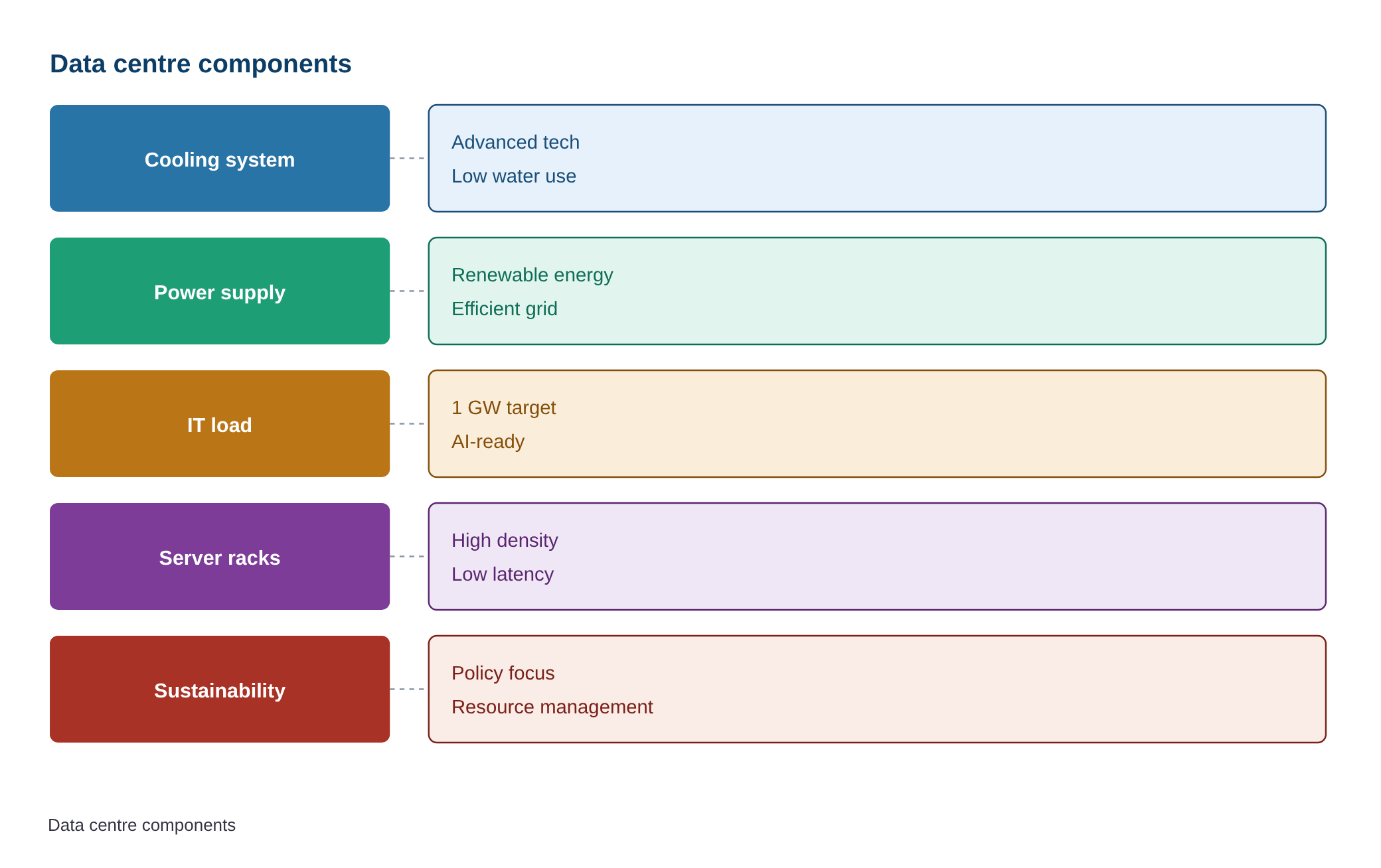
✎ The Sustainable Data Centre Policy 2026–2031 of Karnataka aims to achieve 1 GW IT load by 2031 through sustainable infrastructure, renewable energy integration, and performance monitoring via PUE and WUE metrics.
Subject Relevance — Where This Topic Fits
- GS Paper II — Government Policies and Interventions for Development in various sectors | GS Paper III — Infrastructure: Energy, IT and Digital Services, Environmental Pollution and Degradation
- Prelims: Data Centre Policy, Power Usage Effectiveness (PUE), Water Usage Effectiveness (WUE), Renewable Energy Integration, Single Window Clearance, Sustainable Data Centre Zones, Centre of Excellence for R&D, Karnataka Innovation and Technology Society, Karnataka Udyoga Mitra
- Essay: The Role of State Policies in Shaping Sustainable Digital Infrastructure: A Case Study of Karnataka’s Data Centre Policy, Balancing Economic Growth and Environmental Sustainability in the Digital Age
Quick Revision: The Sustainable Data Centre Policy 2026–2031 of Karnataka aims to achieve 1 GW IT load by 2031 through sustainable infrastructure, renewable energy integration, and performance monitoring via PUE and WUE metrics.
Why is this in the news?
The Karnataka Cabinet has approved the Sustainable Data Centre Policy 2026–2031, a five-year framework aimed at positioning the state as a global hub for next-generation digital infrastructure. The policy targets 1 GW of cumulative IT load and seeks to account for 10–12% of India’s AI-ready data centre capacity by 2031, while prioritising sustainability through renewable energy adoption, advanced cooling technologies, and efficient resource management. This initiative is significant as it aligns Karnataka’s digital growth with environmental responsibility, addressing concerns over high water and power consumption in data centre operations.
Background
- Data centres are critical to India’s digital economy, supporting cloud computing, AI, e-governance, and digital services, with the sector projected to grow at a CAGR of 15–20% over the next decade.
- Karnataka, particularly Bengaluru, is a major hub for IT and IT-enabled services, hosting over 50% of India’s software exports and a significant share of global IT companies.
- The exponential growth of data centres has raised concerns about their environmental impact, including high electricity consumption (accounting for 1–1.5% of global electricity use) and water usage for cooling systems.
- India’s data centre market is expected to reach 17 GW of IT load by 2030, with Karnataka aiming to capture a substantial share through targeted policy interventions.
- The policy builds on Karnataka’s existing strengths in IT infrastructure, innovation ecosystems, and talent pool, while introducing sustainability as a core governance principle.
- The Union Government has also launched the ‘Digital India’ initiative and the ‘National Data Centre Policy’ to promote data centre growth, with states required to align their policies with national objectives.
What is the Sustainable Data Centre Policy 2026–2031?
- A five-year policy framework (2026–2031) approved by the Karnataka Cabinet to develop the state as a global hub for next-generation digital infrastructure, with a focus on sustainability.
- The policy sets a target of achieving 1 GW of cumulative IT load by 2031, positioning Karnataka as a key player in India’s AI-ready data centre capacity (10–12% share).
- It introduces ‘Sustainable Data Centre Zones/Parks’ as designated areas for data centre development, supported by infrastructure such as cable landing stations and edge centres.
- The policy mandates the adoption of renewable energy sources, advanced cooling technologies, and efficient water management systems to reduce environmental impact.
- Performance metrics such as Power Usage Effectiveness (PUE) and Water Usage Effectiveness (WUE) will be monitored to ensure operational efficiency and sustainability.
- A Centre of Excellence for research and innovation will be established to drive technological advancements in data centre infrastructure and sustainability practices.
- The Karnataka Innovation and Technology Society will serve as the registration and implementation interface, while Karnataka Udyoga Mitra will act as the single-window clearance agency for proposals.
- The policy allocates a revised budget of ₹1,300.45 crore for implementation over five years, covering incentives, infrastructure development, and sustainability initiatives.
Key Features
| Feature | Significance |
|---|---|
| 1 GW cumulative IT load target by 2031 | Positions Karnataka as a global leader in digital infrastructure, meeting India’s rising data demand while ensuring scalability. |
| Sustainable Data Centre Policy 2026–2031 | A five-year framework balancing growth with environmental responsibility through renewable energy and advanced technologies. |
| Investment facilitation for ecosystem components | Includes parks, edge centres, cable landing stations, and allied infrastructure to attract private and public investments. |
| Renewable energy adoption and advanced cooling | Reduces carbon footprint and operational costs while improving energy efficiency in data centres. |
| Sustainable Data Centre Zones/Parks | Dedicated zones with shared infrastructure to optimise resource utilisation and promote sustainable practices. |
Why it Matters
Economic Growth and Employment
- Expected to generate substantial employment opportunities in IT, engineering, and allied sectors, contributing to Karnataka’s economic diversification.
- Attracts domestic and foreign investments, enhancing the state’s revenue base through taxes, fees, and infrastructure development.
- Strengthens Karnataka’s position as a preferred destination for high-tech industries, fostering innovation and entrepreneurship.
Strategic Digital Infrastructure
- Aims to capture 10–12% of India’s AI-ready data centre capacity, positioning Karnataka as a critical node in the national digital ecosystem.
- Supports the expansion of edge computing and low-latency services, essential for emerging technologies like 5G, IoT, and AI-driven applications.
- Enhances data sovereignty and security by reducing reliance on foreign data centres, aligning with national digital autonomy goals.
Environmental Sustainability
- Mandates the use of renewable energy sources, reducing the carbon footprint of data centres and aligning with India’s climate commitments.
- Introduces advanced cooling technologies and water management systems to mitigate environmental degradation from high energy and water consumption.
- Promotes monitoring of Power Usage Effectiveness (PUE) and Water Usage Effectiveness (WUE) to ensure optimal resource utilisation.
Policy Innovation and Governance
- Demonstrates Karnataka’s proactive approach to policy design, integrating sustainability with economic growth in a structured five-year framework.
- Establishes a Centre of Excellence for research and innovation, fostering collaboration between industry, academia, and government.
- Introduces single-window clearance mechanisms to streamline approvals, reducing bureaucratic delays for investors.
Challenges
1. High Energy and Water Consumption
- Data centres are among the highest consumers of electricity and water, posing risks to local resources and sustainability goals.
- Balancing the demand for high-performance computing with environmental constraints requires innovative solutions like immersion cooling and closed-loop water systems.
UPSC Link: GS3: Environment and Sustainable Development
2. Infrastructure and Connectivity Gaps
- Reliable and high-speed connectivity is essential for data centres, requiring significant investments in fibre optics and network infrastructure.
- Urban congestion and power grid vulnerabilities in Bengaluru and other cities may hinder seamless operations.
UPSC Link: GS3: Infrastructure
3. Regulatory and Compliance Hurdles
- Ensuring compliance with multiple environmental, zoning, and safety regulations while maintaining operational efficiency is a complex challenge.
- Land acquisition and clearances for large-scale projects may face delays due to legal and administrative bottlenecks.
UPSC Link: GS2: Government Policies and Interventions
4. Talent and Skill Shortages
- The rapid expansion of data centres demands a skilled workforce in IT, engineering, and sustainability domains, which may not be readily available.
- Requires collaboration with educational institutions to upskill the local talent pool and attract professionals from other regions.
UPSC Link: GS3: Employment and Human Resource Development
5. Competition from Other States
- Other states, such as Maharashtra, Tamil Nadu, and Telangana, are also vying to attract data centre investments, creating a competitive environment.
- Karnataka must differentiate itself through policy incentives, infrastructure quality, and sustainability commitments.
UPSC Link: GS3: Economic Development
Challenges — UPSC Perspective
| Issue | Concern |
|---|---|
| Energy Demand | High electricity consumption may strain state power grids and increase carbon emissions without renewable integration. |
| Water Scarcity | Advanced cooling systems require significant water, exacerbating water stress in regions like Bengaluru. |
| Land Availability | Limited urban land and high real estate costs may restrict the establishment of large-scale data centres. |
| Regulatory Complexity | Multiple approvals from environmental, urban planning, and safety authorities can delay project timelines. |
| Talent Shortage | Insufficient local expertise in data centre operations, sustainability, and AI-ready infrastructure may hinder growth. |
| Cybersecurity Risks | Increased digital infrastructure expands the attack surface for cyber threats, requiring robust security frameworks. |
Way Forward
- Implement phased renewable energy targets, such as solar and wind power, to achieve 100% green energy for data centres by 2031.
- Develop dedicated Sustainable Data Centre Zones/Parks with shared infrastructure to optimise resource utilisation and reduce costs.
- Establish a Centre of Excellence in collaboration with IISc, NLSIU, and industry partners to drive R&D in cooling, energy, and AI-ready infrastructure.
- Strengthen single-window clearance mechanisms to expedite approvals for land, power, and environmental clearances.
- Invest in skill development programmes in partnership with ITIs, engineering colleges, and online platforms to address talent shortages.
- Enhance fibre optic and 5G network infrastructure to ensure low-latency, high-speed connectivity for data centres.
- Mandate strict monitoring of PUE and WUE metrics, with incentives for exceeding efficiency benchmarks.
- Promote public-private partnerships to fund pilot projects in advanced cooling and water recycling technologies.
UPSC Value Addition
Keywords for Mains Answer-Writing
Digital public infrastructure · Data centre policy · Sustainable digital infrastructure · Renewable energy in IT · Power Usage Effectiveness (PUE) · Water Usage Effectiveness (WUE) · Centre of Excellence for data centres · State-level digital governance · Cumulative IT load · AI-ready data centre capacity · Single-window clearance mechanism · Sustainable Data Centre Zones · Karnataka Innovation and Technology Society · Department of Electronics, IT, Biotechnology and Science & Technology · Investment facilitation in digital infrastructure
Concept Flow
Rising global demand for digital infrastructure → Karnataka’s policy response to attract investments → Target of 1 GW IT load by 2031 → Emphasis on sustainability and innovation. → Sustainable Data Centre Policy 2026–2031 → Investment facilitation and ecosystem development → Establishment of Sustainable Data Centre Zones/Parks → Creation of Centre of Excellence. → Renewable energy adoption and advanced cooling → Reduction in carbon and water footprint → Alignment with India’s climate and digital autonomy goals. → Single-window clearance and skill development → Streamlined approvals and talent pipeline → Enhanced competitiveness of Karnataka’s data centre ecosystem. → Regulatory compliance and infrastructure upgrades → Mitigation of environmental and operational risks → Sustainable growth of digital infrastructure.
Prelims Practice Questions
Q1. Consider the following statements regarding the Sustainable Data Centre Policy 2026–2031 of Karnataka:
1. The policy aims to achieve 1 GW of cumulative Data Centre IT load by 2031.
2. It mandates the use of renewable energy for all data centres in the state.
3. The policy includes the establishment of Sustainable Data Centre Zones/Parks.
4. Karnataka Udyoga Mitra will serve as the single-window clearance agency for proposals.
How many of the above statements are correct?
- Only one
- Only two
- Only three
- All four
Answer: All four — Statements 1, 3, and 4 are correct. Statement 2 is incorrect as the policy emphasizes the greater use of renewable energy but does not mandate its use for all data centres.
Q2. Assertion (A): The Sustainable Data Centre Policy 2026–2031 of Karnataka includes a budgetary allocation of Rs 1,300.45 crore for its implementation over five years.
Reason (R): The policy aims to position Karnataka as a global hub for next-generation digital infrastructure.
Options:
A. Both A and R are true, and R is the correct explanation of A.
B. Both A and R are true, but R is not the correct explanation of A.
C. A is true, but R is false.
D. A is false, but R is true.
Answer: ? — Both A and R are true, but R does not explain A. The budgetary allocation is a separate provision, while the policy’s aim is a strategic objective.
Q3. Match the following features of the Sustainable Data Centre Policy 2026–2031 with their respective implementing agencies:
Column I (Feature) | Column II (Implementing Agency)
———————————————|———————————-
1. Registration and implementation interface | A. Department of Electronics, IT, Biotechnology and Science & Technology
2. Single-window clearance agency | B. Karnataka Innovation and Technology Society
3. Policy roll-out | C. Karnataka Udyoga Mitra
- 1-B, 2-C, 3-A
- 1-A, 2-B, 3-C
- 1-C, 2-A, 3-B
- 1-B, 2-A, 3-C
Answer: 1-B, 2-C, 3-A — 1-B (Karnataka Innovation and Technology Society serves as the registration and implementation interface), 2-C (Karnataka Udyoga Mitra acts as the single-window clearance agency), 3-A (The Department of Electronics, IT, Biotechnology and Science & Technology will roll out the policy).
Mains Practice Question
✍ Critically examine the significance of the Sustainable Data Centre Policy 2026–2031 of Karnataka in the context of India’s digital infrastructure transformation. How does the policy balance the imperatives of growth, sustainability, and technological advancement? (15 Marks)
Approach: MODEL-ANSWER SKELETON:
1. **Contextual Background**: Define digital infrastructure and its role in India’s digital economy (e.g., National Digital Communications Policy 2018, Digital India initiatives).
2. **Policy Objectives**: Outline Karnataka’s targets—1 GW IT load by 2031, 10–12% of India’s AI-ready capacity, and sustainability metrics (PUE, WUE).
3. **Sustainability Framework**: Explain the emphasis on renewable energy, advanced cooling, water management, and monitoring mechanisms.
4. **Institutional Mechanisms**: Highlight the roles of the Department of Electronics, IT, Biotechnology and Science & Technology, Karnataka Innovation and Technology Society, and Karnataka Udyoga Mitra.
5. **Comparative Advantage**: Discuss Karnataka’s existing ecosystem (Bengaluru as a tech hub, talent pool, and infrastructure) and how the policy leverages it.
6. **Challenges**: Address concerns such as high water/power consumption, land acquisition, and regulatory hurdles.
7. **Broader Implications**: Link the policy to India’s self-reliance in digital infrastructure (e.g., Atmanirbhar Bharat, semiconductor mission) and global competitiveness.
8. **Balancing Act**: Conclude with an analysis of how the policy attempts to reconcile growth with sustainability, citing examples of similar policies in other states (e.g., Tamil Nadu’s data centre policy).
Source: The Indian Express
Karnataka PCS (KPSC) — State PCS Practice
Prelims: Under Karnataka’s Data Centre Policy 2023, what is the targeted IT load capacity by the year 2031?
- 500 MW
- 750 MW
- 1 GW
- 1.5 GW
Answer: 1 GW — The Karnataka Data Centre Policy 2023 aims to achieve a 1 GW IT load capacity by 2031.
Mains: Critically analyze the potential socio-economic impacts of Karnataka’s Data Centre Policy 2023, with a focus on its alignment with the state’s digital transformation goals and challenges in implementation.
Generated by AanyaAi for educational purpose.
Related guides on our sites
- Best PSIR optional coaching for upsc
- Best PSIR optional teacher for upsc
- Best teacher of PSIR optional for upsc
- Best PSIR optional coaching in delhi for UPSC

- Karnataka’s Sustainable Data Centre Policy 2026–2031: Key Features & UPSC Relevance - September 18, 2026
- बॉम्बे हाईकोर्ट ने मुंबई में वर्सोवा-माध कनेक्टर पुल निर्माण को हरी झंडी, 1237 मैंग्रोव वृक्षों की कटाई को मंजूरी - September 18, 2026
- Bombay HC Clears Versova-Madh Bridge: Mangroves Felling Approved for Traffic Relief - September 18, 2026

No Comments