


07 Aug Kashmiri Pandits Rehabilitation Bill 2025: Key Features & UPSC Exam Relevance
✎ The Kashmiri Pandits (Recourse, Restitution, Rehabilitation and Resettlement) Bill, 2025, aims to provide a statutory framework for the safe return, resettlement, and rehabilitation of displaced Kashmiri Pandits, addressing…
Subject Relevance — Where This Topic Fits
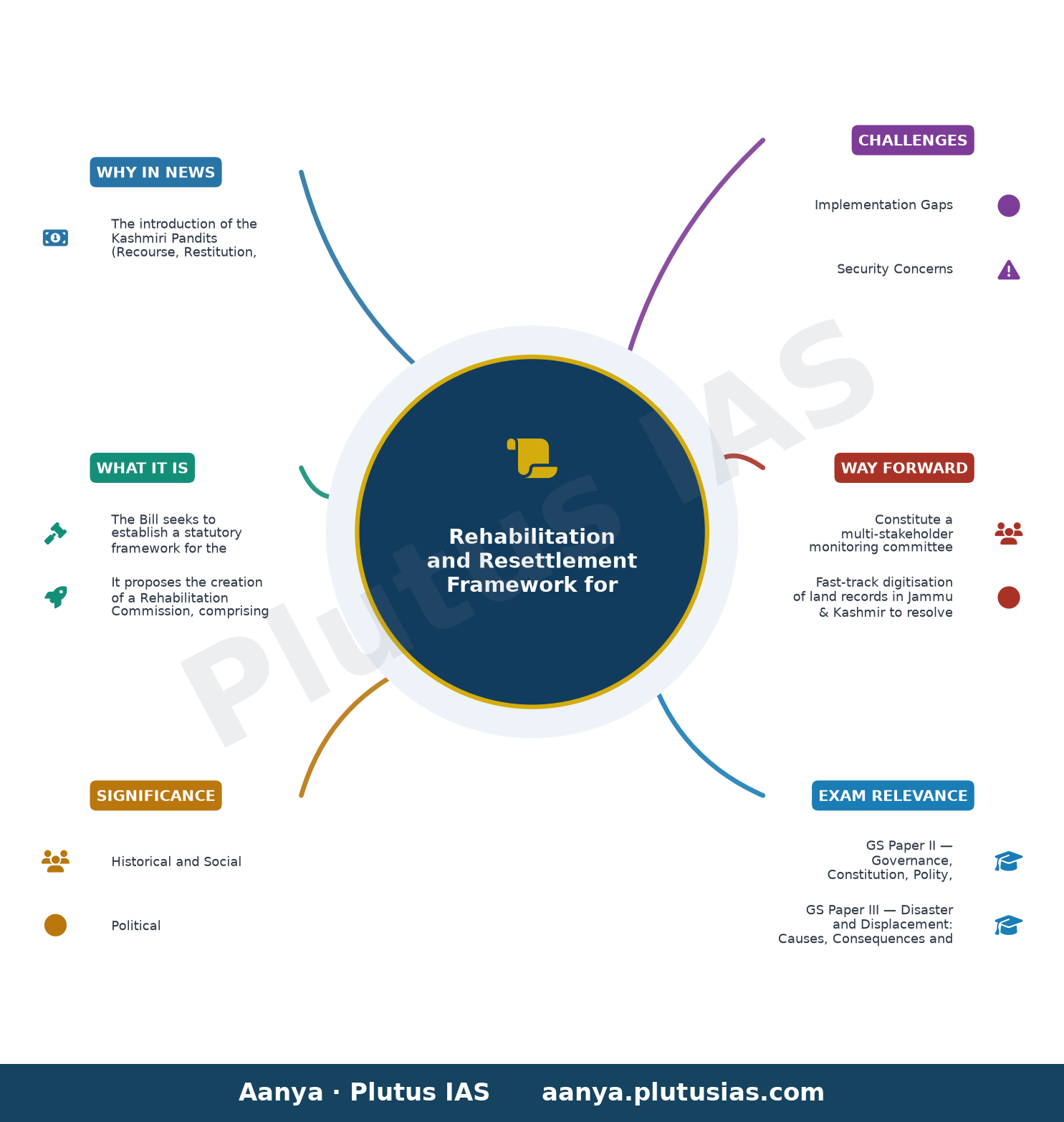
- GS Paper II — Governance, Constitution, Polity, Social Justice and International Relations | GS Paper III — Disaster and Displacement: Causes, Consequences and Management
- Prelims: Kashmiri Pandits, Article 370, Internal Displacement, Rehabilitation Policy, Jammu and Kashmir Reorganisation Act 2019, Right to Fair Compensation and Transparency in Land Acquisition Act 2013
- Essay: The ethical imperative of state-led rehabilitation in post-conflict societies, Balancing identity preservation and state integration in minority resettlement
Quick Revision: The Kashmiri Pandits (Recourse, Restitution, Rehabilitation and Resettlement) Bill, 2025, aims to provide a statutory framework for the safe return, resettlement, and rehabilitation of displaced Kashmiri Pandits, addressing property restitution, cultural preservation, and socio-economic integration.
Why is this in the news?
The introduction of the Kashmiri Pandits (Recourse, Restitution, Rehabilitation and Resettlement) Bill, 2025 in the Lok Sabha during the 2026 Monsoon Session underscores the persistent challenge of rehabilitating internally displaced communities in India. The Bill seeks to provide a comprehensive legal framework for the social, political, and economic rehabilitation of Kashmiri Pandits, who were displaced from the Kashmir Valley following the onset of insurgency in the late 1980s. This legislative initiative assumes significance in the context of India’s constitutional obligations to protect minority rights and ensure justiciable remedies for historical injustices.
Background
- The exodus of Kashmiri Pandits from the Kashmir Valley began in 1989–1990, triggered by targeted violence, threats, and systemic marginalisation, leading to the displacement of approximately 300,000–400,000 individuals.
- The displacement occurred against the backdrop of rising insurgency in Jammu and Kashmir, with militant groups explicitly targeting the Kashmiri Pandit community, resulting in mass killings, abductions, and forced evictions.
- Efforts to rehabilitate Kashmiri Pandits have been sporadic, with limited success due to the absence of a dedicated legal framework, inadequate compensation, and persistent security concerns in the Valley.
- The Jammu and Kashmir Reorganisation Act, 2019, bifurcated the erstwhile state into two Union Territories, raising questions about the constitutional and administrative mechanisms for addressing the grievances of displaced communities.
- The Supreme Court of India, in its 2020 judgment in *Dr. Ashwani Kumar v. Union of India*, directed the Union Government to frame a policy for the rehabilitation of Kashmiri Pandits, highlighting the judiciary’s role in addressing historical injustices.
- The Bill aligns with India’s commitments under international law, including the UN Guiding Principles on Internal Displacement, which emphasise the state’s responsibility to provide protection and assistance to internally displaced persons (IDPs).
What is the Kashmiri Pandits (Recourse, Restitution, Rehabilitation and Resettlement) Bill, 2025?
- The Bill seeks to establish a statutory framework for the rehabilitation of Kashmiri Pandits, who were displaced from the Kashmir Valley in the late 1980s and early 1990s, ensuring their safe, dignified, and voluntary return or resettlement.
- It proposes the creation of a Rehabilitation Commission, comprising representatives from the Union Government, state governments, and civil society, to oversee the implementation of rehabilitation measures and monitor progress.
- The Bill mandates the restoration of property rights, including immovable assets, to displaced Kashmiri Pandits, in accordance with the provisions of the Right to Fair Compensation and Transparency in Land Acquisition Act, 2013, and other relevant laws.
- It includes provisions for the protection of cultural heritage, including the revival of temples, manuscripts, and traditional practices, ensuring the preservation of Kashmiri Pandit identity and heritage.
- The Bill provides for a comprehensive rehabilitation package, including financial assistance, housing, employment opportunities, and access to education and healthcare, tailored to the needs of displaced families.
- It addresses security concerns by mandating the deployment of adequate police and administrative support in areas targeted for resettlement, ensuring the safety of returning families.
- The Bill recognises the principle of restitution, requiring the state to compensate for losses incurred due to displacement, including economic, social, and psychological damages.
- It seeks to integrate rehabilitation efforts with broader development policies in Jammu and Kashmir, ensuring that displaced communities are not marginalised in the region’s socio-economic transformation.
Key Features
| Feature | Significance |
|---|---|
| Kashmiri Pandits (Recourse, Restitution, Rehabilitation and Resettlement) Bill, 2025 | Proposes structured rehabilitation mechanisms for displaced Kashmiri Pandits, addressing socio-economic and cultural restoration. |
| Provision for property restoration | Mandates legal recourse for reclaiming immovable property seized or abandoned during displacement. |
| Cultural heritage protection | Includes measures for safeguarding temples, manuscripts, and traditional practices of the Kashmiri Pandit community. |
| Rehabilitation package | Envisages financial aid, employment quotas, and housing schemes for returnees. |
| Safety and security provisions | Incorporates measures for protection against intimidation and violence upon return. |
| Fishermen (Protection and Welfare) Bill, 2024 | Aims to institutionalise welfare mechanisms for coastal fishing communities through a dedicated board and fund. |
Why it Matters
Historical and Social
- Represents a legislative response to the 1989-90 exodus of Kashmiri Pandits, a critical episode in India’s internal displacement history.
- Highlights the state’s obligation to address long-standing grievances of a minority community subjected to forced migration.
- Underscores the need for reconciliation and justice in conflict-affected regions, aligning with constitutional principles of equity and inclusion.
Political
- Demonstrates parliamentary engagement with issues of minority rights and rehabilitation, a recurring theme in India’s democratic discourse.
- Reflects opposition-led legislative initiatives, indicating cross-party interest in addressing community-specific concerns.
- May influence electoral narratives in Jammu & Kashmir and other regions with displaced populations.
Economic
- Rehabilitation packages could stimulate local economies in Kashmir through return migration and investment in cultural heritage.
- Welfare boards for fishermen may enhance productivity and sustainability in India’s coastal economy.
Legal
- Introduces a rights-based framework for restitution, distinct from ad-hoc relief measures post-conflict.
- Could set a precedent for similar legislation addressing displacement in other regions (e.g., Northeast, Naxal-affected areas).
Challenges
1. Implementation Gaps
- Historical precedents (e.g., PM’s Package for Kashmiri Pandits) show limited success due to bureaucratic delays and lack of monitoring.
- Restoration of property faces legal hurdles, including encroachments and unclear land records in Jammu & Kashmir.
UPSC Link: GS2: Welfare schemes for vulnerable sections
2. Security Concerns
- Persistent threats to returnees, including sporadic violence and social alienation, may deter rehabilitation efforts.
- Dependence on local law enforcement agencies, which may lack capacity or political will for robust protection.
UPSC Link: GS3: Internal security challenges
3. Funding and Resource Allocation
- Rehabilitation packages require substantial budgetary commitments, competing with other socio-economic priorities.
- Dependence on state governments for execution may lead to disparities in implementation.
UPSC Link: GS2: Centre-state financial relations
4. Community Trust Deficit
- Distrust among Kashmiri Pandits towards government assurances, stemming from unfulfilled promises over decades.
- Need for transparent grievance redressal mechanisms to rebuild confidence.
UPSC Link: GS2: Role of civil society
5. Political Polarisation
- Legislative initiatives may be perceived through partisan lenses, risking politicisation of humanitarian issues.
- Opposition protests during Monsoon Session highlight polarised narratives on governance and security.
UPSC Link: GS2: Parliament and its functioning
Challenges — UPSC Perspective
| Issue | Concern |
|---|---|
| Land records and property disputes | Ambiguities in land records in Jammu & Kashmir impede restitution efforts. |
| Sustainable livelihoods | Lack of employment opportunities in Kashmir may discourage long-term return of displaced families. |
| Community integration | Social stigma and cultural alienation hinder the reintegration of Kashmiri Pandits into local society. |
| Monitoring and evaluation | Absence of robust mechanisms to track progress and address grievances in real time. |
| Inter-state coordination | Need for seamless collaboration between J&K administration and central agencies for effective implementation. |
| Legal ambiguities | Unclear provisions on compensation and restitution may lead to judicial delays. |
Way Forward
- Constitute a multi-stakeholder monitoring committee with representatives from government, civil society, and Kashmiri Pandit community for real-time oversight.
- Fast-track digitisation of land records in Jammu & Kashmir to resolve property disputes expeditiously.
- Introduce employment-linked incentives for returnees, including skill development and entrepreneurship support.
- Strengthen security apparatus in vulnerable districts through community policing and rapid response teams.
- Establish a grievance redressal portal with time-bound resolution mechanisms for restitution claims.
- Collaborate with international bodies (e.g., UNHCR) for best practices in post-conflict rehabilitation.
- Ensure transparent disbursement of rehabilitation funds with third-party audits to prevent leakages.
- Promote cultural revival initiatives, such as restoration of temples and documentation of oral histories.
UPSC Value Addition
Keywords for Mains Answer-Writing
Kashmiri Pandits Rehabilitation Bill 2025 · Article 370 abrogation and its socio-legal implications · Right to Return under International Law · Internal Displacement (Compensation and Rehabilitation) Policy · Ministry of Home Affairs (MHA) rehabilitation schemes · Jammu and Kashmir Reorganisation Act 2019 · UN Guiding Principles on Internal Displacement · Article 21 of the Constitution (Right to Life and Livelihood) · Parliamentary Standing Committee on Home Affairs · Article 35A and its judicial review · Kashmiriyat and cultural preservation · Union Territory status of Jammu and Kashmir
Concept Flow
Exodus of Kashmiri Pandits (1989-90) → Constitutional obligation to protect minority rights (Article 29, 30) → Legislative response via Rehabilitation Bill → Implementation challenges (property disputes, security) → Way forward: institutional reforms and community engagement
Prelims Practice Questions
Q1. Consider the following statements regarding the Kashmiri Pandits Rehabilitation Bill, 2025:
1. The Bill seeks to provide for the social, political, and economic rehabilitation of Kashmiri Pandits.
2. It includes provisions for the protection of their property and restoration of cultural heritage.
3. The Bill mandates the establishment of a dedicated Rehabilitation Authority under the Ministry of Home Affairs.
4. It proposes a rehabilitation package exclusively for Kashmiri Pandits displaced after the abrogation of Article 370.
How many of the above statements are correct?
- Only one
- Only two
- Only three
- All
Answer: All — Statements 1, 2, and 4 are correct. Statement 3 is incorrect as the Bill does not explicitly mandate the creation of a dedicated Rehabilitation Authority under the Ministry of Home Affairs.
Q2. Assertion (A): The Foreign Contribution (Regulation) Amendment Bill, 2026, aims to regulate the flow of foreign donations to non-governmental organisations (NGOs) in India.
Reason (R): The Bill seeks to amend the Foreign Contribution (Regulation) Act, 2010, to enhance transparency and accountability in the receipt and utilisation of foreign contributions.
In the context of the above two statements, which one of the following is correct?
- Both A and R are true, and R is the correct explanation of A
- Both A and R are true, but R is not the correct explanation of A
- A is true, but R is false
- A is false, but R is true
Answer: Both A and R are true, but R is not the correct explanation of A — Both the Assertion and Reason are true, and the Reason correctly explains the Assertion as the Bill directly amends the FCRA, 2010, to regulate foreign contributions.
Q3. Match the following Bills introduced in the Lok Sabha with their respective objectives:
Column I (Bill) | Column II (Objective)
————————————-|————————————-
A. Kashmiri Pandits (Recourse, Restitution, Rehabilitation and Resettlement) Bill, 2025 | 1. Regulates foreign donations to NGOs
B. MSME Development (Amendment) Bill, 2026 | 2. Provides social, political, and economic rehabilitation for displaced Kashmiri Pandits
C. Foreign Contribution (Regulation) Amendment Bill, 2026 | 3. Amends the Micro, Small and Medium Enterprises Development Act, 2006
D. Fishermen (Protection and Welfare) Bill, 2024 | 4. Establishes a welfare board and fund for fishermen
Select the correct match:
- A-2, B-3, C-1, D-4
- A-1, B-2, C-3, D-4
- A-4, B-3, C-1, D-2
- A-2, B-1, C-3, D-4
Answer: A-2, B-3, C-1, D-4 — The correct matches are: A-2 (Kashmiri Pandits Bill aims for rehabilitation), B-3 (MSME Amendment Bill amends the 2006 Act), C-1 (FCRA Amendment Bill regulates foreign donations), and D-4 (Fishermen Bill establishes a welfare board and fund).
Mains Practice Question
✍ Critically examine the constitutional and legal framework governing the rehabilitation and resettlement of internally displaced persons (IDPs) in India with specific reference to the proposed Kashmiri Pandits (Recourse, Restitution, Rehabilitation and Resettlement) Bill, 2025. How far does this Bill address the lacunae in existing policies for the protection of cultural heritage and property rights of displaced communities? (15 Marks)
Approach: A full answer must cover the following dimensions:
1. **Constitutional and Legal Framework for IDPs in India**:
– Article 21 (Right to Life and Livelihood) and its judicial interpretation (e.g., *Olga Tellis v. Bombay Municipal Corporation*, 1985).
– Directive Principles of State Policy (Articles 38, 39, 41, 42) and their relevance to rehabilitation.
– The role of the National Disaster Management Authority (NDMA) and State Disaster Management Authorities (SDMAs) under the Disaster Management Act, 2005.
– The absence of a centralised IDP policy and reliance on ad-hoc schemes (e.g., Prime Minister’s Package for Return and Rehabilitation of Kashmiri Migrants, 2008).
2. **Key Provisions of the Kashmiri Pandits (Recourse, Restitution, Rehabilitation and Resettlement) Bill, 2025**:
– Social, political, and economic rehabilitation measures (e.g., employment quotas, housing schemes).
– Protection of property rights and mechanisms for restoration of cultural heritage (e.g., temples, manuscripts).
– Safety and security provisions (e.g., police protection, anti-terrorism measures).
– Rehabilitation package (financial assistance, education, healthcare).
3. **Lacunae in Existing Policies**:
– Inadequate legal safeguards for property rights (e.g., *State of Jammu and Kashmir v. Bakshi Ghulam Mohammad*, 1967; *S.P. Gupta v. Union of India*, 1982).
– Lack of a statutory framework for cultural heritage preservation (e.g., *Vishwa Lochan Madan v. Union of India*, 2005 on temple management).
– Fragmented implementation and lack of accountability (e.g., delays in the Prime Minister’s Package).
– Overlap with the Jammu and Kashmir Reorganisation Act, 2019 and its implications for IDPs.
4. **International Law and Comparative Perspectives**:
– UN Guiding Principles on Internal Displacement (1998) and their relevance (e.g., principle of non-refoulement, right to return).
– Comparative analysis with other countries (e.g., Sri Lanka’s IDP policies post-civil war, South Africa’s land restitution laws).
5. **Critique and Way Forward**:
– Strengths of the Bill (e.g., comprehensive approach, focus on cultural heritage).
– Limitations (e.g., lack of enforceability, reliance on executive discretion, absence of a dedicated tribunal for property disputes).
– Suggestions for improvement (e.g., statutory backing for the Rehabilitation Authority, integration with the Disaster Management Act, 2005, and judicial mechanisms for property restoration).
Balance of views: Highlight the need for a rights-based approach (e.g., *National Human Rights Commission v. State of Arunachal Pradesh*, 1996) while acknowledging the challenges of balancing security and rehabilitation in a conflict-affected region.
Source: The Indian Express
Generated by AanyaAi for educational purpose.

- मुंबई का जवाहर द्वीप बना भारत का पहला प्लास्टिक-मुक्त ऑयल टर्मिनल - October 3, 2026
- Gujarat HC orders FIR in ITS officer’s 2023 custodial death - October 3, 2026
- डीआरआई ने मुंबई एयरपोर्ट पर सोने-हीरे की तस्करी गिरोह का किया पर्दाफाश, 8 गिरफ्तार - October 3, 2026

No Comments