


20 Jul Kaushal Bharat Mission: Skill India’s Impact on Youth Employment & Entrepreneurship
Subject Relevance — Where This Topic Fits
- GS Paper II — Governance, Transparency and Accountability | GS Paper III — Employment, Skill Development, and Entrepreneurship
- Prelims: Skill India Mission (SIM), PMKVY, Jan Shikshan Sansthan (JSS), National Apprenticeship Promotion Scheme (NAPS), Craftsmen Training Scheme (CTS), Skill India Digital Hub (SIDH), PM Vishwakarma Yojana, Skill for AI Readiness (SOAR), National Entrepreneurship and Small Business Development Institute (NIESBUD), Indian Institute of Entrepreneurship (IIE)
- Essay: Human capital as a driver of India’s demographic dividend, Skill development as a catalyst for inclusive economic growth
Why is this in the news?
The Skill India Mission (SIM) has been highlighted in a recent press release by the Ministry of Skill Development and Entrepreneurship (MSDE), detailing its multi-pronged approach to skilling, upskilling, and reskilling across India’s socio-economic strata. The release underscores the mission’s evolving frameworks, such as PMKVY 4.0, and quantifies placement outcomes, including a 42.8% placement rate under PMKVY’s first three phases. It also introduces initiatives like the Skill India Digital Hub (SIDH) and the Skill for AI Readiness (SOAR) program, reflecting the mission’s adaptation to emerging technological demands.
Background
- Launched in 2015, the Skill India Mission (SIM) is a flagship initiative of the Government of India to address the dual challenges of youth unemployment and skill shortages in the labour market.
- The mission operates under the aegis of the Ministry of Skill Development and Entrepreneurship (MSDE), which coordinates with state governments, industrial training institutes (ITIs), and sector skill councils to implement skill development programs.
- PMKVY (Pradhan Mantri Kaushal Vikas Yojana), one of SIM’s core schemes, has undergone multiple iterations (1.0, 2.0, 3.0, and 4.0), with the latest version (4.0) emphasizing industry-relevant curricula, on-the-job training (OJT), and career diversification support.
- Other key schemes include the National Apprenticeship Promotion Scheme (NAPS), Jan Shikshan Sansthan (JSS), and Craftsmen Training Scheme (CTS), which cater to diverse segments of the workforce, including artisans, school dropouts, and vocational learners.
- Recent initiatives like the PM Vishwakarma Yojana (2023) and the Swavalambini program (2025) reflect a shift toward holistic support for traditional artisans and women entrepreneurs, respectively.
What is the Skill India Mission?
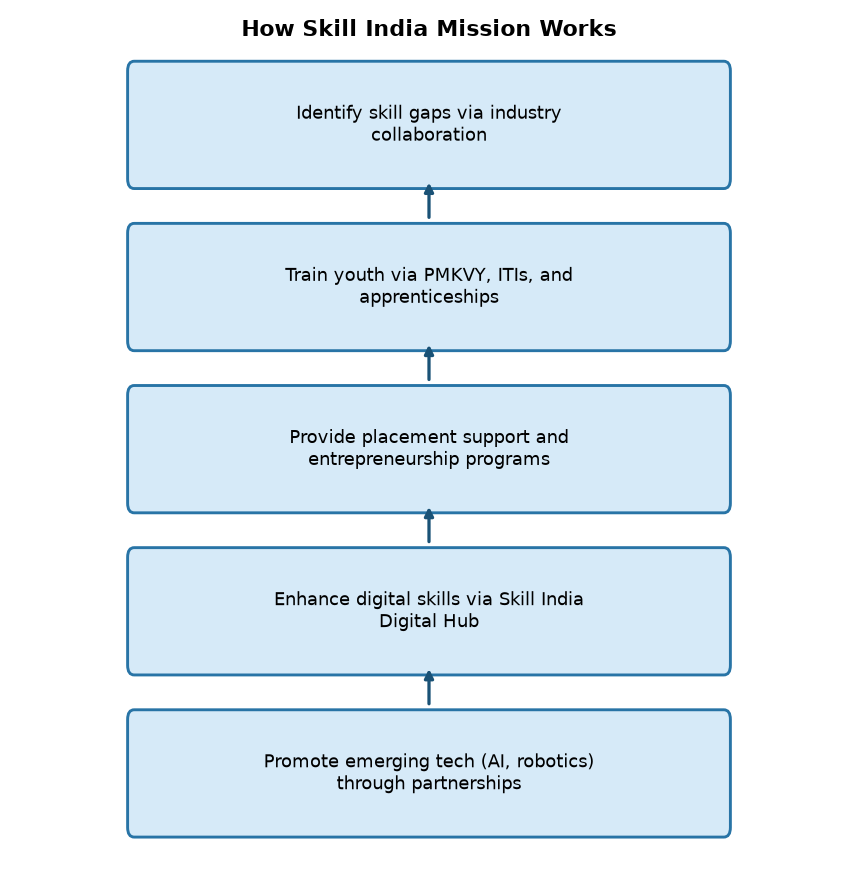
- The Skill India Mission (SIM) is a government-led initiative to enhance the employability of India’s workforce by providing access to industry-aligned skill development, upskilling, and reskilling programs across all socio-economic strata.
- It operates through a network of schemes such as PMKVY, NAPS, JSS, and CTS, delivered via ITIs, sector skill councils, and partner institutions like NIESBUD and IIE.
- PMKVY, the flagship scheme, offers short-term training (STT) in 70+ sectors, with certification and placement support. As of 2026, over 56.89 lakh candidates have been certified under STT, with a 42.8% placement rate recorded across PMKVY 1.0 to 3.0.
- PMKVY 4.0 introduces a career diversification model, integrating on-the-job training (OJT), industry partnerships, and emerging technology domains (AI, robotics, drones, mechatronics, IoT) to align with future labour market demands.
- The mission leverages digital infrastructure through the Skill India Digital Hub (SIDH), a unified platform for course discovery, enrollment, certification, and career guidance, enhancing accessibility and transparency.
- Entrepreneurship development is a critical pillar, with programs like the Entrepreneurship Awareness Program (EAP) and Entrepreneurship Development Program (EDP) offering training, credit linkages, and market access to aspiring entrepreneurs.
- Specialized initiatives such as the PM Vishwakarma Yojana (2023) and the Swavalambini program (2025) target traditional artisans and women entrepreneurs, respectively, providing skill upgradation, toolkits, collateral-free loans, and mentorship.
- The mission incorporates emerging technologies like AI through the Skill for AI Readiness (SOAR) program, which equips students and teachers with foundational and practical AI skills to prepare for the future economy.
Key Features
| Feature | Significance |
|---|---|
| Pradhan Mantri Kaushal Vikas Yojana (PMKVY) 4.0 | Focuses on industry-relevant skills, career diversification pathways, and on-the-job training (OJT) to enhance employability and future readiness of youth. |
| National Apprenticeship Promotion Scheme (NAPS) | Provides financial incentives to employers to engage apprentices, bridging the gap between vocational training and industry requirements. |
| Craftsman Training Scheme (CTS) via ITIs | Ensures standardized skill training in traditional and emerging trades, with a placement rate of 42.8% for certified candidates. |
| Skill India Digital Hub (SIDH) | Integrated digital public infrastructure platform facilitating course discovery, enrollment, and certification for skill development programs. |
| PM Vishwakarma Yojana | Provides holistic support—upskilling, toolkits, and collateral-free credit—to artisans in 18 traditional trades, fostering entrepreneurship and self-employment. |
Why it Matters
Economic
- Enhances labour market efficiency by aligning skill development with industry demands, reducing structural unemployment and underemployment.
- Boosts productivity and competitiveness of the Indian workforce in global value chains, particularly in emerging sectors like AI, robotics, and drone technology.
- Facilitates formalisation of the informal sector by providing certified skills and entrepreneurial opportunities to marginalised groups.
Social
- Promotes inclusive growth by targeting women, northeastern states, and socio-economically disadvantaged groups through tailored programs like Swavalambini.
- Reduces gender disparities in skill acquisition and entrepreneurship via gender-specific initiatives, such as entrepreneurship awareness programs (EAP) and development programs (EDP).
- Empowers artisans and traditional craftsmen through PM Vishwakarma Yojana, preserving cultural heritage while enhancing economic viability.
Strategic
- Aligns with the vision of ‘Atmanirbhar Bharat’ by reducing dependency on imported skilled labour and fostering indigenous skill ecosystems.
- Supports the demographic dividend by equipping the youth with future-ready skills, thereby mitigating the risk of a ‘jobless growth’ scenario.
- Strengthens India’s position as a global skill hub, attracting foreign investments and enhancing the ‘Make in India’ ecosystem.
Challenges
1. Quality and Relevance of Training
- Discrepancies between training curricula and industry requirements, leading to suboptimal placement outcomes despite certification.
- Limited focus on soft skills, digital literacy, and emerging technologies in traditional vocational programs, constraining adaptability in dynamic job markets.
UPSC Link: GS-III: Skill Development
2. Regional and Gender Disparities
- Uneven distribution of skill training infrastructure and opportunities across states, exacerbating regional imbalances in employment and economic growth.
- Lower participation and retention rates among women and marginalised communities due to socio-cultural barriers and limited access to training centers.
UPSC Link: GS-I: Social Empowerment
3. Placement and Sustainability
- Declining placement rates in certain sectors post-training, as highlighted by the 42.8% placement rate under PMKVY, indicating gaps in industry linkages.
- Challenges in sustaining self-employment and entrepreneurship ventures due to limited access to credit, market linkages, and mentorship post-training.
UPSC Link: GS-III: Employment
4. Digital Divide and Infrastructure Gaps
- Limited digital literacy and access to technology among trainees, particularly in rural and remote areas, hindering participation in digital skill programs like SIDH.
- Inadequate physical infrastructure in ITIs and vocational training centers, leading to overcrowding and reduced training quality.
UPSC Link: GS-III: Digital India
Challenges — UPSC Perspective
| Issue | Concern |
|---|---|
| Curriculum-Employer Mismatch | Training programs often fail to align with evolving industry demands, reducing employability outcomes. |
| Low Female Participation | Women constitute a small fraction of trainees in technical and vocational programs due to socio-cultural barriers. |
| Placement Rate Variability | State-wise disparities in placement rates under PMKVY, with some regions achieving significantly lower outcomes. |
| Entrepreneurship Sustainability | High attrition rates among trained entrepreneurs due to lack of post-training support systems like credit access and market linkages. |
| Digital Literacy Gaps | Limited digital infrastructure in rural areas restricts access to online skill development platforms like SIDH. |
Government Initiatives — Must-Memorise for Prelims
- Pradhan Mantri Kaushal Vikas Yojana (PMKVY)
- National Apprenticeship Promotion Scheme (NAPS)
- Craftsman Training Scheme (CTS)
- Skill India Digital Hub (SIDH)
- PM Vishwakarma Yojana
- Swavalambini Program
- Entrepreneurship Awareness Program (EAP)
- Entrepreneurship Development Program (EDP)
Way Forward
- Strengthen industry-academia partnerships to ensure curricula reflect real-time market demands, with mandatory internships and apprenticeships.
- Expand digital infrastructure and mobile training units to bridge the rural-urban divide in skill access, particularly for women and marginalised groups.
- Enhance post-training support mechanisms, including credit guarantees, mentorship, and market linkages, to sustain self-employment and entrepreneurship.
- Introduce outcome-based funding models for vocational training institutes, linking financial incentives to placement rates and skill relevance.
- Mandate periodic third-party audits of training quality and employability outcomes to ensure accountability and continuous improvement.
- Promote multi-stakeholder collaborations with global tech firms (e.g., IBM, Microsoft) to integrate cutting-edge skills like AI, robotics, and IoT into vocational training.
- Establish a national skill registry to track trainee progress, certifications, and employment outcomes, enabling data-driven policy interventions.
UPSC Value Addition
Keywords for Mains Answer-Writing
Skill India Mission (SIM) · Pradhan Mantri Kaushal Vikas Yojana (PMKVY) · National Apprenticeship Promotion Scheme (NAPS) · Craftsman Training Scheme (CTS) · Skill India Digital Hub (SIDH) · employability enhancement · vocational training · entrepreneurship development · AI-ready workforce · industry-academia collaboration · placement rate · Skilling for AI Readiness (SOAR) · PM Vishwakarma Scheme · women entrepreneurship · sector-specific skill gaps
Concept Flow
Demographic Dividend → Need for Skill Development → Launch of Skill India Mission (SIM) → SIM → Implementation via PMKVY, NAPS, CTS, and other schemes → Training and Certification of Youth → Certified Trainees → Placement or Self-Employment Opportunities → Enhanced Employability and Economic Contribution → Industry-Academia Gap → Curriculum-Employer Mismatch → Low Placement Rates and Sustainability Challenges → Policy Interventions → Outcome-Based Funding, Digital Infrastructure, and Post-Training Support → Improved Skill Ecosystem
Prelims Practice Questions
Q1. Which of the following is NOT a component of the Skill India Mission (SIM) under the Ministry of Skill Development and Entrepreneurship (MSDE)?
- A. Pradhan Mantri Kaushal Vikas Yojana (PMKVY)
- B. National Apprenticeship Promotion Scheme (NAPS)
- C. Mahatma Gandhi National Rural Employment Guarantee Scheme (MGNREGS)
- D. Craftsman Training Scheme (CTS)
Answer: C. Mahatma Gandhi National Rural Employment Guarantee Scheme (MGNREGS) — MGNREGS is a rural employment guarantee scheme under the Ministry of Rural Development, whereas PMKVY, NAPS, and CTS are integral components of the Skill India Mission under MSDE.
Q2. The Skill India Digital Hub (SIDH) primarily facilitates:
- A. Direct cash transfers to skilled workers
- B. Online course search, enrolment, and certification
- C. Subsidised toolkits for traditional artisans
- D. Collateral-free loans for startups
Answer: B. Online course search, enrolment, and certification — SIDH is an integrated digital public infrastructure platform designed to streamline course discovery, enrolment, and certification processes for skill training programmes.
Q3. Which programme under the Skill India Mission specifically targets traditional artisans in 18 trades with holistic support including upskilling, toolkits, and collateral-free loans?
- A. PMKVY 4.0
- B. PM Vishwakarma Scheme
- C. National Entrepreneurship Awareness Programme (NEAP)
- D. Skilling for AI Readiness (SOAR)
Answer: B. PM Vishwakarma Scheme — The PM Vishwakarma Scheme, launched in September 2023, provides comprehensive support to artisans in 18 traditional trades, including upskilling, toolkits, and collateral-free loans.
Mains Practice Question
✍ Critically analyse the role of the Skill India Mission (SIM) in addressing India’s demographic dividend and the challenges it faces in ensuring sustainable employment for its beneficiaries. Substantiate your answer with relevant data and policy initiatives.
Approach: Begin by defining the demographic dividend and its relevance to India’s economic growth. Discuss the objectives and key components of SIM, including PMKVY, NAPS, CTS, and digital platforms like SIDH, highlighting their role in enhancing employability. Use the placement rate data (42.8% under PMKVY 1.0–3.0) and the 18.8 percentage-point improvement in employment outcomes post-training to underscore impact. Critically examine challenges such as skill mismatches, industry-academia gaps, and the need for continuous upskilling in emerging sectors like AI and robotics. Conclude by suggesting measures to strengthen SIM’s effectiveness, such as strengthening industry partnerships, expanding apprenticeship opportunities, and integrating AI-ready skill development programmes like SOAR.
Source: PIB (Press Information Bureau)
Generated by AanyaAi for educational purpose.

- उत्तराखंड राज्यपाल की पीएम मोदी से महत्वपूर्ण बैठक: जानिए मुख्य बिंदु - October 23, 2026
- How India’s Rs 20,000 Cr CCUS Budget Can Drive Net-Zero Goals - October 23, 2026
- पंजाब-हरियाणा में पराली जलाने पर सीएक्यूएम की सख्त समीक्षा, तुरंत उठाये गये कदमों पर जोर - October 23, 2026

No Comments