


06 Aug Ken-Betwa Link Project: Tribal Rehabilitation Status & Challenges for UPSC 2026
✎ The Ken-Betwa Link Project must comply with the Forest Rights Act, 2006, which prohibits the diversion of forest land for non-forestry purposes until the rights of Scheduled Tribes and other traditional forest dwellers are…
Subject Relevance — Where This Topic Fits
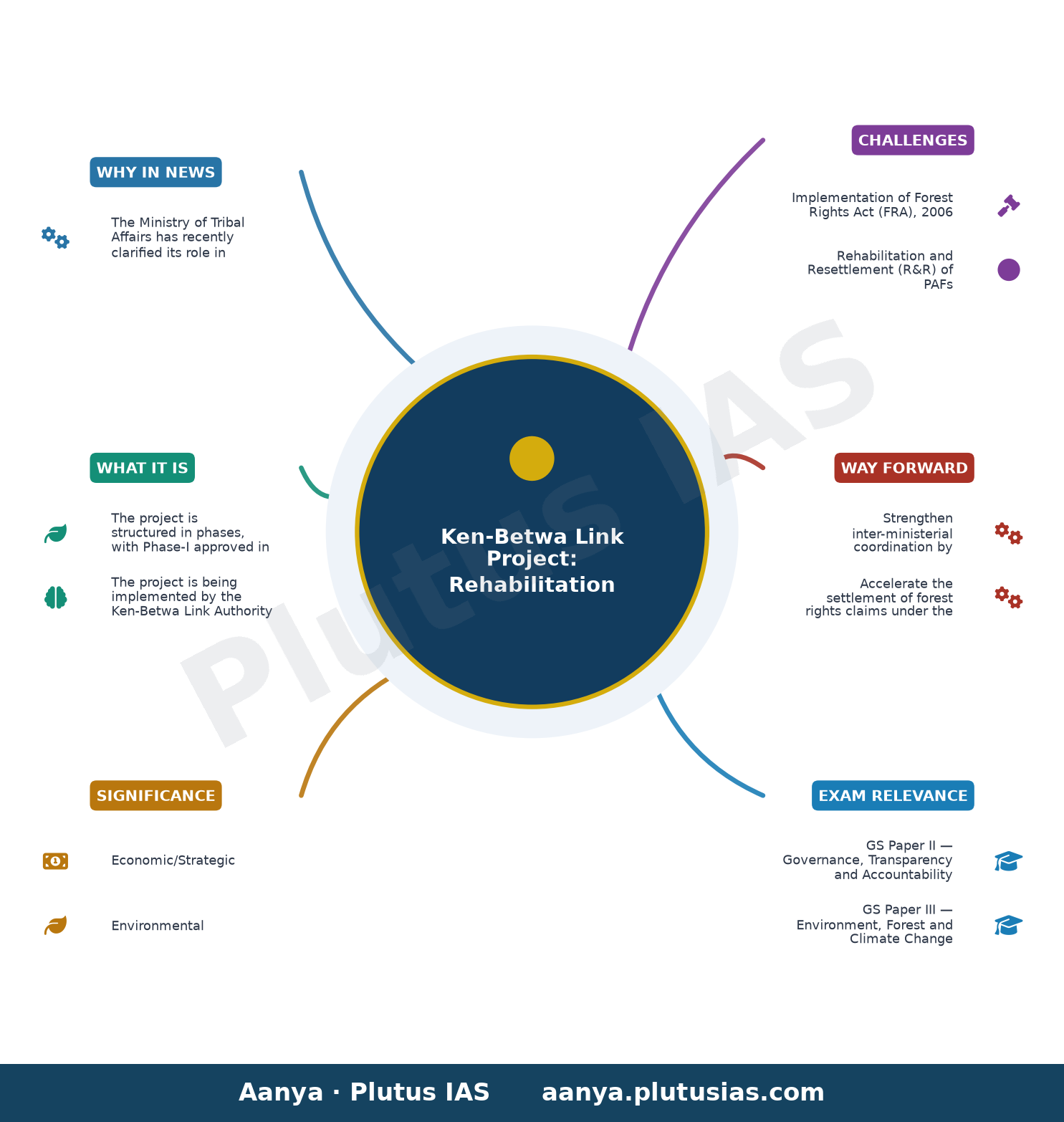
- GS Paper II — Governance, Transparency and Accountability | GS Paper III — Environment, Forest and Climate Change | GS Paper III — Water Resources | GS Paper III — Disaster and Displacement Management
- Prelims: Ken-Betwa Link Project, Forest Rights Act, 2006, National Rehabilitation and Resettlement Policy, 2007, Scheduled Tribes and Other Traditional Forest Dwellers (Recognition of Forest Rights) Act, 2006, Forest (Conservation and Augmentation) Rules, 2023, Project Affected Families (PAF), Scheduled Tribe Project Affected Families (ST-PAF), National Water Development Agency (NWDA), Ken-Betwa Link Authority, Environmental Clearance under EIA Notification, 2006
- Essay: Balancing Development and Tribal Rights: Lessons from the Ken-Betwa Link Project, Environmental Governance and Democratic Decentralisation: The Role of Forest Rights Act in Large Infrastructure Projects
Quick Revision: The Ken-Betwa Link Project must comply with the Forest Rights Act, 2006, which prohibits the diversion of forest land for non-forestry purposes until the rights of Scheduled Tribes and other traditional forest dwellers are recognised and settled.
Why is this in the news?
The Ministry of Tribal Affairs has recently clarified its role in monitoring the rehabilitation and resettlement (R&R) of Scheduled Tribes (STs) displaced by the Ken-Betwa Link Project, a river interlinking initiative under the National Perspective Plan for Water Resources Development. The clarification follows representations alleging procedural lapses in the implementation of the Forest Rights Act, 2006, and the National Rehabilitation and Resettlement Policy, 2007, particularly concerning the rights of STs whose lands and habitats are affected by the project’s Phase-I and proposed Phase-II components. The Ministry’s response underscores the constitutional and statutory framework governing tribal rights in land and forest resources, and the inter-ministerial coordination required to ensure compliance with these safeguards.
Background
- The Ken-Betwa Link Project is a flagship inter-basin water transfer initiative under the National Perspective Plan, aimed at addressing water scarcity in the drought-prone Bundelkhand region by diverting surplus waters from the Ken River (a tributary of the Yamuna) to the Betwa River (a tributary of the Yamuna).
- The project is being implemented by the Ken-Betwa Link Authority, established under the Ministry of Jal Shakti, Government of India, with technical support from the National Water Development Agency (NWDA).
- The project has faced environmental and social scrutiny due to its potential impacts on the Panna Tiger Reserve and the Ken Gharial Sanctuary, necessitating clearance under the Environment Impact Assessment (EIA) Notification, 2006.
- The Forest Rights Act, 2006 (FRA), is a critical legal instrument that recognises the forest rights of Scheduled Tribes and other traditional forest dwellers, including rights to land, habitat, and community resources, and mandates their consent for diversion of forest land for non-forestry purposes.
- The National Rehabilitation and Resettlement Policy, 2007 (NRRP), provides a framework for the rehabilitation and resettlement of Project Affected Families, including provisions for compensation, livelihood restoration, and grievance redressal.
What is the Ken-Betwa Link Project and its interface with tribal rights?
- The project is structured in phases, with Phase-I approved in 2021 and Phase-II proposed for subsequent implementation, subject to environmental and forest clearance.
- The project is being implemented by the Ken-Betwa Link Authority under the Ministry of Jal Shakti, with technical oversight from the National Water Development Agency (NWDA).
- The project will result in the displacement of 1,913 Project Affected Families (PAFs), including 648 Scheduled Tribe families, whose livelihoods and habitats are directly impacted by land acquisition and forest diversion.
- The Forest Rights Act, 2006 (FRA), is the primary statutory framework governing the rights of Scheduled Tribes and other traditional forest dwellers in the project area, and mandates the recognition and settlement of their rights before any diversion of forest land.
- The National Rehabilitation and Resettlement Policy, 2007 (NRRP), provides the procedural framework for the rehabilitation and resettlement of PAFs, including provisions for compensation, livelihood restoration, and grievance redressal mechanisms.
- The Ministry of Tribal Affairs (MoTA) plays a pivotal role in monitoring the implementation of R&R plans for ST-PAFs, including through its representation in the Ken-Betwa Link Project monitoring committees.
- The Ministry of Environment, Forest and Climate Change (MoEFCC) is responsible for granting environmental and forest clearances, subject to compliance with the FRA, NRRP, and other relevant statutory provisions.
Key Features
| Feature | Significance |
|---|---|
| Ken-Betwa Link Project (KBLP) | A river interlinking initiative aimed at transferring surplus water from the Ken River basin to the Betwa River basin to address water scarcity in drought-prone regions of Madhya Pradesh and Uttar Pradesh. |
| Project-Affected Families (PAFs) | 1,913 families (8,339 individuals) are projected to be displaced, including 648 Scheduled Tribe (ST) families, necessitating comprehensive rehabilitation and resettlement measures. |
| Tribal Rehabilitation Plan (TRP) | Approved by the Ministry of Tribal Affairs (MoTA) for ST PAFs, ensuring compliance with the Forest Rights Act (FRA), 2006, and the National Rehabilitation and Resettlement Policy (NRRP), 2007. |
| Monitoring Mechanism | The MoTA is part of the KBLP’s operational and monitoring committees, overseeing the implementation of rehabilitation and resettlement plans for PAFs. |
| Forest Rights Act (FRA), 2006 | Mandates the recognition and vesting of forest rights to forest-dwelling Scheduled Tribes and other traditional forest dwellers, prohibiting eviction until rights are settled. |
| Environmental Clearances | The Ministry of Environment, Forest and Climate Change (MoEFCC) has approved Phase-II proposals for KBLP subject to strict compliance with FRA and environmental safeguards. |
Why it Matters
Economic/Strategic
- The Ken-Betwa Link Project is a flagship initiative under the National Perspective Plan for interlinking rivers, aimed at enhancing water security and agricultural productivity in water-scarce regions.
- The project is expected to irrigate 6.35 lakh hectares, benefiting over 4 million people in Madhya Pradesh and Uttar Pradesh, thereby improving rural livelihoods and food security.
- Strategic importance lies in its potential to mitigate drought impacts in Bundelkhand, a chronically drought-affected region, and reduce dependence on monsoon rains.
- The project aligns with the National Mission for Clean Ganga (NMCG) by ensuring sustainable water management in the Ganga basin.
Environmental
- The project has faced scrutiny due to its potential ecological impacts, including habitat fragmentation and biodiversity loss in the Panna Tiger Reserve and surrounding forests.
- Compliance with the Forest Rights Act (FRA), 2006, is critical to ensure that tribal communities are not displaced without due process and compensation.
- The project is subject to environmental impact assessments (EIAs) and forest clearance processes, with strict conditions imposed by the MoEFCC to mitigate adverse effects.
Social/Administrative
- The rehabilitation and resettlement of PAFs, particularly ST communities, is a key administrative challenge, requiring transparent land acquisition, compensation, and livelihood restoration mechanisms.
- The project underscores the importance of inter-ministerial coordination, with the MoTA, MoEFCC, and Ministry of Jal Shakti working in tandem to address tribal rights and environmental safeguards.
- The FRA, 2006, plays a pivotal role in protecting the rights of forest-dwelling communities, ensuring that their claims are settled before any displacement occurs.
Legal/Institutional
- The project is governed by the National Rehabilitation and Resettlement Policy (NRRP), 2007, which mandates fair compensation, livelihood restoration, and community participation in resettlement planning.
- The Forest (Conservation) Act, 1980, and the Forest Rights Act, 2006, impose stringent conditions on forest land diversion, requiring prior approvals and compliance with tribal rights.
- The MoTA’s role in monitoring the project ensures that tribal rights are not compromised, and grievances are addressed through state-level mechanisms.
Challenges
1. Implementation of Forest Rights Act (FRA), 2006
- The FRA mandates that no eviction can occur until forest rights are settled, delaying project execution if claims are pending or disputed.
- State governments are responsible for FRA implementation, leading to variability in compliance and potential gaps in protecting tribal rights.
- The project’s timeline may be impacted by the need to resolve forest rights claims, particularly in areas overlapping with the Panna Tiger Reserve.
UPSC Link: GS-III: Forest Rights Act, 2006
2. Rehabilitation and Resettlement (R&R) of PAFs
- Ensuring fair compensation and livelihood restoration for displaced families, particularly ST communities, remains a critical challenge due to land acquisition delays and bureaucratic hurdles.
- The project requires robust grievance redressal mechanisms to address complaints related to compensation disbursement and resettlement conditions.
- Monitoring the R&R process is complex, as it involves multiple agencies (MoTA, state governments, and project authorities) with varying degrees of accountability.
UPSC Link: GS-II: Land Acquisition and Rehabilitation
3. Environmental and Ecological Safeguards
- The project’s potential impact on the Panna Tiger Reserve and biodiversity hotspots necessitates strict adherence to environmental clearance conditions and compensatory afforestation measures.
- Balancing developmental needs with ecological conservation requires robust environmental impact assessments (EIAs) and post-clearance monitoring.
- Climate change-induced water scarcity in the Ken-Betwa basin may further complicate the project’s long-term sustainability and ecological balance.
UPSC Link: GS-III: Environmental Impact Assessment
4. Inter-Ministerial Coordination and Compliance
- The project involves multiple ministries (MoTA, MoEFCC, Ministry of Jal Shakti), requiring seamless coordination to ensure compliance with FRA, NRRP, and environmental norms.
- Delays in obtaining clearances or resolving disputes between agencies can stall project progress, highlighting the need for streamlined decision-making.
- Ensuring that state governments adhere to central guidelines (e.g., FRA compliance) remains a persistent challenge due to federalism dynamics.
UPSC Link: GS-II: Federalism and Centre-State Relations
5. Grievance Redressal and Transparency
- The MoTA has received representations regarding displacement issues, necessitating a transparent and accountable grievance redressal mechanism to address complaints promptly.
- Lack of centralized data on FRA implementation and R&R progress complicates monitoring, as compliance is largely state-dependent.
- Public participation in project planning and monitoring is essential to build trust and ensure that affected communities are not marginalized.
UPSC Link: GS-II: Transparency and Accountability in Governance
Challenges — UPSC Perspective
| Issue | Concern |
|---|---|
| Forest Rights Act (FRA), 2006 Compliance | Delays in project execution due to unresolved forest rights claims and potential eviction risks for tribal communities. |
| Rehabilitation and Resettlement (R&R) Implementation | Challenges in ensuring fair compensation, livelihood restoration, and timely disbursement of benefits to displaced families. |
| Environmental Clearance Conditions | Strict compliance requirements with FRA and environmental safeguards may delay project timelines and increase costs. |
| Inter-Ministerial Coordination | Complexity in aligning policies and actions across MoTA, MoEFCC, and Ministry of Jal Shakti, leading to bureaucratic delays. |
| Grievance Redressal Mechanism | Need for a transparent and efficient system to address complaints from project-affected families, particularly ST communities. |
| State-Level Implementation Gaps | Variability in FRA and R&R compliance across states (Madhya Pradesh and Uttar Pradesh) may lead to inconsistencies in project outcomes. |
Government Initiatives — Must-Memorise for Prelims
- National Rehabilitation and Resettlement Policy (NRRP), 2007
- Forest Rights Act (FRA), 2006
- National Perspective Plan for Interlinking of Rivers
- National Mission for Clean Ganga (NMCG)
Way Forward
- Strengthen inter-ministerial coordination by establishing a dedicated task force to oversee FRA compliance, R&R implementation, and environmental safeguards for the Ken-Betwa Link Project.
- Accelerate the settlement of forest rights claims under the FRA, 2006, by expediting verification processes and resolving disputes through local grievance redressal mechanisms.
- Enhance transparency in land acquisition and compensation disbursement by digitizing records and ensuring real-time tracking of payments to project-affected families.
- Conduct regular audits of the R&R process to identify gaps and ensure that displaced families, particularly ST communities, receive adequate livelihood restoration support.
- Implement robust environmental monitoring mechanisms to assess the project’s ecological impact on the Panna Tiger Reserve and surrounding biodiversity hotspots.
- Foster public participation by organizing community consultations and awareness campaigns to build trust and address concerns of affected populations.
- Develop a contingency plan to mitigate delays caused by FRA compliance or environmental clearances, including alternative funding and timeline adjustments.
- Establish a grievance redressal portal for PAFs to submit complaints and track their resolution, ensuring accountability and timely responses from authorities.
UPSC Value Addition
Keywords for Mains Answer-Writing
Ken-Betwa Link Project · Scheduled Tribes · Rehabilitation and Resettlement · Forest Rights Act, 2006 · National Rehabilitation and Resettlement Policy · Tribal Sub-Plan · Environmental Impact Assessment · Inter-State Water Disputes · Displacement of Tribals · Forest Conservation Rules, 2023
Constitutional & Policy Linkages
- [‘Article 244(1)’, ‘Provisions for Scheduled Areas and Tribal Administration’]
- [‘Fifth Schedule’, ‘Governance of Scheduled Areas and Tribal Rights’]
- [‘Seventh Schedule’, ‘Distribution of Legislative Powers (Entry 17: Forests; Entry 18: Land, rights in or over land)’]
- [‘Article 21’, ‘Right to Life and Livelihood Protection’]
Concept Flow
River Interlinking Initiative (Ken-Betwa Link Project) → Water Scarcity in Bundelkhand → National Perspective Plan for Interlinking Rivers → Environmental Impact Assessments (EIAs) → Forest Land Diversion → FRA, 2006 Compliance → Settlement of Forest Rights Claims → Land Acquisition and Compensation → Rehabilitation and Resettlement (R&R) of PAFs → Monitoring by MoTA and MoEFCC → Project Implementation and Ecological Safeguards
Prelims Practice Questions
Q1. Consider the following statements regarding the Ken-Betwa Link Project:
1. The project aims to link the Ken and Betwa rivers to address water scarcity in the Bundelkhand region.
2. The project is being implemented under the aegis of the National Water Development Agency (NWDA).
3. The Forest Rights Act, 2006, is not applicable to the project as it involves inter-state river linking.
4. The Tribal Sub-Plan is a central sector scheme designed to address the developmental needs of Scheduled Tribes.
How many of the above statements are correct?
- Only one
- Only two
- Only three
- All four
Answer: Only three — Statements 1 and 2 are correct as the Ken-Betwa Link Project is a river interlinking initiative under NWDA. Statement 3 is incorrect because the Forest Rights Act, 2006, applies to all projects involving forest land, including river linking. Statement 4 is correct as the Tribal Sub-Plan is a central sector scheme for tribal development.
Q2. Assertion (A): The Forest Rights Act, 2006, mandates that no Scheduled Tribe shall be evicted from forest land until their rights are recognized and verified.
Reason (R): The Act aims to protect the livelihood and cultural rights of forest-dwelling communities by ensuring their rights over forest resources are recognized before any displacement occurs.
In the context of the above two statements, which of the following is correct?
- Both A and R are true, and R is the correct explanation of A
- Both A and R are true, but R is not the correct explanation of A
- A is true, but R is false
- A is false, but R is true
Answer: Both A and R are true, and R is the correct explanation of A — Both the Assertion (A) and Reason (R) are correct. The Forest Rights Act, 2006, explicitly prohibits eviction of forest dwellers until their rights are recognized (Section 4(5)). The Reason (R) correctly explains the rationale behind this provision.
Mains Practice Question
✍ Critically examine the legal and policy framework governing the rehabilitation and resettlement of Scheduled Tribes displaced by the Ken-Betwa Link Project. How far does this framework ensure compliance with the Forest Rights Act, 2006, and the National Rehabilitation and Resettlement Policy? (15 Marks)
Approach: MODEL-ANSWER SKELETON:
1. **Legal Framework**:
– Forest Rights Act, 2006: Highlight Section 4(5) (prohibition of eviction prior to recognition/verification of rights) and Section 2(1) (definition of forest rights).
– National Rehabilitation and Resettlement Policy, 2007: Emphasise its applicability to all projects involving displacement, including river linking projects.
– Forest Conservation Rules, 2023: Discuss Rule 11(7) requiring final approval from the Central Government for diversion of forest land.
2. **Institutional Mechanisms**:
– Role of the Tribal Affairs Ministry (MoTA) as a member of the Ken-Betwa Link Authority’s monitoring committee.
– State-level compliance with the Forest Rights Act, 2006, and the National Rehabilitation and Resettlement Policy.
3. **Compliance Challenges**:
– Delays in recognition and verification of forest rights under the Forest Rights Act, 2006.
– Gaps in implementation of the National Rehabilitation and Resettlement Policy, particularly in ensuring timely compensation and resettlement.
– Role of state governments in ensuring compliance with the Forest Rights Act, 2006, as per the Act’s delegation of powers.
4. **Judicial Precedents and Scholarly Views**:
– Reference to the Supreme Court’s judgment in *Orissa Mining Corporation v. Ministry of Environment and Forests (2013)* on the Forest Rights Act, 2006.
– Scholarly critiques on the efficacy of the Tribal Sub-Plan and its implementation in addressing tribal displacement.
5. **Conclusion**:
– Evaluate whether the existing framework is robust enough to prevent displacement without rights recognition and ensure just rehabilitation. Suggest measures such as stricter monitoring, decentralised grievance redressal, and capacity-building for tribal communities.
Source: PIB (Press Information Bureau)
Generated by AanyaAi for educational purpose.

- पेरियार टाइगर रिजर्व में 6 नई प्रजातियाँ खोजी गईं, जानिए क्या हैं विशेषताएँ - September 22, 2026
- Six New Species Discovered in Periyar Tiger Reserve: UPSC & PCS Key Biodiversity Insights - September 22, 2026
- तमिलनाडु में बस किराए में संशोधन: सरकार को चार सप्ताह और समय मिला, उच्च न्यायालय का फैसला - September 22, 2026

No Comments