


17 Aug Kerala CM flags Centre’s Mining Bill: Federalism & Revenue Risks Explained for UPSC
✎ The Mines and Minerals (Development and Regulation) Amendment Bill, 2026, seeks to restrict State taxation powers over mineral rights and mineral-bearing lands, raising critical constitutional and federalism concerns under the…
Subject Relevance — Where This Topic Fits
- GS Paper II — Polity and Governance: Federalism, Constitutional Provisions | GS Paper III — Economy: Mineral Sector Regulation, Fiscal Federalism
- Prelims: Mines and Minerals (Development and Regulation) Act, 1957 (MMDR Act), Entry 50 and Entry 49 of State List (List II), Article 246 of the Constitution, Cooperative Federalism, Royalty vs Taxation, Union-State fiscal relations, Ilmenite, Rutile, Zircon, Sillimanite, Garnet, Monazite, Chavara mineral belt
- Essay: Federalism in India: Balancing Autonomy and Integration, Fiscal Federalism and Sustainable Development: The Case of Natural Resources
Quick Revision: The Mines and Minerals (Development and Regulation) Amendment Bill, 2026, seeks to restrict State taxation powers over mineral rights and mineral-bearing lands, raising critical constitutional and federalism concerns under the Seventh Schedule of the Constitution.
Why is this in the news?
The Chief Minister of Kerala has written to the Prime Minister urging reconsideration of provisions in the Mines and Minerals (Development and Regulation) Amendment Bill, 2026, which restrict the taxation powers of State governments over mineral rights and mineral-bearing lands. The amendments, passed by Parliament, raise critical questions regarding the constitutional distribution of legislative and fiscal powers between the Union and the States, particularly in the context of cooperative federalism and sustainable mineral development.
Background
- The Mines and Minerals (Development and Regulation) Act, 1957 (MMDR Act) governs the regulation of mines and minerals in India, including the allocation of mineral concessions and the imposition of levies.
- The MMDR Act has been amended multiple times to align with evolving economic and environmental priorities, including the introduction of auctions for mineral concessions in 2015.
- The Constitution of India distributes legislative and fiscal powers between the Union and the States through the Seventh Schedule, with mineral taxation falling under the State List (List II).
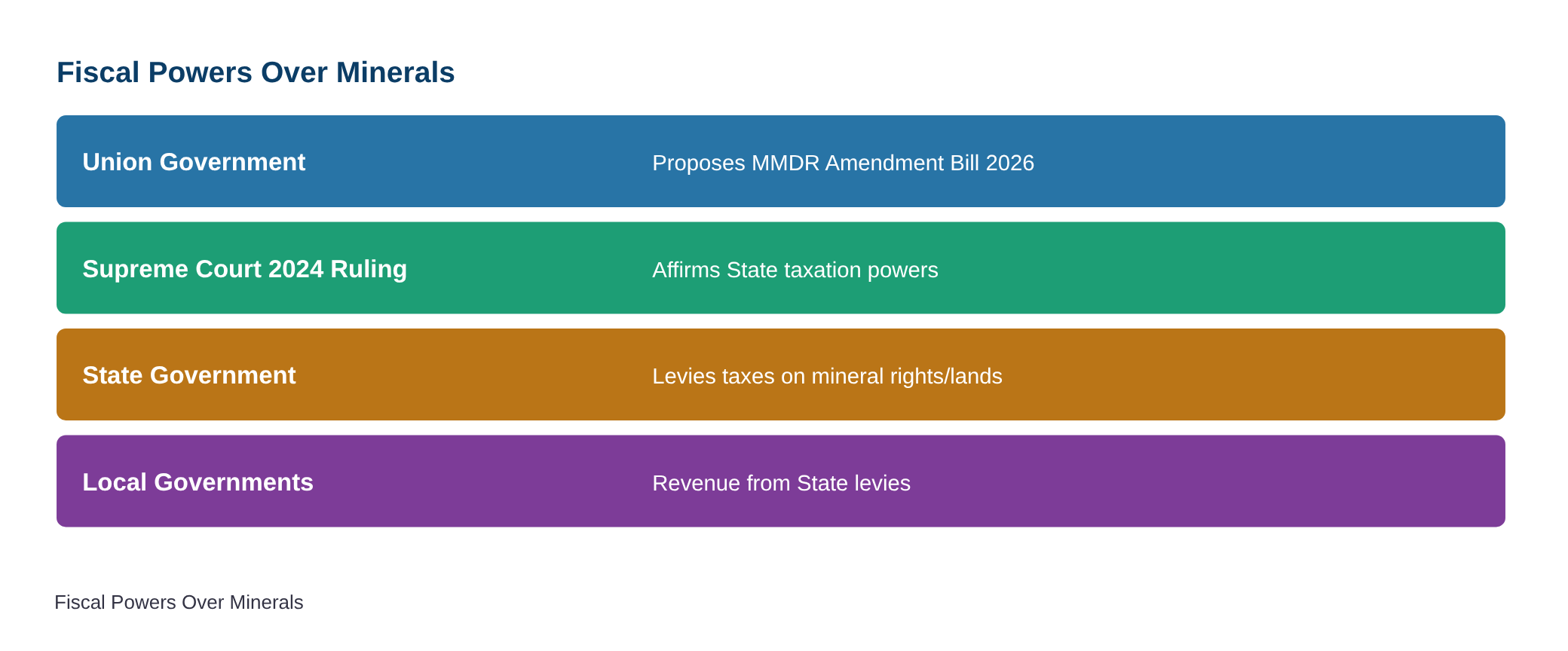
- The Supreme Court, in its 2024 judgment, affirmed the competence of State governments to levy taxes on mineral rights and mineral-bearing lands under Entry 50 and Entry 49 of List II, respectively.
- Kerala, with significant mineral-bearing areas such as the Chavara coastal belt, has historically relied on revenue from mineral taxation to fund local development and environmental conservation.
- The proposed amendments in the MMDR Amendment Bill, 2026, seek to restrict State taxation powers over mineral rights and mineral-bearing lands, citing the need for a nationally coherent policy.
What is the Mines and Minerals (Development and Regulation) Amendment Bill, 2026?
- The Bill amends the MMDR Act, 1957, to introduce provisions that restrict the ability of State governments to impose taxes, cess, or other levies on mineral rights and mineral-bearing lands, except as prescribed by the Union government.
- Section 9D of the Bill explicitly limits State taxation powers over mineral rights and mineral-bearing lands, potentially overriding existing State levies.
- The Bill seeks to bring mineral-bearing lands under the ambit of Union government regulation, centralising control over mineral development and revenue generation.
- The amendments invalidate certain past State levies that remain uncollected or unpaid, raising concerns about retrospective application and fiscal autonomy.
- The Bill aims to create a predictable environment for investment in the mineral sector by standardising levy structures across States, though this may come at the cost of State fiscal independence.
- The provisions are framed within the broader objective of sustainable mineral development and prevention of excessive or arbitrary levies by States.
- The Bill reflects a shift towards greater Union oversight in mineral governance, which may impact the federal balance envisaged by the Constitution.
Key Features
| Feature | Significance |
|---|---|
| Restriction on State taxation powers (Section 9D) | Prohibits States from imposing taxes, cesses, or levies on mineral rights and mineral-bearing lands beyond Union-prescribed parameters, altering the federal fiscal balance. |
| Invalidity of past State levies | Renders certain uncollected or unpaid State levies on mineral-bearing lands unenforceable, potentially reducing State revenue streams. |
| Union regulation of mineral-bearing lands | Expands Union oversight over mineral-bearing lands, shifting regulatory authority from State to Central domains. |
| Constitutional federalism concerns | Raises questions about the erosion of State autonomy in fiscal matters, as taxation powers are circumscribed by Union parameters. |
| Judicial precedent (Supreme Court, 2024) | Affirms State competence to tax mineral rights (Entry 50, List II) and mineral-bearing lands (Entry 49, List II), creating a conflict with the amended Bill. |
Why it Matters
Constitutional and Federal Implications
- The amendments challenge the constitutional division of powers under the Seventh Schedule, particularly Entry 49 (tax on mineral-bearing lands) and Entry 50 (tax on mineral rights) of List II, which vest primary authority in State legislatures.
- The Supreme Court’s 2024 judgment in *State of Tamil Nadu v. Union of India* (or similar) reaffirmed State fiscal autonomy over mineral taxation, creating a legal contradiction with the amended provisions.
- The Bill’s framework may undermine cooperative federalism by centralising regulatory and fiscal control over a State subject, contrary to the spirit of the Constitution.
- The issue exemplifies tensions between Union uniformity in resource governance and State rights over natural resources, a recurring theme in India’s federal structure.
Economic and Fiscal Impact
- States with significant mineral endowments, such as Kerala, risk losing revenue from mineral-bearing lands, including coastal belts rich in heavy minerals (ilmenite, rutile, zircon, etc.).
- Local governments, which often derive revenue from State-imposed levies on mineral-bearing lands, may face reduced fiscal transfers, affecting grassroots development.
- The amendments could deter investment in mineral-rich States by creating uncertainty over the predictability of State levies, despite the Bill’s stated aim of fostering a stable investment environment.
- The restriction on State taxation powers may lead to vertical fiscal imbalances, as States lose autonomy in raising resources for development and welfare schemes.
Environmental and Sustainable Development Concerns
- Centralised regulation of mineral-bearing lands may prioritise Union-led resource exploitation over State-driven sustainable mining practices, potentially conflicting with local environmental priorities.
- The amendments do not explicitly address environmental safeguards or rehabilitation measures, raising concerns about accountability in mineral extraction.
- States may lose leverage to enforce stricter environmental norms through fiscal instruments, such as higher levies on environmentally harmful mining practices.
Legal and Policy Precedents
- The Bill’s provisions conflict with the Supreme Court’s interpretation of State powers under the MMDR Act, necessitating judicial clarification or legislative reconciliation.
- The amendments reflect a broader trend of Union centralisation in resource governance, similar to recent changes in the coal and petroleum sectors.
- The issue highlights the need for a harmonised national policy on mineral taxation that balances Union objectives with State fiscal autonomy.
Challenges
1. Fiscal Autonomy vs. Union Centralisation
- The amendments risk eroding State fiscal autonomy by restricting taxation powers over a State subject, undermining the constitutional balance.
- States may face revenue shortfalls, particularly in mineral-rich regions, affecting their ability to fund development and welfare programmes.
- The Union’s unilateral prescription of tax parameters may disregard local economic conditions and developmental priorities.
UPSC Link: Federalism and Centre-State Relations (GS-II)
2. Legal Contradiction with Judicial Precedents
- The Supreme Court’s 2024 ruling affirmed State competence to tax mineral rights and mineral-bearing lands, creating a direct conflict with the amended Bill.
- The amendments may be challenged in the Supreme Court, leading to prolonged legal uncertainty and policy paralysis.
- The Union’s attempt to override judicial interpretations could set a precedent for further centralisation of State subjects.
UPSC Link: Judicial Review and Constitutional Interpretation (GS-II)
3. Investment Uncertainty and Policy Inconsistency
- The amendments introduce ambiguity over the legality of past State levies, creating uncertainty for investors and State governments alike.
- States may hesitate to enforce existing levies or introduce new ones, fearing legal challenges or Union intervention.
- The lack of consultation with States in framing the amendments may undermine investor confidence in State-level resource governance.
UPSC Link: Investment Climate and Ease of Doing Business (GS-III)
4. Environmental and Local Governance Gaps
- Centralised regulation may dilute State-level environmental safeguards, particularly in ecologically sensitive areas like Kerala’s coastal mineral belts.
- Local governments, which often rely on State-imposed levies for revenue, may face reduced fiscal capacity to address environmental degradation.
- The amendments do not provide a clear mechanism for States to enforce sustainable mining practices through fiscal instruments.
UPSC Link: Environmental Governance and Sustainable Development (GS-III)
5. Horizontal Fiscal Imbalance
- Mineral-rich States like Kerala may bear a disproportionate burden of resource exploitation without commensurate fiscal benefits, exacerbating inter-State disparities.
- States without significant mineral resources may face reduced competition for development funds, further skewing fiscal federalism.
- The amendments could incentivise Union-led resource exploitation over State-driven economic development.
UPSC Link: Fiscal Federalism and Resource Distribution (GS-II)
Challenges — UPSC Perspective
| Issue | Concern |
|---|---|
| Restriction on State taxation powers | Erosion of fiscal autonomy under List II, Entry 49 and 50 of the Seventh Schedule. |
| Conflict with judicial precedents | Supreme Court’s 2024 ruling on State competence to tax mineral rights and lands. |
| Revenue loss for mineral-rich States | Potential reduction in State and local government revenues from mineral levies. |
| Investment uncertainty | Ambiguity over past levies and future taxing powers may deter investors. |
| Environmental governance gaps | Centralisation may weaken State-level environmental safeguards and sustainable mining practices. |
| Horizontal fiscal imbalance | Mineral-rich States may bear costs without commensurate benefits, exacerbating inter-State disparities. |
Way Forward
- Convene a high-level inter-governmental dialogue between the Union and States to reconcile the amendments with constitutional provisions and judicial precedents.
- Amend Section 9D to explicitly recognise State powers under Entry 49 and 50 of List II, while harmonising Union objectives through consultation.
- Establish a joint task force comprising Union and State representatives to review the fiscal and regulatory implications of the amendments.
- Clarify the status of past State levies through a Supreme Court-monitored settlement mechanism to resolve legal ambiguities.
- Incorporate environmental safeguards and sustainable development goals into the Union-prescribed tax parameters to balance revenue and ecological priorities.
- Strengthen State-level institutions for mineral governance to ensure local accountability and compliance with national policies.
- Publish a white paper on the fiscal and developmental impact of the amendments to facilitate informed public discourse and stakeholder engagement.
- Explore constitutional amendments, if necessary, to explicitly delineate Union and State roles in mineral taxation and regulation.
UPSC Value Addition
Keywords for Mains Answer-Writing
Mines and Minerals (Development and Regulation) Amendment Bill 2026 · federalism and cooperative federalism · constitutional division of powers under Seventh Schedule · Entry 50 and Entry 49 of State List · mineral taxation powers of States · royalty vs tax under MMDR Act · Supreme Court judgment on mineral rights taxation (2024) · fiscal autonomy of States · ilmenite, rutile, zircon, sillimanite, garnet, monazite deposits in Keralam · mineral-bearing lands and local government revenues
Constitutional & Policy Linkages
- [‘Article 246’, ‘Division of legislative powers (Seventh Schedule)’]
- [‘Entry 49, List II’, ‘Tax on mineral-bearing lands’]
- [‘Entry 50, List II’, ‘Tax on mineral rights’]
- [‘Article 263’, ‘Coordination between Union and States’]
- [‘Article 280’, ‘Finance Commission and fiscal federalism’]
Concept Flow
Union introduces amendments to the MMDR Act, 2026 restricting State taxation powers over mineral-bearing lands (Section 9D). → States, particularly mineral-rich ones like Kerala, raise concerns over erosion of fiscal autonomy and revenue loss. → Supreme Court’s 2024 judgment affirms State competence to tax mineral rights and lands under Entry 49 and 50 of List II, creating a legal contradiction. → Union’s unilateral prescription of tax parameters challenges the constitutional balance of cooperative federalism. → Potential revenue shortfalls for States and local governments, affecting development and welfare programmes. → Investment uncertainty arises due to ambiguity over past levies and future taxing powers. → Environmental governance gaps emerge as centralisation may dilute State-level sustainable mining practices. → Legal challenges and inter-governmental disputes escalate, necessitating dialogue and policy reconciliation.
Prelims Practice Questions
Q1. Consider the following statements regarding the Mines and Minerals (Development and Regulation) Amendment Bill, 2026:
1. The Bill seeks to restrict the power of State governments to levy taxes on mineral rights and mineral-bearing lands.
2. Section 9D of the Bill empowers State governments to impose taxes on mineral rights without any restrictions.
3. The Supreme Court in 2024 held that royalty payable under the MMDR Act is a tax.
4. The Bill aims to bring mineral-bearing lands under the ambit of Union government regulation.
How many of the above statements are correct?
- Only one
- Only two
- Only three
- All
Answer: Only three — Statements 1 and 4 are correct as the Bill restricts State taxation powers and brings mineral-bearing lands under Union regulation. Statements 2 and 3 are incorrect: Section 9D restricts State powers, and the Supreme Court in 2024 held that royalty is not a tax.
Q2. Assertion (A): The Supreme Court in 2024 affirmed the legislative competence of States to tax mineral rights under Entry 50 of List II.
Reason (R): The MMDR Act, 1957, vests exclusive legislative and executive powers over mineral development with the Union government.
Options:
A. Both A and R are true, and R is the correct explanation of A.
B. Both A and R are true, but R is not the correct explanation of A.
C. A is true, but R is false.
D. A is false, but R is true.
Answer: ? — Assertion (A) is true as the Supreme Court in 2024 upheld State competence under Entry 50. Reason (R) is false because the MMDR Act does not vest exclusive powers with the Union; it is a concurrent subject under the Seventh Schedule.
Q3. Match the following provisions of the Constitution of India with their respective entries in the Seventh Schedule:
Column I (Provision)
1. Taxes on mineral rights
2. Regulation of mines and minerals
3. Taxes on mineral-bearing lands
4. Regulation of trade and commerce in minerals
Column II (Entry in Seventh Schedule)
A. Entry 50 of List II (State List)
B. Entry 49 of List II (State List)
C. Entry 54 of List I (Union List)
D. Entry 26 of List III (Concurrent List)
Options:
1-A, 2-D, 3-B, 4-C
1-A, 2-C, 3-B, 4-D
1-B, 2-C, 3-A, 4-D
1-B, 2-D, 3-A, 4-C
Answer: ? — Taxes on mineral rights fall under Entry 50 of List II (State List), regulation of mines and minerals under Entry 54 of List I (Union List), taxes on mineral-bearing lands under Entry 49 of List II (State List), and regulation of trade and commerce in minerals under Entry 26 of List III (Concurrent List).
Mains Practice Question
✍ Critically examine the constitutional implications of the Mines and Minerals (Development and Regulation) Amendment Bill, 2026, with particular reference to the federal balance envisaged under the Constitution of India. Also, analyse how the Bill may impact the fiscal autonomy of States like Keralam. (15 Marks)
Approach: MODEL-ANSWER SKELETON:
1. Constitutional Framework:
– Seventh Schedule: Entry 50 (State List) – taxes on mineral rights; Entry 49 (State List) – taxes on mineral-bearing lands; Entry 54 (Union List) – regulation of mines and minerals.
– Doctrine of Federalism and Cooperative Federalism: Emphasise the balance between Union and State powers under the Constitution.
2. Key Provisions of the Bill:
– Section 9D: Restricts State taxation powers on mineral rights and mineral-bearing lands, subject to Union-prescribed parameters.
– Invalidates past State levies uncollected or unpaid.
– Brings mineral-bearing lands under Union regulation.
3. Supreme Court Precedent (2024):
– Held that royalty under MMDR Act is not a tax.
– Affirmed State competence under Entry 50 to tax mineral rights.
– Recognised State competence under Entry 49 to tax mineral-bearing lands based on yield or value.
4. Implications for Federal Balance:
– Curtailment of State fiscal autonomy: Discuss the potential erosion of State revenue-raising powers.
– Centralisation of regulatory powers: Analyse the shift towards Union dominance in mineral regulation.
– Impact on cooperative federalism: Examine the strain on Centre-State relations and the principle of subsidiarity.
5. Impact on Keralam:
– Mineral-rich coastal belt (ilmenite, rutile, zircon, sillimanite, garnet, monazite): Discuss potential revenue loss for State and local governments.
– Consequences for sustainable mineral development and investment predictability.
6. Balanced View:
– Acknowledge the need for a coherent national policy for sustainable mineral development and prevention of arbitrary levies.
– Argue for consultation and consensus with States to preserve constitutional federalism.
7. Conclusion:
– Reiterate the importance of maintaining the federal balance as envisaged under the Constitution.
– Suggest a consultative framework for future amendments to uphold cooperative federalism.
Source: The Hindu
Generated by AanyaAi for educational purpose.

- मद्रास उच्च न्यायालय में ‘वेट्ट्री पयणम’ योजना को असंवैधानिक घोषित करने की मांग - October 4, 2026
- Gurugram’s groundwater extraction exceeds limit by 212%; HC seeks ban - October 4, 2026
- स्वतंत्रता सेनानी श्यामजी कृष्ण वर्मा की जन्म जयंती पर पीएम का श्रद्धांजलि - October 4, 2026

No Comments