


08 Aug Kerala Ends Cooperative Bank Pension Delivery, Shifts to DBT for Welfare Schemes
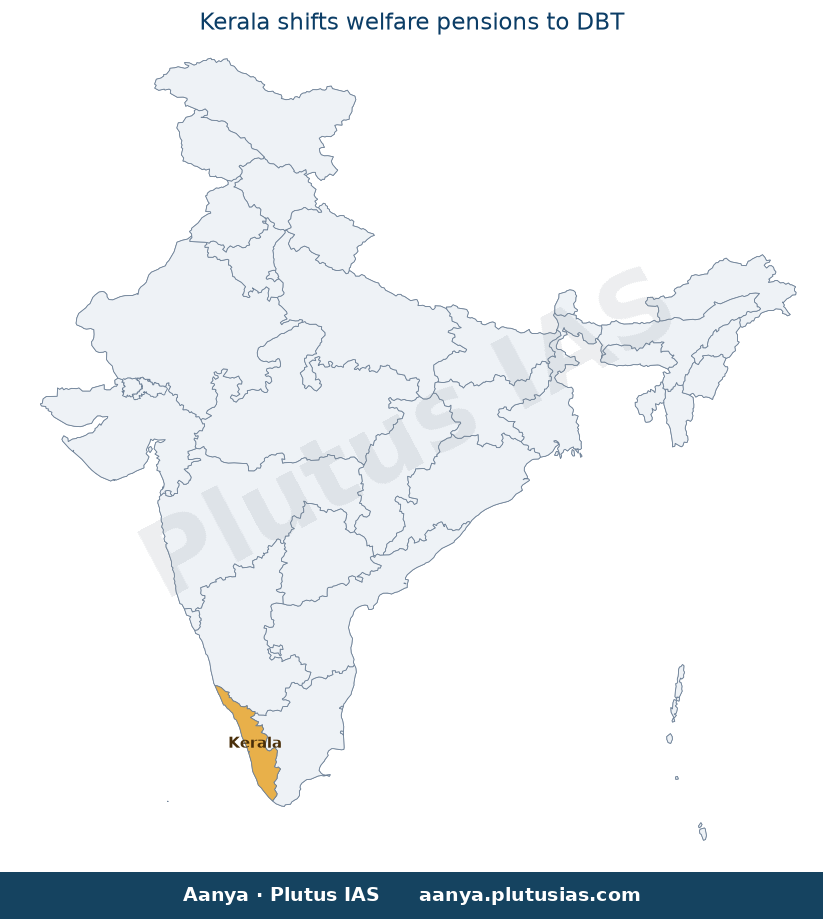
✎ Kerala’s shift to DBT for welfare pensions aims to eliminate intermediaries, reduce leakages, and align with Central norms, while ensuring inclusivity for bedridden beneficiaries through continued doorstep delivery.
Subject Relevance — Where This Topic Fits
- GS Paper II — Governance, Transparency and Accountability | GS Paper III — Issues Relating to Poverty and Human Development
- Prelims: Direct Benefit Transfer (DBT), Aadhaar-enabled Payment System (AePS), Social Security Pensions, Cooperative Banks, Financial Inclusion, Direct Benefit Transfer Mission, Kerala Model of Development, Fiscal Federalism, Public Financial Management
- Essay: The Role of Technology in Public Service Delivery: Balancing Efficiency and Inclusion, Federalism in India: Centre-State Cooperation in Welfare Delivery Systems
Quick Revision: Kerala’s shift to DBT for welfare pensions aims to eliminate intermediaries, reduce leakages, and align with Central norms, while ensuring inclusivity for bedridden beneficiaries through continued doorstep delivery.
Why is this in the news?
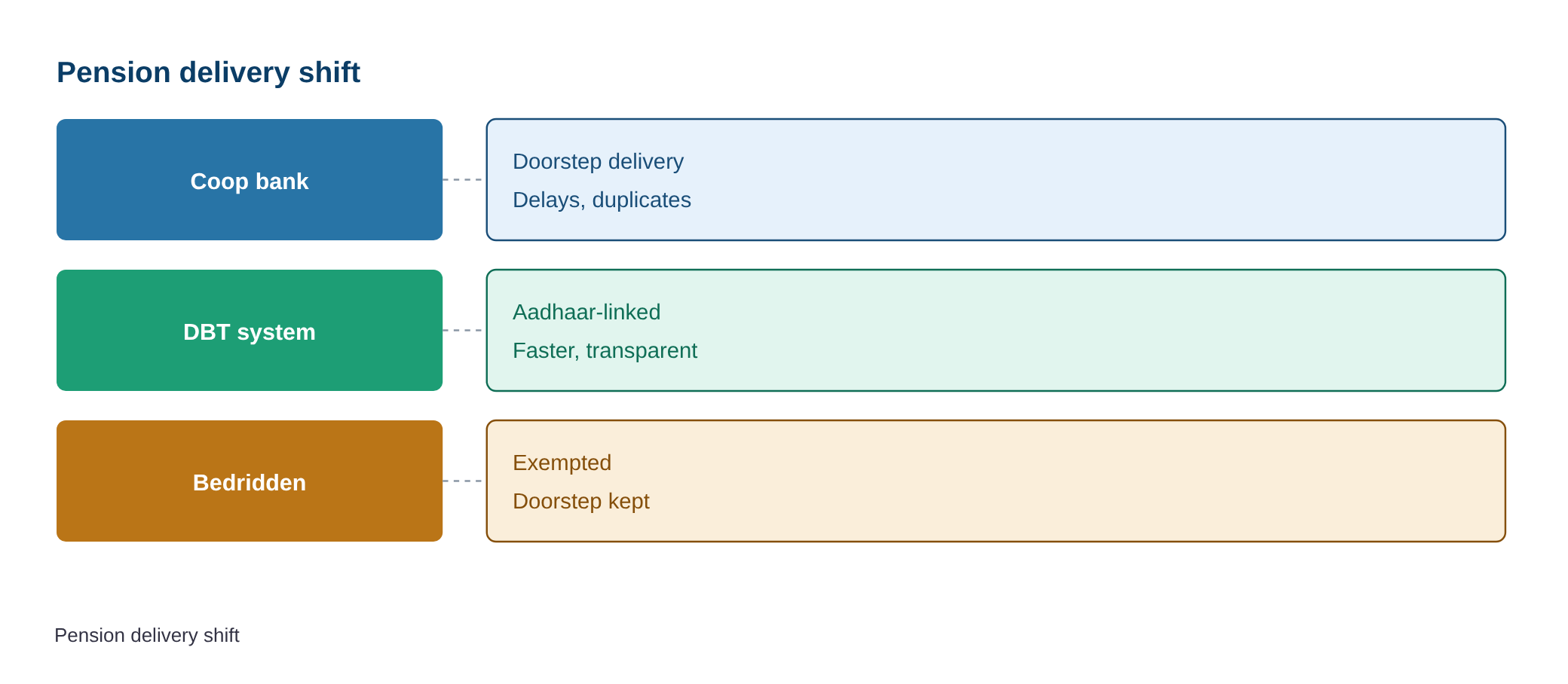
The Kerala government has issued an order to discontinue the distribution of social security and welfare pensions through cooperative banks, transitioning to Direct Benefit Transfer (DBT) to Aadhaar-linked bank accounts. This decision follows persistent issues such as delayed remittances, reconciliation failures, and duplicate payments under the existing cooperative bank-led delivery system. The move also aims to align with Central government norms to avoid potential loss of financial assistance.
Background
- Kerala has historically relied on cooperative banks for the doorstep delivery of welfare pensions, a system established to ensure last-mile connectivity in a state with high rural penetration of cooperative institutions.
- The existing model involved cooperative banks receiving incentives for doorstep delivery, which has been criticised for inefficiencies, including delays in fund disbursement and reconciliation discrepancies.
- Reports of duplicate payments, failure to update beneficiary records, and non-compliance with Aadhaar-based payment norms prompted a review of the system by the Kerala government.
- The Finance Department’s in-principle approval for DBT-based disbursement reflects a broader shift towards digital governance and financial inclusion in public welfare delivery.
- The decision aligns with the Central government’s Direct Benefit Transfer Mission, which aims to reduce leakages and improve transparency in welfare fund disbursement.
- Exemptions for bedridden beneficiaries underscore the government’s commitment to inclusivity, recognising that technological solutions may not be universally accessible.
What is Direct Benefit Transfer (DBT) in the context of welfare pensions?
- DBT is a mechanism where welfare benefits are transferred directly from the government to the beneficiary’s bank account, eliminating intermediaries like cooperative banks to reduce delays and leakages.
- In Kerala’s new system, pensions will be credited to Aadhaar-linked bank accounts, ensuring unique identification and reducing the risk of duplicate or erroneous payments.
- The transition to DBT is part of a broader national initiative under the DBT Mission, launched in 2013, to reform subsidy and welfare fund disbursement across India.
- DBT leverages the Aadhaar-enabled Payment System (AePS), which allows biometric authentication for seamless fund transfers, particularly in rural and remote areas.
- The system is designed to enhance transparency by enabling real-time tracking of transactions and beneficiary status, thereby improving accountability in public expenditure.
- Kerala’s move reflects a global trend where governments adopt digital payment systems to improve efficiency, reduce corruption, and enhance citizen trust in welfare programmes.
- The decision also addresses fiscal concerns, as the existing cooperative bank-led model incurred additional costs in the form of incentives for doorstep delivery.
- However, the shift requires robust digital infrastructure, including widespread Aadhaar seeding of bank accounts and functional grievance redressal mechanisms to handle exceptions.
Key Features
| Feature | Significance |
|---|---|
| Direct Benefit Transfer (DBT) to Aadhaar-linked accounts | Ensures direct, transparent, and leakage-proof transfer of welfare funds, eliminating intermediaries like cooperative banks. |
| Mandatory Aadhaar seeding | Facilitates unique identification, reduces duplication, and prevents ghost beneficiaries in welfare schemes. |
| Exclusion of bedridden beneficiaries | Balances efficiency with inclusivity by maintaining doorstep delivery for vulnerable groups unable to access bank accounts. |
| In-principle approval from Finance Department | Signals formal commitment to systemic reform and adherence to central DBT norms. |
| Incentive payments to cooperative banks discontinued | Reduces fiscal burden on the state and aligns with the principle of direct fund flow to beneficiaries. |
Why it Matters
Governance and Public Finance
- Enhances fiscal discipline by reducing transaction costs and eliminating intermediary commissions paid to cooperative banks.
- Strengthens the Direct Benefit Transfer architecture, aligning with the Centre’s push for Aadhaar-enabled welfare delivery.
- Improves transparency in pension disbursement, reducing leakages and reconciliation discrepancies reported under the cooperative bank model.
Social Justice and Inclusivity
- Ensures equitable access to welfare pensions by leveraging Aadhaar-linked bank accounts, particularly for marginalised sections.
- Maintains inclusivity for bedridden beneficiaries through continued doorstep delivery, addressing accessibility concerns.
- Reduces delays in pension disbursement, thereby supporting the economic security of vulnerable populations such as elderly and disabled individuals.
Administrative Efficiency
- Simplifies the pension delivery mechanism by centralising disbursement through a single platform (DBT), reducing administrative overheads.
- Mitigates risks of duplicate payments and record-keeping errors, which were prevalent in the cooperative bank-based system.
- Facilitates real-time monitoring and grievance redressal through digital tracking of transactions.
Federal and Policy Alignment
- Aligns with the Union Government’s DBT directives, ensuring compliance with central norms to avoid loss of financial assistance.
- Demonstrates Kerala’s commitment to adopting best practices in welfare delivery, setting a precedent for other states.
- Reflects a shift from decentralised (cooperative bank) to centralised (DBT) welfare distribution, enhancing scalability and uniformity.
Challenges
1. Digital Divide and Financial Exclusion
- Risk of exclusion for beneficiaries without Aadhaar-linked bank accounts, particularly in rural and tribal areas.
- Potential difficulties in accessing funds for elderly or differently-abled individuals unfamiliar with digital banking.
- Need for robust grievance redressal mechanisms to address issues such as failed transactions or account seeding errors.
UPSC Link: GS-II: Welfare schemes
2. Operational and Logistical Hurdles
- Ensuring seamless transition from cooperative banks to DBT without disrupting pension disbursements during the interim period.
- Addressing the loss of employment for cooperative bank employees engaged in doorstep delivery of pensions.
- Managing the administrative burden of updating beneficiary records and resolving discrepancies in Aadhaar seeding.
UPSC Link: GS-II: Governance
3. Data Privacy and Security Concerns
- Safeguarding Aadhaar-linked financial data from cyber threats and unauthorised access.
- Ensuring compliance with the Personal Data Protection Bill (once enacted) and other privacy regulations.
- Preventing misuse of beneficiary data by third parties or intermediaries in the DBT ecosystem.
UPSC Link: GS-II: Governance
4. Resistance from Stakeholders
- Potential pushback from cooperative banks and their employees over loss of revenue and employment.
- Political opposition to reforms perceived as undermining cooperative sector institutions.
- Need for stakeholder consultations to build consensus and ensure smooth implementation.
UPSC Link: GS-II: Cooperative societies
Challenges — UPSC Perspective
| Issue | Concern |
|---|---|
| Exclusion of beneficiaries without Aadhaar-linked accounts | Risk of financial exclusion for vulnerable groups lacking access to banking infrastructure. |
| Transition disruptions in pension disbursement | Potential delays or gaps in payments during the shift from cooperative banks to DBT. |
| Cybersecurity risks in Aadhaar-linked transactions | Vulnerability to data breaches or fraud in digital welfare delivery. |
| Loss of employment for cooperative bank employees | Social and economic impact on workers displaced by the reform. |
| Grievance redressal for failed transactions | Need for efficient mechanisms to resolve issues such as failed Aadhaar authentication or bank account mismatches. |
| Political and institutional resistance | Opposition from cooperative sectors or political entities opposing the reform. |
Way Forward
- Conduct targeted Aadhaar seeding and bank account opening drives in rural and tribal areas to minimise exclusion risks.
- Establish a dedicated helpline and grievance redressal portal for beneficiaries to report issues in DBT transactions.
- Phase out the cooperative bank model gradually, ensuring no disruption in pension disbursements during the transition.
- Provide digital literacy and banking awareness programmes for elderly and differently-abled beneficiaries.
- Strengthen cybersecurity protocols for Aadhaar-linked transactions to prevent data breaches and fraud.
- Engage with cooperative banks and their employees to explore alternative livelihood opportunities within the welfare ecosystem.
- Monitor and evaluate the impact of DBT implementation through periodic audits and beneficiary feedback surveys.
- Align state-level reforms with central DBT guidelines to ensure compliance and avoid loss of financial assistance.
UPSC Value Addition
Keywords for Mains Answer-Writing
Direct Benefit Transfer (DBT) · Aadhaar-linked payments · cooperative banks · welfare pensions · Direct Benefit Transfer Mission · Aadhaar Enabled Payment System (AEPS) · Social Security Pensions · Direct Benefit Transfer Architecture · financial inclusion · financial intermediaries · public financial management · Kerala Public Finance · Aadhaar seeding · subsidies and welfare delivery · financial governance reforms
Concept Flow
Kerala’s existing pension delivery system via cooperative banks faced delays, reconciliation issues, and leakage risks. → State reviews the system and identifies non-compliance with central DBT norms, risking loss of financial assistance. → Government issues order mandating DBT to Aadhaar-linked accounts for all beneficiaries except bedridden patients. → Cooperative banks’ role in doorstep delivery is phased out, except for vulnerable groups requiring continued support. → DBT system is implemented, reducing intermediaries, improving transparency, and aligning with central welfare delivery norms. → State monitors transition, addresses exclusions, and ensures seamless pension disbursement to all eligible beneficiaries.
Prelims Practice Questions
Q1. Consider the following statements regarding the Direct Benefit Transfer (DBT) system in India:
1. DBT aims to transfer subsidies and welfare benefits directly to the bank accounts of beneficiaries.
2. The Aadhaar Enabled Payment System (AEPS) is a prerequisite for all DBT transactions.
3. Cooperative banks are the primary agencies for DBT disbursements under the DBT Mission.
4. The DBT Mission is administered by the Ministry of Finance.
How many of the above statements are correct?
- Only one
- Only two
- Only three
- All
Answer: Only three — Statements 1 and 4 are correct. Statement 2 is incorrect because AEPS is one of the modes but not a prerequisite for all DBT transactions. Statement 3 is incorrect as cooperative banks are not the primary agencies for DBT disbursements; they are being phased out in Kerala for welfare pension delivery.
Q2. Assertion (A): The Kerala government’s decision to shift welfare pension delivery from cooperative banks to Direct Benefit Transfer (DBT) aligns with the central government’s DBT Mission objectives.
Reason (R): DBT ensures timely, transparent, and leakage-free delivery of welfare benefits by reducing intermediaries and using Aadhaar-linked bank accounts.
Options:
A. Both A and R are true, and R is the correct explanation of A.
B. Both A and R are true, but R is not the correct explanation of A.
C. A is true, but R is false.
D. A is false, but R is true.
Answer: ? — Both the assertion and reason are true. The Kerala government’s decision to shift to DBT for welfare pensions is consistent with the central government’s DBT Mission, which aims to ensure timely, transparent, and leakage-free delivery of welfare benefits by reducing intermediaries and using Aadhaar-linked bank accounts. The reason correctly explains the assertion.
Mains Practice Question
✍ In recent times, several Indian states have transitioned from physical cash delivery or intermediary-based systems to Direct Benefit Transfer (DBT) for welfare disbursements. Critically examine the rationale behind Kerala’s decision to shift welfare pension delivery from cooperative banks to DBT. Also, analyse the potential challenges in implementing DBT in a state with diverse socio-economic groups. (15 Marks)
Approach: MODEL-ANSWER SKELETON:
1. **Introduction (2 marks)**
– Briefly define DBT and its objectives as per the DBT Mission (2013) under the Ministry of Finance.
– State Kerala’s decision to shift from cooperative banks to DBT for welfare pensions, citing the order dated August 7, 2026.
2. **Rationale for the Shift (5 marks)**
– **Transparency and Leakage Reduction**: Highlight issues of delays, incomplete records, and duplicate payments in the cooperative bank system.
– **Financial Efficiency**: Mention the reduction in incentive payments to cooperative banks and alignment with central DBT norms to avoid loss of financial assistance.
– **Aadhaar Integration**: Emphasise the role of Aadhaar-linked bank accounts in ensuring accurate beneficiary identification and reducing fraud.
– **Financial Inclusion**: Note that DBT leverages the JAM trinity (Jan Dhan, Aadhaar, Mobile) to reach marginalised groups.
– **Central Government Compliance**: Reference the need to comply with DBT norms to access central financial assistance.
3. **Potential Challenges in Implementation (6 marks)**
– **Digital Divide**: Discuss the exclusion of elderly, bedridden, or technologically disadvantaged beneficiaries who may struggle with Aadhaar-linked transactions.
– **Banking Infrastructure**: Highlight gaps in banking penetration in rural and tribal areas of Kerala.
– **Aadhaar Seeding Issues**: Address challenges in Aadhaar seeding for marginalised groups (e.g., tribals, migrants).
– **Last-Mile Delivery**: Examine the need for doorstep delivery for bedridden beneficiaries and the logistical challenges in ensuring continuity.
– **Data Privacy and Security**: Discuss concerns related to Aadhaar-linked financial transactions and cybersecurity risks.
– **Monitoring and Grievance Redressal**: Highlight the need for robust grievance mechanisms to address beneficiary complaints.
4. **Conclusion (2 marks)**
– Summarise the transformative potential of DBT in improving welfare delivery while acknowledging the need for inclusive implementation.
– Suggest measures such as strengthening last-mile delivery systems, digital literacy campaigns, and multi-modal grievance redressal mechanisms.
Source: The Hindu
Generated by AanyaAi for educational purpose.

- आपातकाल में ‘गायब’ शाह आयोग रिपोर्ट का रहस्यमयी पुनर्प्राप्ति - September 23, 2026
- What happened to the Shah Commission report on Emergency? UPSC analysis - September 23, 2026
- तमिलनाडु के लिए क्या है ‘एल नीनो’ और उत्तर-पूर्वी मानसून का खतरा? - September 23, 2026

No Comments