


01 Sep Kerala Excise Scandal: Vigilance Probe Against Suspended Officials by September-End
✎ The Prevention of Corruption Act, 1988, and the Kerala Vigilance Commission are the primary institutional mechanisms for investigating corruption in the state, while the Kerala Abkari Act governs liquor regulation and enforcement.
Subject Relevance — Where This Topic Fits
- GS Paper II — Governance, Transparency and Accountability | GS Paper III — Issues relating to Liquor Policy, Public Health, and Law Enforcement
- Prelims: Prevention of Corruption Act, 1988, Vigilance Commission, Liquor Policy, Operation Bijapur, Proportionality Doctrine in Corruption Cases, Excise Department Functions, Low-Alcohol Beverages Regulation, Disproportionate Assets Under PC Act
- Essay: Governance and Ethical Conduct in Public Administration, Balancing Public Health and Economic Interests in Policy Formulation
Quick Revision: The Prevention of Corruption Act, 1988, and the Kerala Vigilance Commission are the primary institutional mechanisms for investigating corruption in the state, while the Kerala Abkari Act governs liquor regulation and enforcement.
Why is this in the news?
The Kerala Excise Minister’s announcement of a Vigilance inquiry against suspended Excise officials under the Prevention of Corruption Act, alongside the impending formulation of a new liquor policy by September-end, underscores the state’s commitment to administrative accountability, corruption control, and evidence-based policy reform in the liquor sector. This development is significant as it integrates enforcement vigilance with policy recalibration, addressing both systemic malfeasance and public health concerns in alcohol regulation.
Background
- The Prevention of Corruption Act, 1988, is the primary legislation governing corruption in India, including disproportionate asset cases and bribery.
- Kerala’s Excise Department is responsible for regulating liquor trade, licensing, and enforcement of liquor laws under the Kerala Abkari Act, 1077 (Amended).
- Operation Bijapur was initiated in Kerala following whistleblower inputs and independent reports alleging violations by licensed establishments and potential misconduct within the enforcement system in Kottayam district.
- The existing liquor policy in Kerala has been criticised for inconsistencies in enforcement, rising instances of illegal liquor sales, and inadequate mechanisms to curb corruption in the department.
- Kerala has historically adopted progressive public health policies, including restrictions on alcohol availability, to address alcohol-related harms, as reflected in earlier liquor policies.
- The state government’s emphasis on modernising the Excise Department aligns with broader administrative reforms aimed at enhancing transparency and efficiency in governance.
What is the legal and administrative framework governing liquor policy and corruption control in Kerala?
- The Prevention of Corruption Act, 1988, empowers vigilance authorities to investigate allegations of disproportionate assets, bribery, and abuse of official position, with penalties including imprisonment and fines.
- The Kerala Abkari Act, 1077 (Amended), governs the regulation, licensing, and sale of liquor in the state, including provisions for suspension and cancellation of licenses for violations.
- Operation Bijapur represents an enforcement initiative by the Excise Department to curb illegal liquor sales, enforce licensing norms, and investigate potential collusion between officials and licensees.
- The proposed new liquor policy aims to address gaps in the existing framework by incorporating stakeholder consultations, evidence-based reforms, and public health considerations.
- Modernisation of the Excise Department includes proposals for enhanced tracking mechanisms, inter-departmental coordination (e.g., with police for drug interdiction), and digitalisation of licensing and enforcement processes.
- The government’s stance against increasing the number of bars reflects a public health-oriented approach, prioritising harm reduction over commercial expansion.
Challenges
1. Systemic Corruption in Enforcement Agencies
- Corruption within enforcement agencies undermines the integrity of the Excise Department and erodes public trust in governance.
- The need for vigilance against collusion between officials and licenced establishments poses a persistent challenge.
- Addressing this requires robust internal audits, whistleblower protections, and periodic capacity-building programs.
UPSC Link: GS2: Role of Civil Services in a Democracy
2. Balancing Revenue and Public Health
- The liquor policy must reconcile revenue generation with public health objectives, particularly in a state with high alcohol consumption rates.
- The policy’s stance against increasing bars may face resistance from stakeholders advocating for economic growth.
- Ensuring compliance with the WHO’s alcohol harm reduction guidelines while maintaining fiscal sustainability is a critical challenge.
UPSC Link: GS2: Government Policies and Interventions
3. Technological Integration in Governance
- Modernising the Excise Department requires significant investment in technology and training for officials.
- Data privacy and cybersecurity concerns must be addressed when implementing GPS tracking and digital surveillance.
- Inter-departmental coordination between the Excise Department, Police, and Revenue authorities is essential for effective enforcement.
UPSC Link: GS3: Science and Technology in Governance
4. Stakeholder Engagement and Policy Legitimacy
- Balancing the interests of bar owners, workers, social organisations, and anti-liquor activists is complex and requires inclusive consultations.
- Policy legitimacy is enhanced when stakeholders perceive the process as transparent and participatory.
- The government must address concerns about arbitrary enforcement and ensure consistency in policy application.
UPSC Link: GS2: Pressure Groups and Formal/Informal Associations
5. Addressing Illicit Liquor Trade and Drug Networks
- The Excise Department’s limited powers in tracking illicit activities necessitate collaboration with other agencies, such as the Narcotics Control Bureau.
- The rise of drug gangs and their nexus with liquor trade poses a multi-dimensional challenge requiring inter-agency coordination.
- Effective enforcement requires intelligence-sharing mechanisms and proactive surveillance.
UPSC Link: GS3: Security Challenges and Their Management
6. Public Perception and Social Norms
- Public attitudes toward alcohol consumption and enforcement actions can influence policy effectiveness.
- The government must address perceptions of hypocrisy, such as permitting legal sales while cracking down on illegal activities.
- Social stigma associated with alcohol consumption may deter reporting of violations, complicating enforcement.
UPSC Link: GS4: Ethics and Human Interface
Challenges — UPSC Perspective
| Issue | Concern |
|---|---|
| Corruption within enforcement agencies | Undermines institutional integrity and public trust in governance. |
| Balancing revenue and public health objectives | Requires careful policy design to avoid economic or health trade-offs. |
| Technological integration in governance | Demands investment, training, and addressing data privacy concerns. |
| Stakeholder engagement in policy-making | Necessitates inclusive consultations to ensure legitimacy and compliance. |
| Illicit liquor trade and drug networks | Requires inter-agency coordination and proactive surveillance. |
| Public perception and social norms | Influences enforcement effectiveness and policy acceptance. |
Government Initiatives — Must-Memorise for Prelims
- Kerala Abkari Act, 1077 (Amended)
- Prevention of Corruption Act, 1988
- Kerala Public Servants (Inquiries) Act, 1960
- Lokpal and Lokayuktas Act, 2013
Way Forward
- Conduct a comprehensive audit of the Excise Department’s enforcement mechanisms to identify systemic vulnerabilities and propose corrective measures.
- Strengthen whistleblower protections under the Whistle Blower Protection Act, 2014, to encourage reporting of corruption and violations.
- Develop a multi-agency task force, including the Excise Department, Police, and Revenue authorities, to address the nexus between liquor trade and drug networks.
- Implement a phased modernisation plan for the Excise Department, focusing on digital surveillance, data analytics, and capacity-building for officials.
- Formulate the new liquor policy through structured stakeholder consultations, ensuring representation from bar owners, workers, health experts, and anti-liquor activists.
- Enhance public awareness campaigns to educate citizens on the harms of illicit liquor and the consequences of violations, fostering a culture of compliance.
- Establish a grievance redressal mechanism for licenced establishments to report arbitrary enforcement and seek timely resolution.
- Monitor the impact of the new liquor policy on revenue generation, public health outcomes, and social order, with periodic reviews and adjustments.
UPSC Value Addition
Keywords for Mains Answer-Writing
Prevention of Corruption Act, 1988 · Vigilance inquiry under the Lokpal and Lokayukta Act · Proportionality doctrine in disproportionate assets cases · Constitutional provisions on corruption and probity · Role of State Vigilance Commissions · Administrative reforms in Excise departments · Policy-making under the Seventh Schedule · Zero tolerance policy against corruption · Modernisation of law enforcement agencies · Inter-state coordination in excise enforcement
Constitutional & Policy Linkages
- Article 309: Services under the Union and the States (Governance of civil services)
Concept Flow
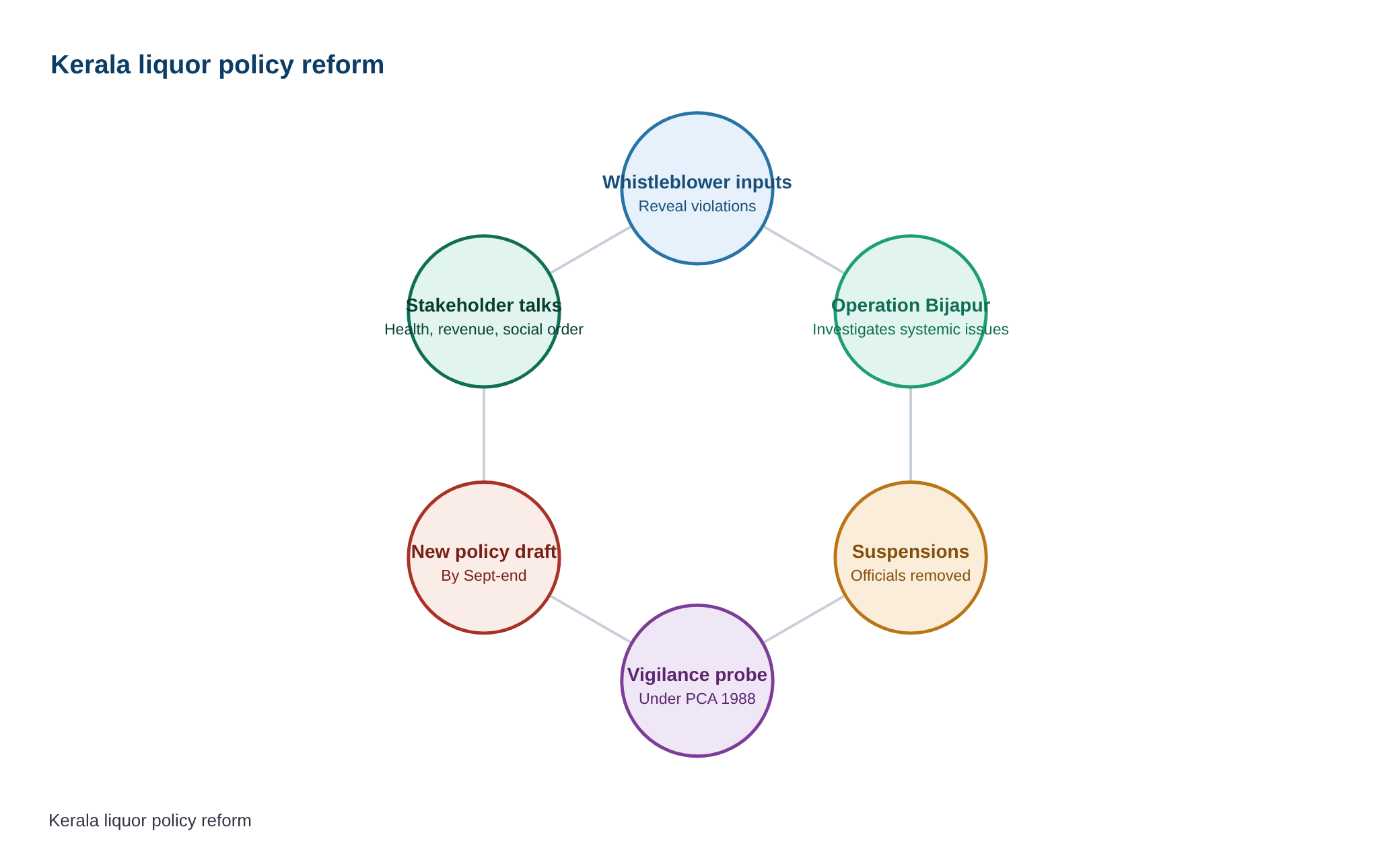
Whistleblower inputs and independent investigations → Detection of corruption in Excise Department → Suspension of officials under Kerala Public Servants (Inquiries) Act, 1960 → Recommendation for Vigilance probe under Prevention of Corruption Act, 1988 → Operation Bijapur identifies systemic violations → Government announces zero-tolerance policy → Modernisation of Excise Department proposed → Enhanced powers sought for tracking illicit activities → New liquor policy drafted by September-end → Stakeholder consultations with bar owners, workers, health experts, and anti-liquor activists → Policy balances revenue, public health, and social order → Decision on low-alcohol beverages deferred for expert opinion → Enforcement actions against illegal activities → Public perception of hypocrisy or selective enforcement → Need for transparent and consistent policy application → Grievance redressal mechanisms for stakeholders → Illicit liquor trade and drug networks → Collaboration between Excise Department, Police, and Revenue authorities → Technological integration for surveillance → Inter-agency task force for coordinated enforcement
Prelims Practice Questions
Q1. Consider the following statements regarding the Prevention of Corruption Act, 1988:
1. It applies to all public servants including those in the State Excise Department.
2. The Act mandates a Vigilance inquiry only upon receipt of a formal complaint from a citizen.
3. The Act provides for attachment of property acquired disproportionately to known sources of income.
4. The Act is administered by the Central Vigilance Commission (CVC) exclusively.
How many of the above statements are correct?
- Only one
- Only two
- Only three
- All four
Answer: Only three — Statements 1 and 3 are correct under Sections 2(c) and 13(1)(e) of the Act. Statement 2 is incorrect as vigilance inquiries can be initiated suo motu or on the basis of whistleblower inputs. Statement 4 is incorrect as the Act is administered by both the CVC and State Vigilance Commissions.
Q2. Assertion (A): The Seventh Schedule of the Constitution vests the subject of ‘intoxicating liquors’ in the State List.
Reason (R): The power to regulate the manufacture, sale, and consumption of liquor is exclusively exercised by the Union Government under Entry 84 of the Union List.
Options:
A. Both A and R are true, and R is the correct explanation of A.
B. Both A and R are true, but R is not the correct explanation of A.
C. A is true, but R is false.
D. A is false, but R is true.
- A
- B
- C
- D
Answer: C — Assertion (A) is correct as ‘intoxicating liquors’ is under the State List (Entry 8). Reason (R) is incorrect because Entry 84 of the Union List pertains to duties of excise on tobacco and other goods manufactured or produced in India, not liquor regulation.
Q3. Which of the following is NOT a function of the State Vigilance Commission under the Lokpal and Lokayukta Act, 2013?
A. Conducting preliminary inquiry into allegations of corruption against public servants.
B. Recommending disciplinary action against public servants.
C. Investigating cases referred by the Lokpal.
D. Framing policies for the prevention of corruption in government departments.
- A
- B
- C
- D
Answer: D — The State Vigilance Commission does not investigate cases referred by the Lokpal (which is a function of the Lokpal itself under Section 11). Its functions include preliminary inquiry, recommending disciplinary action, and advising on anti-corruption measures.
Mains Practice Question
✍ The Constitution of India mandates a high standard of probity and integrity for all public servants. In light of the recent Vigilance inquiry initiated against suspended Excise officials in Keralam under the Prevention of Corruption Act, critically examine the legal and institutional framework governing corruption in India. How does this framework balance the need for accountability with the protection of civil liberties? (15 Marks)
Approach: MODEL-ANSWER SKELETON:
1. Constitutional foundations: Art. 311(2) (dismissal/removal of public servants), Art. 324 (Election Commission’s role in ensuring probity), and the doctrine of ‘proportionality’ in disproportionate assets cases (State of Punjab v. Major Singh, 1966).
2. Statutory framework: Prevention of Corruption Act, 1988 (Sections 7-13 on criminal misconduct), Lokpal and Lokayukta Act, 2013 (powers of State Vigilance Commissions), and the Whistleblower Protection Act, 2014.
3. Institutional mechanisms: Role of the Central Vigilance Commission (CVC), State Vigilance Commissions, and the judiciary in ensuring due process (e.g., Vineet Narain v. Union of India, 1998).
4. Balancing accountability and civil liberties: The need for fair investigation (Art. 21: right to reputation), the principle of ‘innocent until proven guilty,’ and safeguards against false accusations (e.g., Section 182 IPC for false complaints).
5. Contemporary challenges: Whistleblower intimidation, delays in inquiries, and the role of digital evidence in corruption cases.
6. Conclude with a balanced view: The framework is robust but requires timely implementation and judicial oversight to prevent misuse.
Source: The Hindu
Generated by AanyaAi for educational purpose.
Related guides on our sites
- Best PSIR optional coaching for upsc
- Best PSIR optional teacher for upsc
- Best teacher of PSIR optional for upsc
- Best PSIR optional coaching in delhi for UPSC

- मद्रास उच्च न्यायालय में ‘वेट्ट्री पयणम’ योजना को असंवैधानिक घोषित करने की मांग - October 4, 2026
- Gurugram’s groundwater extraction exceeds limit by 212%; HC seeks ban - October 4, 2026
- स्वतंत्रता सेनानी श्यामजी कृष्ण वर्मा की जन्म जयंती पर पीएम का श्रद्धांजलि - October 4, 2026

No Comments