


22 Sep Kerala forms expert panel to streamline wildlife conflict compensation guidelines
✎ The Government of Keralam has constituted an expert committee, led by the Chief Wildlife Warden, to formulate uniform guidelines for compensating victims of human-wildlife conflict, aiming to streamline administrative processes…
Subject Relevance — Where This Topic Fits
- GS Paper III — Environment, Ecology, Biodiversity and Climate Change | GS Paper II — Governance, Transparency and Accountability
- Prelims: Human-Wildlife Conflict (HWC), Compensation for Wildlife Attacks, Wildlife Protection Act, 1972, Chief Wildlife Warden, Kerala State Disaster Management Authority, Revenue and Forest Department Jurisdiction
- Essay: Balancing Development and Environmental Conservation: The Imperative of Institutional Frameworks in Human-Wildlife Conflict Mitigation
Quick Revision: The Government of Keralam has constituted an expert committee, led by the Chief Wildlife Warden, to formulate uniform guidelines for compensating victims of human-wildlife conflict, aiming to streamline administrative processes and eliminate delays in relief disbursement.
Why is this in the news?
The constitution of an expert committee by the Government of Keralam to formulate uniform guidelines for compensating victims of human-wildlife conflict represents a significant governance reform aimed at streamlining administrative processes, reducing delays, and addressing systemic ambiguities in compensation disbursement. This initiative is particularly noteworthy as it seeks to resolve jurisdictional disputes between the Forest and Revenue departments and eliminate the need for ad hoc Cabinet interventions, thereby enhancing transparency and predictability in relief mechanisms.
Background
- Human-wildlife conflict (HWC) is a growing challenge in India, exacerbated by habitat fragmentation, encroachment into wildlife corridors, and increasing human settlements adjacent to protected areas.
- Keralam, with its dense forests and high human population density, has witnessed a rise in HWC incidents, particularly involving elephants, tigers, and wild boars, leading to loss of life, livelihoods, and property.
- Existing compensation mechanisms in Keralam have been criticised for their ad hoc nature, with delays in disbursement and disputes over eligibility criteria, often requiring individual Cabinet approvals.
- The absence of a standardised framework has resulted in inconsistencies in compensation amounts, prolonged administrative processes, and public dissatisfaction, particularly in affected rural and tribal communities.
- The committee’s formation is part of the UDF government’s 100-day action plan, reflecting a governance-driven approach to addressing long-standing administrative inefficiencies.
What are the Key Features of Keralam’s Expert Committee for HWC Compensation Guidelines?
- The committee is headed by the Chief Wildlife Warden of Keralam, underscoring the primacy of wildlife conservation and legal frameworks in the compensation process.
- The panel includes representatives from the Kerala State Disaster Management Authority, the Land Revenue Commissioner, the Director of Animal Husbandry, and the Director of Agriculture, ensuring inter-departmental coordination and technical expertise.
- The primary objective is to develop a uniform set of guidelines for assessing compensation claims, including criteria for determining eligibility, injury severity, and causality in HWC incidents.
- The guidelines aim to eliminate case-by-case administrative deliberations, reducing delays in disbursement and ensuring timely relief to affected families.
- The committee will address jurisdictional ambiguities, particularly disputes between the Forest and Revenue departments over land classification (forestland vs. revenue land) in HWC incidents.
- The proposed mechanism seeks to replace ad hoc Cabinet decisions with a standardised, transparent process, thereby enhancing public trust and administrative efficiency.
- The guidelines will likely draw from best practices in other states, such as Tamil Nadu’s ‘Crop Damage Compensation Scheme’ and Karnataka’s ‘Wildlife Conservation Compensation Scheme’, while tailoring them to Keralam’s specific ecological and socio-economic context.
Key Features
| Feature | Significance |
|---|---|
| Expert committee formation | Ensures multi-departmental expertise in addressing human-wildlife conflict compensation, integrating forest, revenue, and disaster management perspectives. |
| Uniform compensation guidelines | Standardises assessment criteria to eliminate ad-hoc administrative decisions, reducing delays in disbursement of relief. |
| Clear jurisdiction delineation | Resolves inter-departmental disputes over forestland vs. revenue land by establishing definitive criteria for incident classification. |
| Timely assistance mechanism | Prioritises rapid relief delivery to victims, addressing current procedural bottlenecks and public grievances. |
| Cabinet decision bypass | Replaces individual Cabinet approvals with a pre-defined framework, expediting compensation processes. |
Why it Matters
Administrative Efficiency
- Streamlines compensation disbursement by replacing case-specific deliberations with a standardised, rule-based mechanism.
- Reduces bureaucratic delays through predefined eligibility and assessment protocols, enhancing governance responsiveness.
- Mitigates inter-departmental conflicts by clarifying jurisdictional roles in human-wildlife conflict incidents.
Economic Impact
- Provides financial security to affected families, particularly marginalised communities dependent on agriculture and forest resources.
- Minimises economic losses from prolonged disputes by ensuring predictable and timely compensation.
- Supports rural livelihoods by addressing the economic burden of human-wildlife conflict, which disproportionately impacts agrarian economies.
Environmental Governance
- Balances conservation imperatives with human welfare by formalising compensation frameworks for wildlife-induced damages.
- Encourages coexistence between human settlements and wildlife habitats through structured conflict resolution mechanisms.
- Strengthens the implementation of the Wildlife Protection Act, 1972, by ensuring systematic redressal of conflict-related grievances.
Social Justice
- Upholds the constitutional directive of equitable relief distribution by standardising compensation criteria across regions and incident types.
- Reduces social unrest and protests in conflict-prone areas by addressing grievances through transparent, uniform processes.
- Promotes inclusive governance by incorporating inputs from disaster management, revenue, and agricultural departments.
Challenges
1. Inter-Departmental Coordination
- Historical turf disputes between Forest and Revenue departments over land classification may persist despite guidelines.
- Requires sustained institutional collaboration to ensure seamless implementation across multiple agencies.
- Risk of delayed operationalisation if inter-departmental consensus-building becomes protracted.
UPSC Link: GS Paper II: Centre-State Relations
2. Standardisation vs. Local Context
- Balancing uniformity with regional variations in wildlife species, habitat density, and socio-economic conditions.
- Ensuring flexibility in guidelines without compromising fairness or creating loopholes for discretionary decisions.
- Potential resistance from local communities if standardised criteria do not adequately reflect ground realities.
UPSC Link: GS Paper III: Environmental Governance
3. Data Deficiencies
- Incomplete or inconsistent documentation of human-wildlife conflict incidents may hinder accurate compensation assessments.
- Lack of real-time reporting mechanisms could delay the identification of eligible beneficiaries.
- Need for robust data-sharing protocols between departments to validate incident claims.
UPSC Link: GS Paper II: Government Policies and Interventions
4. Public Awareness and Accessibility
- Ensuring that affected communities are aware of the new guidelines and their entitlements under the scheme.
- Addressing language barriers and literacy gaps in rural areas to facilitate smooth claim processes.
- Preventing exploitation by middlemen or agents who may misguide applicants regarding eligibility or procedures.
UPSC Link: GS Paper II: Welfare Schemes for Vulnerable Sections
5. Funding Adequacy
- Sustained budgetary allocations required to meet compensation demands, especially in high-conflict zones.
- Risk of fiscal strain if compensation amounts are set too high without corresponding resource mobilisation.
- Need for transparent fund utilisation mechanisms to prevent misappropriation or delays in disbursement.
UPSC Link: GS Paper III: Resource Mobilisation
Challenges — UPSC Perspective
| Issue | Concern |
|---|---|
| Land classification disputes | Forest vs. revenue land determinations may lead to delayed or inequitable compensation. |
| Inconsistent incident documentation | Lack of standardised reporting mechanisms hampers accurate assessment of conflicts. |
| Community awareness gaps | Low literacy and information asymmetry may prevent eligible beneficiaries from accessing relief. |
| Inter-departmental delays | Bureaucratic inertia and lack of coordination could undermine the effectiveness of the guidelines. |
| Fiscal sustainability | Unpredictable funding requirements may strain state exchequers in high-conflict regions. |
| Legal ambiguities | Overlapping provisions in the Wildlife Protection Act and other laws may create interpretational challenges. |
Government Initiatives — Must-Memorise for Prelims
- Compensatory Afforestation Fund Management and Planning Authority (CAMPA) Funds (utilised for wildlife-related relief in some states)
- National Wildlife Action Plan (2017-2031) (provides framework for conflict mitigation strategies)
Way Forward
- Constitute a state-level nodal agency to oversee the implementation of the new guidelines and resolve inter-departmental disputes.
- Develop a digital portal for real-time reporting of human-wildlife conflict incidents, integrated with revenue and forest department databases.
- Conduct capacity-building workshops for field officials to ensure uniform interpretation and application of the guidelines.
- Launch awareness campaigns in local languages, targeting rural communities through ASHA workers, Anganwadi centres, and panchayat offices.
- Establish a grievance redressal mechanism with a dedicated helpline and field-level officers for on-ground support.
- Pilot the guidelines in high-conflict districts (e.g., Wayanad, Idukki) before statewide rollout to identify and address implementation gaps.
- Integrate the compensation framework with existing social security schemes (e.g., PM-KISAN) to streamline beneficiary identification.
- Regularly review and update the guidelines based on field feedback and emerging conflict patterns.
UPSC Value Addition
Keywords for Mains Answer-Writing
Human-Wildlife Conflict (HWC) · Compensation Mechanisms · Forest Rights Act, 2006 · Wildlife Protection Act, 1972 · Administrative Deliberations · Disaster Management · Revenue vs Forest Land Jurisdiction · Keralam State Policy · Expert Committee · Administrative Efficiency · Constitutional Provisions (Article 21, Directive Principles of State Policy) · Environmental Governance
Constitutional & Policy Linkages
- Article 21 (Right to Life and Personal Liberty) — Ensures timely and adequate compensation as part of state duty to protect citizens.
- Article 48A (Directive Principles of State Policy) — Mandates protection and improvement of environment and safeguarding of forests and wildlife.
Concept Flow
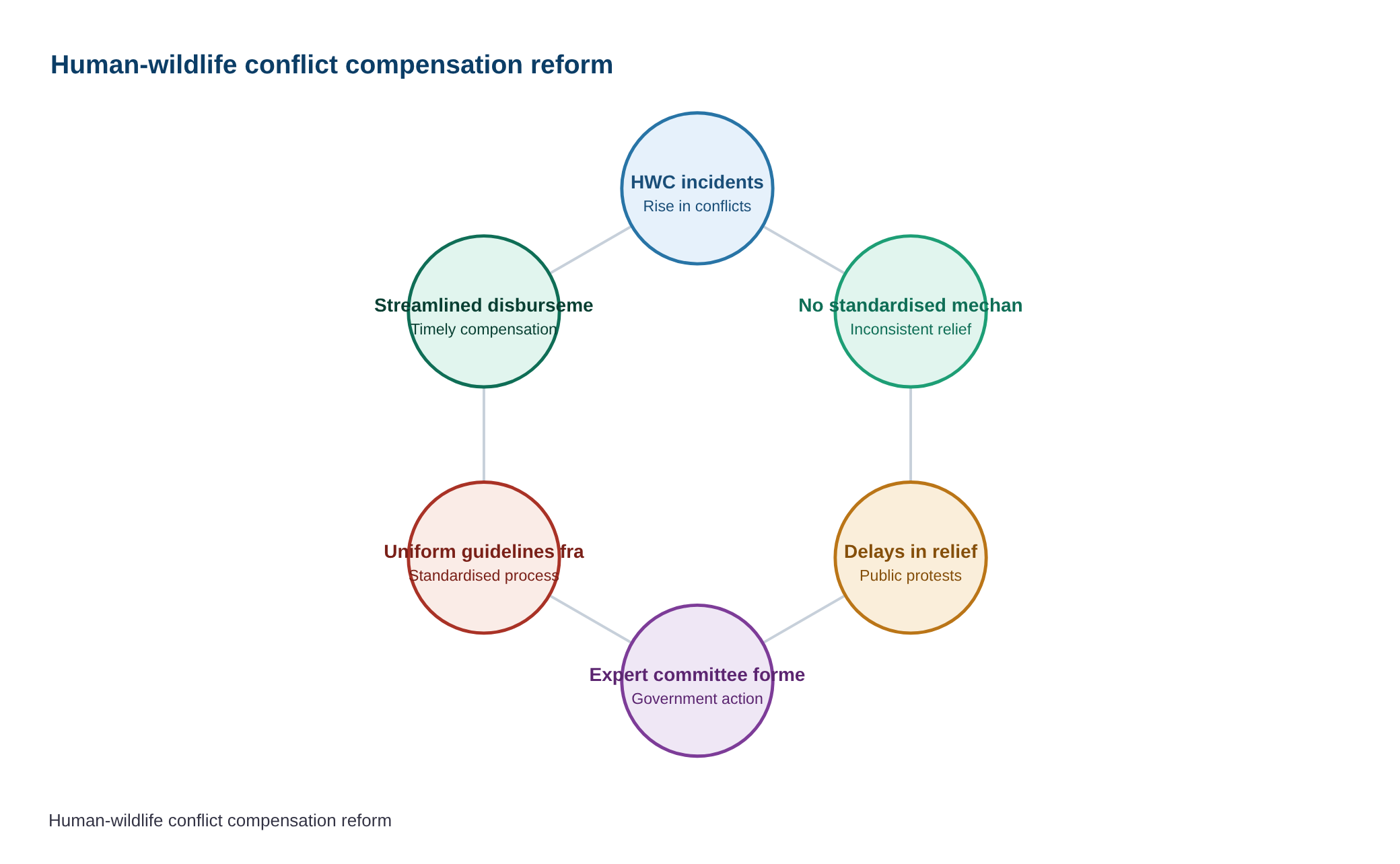
Human-wildlife conflict incidents → Absence of standardised compensation mechanisms → Delays in relief disbursement → Public grievances and protests → Government constitutes expert committee → Formulates uniform guidelines → Streamlines assessment and disbursement → Timely compensation to affected families → Enhanced trust in governance and conservation efforts.
Prelims Practice Questions
Q1. Consider the following statements regarding human-wildlife conflict (HWC) in India:
1. The Wildlife Protection Act, 1972, mandates the establishment of a National Board for Wildlife.
2. Compensation for HWC incidents is uniformly governed by a single central legislation.
3. The Forest Rights Act, 2006, recognises the rights of forest-dwelling communities over forest resources.
4. The Ministry of Environment, Forest and Climate Change (MoEFCC) is the nodal agency for implementing HWC mitigation measures.
How many of the above statements are correct?
- Only one
- Only two
- Only three
- All
Answer: All — Statements 1, 3, and 4 are correct. Statement 2 is incorrect as compensation mechanisms vary across states and are not uniformly governed by a single central legislation.
Q2. Assertion (A): The absence of standardised guidelines for compensation in human-wildlife conflict cases often leads to delays in disbursement.
Reason (R): The jurisdiction over compensation claims is divided between the Forest and Revenue departments, causing administrative ambiguities.
Options:
A. Both A and R are true, and R is the correct explanation of A.
B. Both A and R are true, but R is NOT the correct explanation of A.
C. A is true, but R is false.
D. A is false, but R is true.
- A
- B
- C
- D
Answer: A — Both A and R are true, and R correctly explains A. The divided jurisdiction between departments creates administrative ambiguities, leading to delays in compensation disbursement.
Q3. Match the following pairs related to human-wildlife conflict management in India:
Column I (Institutions/Acts)
1. National Board for Wildlife
2. Forest Rights Act, 2006
3. Wildlife Protection Act, 1972
4. State Disaster Management Authority
Column II (Functions)
A. Recognises rights of forest-dwelling communities
B. Mandates establishment of a statutory body for wildlife conservation
C. Governs compensation mechanisms for HWC incidents
D. Provides for disaster risk reduction and relief management
Options:
1. 1-B, 2-A, 3-C, 4-D
2. 1-A, 2-B, 3-C, 4-D
3. 1-D, 2-A, 3-B, 4-C
4. 1-B, 2-C, 3-A, 4-D
- 1
- 2
- 3
- 4
Answer: 1 — 1-B (National Board for Wildlife is established under the Wildlife Protection Act, 1972), 2-A (Forest Rights Act, 2006 recognises rights of forest-dwelling communities), 3-C (Wildlife Protection Act, 1972 governs wildlife conservation but compensation mechanisms are state-specific), 4-D (State Disaster Management Authority is responsible for disaster risk reduction and relief management).
Mains Practice Question
✍ The establishment of an expert committee to formulate uniform guidelines for compensation in human-wildlife conflict (HWC) cases in Keralam underscores the need for administrative efficiency in governance. Critically examine the legal and institutional challenges in compensating victims of HWC incidents in India. Also, assess the role of the Forest Rights Act, 2006, in addressing the rights of affected communities. (15 Marks)
Approach: MODEL-ANSWER SKELETON:
1. **Introduction (2 marks)**
– Define human-wildlife conflict (HWC) and its socio-economic impact.
– Highlight the constitutional and statutory framework governing HWC compensation (Article 21, Directive Principles of State Policy, Wildlife Protection Act, 1972, Forest Rights Act, 2006).
2. **Legal and Institutional Challenges (6 marks)**
– **Jurisdictional Ambiguities**: Division of authority between Forest and Revenue departments; disputes over land classification (forestland vs. revenue land).
– **Lack of Standardised Guidelines**: Absence of uniform criteria for assessing compensation; reliance on case-by-case administrative deliberations leading to delays.
– **Administrative Delays**: Need for Cabinet approvals in individual cases; bureaucratic inefficiencies.
– **Constitutional Provisions**: Right to life (Article 21) and the state’s obligation to provide timely relief.
3. **Role of the Forest Rights Act, 2006 (4 marks)**
– Recognition of rights of forest-dwelling communities over forest resources.
– Provisions for community participation in wildlife management and compensation.
– Limitations: Ambiguities in implementation; lack of clarity on compensation mechanisms for HWC within the Act.
4. **Way Forward (3 marks)**
– Need for a national-level policy on HWC compensation with standardised criteria.
– Strengthening inter-departmental coordination (Forest, Revenue, Disaster Management).
– Leveraging technology (GIS, satellite imagery) for accurate land classification and incident mapping.
– Ensuring timely disbursement of compensation through direct benefit transfer (DBT) mechanisms.
Source: The Hindu
Generated by AanyaAi for educational purpose.
Related guides on our sites
- How to prepare for GS paper 1 for UPSC CSE mains exam
- Best UPSC coaching for IFOS exam
- Best geography optional coaching
- Best geography optional coaching

- संयुक्त राष्ट्र की विफलता पर तुर्की राष्ट्रपति ने उठाया बड़ा सवाल, जानिए पूरा मामला - September 23, 2026
- UN’s Failure in Peacekeeping: Erdoğan’s Critique on UNSC Reforms for UPSC 2026 - September 23, 2026
- मद्रास उच्च न्यायालय ने 50 वर्ष से अधिक उम्र की विदेशी महिला को दिया आईवीएफ उपचार का अधिकार - September 23, 2026

No Comments