


08 Aug Kerala HC Orders Panchayat to Pay ₹10,000 for Stray Dog Attack
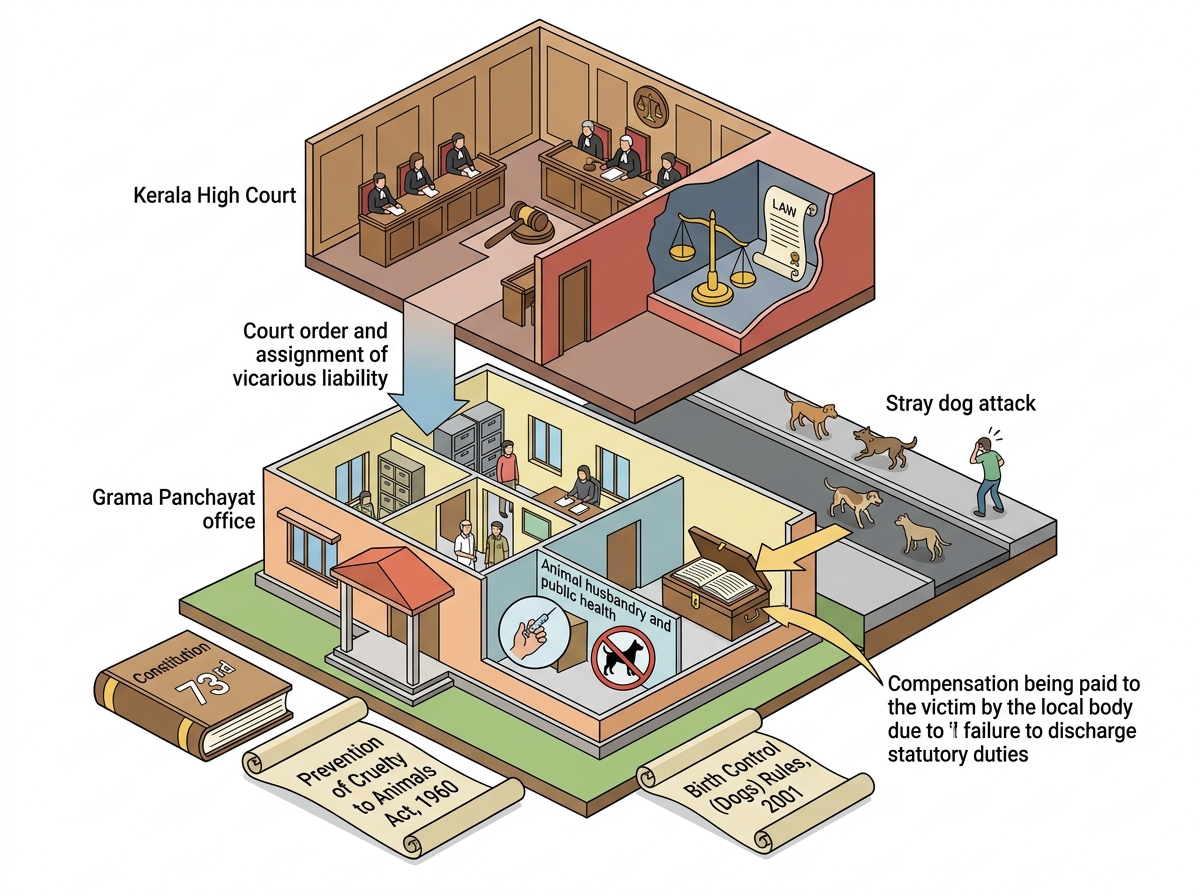
Kerala High CourtPanchayati Raj InstitutionStray dog victimPrevention of Cruelty to Animals ABirth Control (Dogs) RulesConstitutional Amendment Act✎ Local self-government institutions are constitutionally and statutorily obligated to implement Animal Birth Control programmes under the PCA Act, 1960, and the Birth Control Rules, 2001; failure to do so renders them vicariously…
Subject Relevance — Where This Topic Fits
- GS Paper II — Governance, Constitution, Polity, Social Justice and International Relations | GS Paper III — Environment, Disaster Management and Animal Welfare
- Prelims: Panchayati Raj Institutions (PRIs), 73rd Constitutional Amendment Act, 1992, Prevention of Cruelty to Animals Act, 1960, Birth Control (Dogs) Rules, 2001, Animal Birth Control (ABC) Rules, 2023, Local Self-Government Functions, Judicial Activism in Animal Welfare, Compensatory Jurisprudence, Vicarious Liability of Local Bodies, Fundamental Duty under Article 51A(g) of the Constitution
- Essay: The Role of Local Governance in Public Health and Safety: Balancing Rights, Duties, and Accountability, Judicial Intervention in Socio-Economic Issues: A Case for Compensatory Justice in Animal Welfare
Quick Revision: Local self-government institutions are constitutionally and statutorily obligated to implement Animal Birth Control programmes under the PCA Act, 1960, and the Birth Control Rules, 2001; failure to do so renders them vicariously liable for compensating victims of stray dog attacks.
Why is this in the news?
The Kerala High Court’s judgment in *Tankappan v. Eruvessy Grama Panchayat* establishes a significant precedent by holding a local self-government institution vicariously liable for compensating a victim of a stray dog attack due to its failure to discharge statutory duties under the Prevention of Cruelty to Animals Act, 1960, and the Birth Control (Dogs) Rules, 2001. The ruling underscores the legal accountability of Panchayati Raj Institutions (PRIs) in ensuring public safety and animal welfare, while addressing the broader implications of judicial intervention in local governance failures.
Background
- The 73rd Constitutional Amendment Act, 1992, devolves specific functions to Panchayati Raj Institutions (PRIs), including public health, sanitation, and animal husbandry, thereby imposing statutory obligations on local bodies.
- The Prevention of Cruelty to Animals Act, 1960, is the primary legislation governing the welfare of animals in India, mandating measures to prevent cruelty and regulate the population of stray animals.
- The Birth Control (Dogs) Rules, 2001, framed under the Prevention of Cruelty to Animals Act, 1960, require local authorities to implement Animal Birth Control (ABC) programmes, including sterilisation and immunisation of stray dogs.
- Kerala, through its local self-government institutions, has historically struggled with the management of stray dog populations, leading to frequent human-animal conflicts.
- The case highlights the recurring issue of underfunding and lack of capacity in local bodies to implement statutory duties, despite clear legal mandates.
- The judgment aligns with the Supreme Court’s directives in *Animal Welfare Board of India v. A. Nagaraja* (2014), which emphasised the duty of the state to protect animals and prevent cruelty.
Legal and Constitutional Framework Governing Stray Dog Management in India
- The **Prevention of Cruelty to Animals Act, 1960** (PCA Act) is the foundational legislation that prohibits cruelty to animals and mandates the prevention of suffering, including through the regulation of stray animal populations.
- Under the **Birth Control (Dogs) Rules, 2001**, local authorities are legally obligated to implement **Animal Birth Control (ABC) programmes**, which include sterilisation, immunisation, and humane relocation of stray dogs to mitigate human-animal conflicts.
- The **73rd Constitutional Amendment Act, 1992**, empowers Panchayati Raj Institutions (PRIs) with functions such as public health, sanitation, and animal husbandry, thereby imposing a **constitutional duty** to manage stray dog populations within their jurisdictions.
- Local bodies are required to issue **licences for domestic dogs** and maintain records of vaccinated and sterilised animals, as stipulated under the PCA Act and state-specific rules.
- The **Fundamental Duty under Article 51A(g) of the Constitution** imposes a moral and legal obligation on every citizen, including local authorities, to protect and improve the natural environment, including wildlife and animals.
- The **Kerala Panchayat Raj Act, 1994**, further delineates the responsibilities of grama panchayats in public health and animal welfare, including the management of stray dog populations.
- Judicial precedents, such as *Animal Welfare Board of India v. A. Nagaraja* (2014), have established that the state and its instrumentalities cannot evade liability for failing to discharge statutory duties under animal welfare laws.
Key Features
| Feature | Significance |
|---|---|
| Statutory duty of local bodies under PCA Act, 1960 | Mandates panchayats to prevent cruelty to animals and control stray dog populations, including sterilisation and licensing. |
| Birth Control Rules for Dogs, 2001 | Provides the legal framework for sterilisation and immunisation of stray dogs to manage their population humanely. |
| Judicial interpretation of municipal liability | Clarifies that local bodies can be held financially accountable for dereliction of statutory duties, setting a precedent for future cases. |
| Foreseeability in tort law | Establishes that harm from stray dog attacks is a reasonably foreseeable consequence of a panchayat’s failure to act, justifying compensation. |
| Hierarchy of judicial scrutiny | Demonstrates the process of appeal from Munsiff Court to High Court, highlighting the role of higher judiciary in upholding statutory obligations. |
Why it Matters
Legal-Political
- Reinforces the principle of ‘duty of care’ imposed on local self-government institutions under the Constitution of India, particularly in Articles 243G and 243W.
- Sets a judicial precedent for holding municipal bodies financially liable for failing to discharge statutory duties, potentially influencing similar cases nationwide.
- Highlights the tension between municipal autonomy and citizens’ right to a safe environment under Article 21 of the Constitution.
- Underscores the role of the judiciary in enforcing statutory compliance by local bodies, even in the absence of explicit financial support from the state.
Administrative
- Exposes systemic gaps in the implementation of the Prevention of Cruelty to Animals Act, 1960, and Birth Control Rules for Dogs, 2001, by local bodies.
- Raises questions about the adequacy of financial and technical support provided by state governments to panchayats for managing stray dog populations.
- Demonstrates the need for robust record-keeping and monitoring mechanisms by panchayats to track compliance with animal welfare laws.
Social
- Emphasises the public health and safety implications of unchecked stray dog populations, including the risk of zoonotic diseases and road accidents.
- Highlights the ethical responsibility of local bodies towards animal welfare and community safety, balancing human and animal rights.
- May encourage greater public awareness and civic participation in reporting stray dog sightings and demanding accountability from local authorities.
Challenges
1. Implementation deficit in local governance
- Inadequate capacity of panchayats to enforce animal welfare laws due to limited financial resources and technical expertise.
- Lack of coordination between panchayats, municipal corporations, and state animal husbandry departments in managing stray dog populations.
- Absence of a uniform national policy for stray dog management, leading to inconsistent enforcement across jurisdictions.
- Over-reliance on ad-hoc measures rather than structured, long-term strategies for population control.
UPSC Link: GS-II: Local Government
2. Judicial overreach vs. municipal autonomy
- Risk of courts substituting executive functions by dictating operational details of stray dog management, potentially undermining local autonomy.
- Potential for excessive litigation if compensation claims become routine, diverting resources from core municipal functions.
- Need for clear guidelines on the extent of judicial intervention in cases of statutory non-compliance by local bodies.
UPSC Link: GS-II: Judiciary
3. Balancing animal rights and public safety
- Ethical dilemma in culling vs. sterilisation as methods for controlling stray dog populations, with implications for animal welfare activists and public health authorities.
- Conflict between the rights of domestic dog owners (under PCA Act) and the need to mitigate risks posed by stray dogs.
- Lack of consensus on the most humane and effective methods for managing stray dog populations in urban and rural areas.
UPSC Link: GS-III: Environment
4. Resource constraints and policy gaps
- Insufficient state funding for sterilisation and immunisation programmes, leading to poor compliance with Birth Control Rules.
- Absence of a dedicated national fund or scheme for stray dog management, unlike other welfare initiatives (e.g., Swachh Bharat Mission).
- Limited awareness among panchayat officials and citizens about legal provisions and best practices for stray dog control.
UPSC Link: GS-II: Centre-State Relations
Challenges — UPSC Perspective
| Issue | Concern |
|---|---|
| Financial constraints of panchayats | Inability to allocate sufficient funds for sterilisation, immunisation, and public awareness campaigns. |
| Lack of standardised protocols | Inconsistent enforcement of PCA Act and Birth Control Rules across different panchayats and states. |
| Judicial activism vs. executive functions | Risk of courts overstepping into policy-making by awarding compensation, potentially creating a burden on local bodies. |
| Public apathy and reporting gaps | Low citizen engagement in reporting stray dog sightings or demanding accountability from local authorities. |
| Ethical and legal dilemmas | Balancing the rights of animals under PCA Act with the right to life and personal liberty of citizens under Article 21. |
| Inter-departmental coordination failures | Poor collaboration between panchayats, municipal bodies, and animal husbandry departments in managing stray dog populations. |
Way Forward
- Strengthen the financial and technical capacity of panchayats through targeted grants under the 15th Finance Commission for animal welfare initiatives.
- Develop a national framework for stray dog management, including standardised protocols for sterilisation, immunisation, and public awareness.
- Enhance inter-departmental coordination by mandating regular meetings between panchayats, municipal bodies, and state animal husbandry departments.
- Promote citizen participation through mobile applications and grievance redressal mechanisms for reporting stray dog sightings.
- Conduct mandatory training programmes for panchayat officials on the Prevention of Cruelty to Animals Act, 1960, and Birth Control Rules for Dogs, 2001.
- Encourage state governments to allocate dedicated funds for stray dog management, similar to schemes for other welfare initiatives.
- Establish a monitoring and evaluation system to track compliance with animal welfare laws by panchayats and municipal bodies.
- Raise public awareness through campaigns highlighting the legal and ethical responsibilities of panchayats in managing stray dog populations.
UPSC Value Addition
Keywords for Mains Answer-Writing
Local Government and Administration · Prevention of Cruelty to Animals Act, 1960 · Birth Control Rules for Dogs · Judicial Activism in Animal Welfare · Constitutional Liability of Panchayats · Stray Dog Menace in Urban and Rural India · Compensation for Animal Attack Victims · Doctrine of Statutory Duty · Public Health and Municipal Functions · Judicial Review of Administrative Inaction
Concept Flow
Statutory duty under PCA Act, 1960 and Birth Control Rules → Failure of panchayat to enforce provisions (e.g., sterilisation, licensing) → Stray dog population growth → Foreseeable harm to citizens (e.g., dog attack) → Victim seeks compensation → Judicial review of panchayat’s liability → High Court upholds compensation for dereliction of duty → Precedent for future cases of municipal negligence.
Prelims Practice Questions
Q1. Consider the following statements regarding the legal framework for the control of stray dogs in India:
1. The Prevention of Cruelty to Animals Act, 1960, mandates the sterilization and vaccination of stray dogs by local authorities.
2. The Birth Control Rules for Dogs are framed under the Prevention of Cruelty to Animals Act, 1960.
3. The 74th Constitutional Amendment Act, 1992, assigns the responsibility of animal welfare to municipal corporations and panchayats.
How many of the above statements are correct?
- Only one
- Only two
- All three
- None
Answer: All three — Statements 1 and 2 are correct as the Prevention of Cruelty to Animals Act, 1960, and the Birth Control Rules framed thereunder mandate sterilization and vaccination of stray dogs. Statement 3 is incorrect because the 74th Amendment assigns functions like public health and sanitation to local bodies but does not explicitly mention animal welfare as a mandatory function.
Q2. Assertion (A): The Kerala High Court, in the case of a stray dog attack victim, held the Eruvessy grama panchayat liable for compensation due to its failure to discharge statutory duties.
Reason (R): The panchayat had not complied with the provisions of the Prevention of Cruelty to Animals Act, 1960, and the Birth Control Rules for Dogs, which mandate the control of stray dogs.
Codes:
A. Both A and R are true, and R is the correct explanation of A.
B. Both A and R are true, but R is not the correct explanation of A.
C. A is true, but R is false.
D. A is false, but R is true.
- A
- B
- C
- D
Answer: A — Both the Assertion (A) and Reason (R) are true, and the Reason (R) correctly explains the Assertion (A). The Kerala High Court held the panchayat liable for failing to comply with the statutory duties under the Prevention of Cruelty to Animals Act, 1960, and the Birth Control Rules for Dogs.
Q3. Match the following legal provisions with their respective objectives:
Column I (Provisions)
A. Section 11(1)(h) of the Prevention of Cruelty to Animals Act, 1960
B. Article 21 of the Constitution of India
C. Directive Principles of State Policy (DPSP) under Article 48A
D. 74th Constitutional Amendment Act, 1992
Column II (Objectives)
1. Protection of life and personal liberty
2. Duty of the State to protect and improve the environment and safeguard wildlife
3. Prohibition of unnecessary pain or suffering to animals
4. Assignment of functions like public health and sanitation to local bodies
Select the correct match:
- A-1, B-3, C-2, D-4
- A-3, B-1, C-2, D-4
- A-2, B-1, C-3, D-4
- A-3, B-2, C-1, D-4
Answer: A-3, B-1, C-2, D-4 — The correct match is A-3 (Section 11(1)(h) prohibits unnecessary pain or suffering to animals), B-1 (Article 21 protects life and personal liberty), C-2 (Article 48A directs the State to protect and improve the environment and wildlife), and D-4 (74th Amendment assigns functions like public health and sanitation to local bodies).
Mains Practice Question
✍ The Kerala High Court’s directive to the Eruvessy grama panchayat to compensate a victim of a stray dog attack underscores the principle of constitutional liability of local bodies for failure to discharge statutory duties. Critically examine the legal and administrative framework governing the control of stray dogs in India, with particular reference to the roles of panchayats and municipal corporations. Also, discuss the implications of this judgment for public health governance in rural and urban India. (15 Marks)
Approach: 1. **Legal Framework**: Outline the Prevention of Cruelty to Animals Act, 1960, and the Birth Control Rules for Dogs, 2001, highlighting the statutory duties of local bodies (panchayats and municipal corporations) to control stray dogs through sterilization, vaccination, and licensing.
2. **Constitutional and Statutory Basis**: Discuss the 74th Constitutional Amendment Act, 1992, and its assignment of functions like public health and sanitation to local bodies. Reference Article 21 (right to life and personal liberty) and Article 48A (DPSP on environment and wildlife protection) as foundational principles.
3. **Judicial Precedents**: Cite the Kerala High Court’s judgment in the Eruvessy grama panchayat case, emphasizing the doctrine of statutory duty and judicial review of administrative inaction. Contrast with other judgments where courts have upheld local body liability for public health failures.
4. **Administrative Challenges**: Analyze the practical challenges faced by panchayats and municipal corporations in implementing stray dog control measures, including financial constraints, lack of awareness, and coordination issues with state agencies.
5. **Public Health Implications**: Discuss the public health risks posed by stray dogs (e.g., rabies transmission) and the role of local bodies in mitigating these risks. Highlight the judgment’s potential to strengthen accountability in public health governance.
6. **Balanced View**: Present counterarguments, such as the panchayat’s contention of limited financial resources or the argument that stray dog control is a state subject under the Concurrent List. Conclude with a reasoned assessment of the judgment’s impact on local governance and public health.
Source: The Hindu
Generated by AanyaAi for educational purpose.

- महाराष्ट्र में त्योहार जुलूसों पर बॉम्बे हाईकोर्ट का बड़ा फैसला: पटाखे, लेजर और संगीत पर रोक - September 24, 2026
- Bombay HC Bans Firecrackers, Music in Maharashtra Processions: Key UPSC Analysis - September 24, 2026
- तमिलनाडु में महिला कर्मचारियों के लिए सवैतनिक माहवारी अवकाश नीति पर HC का आदेश - September 24, 2026

No Comments