


08 Aug Kerala HC: Panchayat Liable for Stray Dog Attack Compensation
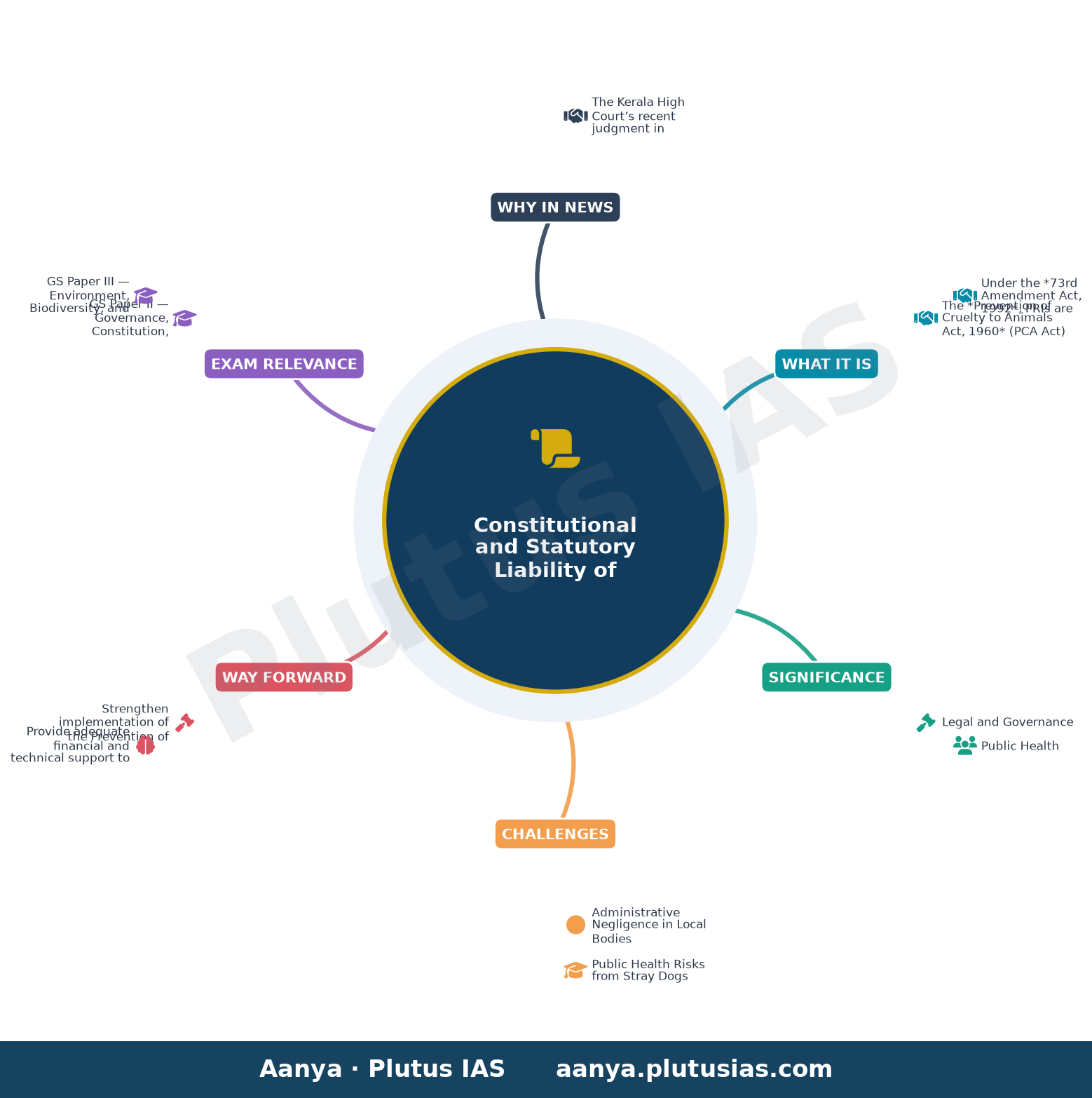
✎ Panchayats are constitutionally and statutorily obligated under the *73rd Amendment Act, 1992*, *Prevention of Cruelty to Animals Act, 1960*, and *Birth Control Rules*, to manage stray dog populations; failure to do so renders…
Subject Relevance — Where This Topic Fits
- GS Paper II — Governance, Constitution, Polity, Social Justice and International Relations (Local Governance and Animal Welfare) | GS Paper III — Environment, Biodiversity, and Animal Welfare
- Prelims: Panchayati Raj System, 73rd Amendment Act, 1992, Prevention of Cruelty to Animals Act, 1960, Birth Control (Dogs) Rules, 2001, Compensatory Jurisprudence under Tort Law, Doctrine of Vicarious Liability, Fundamental Duties under Article 51A(g), Local Self-Government Institutions, Judicial Activism in Animal Welfare Cases
- Essay: Role of Local Governance in Public Health and Safety: Balancing Rights and Duties, Animal Welfare and Constitutional Morality: A Case for Legal Accountability
Quick Revision: Panchayats are constitutionally and statutorily obligated under the *73rd Amendment Act, 1992*, *Prevention of Cruelty to Animals Act, 1960*, and *Birth Control Rules*, to manage stray dog populations; failure to do so renders them vicariously liable for injuries caused by stray dogs.
Why is this in the news?
The Kerala High Court’s recent judgment in *Tankappan v. Eruvessy Grama Panchayat* reaffirms the constitutional and statutory obligations of local self-government institutions under the *Prevention of Cruelty to Animals Act, 1960*, and the *Birth Control Rules*, to manage stray dog populations and compensate victims of dog attacks resulting from institutional neglect. This ruling underscores the legal accountability of panchayats in discharging public health and safety duties, setting a significant precedent for local governance and animal welfare jurisprudence in India.
Background
- The *Prevention of Cruelty to Animals Act, 1960* (PCA Act) mandates the prevention of cruelty to animals and the regulation of animal populations, including stray dogs, through local authorities.
- The *73rd Constitutional Amendment Act, 1992*, devolves specific functions, including public health and animal welfare, to Panchayati Raj Institutions (PRIs) like grama panchayats.
- Kerala’s *Kerala Panchayat Raj Act, 1994*, further delineates the duties of grama panchayats in implementing central and state welfare schemes, including animal control measures.
- The Kerala High Court’s judgment aligns with the Supreme Court’s observations in *Animal Welfare Board of India v. A. Nagaraja* (2014), which emphasised the state’s duty to protect animals and prevent cruelty.
- The case highlights the recurring issue of institutional apathy in managing stray dog populations, leading to public health risks and legal liabilities.
Legal and Governance Framework for Stray Dog Management in India
- The *Prevention of Cruelty to Animals Act, 1960* (PCA Act) is the primary legislation governing animal welfare in India, with Sections 11 and 38 empowering local authorities to regulate and control stray animals.
- Under the *73rd Amendment Act, 1992*, PRIs are constitutionally mandated to perform functions related to public health, sanitation, and animal welfare, devolving these responsibilities from state governments.
- The *Kerala Panchayat Raj Act, 1994*, further specifies the duties of grama panchayats, including the implementation of animal birth control programmes and the prevention of zoonotic diseases.
- Judicial precedents, such as *Animal Welfare Board of India v. A. Nagaraja* (2014), have reinforced the state’s obligation to prevent cruelty to animals and uphold their welfare under Article 51A(g) of the Constitution.
- The doctrine of vicarious liability holds local bodies accountable for failing to discharge statutory duties, as seen in the Kerala High Court’s ruling, where the panchayat was held liable for the victim’s injuries due to its inaction.
- The judgment also addresses the argument of financial constraints, clarifying that the absence of state assistance does not absolve local bodies of their constitutional and statutory obligations.
Key Features
| Feature | Significance |
|---|---|
| Statutory duty of local bodies under PCA Act, 1960 | Mandates that panchayats must issue licences for domestic dogs and control stray dog populations, failing which they are liable for negligence. |
| Birth Control Rules for dogs | Legal framework for sterilisation and vaccination of stray dogs to prevent zoonotic disease transmission and public nuisance. |
| Judicial interpretation of negligence | Establishes that failure to discharge statutory duties constitutes negligence, making local bodies liable for compensation in case of harm. |
| Compensation for dog attack victims | Provides a legal recourse for victims of stray dog attacks when local bodies fail to implement statutory obligations. |
| Hierarchy of judicial review | Demonstrates the process of appeals from subordinate courts to the High Court, reaffirming judicial scrutiny of administrative actions. |
Why it Matters
Legal and Governance
- Reinforces the principle of administrative accountability for local self-government institutions under the Prevention of Cruelty to Animals Act, 1960.
- Clarifies the legal liability of panchayats in cases of public harm due to non-compliance with statutory duties.
- Sets a precedent for compensation claims against local bodies for failure to control stray dog populations.
Public Health
- Highlights the public health risks posed by unchecked stray dog populations, including zoonotic disease transmission and injuries.
- Emphasises the role of local bodies in implementing sterilisation and vaccination programmes as mandated by law.
Judicial Precedent
- Demonstrates the judiciary’s role in interpreting statutory duties and enforcing accountability on local bodies.
- Reaffirms that judicial review extends to administrative failures, even in cases of public safety.
Local Governance
- Underscores the importance of proactive measures by panchayats in fulfilling statutory obligations.
- Exposes gaps in implementation of animal birth control programmes, despite legal mandates.
Challenges
1. Administrative Negligence in Local Bodies
- Failure to implement statutory duties such as issuing dog licences and controlling stray dog populations.
- Lack of financial and logistical support from state governments to address stray dog menace.
- Inadequate monitoring and enforcement of animal birth control rules by panchayats.
UPSC Link: GS-II: Local Governance
2. Public Health Risks from Stray Dogs
- Increased risk of zoonotic diseases such as rabies due to unvaccinated and unsterilised stray dogs.
- Potential for injuries and psychological trauma to citizens, particularly in rural and semi-urban areas.
UPSC Link: GS-II: Health
3. Judicial Overreach vs. Administrative Autonomy
- Concerns about courts substituting administrative discretion with judicial orders, potentially hindering local governance.
- Risk of floodgates of litigation if compensation claims become routine for public safety failures.
UPSC Link: GS-II: Judiciary
4. Financial Constraints in Local Governance
- Limited financial resources with panchayats to implement animal birth control programmes.
- Dependence on state and central government funding, which may not be consistently available.
UPSC Link: GS-II: Local Governance
5. Awareness and Compliance Gaps
- Lack of public awareness about the legal framework governing dog ownership and stray dog control.
- Low compliance with licensing requirements for domestic dogs, exacerbating stray dog populations.
UPSC Link: GS-II: Governance
Challenges — UPSC Perspective
| Issue | Concern |
|---|---|
| Non-implementation of statutory duties | Panchayats failing to issue licences or control stray dogs despite legal mandates. |
| Financial constraints | Insufficient funds to implement animal birth control programmes or hire veterinary staff. |
| Judicial scrutiny of administrative actions | Risk of courts overstepping into domain of local governance, leading to administrative paralysis. |
| Public health risks | Unchecked stray dog populations increasing risk of rabies and injuries. |
| Awareness and compliance gaps | Low public awareness about licensing requirements and stray dog control measures. |
| Lack of inter-departmental coordination | Poor coordination between panchayats, state departments, and veterinary services. |
Way Forward
- Strengthen implementation of the Prevention of Cruelty to Animals Act, 1960, and Birth Control Rules through regular audits of panchayat actions.
- Provide adequate financial and technical support to panchayats for sterilisation, vaccination, and monitoring of stray dog populations.
- Enhance public awareness campaigns on dog licensing, responsible pet ownership, and reporting of stray dogs.
- Establish a grievance redressal mechanism for citizens to report failures in stray dog control by local bodies.
- Promote inter-departmental coordination between panchayats, state animal husbandry departments, and municipal corporations.
- Conduct periodic training programmes for panchayat officials on legal obligations and best practices for animal birth control.
- Encourage community participation in reporting and managing stray dog populations through local initiatives.
UPSC Value Addition
Keywords for Mains Answer-Writing
Local Self-Government · Prevention of Cruelty to Animals Act, 1960 · Birth Control Rules for Dogs · Stray Dog Management · Compensation for Animal Attacks · Constitutional Obligations of Panchayats · Judicial Activism in Animal Welfare · Public Health and Safety · Decentralised Governance · Animal Rights Jurisprudence · Statutory Duty of Local Bodies · Kerala High Court Judgments on Animal Welfare
Constitutional & Policy Linkages
- [‘Article 243G’, ‘Empowers panchayats to prepare plans for economic development and social justice.’]
- [‘Article 243W’, ‘Assigns functions relating to animal husbandry to municipalities and panchayats.’]
- [‘Seventh Schedule’, ‘Distributes legislative and administrative responsibilities between Union and State governments, including animal welfare.’]
Concept Flow
Statutory duty to control stray dogs (PCA Act, 1960) → Failure of panchayat to implement duties → Stray dog attack on citizen → Legal recourse sought by victim → Judicial scrutiny of panchayat’s negligence → High Court upholds liability → Compensation awarded to victim → Precedent set for future cases → Emphasis on proactive governance by local bodies.
Prelims Practice Questions
Q1. Consider the following statements regarding the statutory duties of a Gram Panchayat under the Prevention of Cruelty to Animals Act, 1960 and the Birth Control Rules for Dogs:
1. A Gram Panchayat is legally obligated to issue licences for domestic dogs within its jurisdiction.
2. The Act mandates the sterilisation and immunisation of stray dogs by local bodies.
3. The Birth Control Rules for Dogs are framed under the Environment Protection Act, 1986.
4. Failure to perform these duties does not attract liability for compensation in case of animal attacks.
How many of the above statements are correct?
- Only one
- Only two
- Only three
- All four
Answer: Only two — Statement 1 is correct as the Act requires local bodies to regulate domestic dogs through licensing. Statement 2 is correct as the Birth Control Rules mandate sterilisation and immunisation of stray dogs. Statement 3 is incorrect as the Rules are framed under the Prevention of Cruelty to Animals Act, 1960, not the Environment Protection Act. Statement 4 is incorrect as the Kerala High Court has held that failure to discharge duties can attract liability for compensation.
Q2. Assertion (A): The Kerala High Court ruled that the Eruvessy Grama Panchayat was liable to compensate a victim of a stray dog attack due to its failure to discharge statutory duties.
Reason (R): The Prevention of Cruelty to Animals Act, 1960, imposes a mandatory duty on local bodies to control stray dogs through sterilisation and licensing.
Select the correct code:
- Both A and R are true, and R is the correct explanation of A
- Both A and R are true, but R is not the correct explanation of A
- A is true, but R is false
- A is false, but R is true
Answer: Both A and R are true, and R is the correct explanation of A — The assertion (A) is true as the Kerala High Court held the panchayat liable for compensation due to its failure to control stray dogs. The reason (R) is also true and correctly explains the assertion, as the Act mandates local bodies to control stray dogs through sterilisation and licensing.
Mains Practice Question
✍ The Kerala High Court, in its recent judgment, held a Gram Panchayat liable for compensation to a victim of a stray dog attack, citing its failure to discharge statutory obligations under the Prevention of Cruelty to Animals Act, 1960 and the Birth Control Rules for Dogs. Critically examine the legal and constitutional dimensions of this judgment, with particular reference to the obligations of local self-government institutions in ensuring public health and safety. (15 Marks)
Approach: MODEL-ANSWER SKELETON:
1. **Introduction** (2 marks): Briefly state the facts of the case and the Kerala High Court’s ruling, highlighting the legal basis (Prevention of Cruelty to Animals Act, 1960; Birth Control Rules for Dogs).
2. **Constitutional and Statutory Framework** (4 marks):
– Article 243G of the Constitution: Empowers Panchayats to prepare plans for economic development and social justice, including public health.
– Article 243W: Enumerates the functions of Municipalities, which are analogous to Panchayats in urban areas, including public health and sanitation.
– Prevention of Cruelty to Animals Act, 1960: Sections 3, 4, and 11 impose duties on local authorities to prevent cruelty and regulate stray animals.
– Birth Control Rules for Dogs (2001): Mandate sterilisation, immunisation, and licensing of dogs by local bodies.
3. **Judicial Precedents and Jurisprudence** (4 marks):
– Reference to the Kerala High Court’s judgment in this case, emphasising the principle of **vicarious liability** for statutory failure.
– Cite the Supreme Court’s observations in *Animal Welfare Board of India v. A. Nagaraja* (2014) on the state’s obligation to protect animals and prevent cruelty.
– Discuss the doctrine of **foreseeability** in tort law, as applied by the court to hold the panchayat liable for the reasonably foreseeable consequence of its inaction.
4. **Balancing Public Health and Local Governance** (3 marks):
– Arguments for strict liability: Ensures accountability of local bodies, deters negligence, and upholds animal welfare.
– Counterarguments: Risk of excessive litigation, financial burden on already resource-constrained panchayats, and potential conflict with state policies.
– Suggest a balanced approach: Gradual implementation of duties, state funding for sterilisation programmes, and community participation.
5. **Conclusion** (2 marks): Summarise the judgment’s significance in reinforcing the legal accountability of local bodies while acknowledging practical challenges. Propose measures such as state-funded sterilisation drives and public awareness campaigns to mitigate stray dog populations.
Source: The Hindu
Generated by AanyaAi for educational purpose.

- मुस्लिम महिलाओं को विरासत में समान अधिकार: सुप्रीम कोर्ट ने केंद्र से पूछा जवाब - September 23, 2026
- Supreme Court Questions Muslim Women’s Inheritance Rights Under Personal Law - September 23, 2026
- सुप्रीम कोर्ट ने पटना हाईकोर्ट के बलात्कार फैसले पर लिया स्वतः संज्ञान - September 23, 2026

No Comments