


08 Aug Kerala HC: Panchayat Liable for Stray Dog Attack Compensation
✎ Panchayats are legally obligated under the Prevention of Cruelty to Animals Act, 1960, and the Birth Control (Dogs) Rules, 2001, to implement stray dog control measures; failure to do so may result in compensatory liability for…
Subject Relevance — Where This Topic Fits
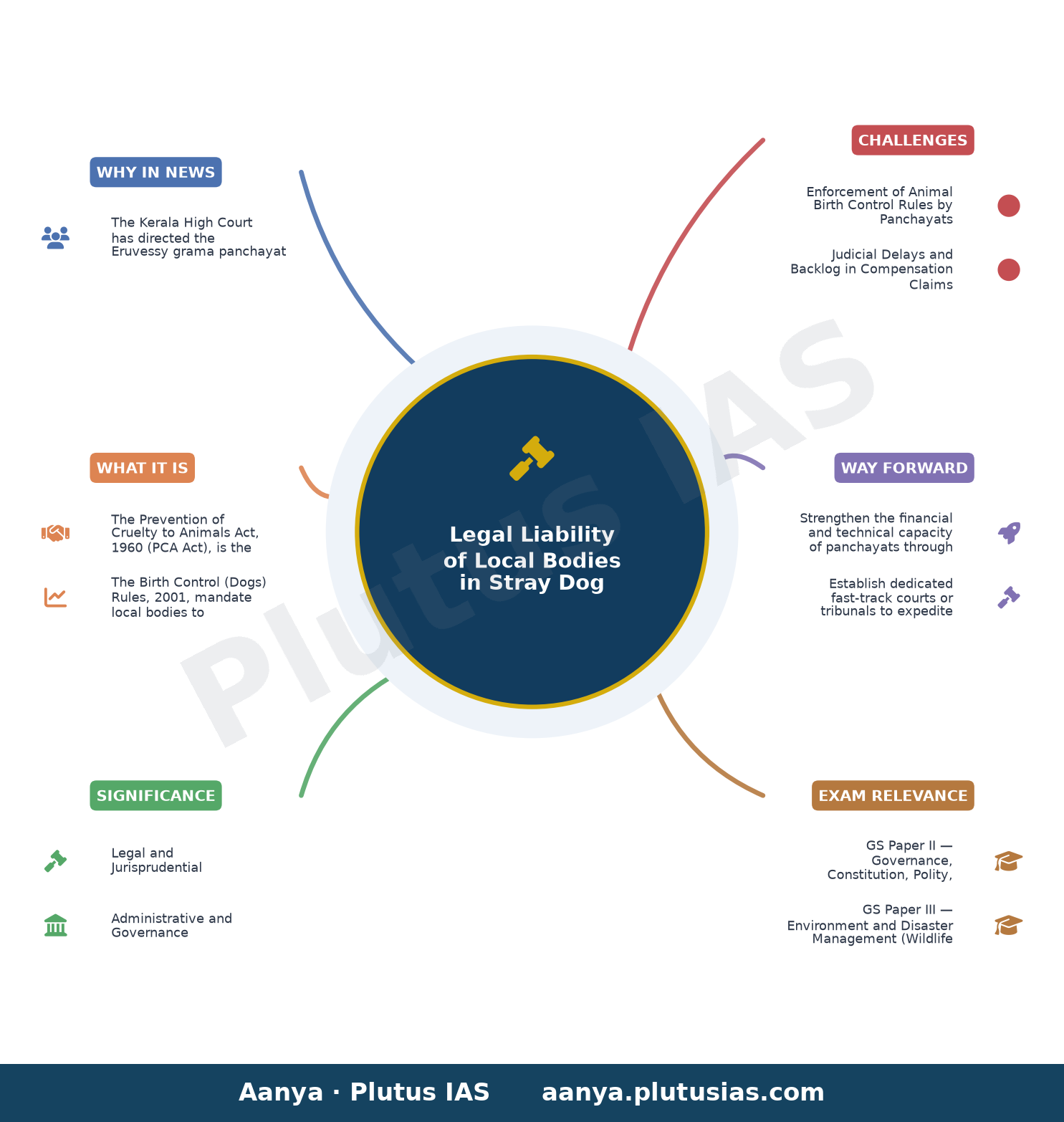
- GS Paper II — Governance, Constitution, Polity, Social Justice and International Relations (Local Self-Government and Animal Welfare Legislation) | GS Paper III — Environment and Disaster Management (Wildlife Protection and Civic Responsibilities)
- Prelims: Prevention of Cruelty to Animals Act, 1960, Birth Control (Dogs) Rules, 2001, 74th Constitutional Amendment Act, Panchayati Raj Institutions, Fundamental Duty under Article 51A(g), Local Self-Government, Stray Dog Management, Compensatory Jurisprudence, Judicial Activism in Animal Rights
- Essay: The Role of Local Governance in Public Health and Safety: Balancing Rights and Responsibilities, Judicial Intervention in Civic Negligence: A Tool for Accountability or a Precedent for Overreach?
Quick Revision: Panchayats are legally obligated under the Prevention of Cruelty to Animals Act, 1960, and the Birth Control (Dogs) Rules, 2001, to implement stray dog control measures; failure to do so may result in compensatory liability for negligence.
Why is this in the news?
The Kerala High Court has directed the Eruvessy grama panchayat to compensate ₹10,000 to a victim of a stray dog attack in 2007, holding the local body vicariously liable for its failure to discharge statutory obligations under the Prevention of Cruelty to Animals Act, 1960, and the Birth Control (Dogs) Rules, 2001. The judgment underscores the legal accountability of panchayats in managing stray dog populations and protecting citizens, reinforcing the principle that statutory negligence can attract compensatory liability in tort.
Background
- The Prevention of Cruelty to Animals Act, 1960, is the primary legislation governing animal welfare in India, mandating humane treatment and protection of animals, including stray dogs.
- The Birth Control (Dogs) Rules, 2001, framed under the Act, impose a statutory duty on local bodies to implement stray dog control measures, including sterilization, vaccination, and licensing of pet dogs.
- Stray dog attacks pose a significant public health risk, with zoonotic disease transmission (e.g., rabies) and physical injuries, necessitating proactive civic action.
- Kerala has historically grappled with stray dog populations, leading to frequent human-animal conflicts and public health concerns, prompting judicial and administrative interventions.
- The case highlights the tension between local governance autonomy and statutory obligations, particularly in resource-constrained settings where financial and administrative capacities may be limited.
Legal and Constitutional Framework Governing Stray Dog Management in India
- The Prevention of Cruelty to Animals Act, 1960 (PCA Act), is the foundational legislation empowering authorities to prevent cruelty to animals, including stray dogs, and to regulate their management through rules framed under Section 38.
- The Birth Control (Dogs) Rules, 2001, mandate local bodies to implement Animal Birth Control (ABC) programmes for stray dogs, including sterilization, vaccination (e.g., anti-rabies), and post-operative care, to control population growth and mitigate public health risks.
- Panchayats are required to issue licences for pet dogs, maintain records of licensed dogs, and take measures to control stray dogs within their jurisdiction, failing which they may incur liability for negligence under tort law.
- The doctrine of vicarious liability holds local bodies accountable for the actions or omissions of their officers or failures in statutory duties, as established in cases such as *Nagpur Municipal Corporation v. Vimal (2012)* and *State of Punjab v. Ram Lubhaya Bagga (1998)*.
- Judicial precedents, including the Kerala High Court’s order, reinforce that statutory negligence—such as failure to implement ABC programmes or control stray dogs—can attract compensatory liability, even in the absence of direct administrative fault, if the negligence is a proximate cause of harm.
- The PCA Act overrides local self-government laws where a conflict arises, as held in *Animal Welfare Board of India v. A. Nagaraja (2014)*, affirming the primacy of animal welfare legislation in civic governance.
- The judgment aligns with the constitutional duty under Article 51A(g), which imposes a fundamental duty on citizens to protect and improve the natural environment, including wildlife and stray animals.
Key Features
| Feature | Significance |
|---|---|
| Statutory duty of local bodies under PCA Act, 1960 | Local self-governments are legally obligated to prevent cruelty to animals and control stray dog populations, failure of which renders them liable for civil compensation. |
| Birth Control Rules for Stray Dogs | Mandatory sterilisation and vaccination of stray dogs is a statutory function of panchayats to mitigate public health risks and animal welfare concerns. |
| Judicial interpretation of foreseeability | Courts assess whether the harm (dog attack) was a direct consequence of the panchayat’s omission to act, establishing liability for omissions under tort law. |
| Hierarchy of judicial review in compensation claims | The case traverses from Munsiff Court to Sub-court and finally to High Court, illustrating the appellate structure and reappreciation of evidence in civil disputes. |
| Doctrine of vicarious liability in local governance | Panchayats, as statutory bodies, can be held vicariously liable for failing to discharge their statutory duties, even if the harm is caused by a third party (stray dog). |
Why it Matters
Legal and Jurisprudential
- Establishes precedent for holding local bodies liable for omissions in statutory duties, reinforcing the principle of accountability in public administration.
- Clarifies the scope of ‘foreseeability’ in tort law, particularly in cases involving public nuisance and statutory negligence.
- Reinforces the judicial trend of prioritising animal welfare and public health in constitutional and statutory interpretations.
Administrative and Governance
- Highlights the critical role of panchayats in implementing animal birth control measures under the PCA Act and Birth Control Rules.
- Exposes systemic gaps in the enforcement of statutory duties by local bodies, necessitating stricter compliance mechanisms.
- Demonstrates the judiciary’s role in correcting administrative failures, even in resource-constrained local governance settings.
Public Health and Safety
- Underscores the public health imperative of controlling stray dog populations to prevent zoonotic diseases and injuries.
- Emphasises the need for integrated municipal strategies combining sterilisation, vaccination, and public awareness.
Judicial Activism and Accountability
- Showcases the judiciary’s proactive stance in addressing failures of local bodies, ensuring justice for victims of statutory negligence.
- Sets a benchmark for future compensation claims against local governments for non-performance of statutory duties.
Challenges
1. Enforcement of Animal Birth Control Rules by Panchayats
- Inadequate financial and technical resources for implementing sterilisation and vaccination programmes.
- Lack of trained personnel and infrastructure for humane capture and management of stray dogs.
- Inconsistent adherence to statutory timelines for sterilisation drives due to administrative apathy or competing priorities.
- Absence of a robust monitoring mechanism to track compliance with Birth Control Rules at the grassroots level.
UPSC Link: GS2: Local Governance
2. Judicial Delays and Backlog in Compensation Claims
- Prolonged litigation due to multiple appellate stages, delaying justice and compensation for victims.
- Inadequate capacity of civil courts to handle specialised cases involving statutory duties and animal welfare.
- Lack of dedicated fast-track courts for public health and animal welfare-related disputes.
UPSC Link: GS2: Judiciary
3. Resource Constraints in Local Governance
- Limited fiscal autonomy of panchayats to allocate funds for stray dog control programmes.
- Dependency on state or central government grants, which may be irregular or insufficient.
- Competing priorities such as infrastructure development, education, and healthcare diverting attention from animal welfare.
UPSC Link: GS2: Panchayati Raj
4. Public Awareness and Community Participation
- Low awareness among citizens regarding the role of panchayats in animal control and their rights to compensation.
- Resistance from local communities to sterilisation drives due to cultural or religious beliefs.
- Lack of participatory governance models involving NGOs and animal welfare organisations in policy implementation.
UPSC Link: GS2: Decentralised Governance
Challenges — UPSC Perspective
| Issue | Concern |
|---|---|
| Statutory Compliance | Panchayats often fail to enforce the Prevention of Cruelty to Animals Act and Birth Control Rules due to administrative inertia. |
| Financial Constraints | Insufficient budgetary allocations for stray dog control programmes hinder effective implementation. |
| Judicial Delays | Multi-tier appellate processes delay compensation, undermining public trust in the legal system. |
| Resource Gaps | Shortage of trained personnel and infrastructure for capturing, sterilising, and vaccinating stray dogs. |
| Community Resistance | Local opposition to sterilisation drives complicates the execution of animal birth control measures. |
| Monitoring Mechanisms | Absence of real-time tracking systems to ensure panchayats comply with statutory obligations. |
Way Forward
- Strengthen the financial and technical capacity of panchayats through targeted grants under the 15th Finance Commission for animal welfare programmes.
- Establish dedicated fast-track courts or tribunals to expedite compensation claims related to statutory negligence by local bodies.
- Mandate annual audits of panchayats’ compliance with the Prevention of Cruelty to Animals Act and Birth Control Rules, with penalties for non-compliance.
- Promote community-based monitoring through partnerships with NGOs, animal welfare organisations, and local self-help groups.
- Introduce mandatory training programmes for panchayat officials on animal birth control, public health, and statutory duties.
- Enhance public awareness campaigns to educate citizens on their rights and the role of panchayats in stray dog control.
- Develop a national-level digital dashboard to track sterilisation drives, vaccination coverage, and compliance reports from panchayats.
- Encourage inter-state and inter-district collaboration for resource-sharing in stray dog management programmes.
UPSC Value Addition
Keywords for Mains Answer-Writing
Local self-government · Panchayati Raj Institutions · Prevention of Cruelty to Animals Act, 1960 · Birth Control Rules for dogs · Stray dog menace · Compensation for animal attacks · Constitutional duties of local bodies · Judicial activism in local governance · Fundamental duties under Article 51A(g) · Animal welfare and public health · Kerala High Court judgment · Statutory obligations of panchayats
Concept Flow
Statutory duty of panchayats under PCA Act, 1960 and Birth Control Rules → Failure to implement sterilisation/vaccination drives → Proliferation of stray dog population → Dog attack on citizen → Citizen files compensation claim → Civil courts assess liability based on foreseeability → High Court upholds panchayat’s vicarious liability → Compensation awarded to victim → Precedent established for future statutory negligence claims.
Prelims Practice Questions
Q1. Consider the following statements regarding the Prevention of Cruelty to Animals Act, 1960:
1. It mandates the establishment of animal welfare boards at the Centre and State levels.
2. It empowers local bodies to control and regulate the population of stray dogs through sterilization and licensing.
3. It prohibits the use of animals for scientific experiments entirely.
4. It imposes penalties for cruelty to animals but does not provide for compensation to victims of animal attacks.
How many of the above statements are correct?
- Only one
- Only two
- Only three
- All
Answer: Only three — Statements 1 and 2 are correct as the Act mandates the establishment of animal welfare boards and empowers local bodies to control stray dog populations. Statement 3 is incorrect as the Act allows limited use of animals for scientific experiments under prescribed conditions. Statement 4 is incorrect as the Act does not explicitly provide for compensation to victims of animal attacks, though courts may award it under civil liability.
Q2. Assertion (A): Local self-government institutions, including panchayats, are constitutionally obligated to protect citizens from public health hazards, including stray dog attacks.
Reason (R): The Eleventh Schedule of the Constitution lists ‘public health and sanitation’ as a mandatory function of panchayats.
Options:
A. Both A and R are true, and R is the correct explanation of A.
B. Both A and R are true, but R is not the correct explanation of A.
C. A is true, but R is false.
D. A is false, but R is true.
Answer: ? — Both the Assertion (A) and Reason (R) are true. The Eleventh Schedule of the Constitution explicitly lists ‘public health and sanitation’ as a mandatory function of panchayats, which includes controlling stray dog populations. The Kerala High Court’s judgment in the Eruvessy grama panchayat case reinforces this constitutional obligation.
Q3. Which of the following is NOT a statutory duty of a panchayat under the Birth Control Rules for dogs?
A. Issuing licences for domestic dogs
B. Capturing and sterilizing stray dogs
C. Providing compensation to victims of dog attacks
D. Maintaining records of dog population and vaccinations
- A
- B
- C
- D
Answer: C — Providing compensation to victims of dog attacks is not a statutory duty of a panchayat under the Birth Control Rules for dogs. While panchayats may be held liable for negligence leading to such incidents, compensation is typically awarded by courts in cases of proven dereliction of duty, as seen in the Kerala High Court judgment.
Mains Practice Question
✍ The Kerala High Court’s judgment in the Eruvessy grama panchayat case underscores the constitutional and statutory obligations of local self-government institutions in safeguarding public health. Critically analyse the legal and administrative framework governing the control of stray dogs in India, with particular reference to the roles of panchayats, municipal bodies, and animal welfare laws. Also, examine the implications of judicial intervention in enforcing these obligations. (15 Marks)
Approach: MODEL-ANSWER SKELETON:
1. **Constitutional and Statutory Framework:**
– Eleventh Schedule of the Constitution: ‘public health and sanitation’ as a mandatory function of panchayats (Article 243G).
– Prevention of Cruelty to Animals Act, 1960: Sections 3-11 (prohibition of cruelty), Section 38 (duties of local authorities to control stray animals).
– Birth Control (Dogs) Rules, 2001: Mandates sterilization, vaccination, and licensing of dogs.
– Municipal Acts (e.g., Kerala Municipality Act, 1994): Duties of municipal bodies in public health and animal control.
2. **Judicial Precedents and Recent Trends:**
– Kerala High Court judgment (Eruvessy grama panchayat case): Held panchayat liable for negligence in failing to control stray dogs.
– Supreme Court observations in *Animal Welfare Board of India v. A. Nagaraja* (2014): Emphasized the need for humane treatment of animals and state responsibility.
– Judicial activism in enforcing animal welfare laws (e.g., orders for sterilization drives, penalties for non-compliance).
3. **Administrative Challenges:**
– Lack of financial resources and manpower in local bodies.
– Coordination gaps between panchayats, municipal bodies, and animal welfare departments.
– Public resistance to sterilization drives and vaccination campaigns.
– Overlapping jurisdictions and unclear accountability.
4. **Implications of Judicial Intervention:**
– Strengthens accountability of local bodies in public health management.
– Encourages proactive measures by local authorities to prevent animal attacks.
– Potential for increased litigation if local bodies fail to discharge duties.
– Need for capacity-building and awareness among local officials.
5. **Way Forward:**
– Strengthening of municipal and panchayat budgets for animal control programs.
– Integration of animal welfare into urban and rural planning.
– Public-private partnerships for sterilization and vaccination drives.
– Sensitization campaigns for local officials and citizens.
Balance of views: Judicial intervention is necessary to enforce accountability, but local bodies must be adequately supported to discharge their duties effectively.
Source: The Hindu
Generated by AanyaAi for educational purpose.

- मुस्लिम महिलाओं को विरासत में समान अधिकार: सुप्रीम कोर्ट ने केंद्र से पूछा जवाब - September 23, 2026
- Supreme Court Questions Muslim Women’s Inheritance Rights Under Personal Law - September 23, 2026
- सुप्रीम कोर्ट ने पटना हाईकोर्ट के बलात्कार फैसले पर लिया स्वतः संज्ञान - September 23, 2026

No Comments