


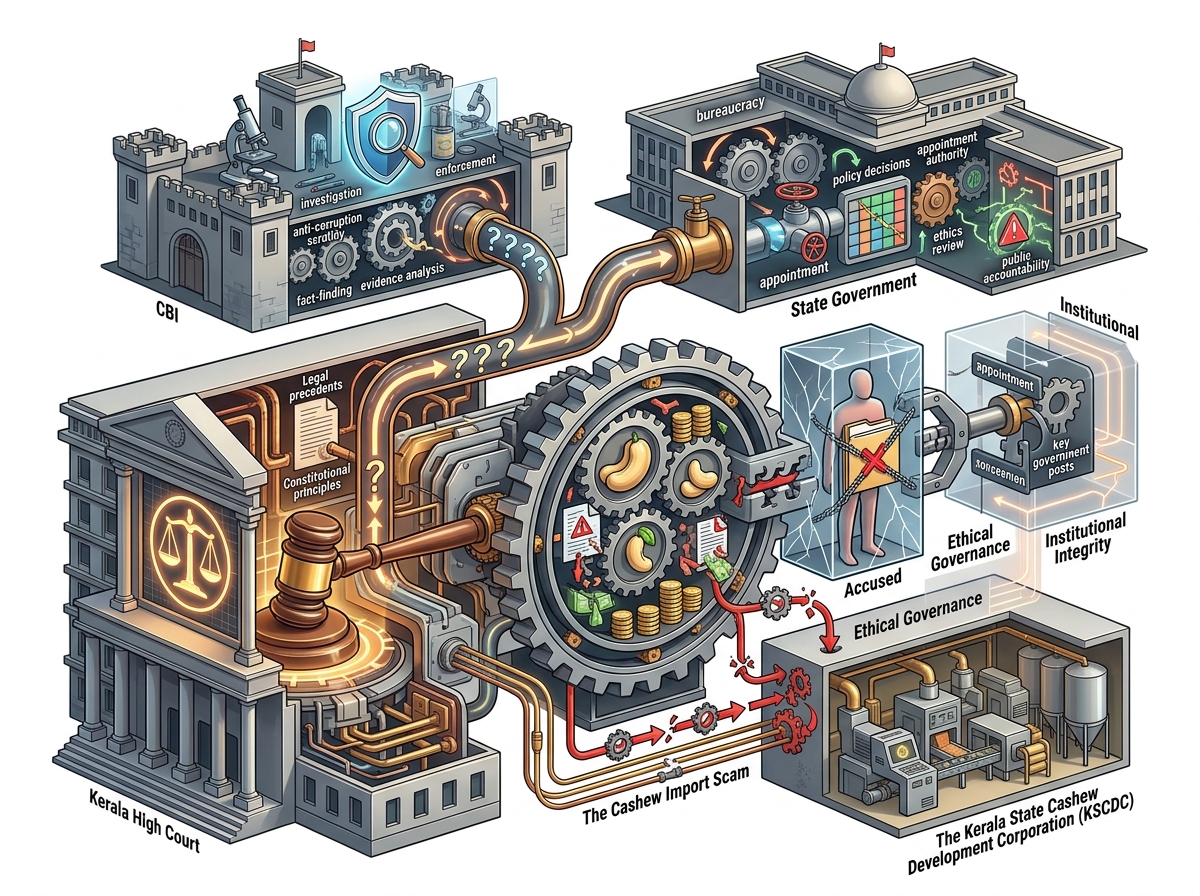
08 Aug Kerala HC seeks CBI, govt response on cashew scam accused’s posts
Kerala High CourtCBIState governmentKSCDCCashew import scam✎ The Kerala cashew import scam exemplifies systemic corruption in public procurement, where collusion between officials and private entities leads to financial losses and erodes institutional trust, necessitating stringent…
Subject Relevance — Where This Topic Fits
- GS Paper II — Constitutional and Non-Constitutional Bodies (Role of CBI, State Vigilance) | GS Paper III — Issues Relating to Transparency and Accountability in Governance | GS Paper IV — Ethics and Integrity in Governance (Public Service Values)
Quick Revision: The Kerala cashew import scam exemplifies systemic corruption in public procurement, where collusion between officials and private entities leads to financial losses and erodes institutional trust, necessitating stringent enforcement of anti-corruption laws and adherence to procurement norms.
Why is this in the news?
The Kerala High Court’s directive to the CBI and State government to respond to a Public Interest Litigation (PIL) seeking to bar K.A. Ratheesh, a chargesheeted accused in the ₹600-crore cashew import scam, from holding key government posts, underscores the intersection of judicial oversight, anti-corruption enforcement, and ethical governance in public administration. The case highlights systemic vulnerabilities in tender processes, procurement norms, and the appointment of officials facing serious corruption allegations, raising critical questions about institutional integrity and the enforcement of anti-corruption statutes in India.
Background
- The Kerala State Cashew Development Corporation (KSCDC) is a statutory body established under the Kerala Cashew Development Corporation Act, 1969, tasked with promoting cashew cultivation, processing, and marketing in Kerala.
- Between 2006 and 2015, KSCDC allegedly engaged in large-scale financial misappropriation through the import of raw cashew nuts at inflated prices, violating procurement norms and store purchase rules.
- The CBI, in its investigation, identified K.A. Ratheesh (former Managing Director) and R. Chandrasekharan (former Chairman) as the primary accused, accusing them of conspiring with private suppliers to award tenders at exorbitant rates, resulting in a pecuniary loss of approximately ₹600 crore to the exchequer.
- The CBI filed chargesheets against the accused, and prosecution sanction was granted, indicating prima facie evidence of criminal conspiracy and breach of trust under the Indian Penal Code (IPC) and the Prevention of Corruption Act, 1988.
- The PIL filed by K.M. Shajahan, a former Additional Private Secretary to the late Chief Minister V.S. Achuthananthan, alleges that Ratheesh’s continued occupation of key government posts—including Secretary of the Kerala Khadi and Village Industries Board—violates public integrity norms and undermines institutional credibility.
- The case has drawn attention to the procedural lapses in tendering processes, the lack of transparency in procurement, and the ethical obligations of public servants, particularly those facing corruption charges.
What is the Kerala Cashew Import Scam?
- The Kerala cashew import scam refers to a multi-year financial fraud involving the Kerala State Cashew Development Corporation (KSCDC), where officials allegedly colluded with private suppliers to import raw cashew nuts at inflated prices between 2006 and 2015.
- The scam involved the violation of procurement norms, including bypassing the mandatory tendering process and store purchase rules, leading to a loss of approximately ₹600 crore to the state exchequer.
- The Central Bureau of Investigation (CBI) investigated the case and identified K.A. Ratheesh (former Managing Director) and R. Chandrasekharan (former Chairman) as the primary accused, charging them under sections of the Indian Penal Code (IPC) and the Prevention of Corruption Act, 1988, including criminal conspiracy (Section 120B IPC), criminal breach of trust (Section 409 IPC), and offences under the Prevention of Corruption Act.
- The CBI’s investigation revealed that tenders were awarded to select private suppliers at rates significantly higher than market prices, with no competitive bidding or adherence to procurement guidelines, indicating a systemic failure in governance and oversight.
- The scam has raised concerns about the integrity of public procurement systems, the role of statutory bodies in economic governance, and the enforcement of anti-corruption laws in India.
- The case also highlights the ethical obligations of public servants, particularly those facing corruption charges, to recuse themselves from positions of authority to maintain public trust and institutional credibility.
- The ongoing legal proceedings and the Kerala High Court’s intervention underscore the judiciary’s role in ensuring accountability and transparency in governance, particularly in cases involving high-ranking officials.
Key Features
| Feature | Significance |
|---|---|
| Allegation of corruption in cashew import scam | Highlights systemic vulnerabilities in procurement processes of State-owned corporations, particularly in high-value agricultural commodity imports. |
| Appointment of an accused officer to key government posts | Demonstrates the tension between administrative expediency and the principle of public integrity, raising questions about due diligence in postings. |
| Role of CBI in investigating financial misconduct | Underscores the investigative mandate of the CBI in cases involving public funds and corruption, particularly in State corporations. |
| Judicial intervention via High Court | Reflects the judiciary’s role in ensuring accountability and adherence to norms in public appointments and corruption cases. |
| Alleged substandard procurement in Khadi Board | Links corruption in one sector (cashew imports) to potential malpractice in another (Khadi and Village Industries Board), indicating systemic rot. |
Why it Matters
Economic Governance
- Exposes structural weaknesses in the procurement and financial management of State-owned enterprises, particularly in commodity imports where price volatility and quality control are critical.
- Raises concerns about the economic cost of corruption to public exchequer, as alleged losses in the cashew scam (₹600 crore) and potential losses in Khadi Board procurement (₹300 crore) demonstrate.
- Highlights the need for robust internal audits, transparent tendering processes, and strict adherence to procurement rules in State corporations to prevent financial haemorrhage.
Administrative Integrity
- Challenges the ethical standards of public appointments, particularly when accused individuals continue to hold key positions despite ongoing corruption cases.
- Raises questions about the efficacy of vigilance mechanisms in State governments, including the role of the Vigilance Director and CBI in addressing representations promptly.
- Underscores the importance of ‘cooling-off periods’ and conflict-of-interest norms in postings to maintain public trust in governance.
Judicial Oversight
- Demonstrates the judiciary’s proactive role in ensuring accountability in cases of alleged corruption, particularly when executive actions may contravene public interest.
- Highlights the role of the High Court in directing responses from investigating agencies (CBI) and the State government, ensuring due process and transparency.
- Serves as a check against executive discretion in appointments, reinforcing the principle that public office is a trust, not a privilege.
Policy and Institutional Reforms
- Calls for systemic reforms in State-owned corporations, including mandatory digitalisation of procurement processes, third-party audits, and real-time financial monitoring.
- Emphasises the need for stricter norms for postings of officers facing corruption charges, including debarment from key positions until the conclusion of legal proceedings.
- Advocates for the establishment of independent anti-corruption ombudsmen at the State level to investigate and recommend action in such cases.
Challenges
1. Systemic Corruption in State Corporations
- Pervasive corruption in procurement processes of State-owned enterprises, particularly in high-value commodity imports, leading to financial losses and erosion of public trust.
- Lack of robust internal controls and audit mechanisms to detect and prevent financial misconduct in State corporations.
- Delayed or inadequate responses from vigilance and investigating agencies, allowing accused individuals to continue in positions of power.
UPSC Link: GS3: Challenges to Internal Security through Corruption
2. Conflict Between Administrative Expediency and Public Integrity
- Tension between the need for administrative continuity and the requirement to uphold public integrity, particularly in postings of accused officers.
- Lack of clear guidelines on ‘cooling-off periods’ or debarment norms for officers facing corruption charges, leading to ambiguity in appointments.
- Potential for political interference in postings, as alleged in the case of the Khadi and Village Industries Board, where the Chief Minister is the Chairman.
UPSC Link: GS4: Ethics and Integrity in Governance
3. Judicial vs. Executive Overreach
- Risk of judicial overreach in cases where the judiciary directs executive actions, potentially encroaching on the domain of the elected government.
- Challenge of balancing judicial activism with the principle of separation of powers, particularly in cases involving public appointments and corruption.
- Need for clear demarcation of roles between the judiciary, executive, and investigating agencies to ensure accountability without undermining governance.
UPSC Link: GS2: Separation of Powers
4. Economic Cost of Corruption
- Direct financial losses to the exchequer due to inflated procurement costs, as seen in the cashew import scam (₹600 crore) and potential losses in Khadi Board procurement (₹300 crore).
- Erosion of investor confidence in State-owned enterprises, leading to reduced economic efficiency and growth.
- Misallocation of public resources, diverting funds from developmental projects to corrupt practices.
UPSC Link: GS3: Inclusive Growth and Associated Challenges
5. Lack of Transparency in Procurement
- Absence of transparent and competitive bidding processes in State corporations, leading to favouritism and corruption.
- Inadequate documentation and record-keeping in procurement, making it difficult to trace financial irregularities.
- Failure to adhere to norms set by central bodies (e.g., Central Khadi Board) in procurement, as alleged in the Khadi Board case.
UPSC Link: GS3: Government Budgeting
Challenges — UPSC Perspective
| Issue | Concern |
|---|---|
| Corruption in State corporations | Financial losses, erosion of public trust, and systemic inefficiencies in governance. |
| Appointment of accused officers to key posts | Undermines public integrity, raises ethical concerns, and violates norms of transparency. |
| Delayed responses from vigilance agencies | Allows accused individuals to retain power, exacerbating corruption and impeding justice. |
| Substandard procurement in Khadi Board | Potential financial haemorrhage, violation of central norms, and loss of trust in government schemes. |
| Judicial intervention in executive matters | Risk of judicial overreach, ambiguity in separation of powers, and challenges to executive autonomy. |
Way Forward
- Enact legislation mandating ‘cooling-off periods’ for officers facing corruption charges before they can be appointed to key government posts.
- Strengthen internal audit mechanisms in State corporations by introducing real-time financial monitoring and third-party audits.
- Establish independent anti-corruption ombudsmen at the State level to investigate and recommend action in cases of financial misconduct.
- Digitise all procurement processes in State corporations to ensure transparency, competitive bidding, and adherence to norms.
- Enforce strict debarment norms for officers facing corruption charges, including automatic suspension from key posts until the conclusion of legal proceedings.
- Conduct mandatory training for government officials on ethical governance, conflict-of-interest norms, and due diligence in postings.
- Encourage whistleblower protection mechanisms to incentivise the reporting of financial irregularities in State corporations.
UPSC Value Addition
Keywords for Mains Answer-Writing
Corruption in public procurement · CBI’s role in corruption cases · Public integrity norms · Vigilance mechanisms in India · Prosecution sanction under criminal law · Public office disqualifications · Judicial oversight of executive appointments · Economic offences and governance · Kerala State Cashew Development Corporation (KSCDC) · Khadi and Village Industries Board · RUTRONIX · Onam procurement scams · Article 311 of the Constitution · Prevention of Corruption Act, 1988 · Central Vigilance Commission (CVC) · Judicial review of executive actions
Constitutional & Policy Linkages
- [‘Article 323A’, ‘Establishment of Administrative Tribunals’]
- [‘Article 324’, “Election Commission’s role in ensuring transparency”]
Concept Flow
Alleged financial misconduct in KSCDC’s cashew imports (2006–2015) → CBI investigation and chargesheet → Accused officer (K.A. Ratheesh) appointed to key government posts → Petition alleging violation of public integrity norms → Kerala High Court seeks responses from CBI and State government → Judicial intervention to ensure accountability and transparency.
Prelims Practice Questions
Q1. Consider the following statements regarding the Central Bureau of Investigation (CBI) in India:
1. The CBI is a statutory body established under the Delhi Special Police Establishment Act, 1946.
2. The CBI derives its investigative powers from the Code of Criminal Procedure, 1973.
3. The CBI can investigate cases referred to it by the High Courts or the Supreme Court of India.
4. The appointment of the CBI Director requires the approval of the Leader of Opposition in the Lok Sabha.
How many of the above statements are correct?
- Only one
- Only two
- Only three
- All
Answer: All — Statements 1, 2, and 3 are correct. Statement 4 is incorrect as the CBI Director is appointed based on the recommendation of a committee headed by the Prime Minister, with members including the Leader of Opposition and the Chief Justice of India.
Q2. Assertion (A): The Prevention of Corruption Act, 1988, empowers the Central Vigilance Commission (CVC) to conduct inquiries into allegations of corruption against public servants.
Reason (R): The CVC is a statutory body established under the Central Vigilance Commission Act, 2003, and functions as the apex vigilance institution in India.
- Both A and R are true, and R is the correct explanation of A
- Both A and R are true, but R is not the correct explanation of A
- A is true but R is false
- A is false but R is true
Answer: Both A and R are true, but R is not the correct explanation of A — Both Assertion (A) and Reason (R) are correct, and Reason (R) correctly explains Assertion (A). The CVC, established under the Central Vigilance Commission Act, 2003, is empowered to conduct inquiries into corruption allegations and supervise the vigilance work of central government organizations.
Q3. Match the following provisions of the Constitution of India with their respective articles:
Column I
A. Prohibition of discrimination on grounds of religion, race, caste, sex or place of birth
B. Equality of opportunity in matters of public employment
C. Protection of certain rights regarding freedom of speech etc.
D. Protection against arrest and detention in certain cases
Column II
1. Article 16
2. Article 19
3. Article 14
4. Article 22
- A-3, B-1, C-2, D-4
- A-1, B-3, C-4, D-2
- A-4, B-2, C-1, D-3
- A-2, B-4, C-3, D-1
Answer: A-3, B-1, C-2, D-4 — Correct match: A-3 (Article 14), B-1 (Article 16), C-2 (Article 19), D-4 (Article 22).
Mains Practice Question
✍ The appointment of persons facing serious corruption charges to key government posts undermines the foundational principles of public integrity and transparency. Critically examine this proposition with reference to the cashew import scam in Kerala and the legal provisions governing disqualification from public office. (15 Marks)
Approach: MODEL-ANSWER SKELETON:
1. **Introduction (2 marks)**: Define public integrity and transparency as constitutional values under Articles 14, 16, and 300A of the Constitution. Highlight the importance of ethical governance in maintaining public trust.
2. **Factual Context (3 marks)**: Briefly outline the cashew import scam involving K.A. Ratheesh and the KSCDC, citing the CBI chargesheet and the ₹600-crore misappropriation. Mention the current posts held by Ratheesh (Khadi Board Secretary, RUTRONIX MD, Khadi Workers’ Welfare Fund CEO).
3. **Legal Framework (4 marks)**:
– **Article 311 of the Constitution**: Safeguards against arbitrary dismissal of public servants but does not bar appointment.
– **Prevention of Corruption Act, 1988**: Sections 13(1)(d) and 13(2) criminalise misconduct by public servants.
– **Prosecution Sanction**: Under Section 19 of the Act, sanction is required for prosecution; its absence does not preclude appointment.
– **Central Vigilance Commission (CVC) Guidelines**: Recommend disqualification of corrupt officials from holding public office.
4. **Judicial Precedents (3 marks)**:
– **Union of India v. Tulsiram Patel (1985)**: Article 311 protects against dismissal but does not address appointment.
– **Lakshmi Kant Pandey v. Union of India (1984)**: Courts have upheld the executive’s discretion in appointments, subject to constitutional morality.
– **Recent Kerala High Court observations**: In the present case, the court has sought responses from the CBI and state government, indicating judicial scrutiny of such appointments.
5. **Critical Analysis (2 marks)**:
– **Executive Discretion vs. Public Trust**: While the executive has discretion in appointments, appointing a chargesheeted official may erode public confidence in governance.
– **Vigilance Mechanisms**: The CVC and state vigilance bodies must proactively recommend disqualification to prevent such appointments.
6. **Conclusion (1 mark)**: Emphasise the need for stricter adherence to integrity norms, possibly through legislative amendments or executive guidelines, to disqualify corrupt officials from holding public office.
Source: The Hindu
Generated by AanyaAi for educational purpose.

- विधायकों की चुप्पी को न्यायालय कैसे मान सकता है शून्य? मद्रास हाईकोर्ट का महत्वपूर्ण फैसला - September 23, 2026
- वायुसेना को मिला बड़ा हथियार: ₹811 करोड़ के 160 स्मार्ट एंटी-एयरफील्ड वेपन समझौता - September 23, 2026
- UPSC Exam Alert: Defence Ministry signs ₹811 Crore SAT-SAAW deal for IAF - September 23, 2026

No Comments