


08 Aug Kerala HC seeks CBI response on cashew scam accused in govt posts
Kerala High CourtCBIState governmentPILK.A. RatheeshKSCDC✎ The Kerala High Court’s directive to the CBI and State government underscores the constitutional imperative to bar individuals facing corruption charges from holding public office.
Subject Relevance — Where This Topic Fits
- GS Paper II — Functions and Responsibilities of the Union and the States, Issues and Challenges Pertaining to the Federal Structure | GS Paper III — Issues related to Direct and Indirect Farm Subsidies and Minimum Support Prices; Public Distribution System; Issues of Buffer Stocks and Food Security; Technology Missions; Economics of Animal-Rearing
- Prelims: KSCDC, CBI, Vigilance Director, corruption scam, public integrity norms, tender manipulation, Khadi and Village Industries Board, RUTRONIX, Kerala Khadi Workers’ Welfare Fund Board, sanction for prosecution, tender fraud, substandard procurement, federal structure in corruption cases
- Essay: Ethical governance and institutional accountability in India: Lessons from the Kerala cashew import scam, The role of vigilance institutions in preserving public trust: A case study of the Kerala High Court’s intervention
Quick Revision: The Kerala High Court’s directive to the CBI and State government underscores the constitutional imperative to bar individuals facing corruption charges from holding public office.
Why is this in the news?
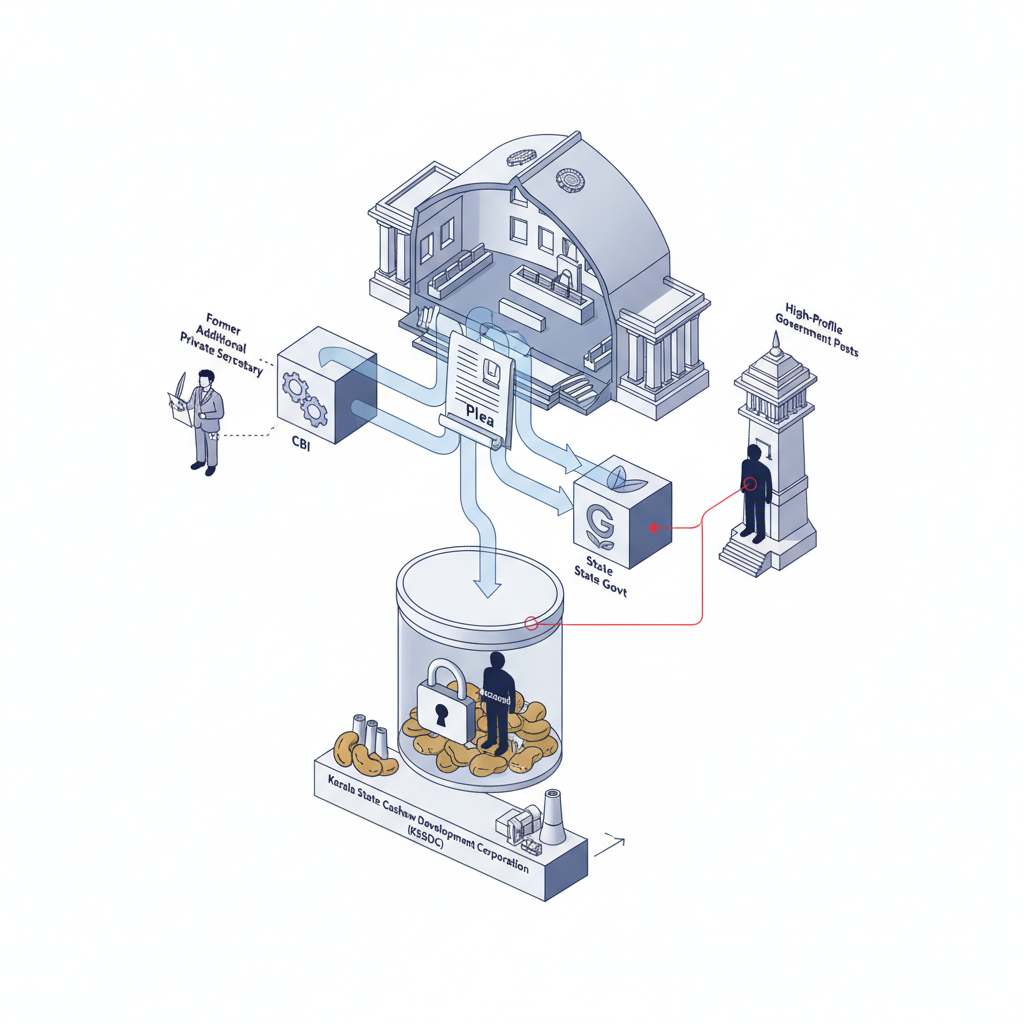
The Kerala High Court has issued a directive to the Central Bureau of Investigation (CBI) and the State government to respond to a public interest litigation (PIL) challenging the continued employment of K.A. Ratheesh, a key accused in the ₹600 crore cashew import scam, in multiple high-profile government posts. The petition, filed by a former Additional Private Secretary to the late Chief Minister V.S. Achuthananthan, alleges violations of public integrity norms and seeks to bar Ratheesh from holding office during ongoing corruption proceedings. This case underscores the tension between administrative continuity and the imperative to uphold anti-corruption standards in public office.
Background
- The Kerala State Cashew Development Corporation (KSCDC) was established under the Kerala Cashew Development Corporation Act, 1969, to promote the cashew industry, ensure fair wages, and regulate trade practices in Kerala.
- Between 2006 and 2015, KSCDC allegedly engaged in large-scale financial misappropriation through the import of raw cashew nuts at inflated prices, bypassing established procurement norms and tender procedures.
- The CBI registered a case against K.A. Ratheesh (former MD of KSCDC) and R. Chandrasekharan (former Chairman), accusing them of conspiracy, criminal breach of trust, and forgery to defraud the exchequer.
- The alleged scam involved the awarding of tenders to private suppliers at rates significantly higher than market prices, resulting in an estimated loss of ₹600 crore to the State exchequer.
- The CBI obtained prosecution sanction against Ratheesh, yet he continues to hold multiple key government positions, raising concerns about the State’s commitment to anti-corruption norms.
- The petitioner’s allegations extend to the Khadi and Village Industries Board, where Ratheesh serves as Secretary, citing risks of substandard procurement and financial irregularities during the festive season.
What is the Kerala Cashew Import Scam?
- The scam pertains to the alleged misappropriation of public funds by the Kerala State Cashew Development Corporation (KSCDC) through fraudulent import practices between 2006 and 2015.
- Key accused, K.A. Ratheesh and R. Chandrasekharan, are alleged to have colluded with private suppliers to inflate cashew import prices, bypassing tender norms and procurement rules.
- The CBI’s investigation revealed that tenders were awarded to favoured suppliers, often without competitive bidding, leading to inflated costs and financial losses estimated at ₹600 crore.
- The scam exemplifies the risks of administrative discretion in public procurement, particularly in state-owned corporations where oversight mechanisms may be weak or compromised.
- The case highlights the procedural lapses in sanctioning prosecutions under the Prevention of Corruption Act, 1988, and the challenges in ensuring timely justice in corruption cases.
- The ongoing employment of Ratheesh in government posts despite prosecution sanction raises questions about the efficacy of vigilance mechanisms and the role of political executive in upholding integrity.
- The Kerala High Court’s intervention reflects judicial activism in safeguarding public interest, particularly where executive inaction may undermine anti-corruption efforts.
- The case also intersects with the functioning of the Khadi and Village Industries Board and other state enterprises, where Ratheesh holds concurrent positions, amplifying concerns over conflict of interest.
Key Features
| Feature | Significance |
|---|---|
| Alleged ₹600-crore cashew import scam (2006–2015) | Highlights systemic corruption in public sector undertakings, particularly in procurement processes, leading to financial losses and erosion of institutional credibility. |
| CBI chargesheet against K.A. Ratheesh | Demonstrates the role of investigative agencies in uncovering financial irregularities and holding public servants accountable for malfeasance. |
| Kerala High Court’s directive to CBI and State government | Reinforces judicial oversight over executive actions, particularly in matters involving corruption and appointment of tainted officials. |
| Petition by K.M. Shajahan | Illustrates the role of whistleblowers and public interest litigation in exposing administrative lapses and demanding transparency. |
| Ongoing prosecution sanction against Ratheesh | Underscores the procedural delays in corruption cases, raising questions about the efficacy of the sanction mechanism under the Prevention of Corruption Act, 1988. |
Why it Matters
Economic
- Exposes systemic inefficiencies in public procurement, leading to financial losses of ₹600 crore, which could have been utilised for developmental projects.
- Undermines investor confidence in Kerala’s public sector enterprises, particularly in agro-based industries like cashew processing.
- Raises concerns about the misuse of funds allocated for welfare schemes, such as the Khadi and Village Industries Board, due to alleged substandard purchases.
Institutional
- Demonstrates the need for robust internal audits and vigilance mechanisms in public sector undertakings to prevent financial misconduct.
- Highlights the role of the judiciary in ensuring accountability and transparency in governance, particularly in cases involving corruption.
- Exposes gaps in the appointment process for key posts, where individuals facing corruption charges are retained in sensitive positions.
Legal
- Reinforces the importance of the Prevention of Corruption Act, 1988, in addressing financial irregularities in public offices.
- Raises questions about the timeliness of prosecution sanctions and the delays in judicial proceedings in corruption cases.
- Emphasises the role of the Central Vigilance Commission (CVC) and the CBI in investigating and prosecuting financial crimes in the public sector.
Ethical
- Undermines public trust in governance institutions by exposing corruption in high-profile public sector roles.
- Highlights the ethical responsibility of public servants to uphold integrity and transparency in their official duties.
- Demonstrates the importance of whistleblowers in exposing corruption and ensuring accountability in public administration.
Challenges
1. Delays in Prosecution Sanctions
- Prolonged delays in granting prosecution sanctions under the Prevention of Corruption Act, 1988, hinder timely justice.
- Undermines the deterrent effect of anti-corruption laws, as accused officials may continue in office during prolonged investigations.
- Delays in sanctions also contribute to the backlog of corruption cases in courts, exacerbating judicial inefficiencies.
UPSC Link: Laxmi Kant Pandey vs Union of India (1991)
2. Lack of Transparency in Appointments
- Appointment of officials facing corruption charges to key government posts violates norms of public integrity.
- Undermines the credibility of selection committees and raises questions about political interference in appointments.
- Exposes gaps in the vigilance and integrity verification processes before appointing individuals to sensitive positions.
UPSC Link: Article 16(2) – Equality of Opportunity
3. Weak Internal Audits and Vigilance Mechanisms
- Inadequate internal audits in public sector undertakings allow financial irregularities to go undetected for years.
- Lack of robust vigilance mechanisms enables officials to bypass procurement rules and engage in corrupt practices.
- Exposes the need for independent audits and real-time monitoring of financial transactions in public enterprises.
UPSC Link: CVC Guidelines on Vigilance
4. Judicial Backlog and Case Management
- Prolonged judicial proceedings in corruption cases delay justice and erode public confidence in the judicial system.
- High case backlog in special courts for corruption cases exacerbates delays in delivering judgments.
- Exposes the need for dedicated fast-track courts and streamlined procedures for corruption-related cases.
UPSC Link: Article 21 – Right to Speedy Trial
5. Public Sector Governance Deficits
- Systemic weaknesses in the governance of public sector undertakings facilitate financial misconduct and corruption.
- Lack of accountability in top management positions enables officials to exploit loopholes in procurement and financial management.
- Exposes the need for structural reforms in public sector governance to enhance transparency and accountability.
UPSC Link: SEBI (Listing Obligations and Disclosure Requirements) Regulations
Challenges — UPSC Perspective
| Issue | Concern |
|---|---|
| Prosecution sanction delays | Undermines the deterrent effect of anti-corruption laws and prolongs judicial proceedings. |
| Appointment of tainted officials | Violates norms of public integrity and erodes trust in governance institutions. |
| Weak internal audits | Allows financial irregularities to go undetected, facilitating corruption. |
| Judicial backlog in corruption cases | Delays justice and erodes public confidence in the judicial system. |
| Lack of transparency in procurement | Enables officials to bypass rules and engage in corrupt practices. |
| Political interference in appointments | Undermines the credibility of selection processes and promotes nepotism. |
Way Forward
- Strengthen internal audit mechanisms in public sector undertakings to detect financial irregularities in real time.
- Expedite prosecution sanctions under the Prevention of Corruption Act, 1988, to ensure timely justice in corruption cases.
- Implement mandatory integrity verification checks before appointing officials to key government posts.
- Establish dedicated fast-track courts for corruption cases to reduce judicial backlog and expedite trials.
- Enhance transparency in procurement processes by adopting e-procurement systems and third-party audits.
- Strengthen the role of the Central Vigilance Commission (CVC) in monitoring vigilance cases and ensuring accountability.
- Promote ethical governance through mandatory training on anti-corruption laws and whistleblower protection for public servants.
- Encourage the use of technology, such as blockchain, to track financial transactions and prevent fraud in public enterprises.
UPSC Value Addition
Keywords for Mains Answer-Writing
Corruption in Public Procurement · CBI and State Government Coordination · Public Integrity Norms · Vigilance Mechanisms in India · Chargesheeted Officials in Government Service · Public Sector Undertakings (PSUs) Governance · Kerala State Cashew Development Corporation (KSCDC) Scam · Constitutional Provisions on Corruption · Judicial Review of Executive Actions · Public Trust Doctrine
Constitutional & Policy Linkages
- Article 14 – Equality before Law (ensuring non-discriminatory treatment in appointments and investigations)
- Article 16(2) – Equality of Opportunity in Public Employment (preventing appointment of tainted officials)
Concept Flow
Alleged misappropriation in cashew imports by KSCDC (2006–2015) → Financial irregularities detected → CBI investigation initiated → Chargesheet filed against accused officials → Petition filed in Kerala High Court → Judicial oversight sought → Systemic gaps in governance exposed → Need for reforms in procurement, audits, and appointments identified
Prelims Practice Questions
Q1. Consider the following statements regarding the Kerala High Court’s directive in the cashew import scam case:
1. The High Court has directed the CBI to respond to allegations against a chargesheeted official.
2. The petitioner sought to bar the accused from holding key government posts.
3. The accused, K.A. Ratheesh, is currently serving as the Managing Director of RUTRONIX.
How many of the above statements are correct?
- Only one
- Only two
- All
- None
Answer: All — Statements 1 and 2 are correct as the High Court directed the CBI to respond and the petitioner sought to bar the accused from key posts. Statement 3 is incorrect as K.A. Ratheesh is the Secretary of the Kerala Khadi and Village Industries Board, not the Managing Director of RUTRONIX.
Q2. Assertion (A): The CBI is empowered to investigate corruption cases involving public servants under the Prevention of Corruption Act, 1988.
Reason (R): The CBI derives its investigative powers solely from the Constitution of India.
- Both A and R are true, and R is the correct explanation of A
- Both A and R are true, but R is not the correct explanation of A
- A is true but R is false
- A is false but R is true
Answer: A is true but R is false — Assertion (A) is true as the CBI investigates corruption cases under the Prevention of Corruption Act, 1988. Reason (R) is false because the CBI’s powers are derived from the Delhi Special Police Establishment Act, 1946, and not the Constitution.
Q3. Match the following bodies with their respective roles in combating corruption in India:
Column I
A. Central Vigilance Commission (CVC)
B. Lokpal
C. CBI
D. State Vigilance Departments
Column II
1. Investigates corruption cases referred by the CVC
2. Receives complaints against public servants and conducts inquiries
3. Acts as the apex anti-corruption body for states
4. Investigates corruption cases involving central government officials
- A-2, B-4, C-1, D-3
- A-1, B-2, C-4, D-3
- A-2, B-1, C-4, D-3
- A-3, B-2, C-1, D-4
Answer: A-1, B-2, C-4, D-3 — A-2: CVC receives complaints and conducts inquiries; B-1: Lokpal is the apex anti-corruption body; C-4: CBI investigates corruption cases involving central government officials; D-3: State Vigilance Departments act as the apex anti-corruption body for states.
Mains Practice Question
✍ The appointment of a chargesheeted official to key government posts undermines public trust in institutions. Critically examine the constitutional and legal framework governing such appointments in India. Also, analyse the role of judicial review in ensuring public integrity. (15 Marks)
Approach: MODEL-ANSWER SKELETON:
1. **Constitutional Framework**:
– Article 14 (Equality before Law) and Article 16 (Equality of Opportunity in Public Employment) — prohibition of arbitrary appointments.
– Article 324 (Election Commission) and Article 311 (Discharge of Public Servants) — safeguards against arbitrary removal but not appointments.
– Doctrine of Public Trust — State acts as a trustee of public resources (K.M. Nanavati case).
2. **Legal Framework**:
– Prevention of Corruption Act, 1988 — bars appointment of a person convicted of an offence involving moral turpitude.
– Section 19 of the Act — prior sanction for prosecution; does not explicitly bar appointment.
– All India Services (Conduct) Rules, 1968 — ethical standards for civil servants.
3. **Judicial Review and Precedents**:
– Supreme Court rulings on public integrity: Vineet Narain v. Union of India (1996) — judicial activism in corruption cases.
– High Court directives in the cashew scam case — judicial review of executive appointments.
– Balancing judicial restraint and activism in governance.
4. **Institutional Mechanisms**:
– Role of CVC, Lokpal, and State Vigilance Departments — oversight and inquiry.
– Coordination between CBI and State governments — challenges in the cashew scam case.
5. **Critique and Way Forward**:
– Gaps in the legal framework — lack of explicit bar on appointment of chargesheeted officials.
– Need for legislative reforms — amending Section 19 of the Prevention of Corruption Act to include appointment restrictions.
– Strengthening vigilance mechanisms — proactive role of CVC and Lokpal.
6. **Conclusion**:
– Public trust as a cornerstone of governance — appointment of chargesheeted officials erodes this trust.
– Judicial review as a safeguard — must be balanced with executive autonomy.
Source: The Hindu
Generated by AanyaAi for educational purpose.

- मुस्लिम महिलाओं को विरासत में समान अधिकार: सुप्रीम कोर्ट ने केंद्र से पूछा जवाब - September 23, 2026
- Supreme Court Questions Muslim Women’s Inheritance Rights Under Personal Law - September 23, 2026
- सुप्रीम कोर्ट ने पटना हाईकोर्ट के बलात्कार फैसले पर लिया स्वतः संज्ञान - September 23, 2026

No Comments