


26 Sep Kerala HC Stays Action Against CPI(M) Leader for Criticizing Home Minister
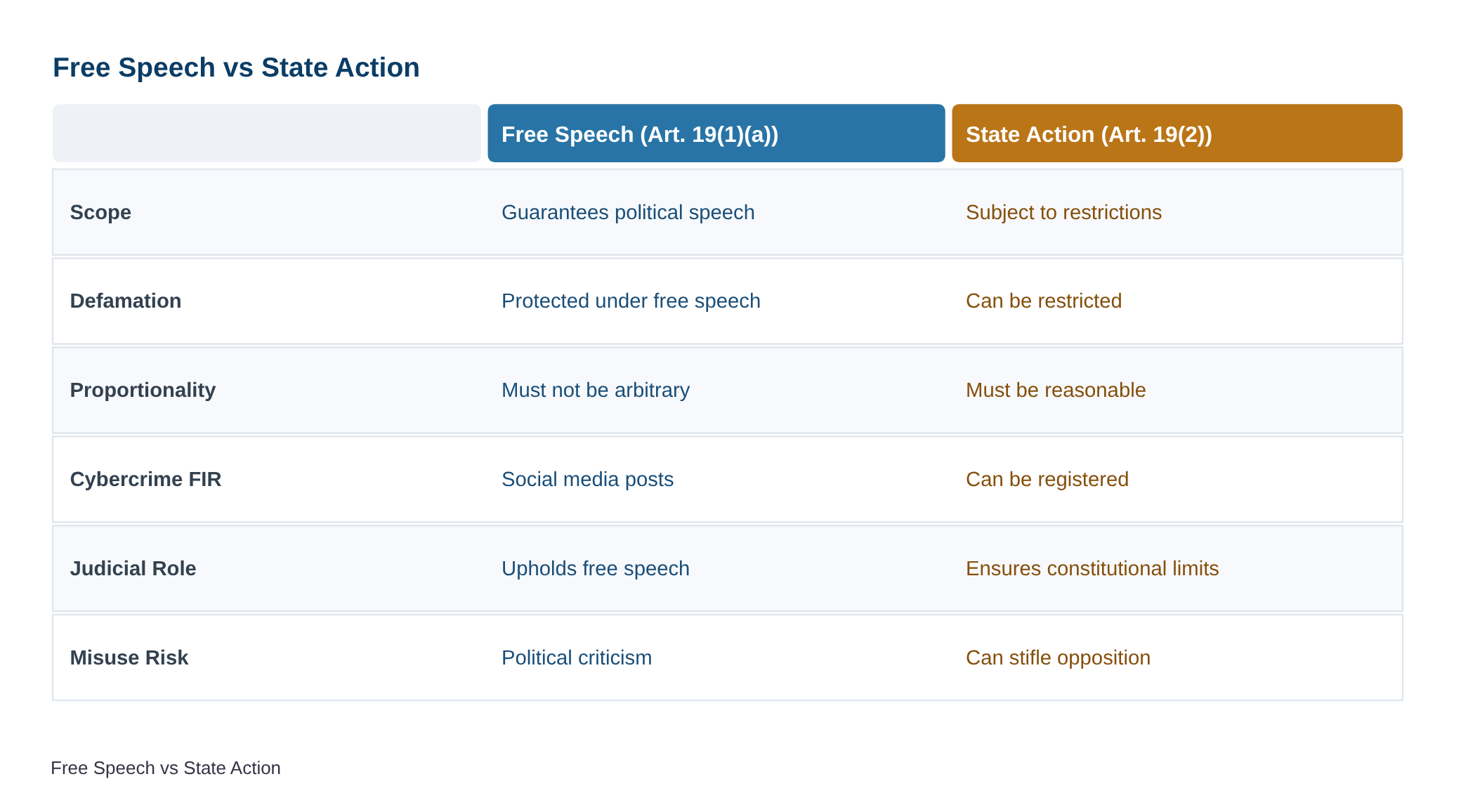
✎ The Kerala High Court’s order underscores that coercive state action in defamation cases must be proportionate, non-arbitrary, and consistent with constitutional guarantees of free speech under Article 19(1)(a).
Subject Relevance — Where This Topic Fits
- GS Paper II — Polity and Governance: Fundamental Rights and Judicial Review | GS Paper II — Polity and Governance: Role of the Judiciary | GS Paper IV — Ethics, Integrity and Aptitude: Civil Servants and Constitutional Values
- Prelims: Defamation under Bharatiya Nyaya Sanhita, 2023, Kerala Police Act, 2011, Article 19(1)(a) of the Constitution, Judicial review of executive actions, First Information Report (FIR), Cybercrime policing, Freedom of speech and reasonable restrictions
- Essay: Judicial Activism vs. Executive Discretion: Balancing Free Speech and Defamation, The Role of the Judiciary in Safeguarding Democratic Dissent
Quick Revision: The Kerala High Court’s order underscores that coercive state action in defamation cases must be proportionate, non-arbitrary, and consistent with constitutional guarantees of free speech under Article 19(1)(a).
Why is this in the news?
The Kerala High Court’s interim order restraining the State from taking coercive action against a CPI(M) member accused of defamation via social media comments on the Home Minister’s foreign trip underscores the judiciary’s role in protecting political speech from arbitrary state interference. The case highlights the tension between defamation laws and the constitutional guarantee of free speech, particularly in the digital public sphere, and raises questions about the proportionality of state action in politically sensitive contexts.
Background
- The Bharatiya Nyaya Sanhita, 2023, repealed and replaced the Indian Penal Code, 1860, consolidating criminal laws including defamation and provisions related to provocation of riots (Section 152).
- The Kerala Police Act, 2011, empowers the police to take action against acts of harassment, defamation, or incitement to violence, but its provisions must align with constitutional safeguards.
- Article 19(1)(a) of the Constitution guarantees freedom of speech and expression, subject to reasonable restrictions under Article 19(2) for defamation, public order, or incitement to an offence.
- The registration of an FIR under cybercrime provisions for social media posts reflects the growing intersection of digital communication and criminal liability.
- Judicial precedents, such as *Subramanian Swamy v. Union of India* (2016), have upheld the constitutional validity of defamation laws while emphasizing the need for proportionality in their application.
- The case follows a pattern of litigation where political criticism, particularly on social media, has led to legal challenges under defamation or public order laws.
Legal and Constitutional Framework Governing Defamation and Political Speech
- The **Kerala Police Act, 2011**, empowers the police to take action against harassment, defamation, or incitement to violence, but its application must be consistent with constitutional principles of free speech and due process.
- **Article 19(1)(a) and Reasonable Restrictions**: While freedom of speech is a fundamental right, it is not absolute. Reasonable restrictions can be imposed under Article 19(2) for defamation, public order, or incitement to an offence, provided such restrictions are narrowly tailored and proportionate.
- **Judicial Review of Executive Action**: The judiciary acts as a check on arbitrary state action, including the registration of FIRs and coercive measures. Courts can quash FIRs if they are found to be frivolous, mala fide, or in violation of constitutional rights.
- **Digital Public Sphere and Liability**: Social media posts fall under the ambit of digital communication, and their regulation must balance free speech with accountability. The **Information Technology Act, 2000**, and its rules provide a framework for addressing cybercrimes, including defamation and incitement.
- **Proportionality Principle**: The Supreme Court has repeatedly emphasized that any restriction on free speech must be proportionate to the harm caused. Courts assess whether the state’s response is necessary and least intrusive to achieve the legitimate aim.
- **Political Criticism and Democratic Dissent**: Political speech, even if critical or controversial, is protected under Article 19(1)(a) unless it crosses the threshold of defamation, incitement, or hate speech. The judiciary plays a crucial role in delineating this boundary.
- The **Kerala High Court’s interim order** in this case reflects the application of these principles, directing the state to refrain from coercive action pending a full hearing, thereby ensuring that the accused’s rights are not prejudiced by premature executive action.
Key Features
| Feature | Significance |
|---|---|
| Kerala High Court’s interim order | Restrains the State from coercive action against the accused, ensuring adherence to due process and preventing arbitrary exercise of police powers under the Kerala Police Act, 2011. |
| FIR registered under Bharatiya Nyaya Sanhita, 2023 | Demonstrates the legal framework governing defamation and incitement to riots, highlighting the intersection of criminal law and political speech in India. |
| Social media as a medium of political expression | Reinforces the role of digital platforms in public discourse, particularly in political criticism, and the legal scrutiny such expression may attract. |
| Right to criticism in a democratic polity | Underscores the constitutional protection for political dissent, subject to reasonable restrictions under Articles 19(1)(a) and 19(2) of the Constitution. |
| Judicial oversight of executive action | Illustrates the judiciary’s role in preventing executive overreach, particularly in cases involving political speech and coercive state action. |
Why it Matters
Legal and Constitutional
- The case exemplifies the delicate balance between freedom of speech under Article 19(1)(a) and reasonable restrictions under Article 19(2), particularly in the context of political speech and criticism of public officials.
- The Kerala High Court’s order reinforces the principle that coercive action against political speech must be proportionate and not arbitrary, aligning with the doctrine of ‘least restrictive means’ in constitutional law.
- The invocation of the Bharatiya Nyaya Sanhita, 2023, highlights the evolving legal framework governing defamation and incitement, necessitating clarity on what constitutes ‘defamatory’ or ‘inciting’ speech in a digital age.
- The case underscores the judiciary’s role in safeguarding democratic dissent, ensuring that political criticism does not unduly attract criminal liability unless it crosses the threshold of incitement to violence or public disorder.
Governance and Institutional
- The registration of an FIR against a political opponent for social media posts reflects the potential for misuse of criminal law to stifle political opposition, raising concerns about the politicisation of law enforcement.
- The Kerala Police Act, 2011, is invoked to address harassment, but its application in cases of political speech requires careful delineation to avoid chilling effects on democratic discourse.
- The case highlights the need for institutional safeguards to prevent arbitrary police action, particularly in cases involving high-ranking public officials and political figures.
- It also demonstrates the role of the judiciary in acting as a check against potential executive overreach in matters of political dissent.
Societal and Democratic
- The case underscores the importance of political criticism in a democracy, where public officials must be subject to scrutiny and accountability, including through social media platforms.
- The use of social media as a tool for political expression necessitates a nuanced understanding of its impact on public discourse, particularly in polarised political environments.
- The case raises questions about the threshold for what constitutes ‘defamatory’ or ‘inciting’ speech in the digital age, where context and intent are often subjective.
- It also highlights the role of political parties in shaping public narratives, where criticism of one party’s actions may be perceived as defamatory by another.
Challenges
1. Balancing Free Speech and Defamation
- The primary challenge lies in distinguishing between legitimate political criticism and defamatory speech, particularly in the context of social media where nuance is often lost.
- The legal framework under the Bharatiya Nyaya Sanhita, 2023, and the Indian Penal Code (where applicable) requires clarity on what constitutes ‘defamation’ in political discourse.
- The subjective nature of ‘defamation’ in political speech risks selective enforcement, where criticism of certain public officials may be treated more harshly than others.
- The challenge is exacerbated by the rapid dissemination of information on social media, where context and intent are difficult to establish.
UPSC Link: GS-2: Fundamental Rights and DPSP
2. Preventing Arbitrary Use of Criminal Law
- The registration of an FIR against a political opponent for social media posts raises concerns about the misuse of criminal law to suppress dissent or political opposition.
- The Kerala Police Act, 2011, and other laws must be applied judiciously to avoid chilling effects on democratic discourse and political criticism.
- The challenge is to ensure that law enforcement agencies do not become tools for political vendetta or intimidation under the guise of legal action.
- Institutional safeguards, such as prior judicial approval for coercive action, may be necessary to prevent arbitrary police action.
UPSC Link: GS-2: Structure, Organisation and Functioning of the Executive
3. Clarity in Legal Definitions
- The Bharatiya Nyaya Sanhita, 2023, introduces new provisions on defamation and incitement, but their application in cases of political speech remains ambiguous.
- The lack of clear guidelines on what constitutes ‘defamatory’ or ‘inciting’ speech in the digital age poses a challenge for both law enforcement and the judiciary.
- The challenge is compounded by the evolving nature of social media, where context, intent, and audience perception are difficult to quantify.
- Legal reforms may be required to provide clarity on the threshold for criminal liability in cases involving political speech.
UPSC Link: GS-2: Judiciary and Judicial Review
4. Protecting Democratic Dissent
- The case highlights the need to protect democratic dissent, particularly in an era where political criticism is increasingly expressed through digital platforms.
- The challenge is to ensure that political speech, even when critical or unflattering, does not unduly attract criminal liability unless it crosses the threshold of incitement to violence or public disorder.
- The judiciary plays a crucial role in safeguarding dissent, but institutional mechanisms must be strengthened to prevent executive overreach.
- The challenge also extends to political parties, which must foster a culture of tolerance for criticism rather than resorting to legal action to suppress opposition.
UPSC Link: GS-2: Fundamental Rights and DPSP
5. Digital Governance and Social Media Regulation
- The case underscores the need for a robust regulatory framework governing social media platforms, particularly in the context of political speech and misinformation.
- The challenge is to balance the need for free expression with the prevention of defamation, incitement, and harassment on digital platforms.
- The role of intermediaries (e.g., social media platforms) in moderating content raises questions about accountability and transparency in content removal policies.
- The challenge also extends to the judiciary, which must adapt to the unique characteristics of digital speech, where context and intent are often difficult to establish.
UPSC Link: GS-3: Science and Technology
6. Institutional Trust and Public Perception
- The registration of an FIR against a political opponent for social media posts may erode public trust in institutions, particularly if perceived as politically motivated.
- The challenge is to ensure that law enforcement agencies maintain impartiality and avoid being perceived as tools for political suppression.
- The judiciary’s role in acting as a check against executive overreach is crucial in maintaining institutional trust and democratic legitimacy.
- The challenge also extends to political parties, which must demonstrate a commitment to democratic norms and tolerance for dissent.
UPSC Link: GS-2: Structure, Organisation and Functioning of the Executive
Challenges — UPSC Perspective
| Issue | Concern |
|---|---|
| Ambiguity in defamation laws | Risk of selective enforcement and chilling effects on political criticism due to subjective interpretations of defamatory speech. |
| Misuse of criminal law | Potential for law enforcement agencies to be weaponised against political opponents under the guise of legal action. |
| Lack of clarity in digital speech regulations | Difficulty in establishing intent, context, and audience perception in cases involving social media posts. |
| Threat to democratic dissent | Risk of criminalising legitimate political criticism, thereby undermising democratic norms and public accountability. |
| Institutional bias in law enforcement | Perception of political interference in police actions, eroding public trust in institutions. |
| Adaptation of legal frameworks | Need for reforms to address the unique challenges posed by digital speech and social media platforms. |
Way Forward
- Conduct a comprehensive review of the Bharatiya Nyaya Sanhita, 2023, and related laws to clarify definitions of ‘defamation’ and ‘incitement’ in the context of political speech, ensuring alignment with constitutional principles.
- Establish institutional safeguards, such as prior judicial approval for coercive action against political speech, to prevent arbitrary police action and executive overreach.
- Strengthen the role of the judiciary in acting as a check against potential misuse of criminal law, particularly in cases involving high-ranking public officials and political figures.
- Develop clear guidelines for law enforcement agencies on the application of the Kerala Police Act, 2011, and other relevant laws in cases of political speech and social media posts.
- Promote digital literacy and awareness among political parties, law enforcement agencies, and the public to foster a culture of tolerance for criticism and dissent.
- Encourage social media platforms to adopt transparent and accountable content moderation policies, balancing free expression with the prevention of defamation and incitement.
- Conduct regular training for police personnel and judicial officers on the nuances of political speech, digital governance, and constitutional protections for dissent.
- Enhance inter-institutional coordination between the judiciary, law enforcement, and political parties to ensure impartiality and prevent the politicisation of legal action.
UPSC Value Addition
Keywords for Mains Answer-Writing
Defamation under Bharatiya Nyaya Sanhita, 2023 · Freedom of speech and expression under Article 19(1)(a) · Judicial review of FIRs · Kerala Police Act, 2011 · Criminal defamation · Procedural safeguards in criminal proceedings · Social media and free speech · Right to dissent · Constitutional remedies under Article 226 · Balancing free speech and reputation · Judicial restraint vs judicial activism · Protective jurisdiction of High Courts · Kerala High Court’s directive on coercive measures · Political speech and legal scrutiny · Procedural fairness in criminal law
Constitutional & Policy Linkages
- Article 19(1)(a): Freedom of speech and expression
- Article 19(2): Reasonable restrictions on free speech
Concept Flow
Political criticism on social media → Registration of FIR under Bharatiya Nyaya Sanhita, 2023 and Kerala Police Act, 2011 → Petition for quashing FIR in Kerala High Court → Interim order restraining coercive action → Debate on balance between free speech and defamation → Need for legal clarity and institutional safeguards
Prelims Practice Questions
Q1. Consider the following statements regarding defamation under the Bharatiya Nyaya Sanhita, 2023:
1. Defamation is punishable with imprisonment up to two years or fine or both.
2. Truth of the statement is a valid defence under Section 356.
3. The offence of defamation can be compounded by the complainant at any stage.
4. The offence is cognizable and non-bailable.
How many of the above statements are correct?
- Only one
- Only two
- Only three
- All four
Answer: Only three — Statements 1 and 2 are correct: Section 356 of the BNS prescribes imprisonment up to two years or fine or both for defamation, and truth is a valid defence under Section 357. Statement 3 is incorrect: defamation is not compoundable under the BNS. Statement 4 is incorrect: defamation is a non-cognizable offence under the BNS.
Q2. Assertion (A): The Kerala High Court, in the case of K.S. Arunkumar v. State of Kerala, directed the State to refrain from taking coercive steps against the accused during the pendency of the petition.
Reason (R): The High Court’s directive was based on the principle of judicial review of FIRs under Article 226 of the Constitution of India, which empowers it to quash proceedings if they are manifestly frivolous or vexatious.
Options:
A. Both (A) and (R) are true, and (R) is the correct explanation of (A).
B. Both (A) and (R) are true, but (R) is not the correct explanation of (A).
C. (A) is true, but (R) is false.
D. (A) is false, but (R) is true.
Answer: ? — Both (A) and (R) are true. The High Court’s directive to refrain from coercive steps is a standard protective measure during the pendency of a petition under Article 226. The reason (R) correctly explains the legal basis for such a directive, as Article 226 empowers High Courts to issue writs for the enforcement of fundamental rights and for other purposes, including judicial review of FIRs.
Q3. Match the following legal provisions with their corresponding statutes:
Column I (Provision) Column II (Statute)
1. Section 356 (Defamation) A. The Kerala Police Act, 2011
2. Section 357 (Defence of truth) B. The Bharatiya Nyaya Sanhita, 2023
3. Section 118 (Power to regulate assembly) C. The Code of Criminal Procedure, 1973
4. Section 41 (Arrest without warrant) D. The Indian Penal Code, 1860 (Repealed)
Options:
A. 1-B, 2-D, 3-A, 4-C
B. 1-B, 2-D, 3-C, 4-A
C. 1-D, 2-B, 3-A, 4-C
D. 1-B, 2-C, 3-D, 4-A
Answer: ? — 1-B: Section 356 (Defamation) is under the Bharatiya Nyaya Sanhita, 2023. 2-D: Section 357 (Defence of truth) is derived from Section 499 of the Indian Penal Code, 1860. 3-A: Section 118 (Power to regulate assembly) is under the Kerala Police Act, 2011. 4-C: Section 41 (Arrest without warrant) is under the Code of Criminal Procedure, 1973.
Mains Practice Question
✍ The Kerala High Court’s directive in K.S. Arunkumar v. State of Kerala, directing the State to refrain from taking coercive steps against the accused during the pendency of a petition challenging an FIR, underscores the delicate balance between freedom of speech and the protection of reputation. Critically examine this balance with reference to the constitutional framework, statutory provisions, and judicial precedents. Also, analyse the implications of such judicial interventions for the procedural fairness in criminal law. (15 Marks)
Approach: MODEL-ANSWER SKELETON:
1. **Constitutional Framework**:
– Freedom of speech and expression (Article 19(1)(a)) vs. reasonable restrictions under Article 19(2) (defamation as a ground).
– Judicial interpretation: *Romesh Thapar v. State of Madras* (1950), *Maneka Gandhi v. Union of India* (1978), and *Shreya Singhal v. Union of India* (2015).
– The balance between dissent and reputational harm.
2. **Statutory Provisions**:
– Defamation under Section 356 of the Bharatiya Nyaya Sanhita, 2023: elements, punishment, and defences (truth, public good).
– Procedural safeguards: Section 154 CrPC (FIR registration), Section 41 CrPC (arrest powers), and Section 167 CrPC (custodial interrogation).
– Protective measures under Section 482 CrPC (inherent powers of High Courts) and Article 226 (writs).
3. **Judicial Precedents**:
– *Arnesh Kumar v. State of Bihar* (2014): Supreme Court’s directive to refrain from automatic arrests in IPC 498A cases.
– *State of Haryana v. Bhajan Lal* (1992): Guidelines for quashing FIRs if they are frivolous or vexatious.
– *Rajesh Sharma v. State of U.P.* (2017): Directions to prevent misuse of Section 498A.
– *K.S. Arunkumar case*: High Court’s exercise of protective jurisdiction under Article 226.
4. **Procedural Fairness and Implications**:
– Judicial review of FIRs: scope, limits, and the thin line between judicial activism and restraint.
– Consequences of coercive measures: chilling effect on free speech, misuse of criminal law for political vendetta, and erosion of public trust in institutions.
– Role of the judiciary in ensuring that criminal law is not weaponised to stifle dissent or political opposition.
5. **Contemporary Relevance**:
– Social media and free speech: the challenge of regulating online speech without undermining democratic discourse.
– The need for clear guidelines on the registration of FIRs for defamation, especially in cases involving political speech.
6. **Conclusion**:
– The judiciary’s role in safeguarding constitutional values while ensuring that criminal law is not misused.
– The balance must tilt towards protecting free speech, subject to reasonable restrictions, and ensuring procedural fairness in criminal proceedings.
Source: The Hindu
Generated by AanyaAi for educational purpose.
Related guides on our sites
- Best PSIR optional coaching for upsc
- Best PSIR optional teacher for upsc
- Best teacher of PSIR optional for upsc
- Best PSIR optional coaching in delhi for UPSC

- Himachal CM Sukhu: All Doctor Vacancies to be Filled by March - September 27, 2026
- कैसे पुलिस की AI तकनीक पहचान कर रही है अस्पष्ट शवों को - September 27, 2026
- Jai Jyoti: 106 km Bisalpur Pipeline to End Jaipur Water Crisis - September 27, 2026

No Comments