


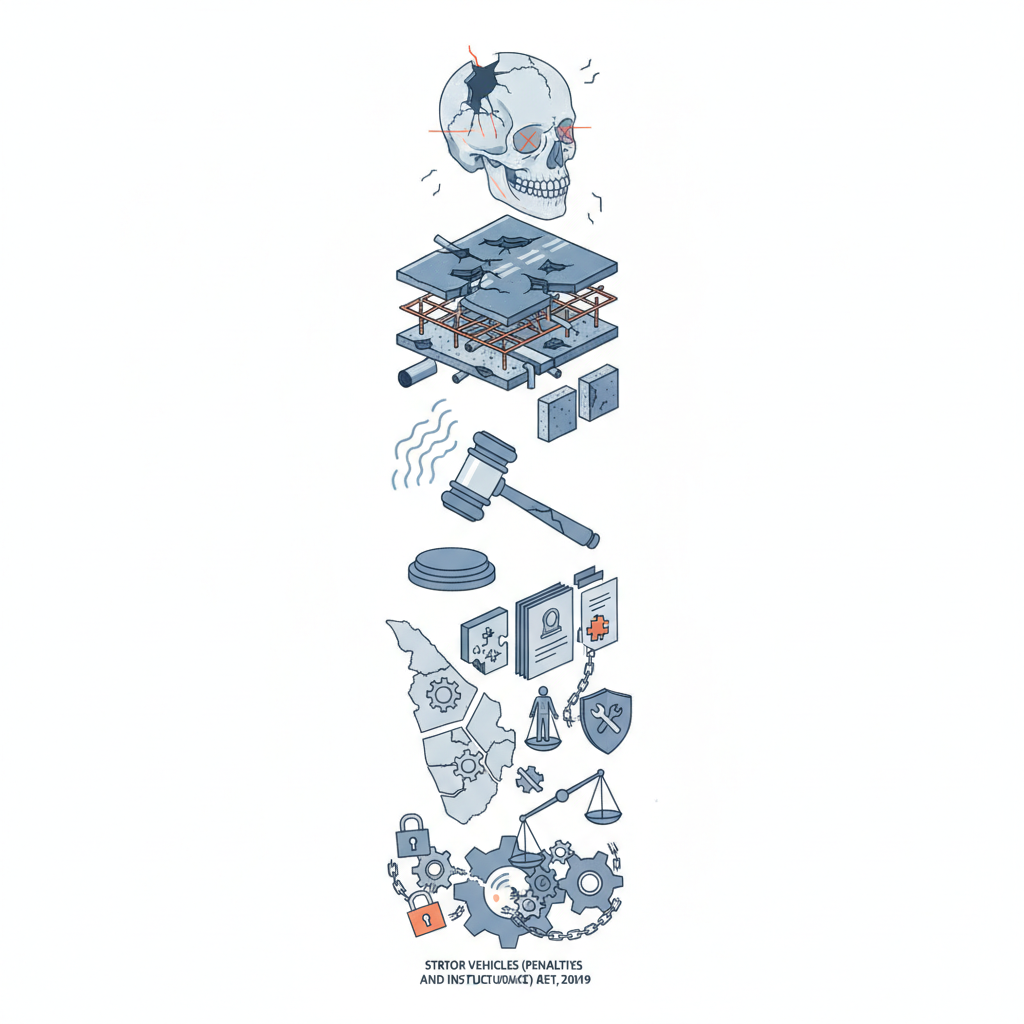
27 Sep Kerala High Court Slams Systemic Road Safety Failures: UPSC Analysis
✎ The Kerala High Court’s directive for an interdisciplinary road safety research committee and a unified monitoring framework underscores the need for evidence-based governance to address systemic deficiencies in road safety…
Subject Relevance — Where This Topic Fits
- GS Paper II — Governance, Constitution, Polity, Social Justice and International Relations (Road Safety as a Public Health and Governance Issue) | GS Paper III — Infrastructure, Environment and Disaster Management (Road Safety and Traffic Management)
- Prelims: Road Safety Audit, National Road Safety Policy 2019, Motor Vehicles (Amendment) Act, 2019, Kerala Road Safety Authority, Black Spot Identification and Rectification, Post-Crash Trauma Response, Driver Profiling, Highway Construction Standards
- Essay: Safety as a Fundamental Right: Balancing Development and Human Security, Judicial Activism in Governance: The Role of the Judiciary in Ensuring Public Welfare
Quick Revision: The Kerala High Court’s directive for an interdisciplinary road safety research committee and a unified monitoring framework underscores the need for evidence-based governance to address systemic deficiencies in road safety management.
Why is this in the news?
The Kerala High Court, in a landmark judgment delivered on 27 September 2026, highlighted systemic deficiencies in road safety management, attributing a significant proportion of road accidents and fatalities in Kerala to institutional failures. The judgment underscores the urgent need for an integrated, accountable, and evidence-based approach to road safety governance, including the establishment of an interdisciplinary research committee and district-level monitoring mechanisms. This ruling is significant for civil services aspirants as it exemplifies the judiciary’s role in directing executive action on public health and safety, a recurring theme in UPSC examinations.
Background
- The Motor Vehicles (Amendment) Act, 2019, introduced stringent penalties and institutional reforms to enhance road safety, including the establishment of the State Road Safety Councils and the National Road Safety Board.
- Kerala recorded 49,889 road accidents and 3,733 fatalities in 2025, with overspeeding identified as the leading cause, reflecting a broader national trend of high road fatality rates despite legislative measures.
- Institutional fragmentation among agencies such as the Public Works Department (PWD), Transport Department, Police, and local bodies has historically impeded coordinated action on road safety.
- The Kerala Road Safety Authority functions as the nodal agency for implementing road safety measures but faces challenges in enforcement and inter-departmental coordination.
What constitutes systemic road safety deficiencies and judicial responses?
- **Institutional Fragmentation**: The absence of a unified command structure leads to overlapping jurisdictions among the PWD, Transport Department, Police, and local bodies, resulting in delayed or inadequate responses to road safety risks.
- Road Safety Audit (RSA)**: A systematic evaluation of road design, signage, and traffic flow to identify hazards; deficiencies in RSA processes contribute to accident-prone stretches.
- Black Spots and Accident-Prone Stretches**: Locations with a disproportionately high number of accidents; Kerala’s High Court noted that despite identification, remedial actions are often not implemented due to lack of accountability.
- Driver Profiling and Training**: Inadequate screening of commercial drivers, particularly in public transport, exacerbates reckless driving and overloading, a recurring cause of fatal accidents.
- Post-Crash Trauma Response**: Delays in emergency medical care due to inadequate trauma infrastructure and coordination between hospitals and accident sites increase preventable fatalities.
- Behavioural Factors**: Psychological and sociological determinants, such as risk-taking, distraction, and non-compliance with traffic rules, require interdisciplinary research to inform policy interventions.
- Highway Construction Standards**: Poor quality control, utility works disrupting newly constructed roads, and deficient medians or lane markings contribute to structural vulnerabilities.
- Enforcement Gaps**: Weak traffic policing, inadequate penalties, and poor monitoring of compliance with safety regulations undermine deterrence and compliance.
Key Features
| Feature | Significance |
|---|---|
| Interdisciplinary road safety research committee | Addresses systemic behavioural and engineering factors in road accidents through expert-led research and policy recommendations. |
| District road safety monitoring committee | Ensures local-level compliance with road safety norms and timely redressal of public complaints. |
| Unified command and monitoring framework | Integrates multiple agencies (PWD, Transport, Police, NHAI) for coordinated road safety governance and accountability. |
| End-to-end risk identification mechanism | Links accident risk assessment, accountability, remedial action, and compliance monitoring in a single workflow. |
| Driver profiling in public transport | Mandates evaluation of driver competence and behavioural patterns to mitigate accident risks in commercial vehicles. |
Why it Matters
Public Health and Safety
- High fatality rate in Kerala (3,733 deaths in 49,889 accidents in 2025) underscores the urgency of systemic road safety reforms.
- Post-crash trauma response inadequacies highlight the need for integrated emergency medical and trauma care systems.
- Behavioural factors (overspeeding, reckless driving) require psychological and sociological interventions beyond engineering fixes.
Governance and Accountability
- Lack of inter-agency coordination and accountability among PWD, Transport, Police, and local bodies exacerbates road safety failures.
- Court-mandated committees (district and state-level) introduce structured oversight to break siloed governance.
- Mandatory compliance reports and public accessibility ensure transparency and judicial scrutiny of executive actions.
Infrastructure and Urban Planning
- Deficient road design elements (medians, lane markings, medians) directly contribute to accident severity and frequency.
- Utility works damaging newly constructed roads and improper highway construction standards reflect systemic engineering lapses.
- Illegal parking and roadside vending obstruct traffic flow, necessitating urban planning reforms and enforcement.
Legal and Judicial Framework
- Judicial activism in public interest litigation (PIL) compels executive action where statutory mechanisms fail.
- Court-appointed committees with interdisciplinary expertise set a precedent for evidence-based policy formulation.
- Time-bound directives (60 days for research committee, 15 days for district committees) enforce urgency in implementation.
Challenges
1. Inter-Agency Coordination Failures
- Fragmented responsibilities among PWD, Transport Department, Police, and local bodies lead to delayed or absent corrective action.
- Absence of a unified data-sharing platform hinders real-time monitoring and targeted interventions.
UPSC Link: GS-II: Governance, Transparency & Accountability
2. Behavioural and Cultural Factors
- Overspeeding and reckless driving are deeply ingrained cultural norms requiring sustained behavioural change campaigns.
- Inadequate driver profiling in public transport perpetuates unsafe driving practices despite regulatory frameworks.
UPSC Link: GS-IV: Ethics, Attitude, Aptitude
3. Infrastructure Maintenance Gaps
- Potholes, black spots, and poor-quality road construction persist due to inadequate maintenance schedules and utility work disruptions.
- Deficient medians and improper lane markings increase collision risks, particularly in high-traffic corridors.
UPSC Link: GS-III: Infrastructure Development
4. Post-Crash Response Deficiencies
- Inadequate trauma care infrastructure and delayed emergency response exacerbate accident fatalities.
- Lack of standardised protocols for post-crash medical evacuation and trauma management prolongs critical care gaps.
UPSC Link: GS-II: Health, Welfare Schemes
5. Urban Planning and Enforcement Lacunae
- Illegal parking, roadside vending, and encroachments obstruct traffic flow, necessitating stricter urban planning and enforcement.
- Utility works often damage newly constructed roads due to poor coordination between agencies and contractors.
UPSC Link: GS-III: Urbanisation, Smart Cities
Challenges — UPSC Perspective
| Issue | Concern |
|---|---|
| Overspeeding and reckless driving | Cultural acceptance of high-risk driving behaviours with minimal deterrence. |
| Poor road maintenance | Chronic underfunding and delayed repairs exacerbate accident risks. |
| Inter-agency silos | Lack of shared data and accountability frameworks hinders coordinated action. |
| Inadequate driver training | Public transport drivers often lack rigorous competency assessments. |
| Post-crash trauma response | Insufficient emergency medical infrastructure and delayed response times. |
| Urban encroachments | Illegal parking and roadside vending obstruct traffic flow and increase accident risks. |
Way Forward
- Constitute the interdisciplinary road safety research committee within 60 days to analyse behavioural and engineering factors.
- Establish district road safety monitoring committees within 15 days to review complaints and ensure compliance with court orders.
- Develop a unified command and monitoring framework integrating PWD, Transport, Police, and NHAI for real-time data sharing.
- Implement mandatory driver profiling and competency assessments for public transport operators with periodic re-evaluations.
- Standardise post-crash trauma response protocols and upgrade emergency medical infrastructure in high-risk zones.
- Enforce stricter urban planning regulations to eliminate illegal parking and roadside vending in accident-prone areas.
- Conduct annual audits of road infrastructure, including medians, lane markings, and utility work impacts, with public disclosure.
- Launch public awareness campaigns targeting overspeeding, reckless driving, and pedestrian safety in coordination with local bodies.
UPSC Value Addition
Keywords for Mains Answer-Writing
Kerala High Court road safety directions · interdisciplinary road safety research committee · systemic deficiencies in road infrastructure · behavioural factors in road accidents · unified command and monitoring framework for road safety · district road safety monitoring committee · accountability in road safety governance · post-crash trauma response in road accidents · driver profiling in public transport · National Highways Authority of India (NHAI) road safety · Kerala Road Safety Authority · public interest litigation road safety Kerala · overspeeding as leading cause of road accidents · road construction quality and utility works impact on safety · multi-agency coordination for road safety
Constitutional & Policy Linkages
- [‘Article 21: Right to Life and Personal Liberty’, ‘Ensures state’s obligation to provide safe road infrastructure.’]
- [‘Article 47: Duty of State to raise public health standards’, ‘Mandates state action to reduce accident fatalities.’]
Concept Flow
Inadequate road maintenance and poor infrastructure design → Increased accident risks and fatalities. → Cultural acceptance of reckless driving and weak enforcement → Normalisation of high-risk behaviours. → Fragmented governance among multiple agencies → Delayed corrective action and accountability gaps. → Inadequate post-crash trauma response → Higher fatality rates despite accident occurrence. → Judicial intervention via PIL → Court-mandated committees and unified monitoring frameworks. → Implementation of expert-led research and district-level oversight → Systematic identification and mitigation of systemic deficiencies. → Sustained public awareness and behavioural change campaigns → Long-term cultural shift towards road safety.
Prelims Practice Questions
Q1. Consider the following statements regarding road safety in India as per the Kerala High Court’s recent directives:
1. The court has mandated the constitution of an interdisciplinary road safety research committee within 60 days.
2. The committee must include traffic psychologists, behavioural scientists, and engineers.
3. The court directed the constitution of a district road safety monitoring committee within 15 days.
4. The court has granted 75 days for authorities to submit compliance reports.
How many of the above statements are correct?
- Only one
- Only two
- Only three
- All
Answer: All — Statements 1, 2, and 3 are correct as per the court’s directives. Statement 4 is incorrect; the court granted 75 days for compliance reports, not 75 days for constituting the committee.
Q2. Assertion (A): The Kerala High Court observed that overspeeding is the leading cause of road accidents in Kerala in 2025.
Reason (R): The court directed the constitution of a unified command and monitoring framework to integrate existing systems of PWD, Motor Vehicles department, and Kerala Police.
Options:
A. Both A and R are true, and R is the correct explanation of A.
B. Both A and R are true, but R is not the correct explanation of A.
C. A is true, but R is false.
D. A is false, but R is true.
Answer: ? — Both the Assertion (A) and Reason (R) are true. The court indeed noted overspeeding as the leading cause of accidents (A), and the unified framework (R) was directed to address systemic deficiencies, including behavioural factors contributing to accidents.
Q3. Match the following entities with their respective roles in road safety governance as directed by the Kerala High Court:
Entities:
1. Public Works Department (PWD)
2. District Collectors
3. National Highways Authority of India (NHAI)
4. Kerala Road Safety Authority
Roles:
A. Identify systemic deficiencies in road infrastructure and ensure compliance with court orders.
B. Constitute district road safety monitoring committees and review pending complaints.
C. Oversee road safety on national highways and coordinate with state agencies.
D. Implement road construction standards and monitor utility works impacting road quality.
Options:
1-A, 2-B, 3-C, 4-D
1-D, 2-A, 3-C, 4-B
1-D, 2-B, 3-A, 4-C
1-A, 2-D, 3-B, 4-C
Answer: ? — 1-D (PWD is responsible for road construction standards and monitoring utility works), 2-B (District Collectors are tasked with constituting district road safety monitoring committees), 3-C (NHAI oversees road safety on national highways), 4-A (Kerala Road Safety Authority is responsible for identifying systemic deficiencies and ensuring compliance).
Mains Practice Question
✍ The Kerala High Court has highlighted systemic deficiencies in road safety governance, including lack of accountability, poor infrastructure, and behavioural factors contributing to road accidents. Critically examine the court’s directions for addressing these deficiencies, with reference to the proposed interdisciplinary road safety research committee and the unified command and monitoring framework. Also, assess the potential challenges in implementing these directives within the stipulated timelines. (15 Marks)
Approach: MODEL-ANSWER SKELETON:
1. **Introduction (2 marks)**: Briefly state the context—Kerala High Court’s observations on systemic deficiencies in road safety, citing 2025 data (49,889 accidents, 3,733 deaths) and overspeeding as the leading cause. Define systemic deficiencies and their governance implications.
2. **Court’s Directions (5 marks)**:
– **Interdisciplinary Road Safety Research Committee (2 marks)**: Constitution within 60 days, comprising traffic psychologists, behavioural scientists, engineers, and other experts. Purpose: Study behavioural factors (e.g., reckless driving, overloading) and propose evidence-based interventions.
– **Unified Command and Monitoring Framework (2 marks)**: Integrate PWD, Motor Vehicles Department, Kerala Police, NHAI, and Kerala Road Safety Authority. Purpose: End-to-end mechanism for identifying risks, accountability, remedial action, and compliance monitoring.
– **District Road Safety Monitoring Committees (1 mark)**: Constituted within 15 days to review complaints and ensure compliance at the district level.
3. **Potential Challenges in Implementation (5 marks)**:
– **Inter-agency Coordination (1.5 marks)**: Challenges in synchronising multiple agencies (PWD, police, NHAI) due to differing mandates, bureaucratic inertia, and lack of a precedent for such integrated frameworks.
– **Expertise and Resource Constraints (1.5 marks)**: Shortage of traffic psychologists/behavioural scientists, delays in constituting committees, and funding constraints for research and infrastructure upgrades.
– **Behavioural Change and Enforcement (1 mark)**: Difficulty in altering entrenched driving behaviours (e.g., overspeeding) despite research insights; weak enforcement mechanisms.
– **Timeline Pressures (1 mark)**: 60 days for committee constitution and 75 days for compliance reports may be unrealistic given the scale of systemic deficiencies.
4. **Conclusion (3 marks)**:
– **Significance**: Court’s directives represent a paradigm shift from ad-hoc measures to systemic, evidence-based governance in road safety.
– **Way Forward**: Recommend phased implementation, capacity-building for agencies, and periodic judicial review to ensure accountability. Highlight the need for a national-level model framework inspired by Kerala’s approach.
Source: The Hindu
Kerala PCS (Kerala PSC (KAS)) — State PCS Practice
Prelims: Which of the following systemic deficiencies on Kerala roads has been highlighted by the Kerala High Court as a major cause of fatalities?
- A. Lack of pedestrian crossings and footpaths
- B. Absence of speed limit enforcement and traffic signal violations
- C. Poor maintenance of road surfaces and inadequate street lighting
- D. All of the above
Answer: D. All of the above — The Kerala High Court has identified multiple systemic deficiencies, including lack of pedestrian infrastructure, poor road maintenance, and weak enforcement of traffic rules, as key contributors to road fatalities.
Mains: Critically analyze the systemic deficiencies in Kerala’s road infrastructure and traffic management that have been flagged by the Kerala High Court. Suggest measures to address these issues, with a focus on Kerala-specific solutions.
Generated by AanyaAi for educational purpose.
Related guides on our sites
- Current affairs for upsc 2026
- Best PSIR optional coaching for upsc
- Best PSIR optional teacher for upsc
- Best teacher of PSIR optional for upsc

- यूक्रेन का रोबोट सेना अभियान: युद्ध में मानव हानि कम करने की रणनीति - September 27, 2026
- Ukraine’s ‘Army of Robots’: A Game-Changer for UPSC Mains 2026 Polity & Governance - September 27, 2026
- रूस ने भारत-ब्राजील को दिया UNSC स्थायी सदस्यता का समर्थन, जर्मनी-जापान विरोध में - September 27, 2026

No Comments