


11 Aug Kerala Launches Child Rights Courses for UPSC & State PCS Aspirants
✎ The Kerala State Commission for Protection of Child Rights and Sree Narayana Guru Open University have launched certificate and diploma courses on child rights to institutionalise training on constitutional protections, the…
Subject Relevance — Where This Topic Fits
- GS Paper II — Governance, Constitution, and Social Justice | GS Paper IV — Ethics, Integrity, and Aptitude (Public Service Values)
- Prelims: Child Rights Commission, Juvenile Justice Act, 2015, Protection of Children from Sexual Offences (POCSO) Act, 2012, Right to Education (RTE) Act, 2009, Prohibition of Child Marriage Act, 2006, National Commission for Protection of Child Rights (NCPCR), State Commission for Protection of Child Rights (SCPCR), Sree Narayana Guru Open University, Kerala State Commission for Protection of Child Rights (KSCPCR), Cyber threats against children
- Essay: The Role of Education in Realising Constitutional Rights: A Case Study of Child Rights Awareness Programmes, Institutional Mechanisms for Social Justice: Balancing Rights, Protection, and Governance
Quick Revision: The Kerala State Commission for Protection of Child Rights and Sree Narayana Guru Open University have launched certificate and diploma courses on child rights to institutionalise training on constitutional protections, the Juvenile Justice Act, POCSO Act, and other child protection laws, aiming to enhance governance capacity and societal awareness.
Why is this in the news?
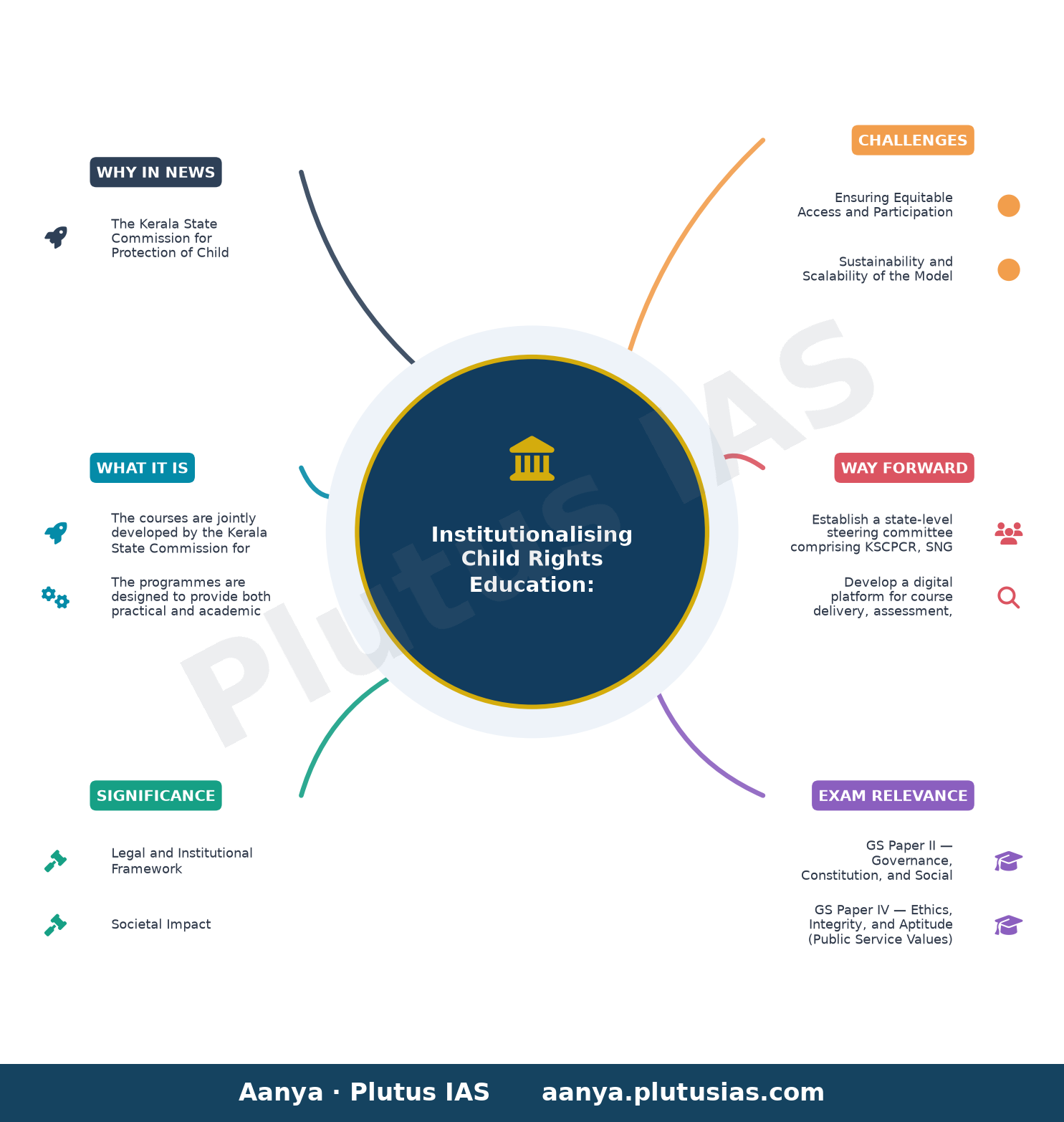
The Kerala State Commission for Protection of Child Rights (KSCPCR) and the Sree Narayana Guru Open University have signed a memorandum of understanding to launch certificate and diploma courses on child rights and protection laws. This initiative is significant as it seeks to institutionalise training on child rights frameworks—including constitutional provisions, the Juvenile Justice Act, the POCSO Act, and the Right to Education Act—amid rising concerns over violence, exploitation, neglect, and cyber threats against children. The courses aim to enhance the capacity of officials, teachers, students, and the general public to understand and uphold child rights within a governance and legal framework.
Background
- The Constitution of India guarantees fundamental rights to all citizens, including children, under Articles 14, 15, 21, 21A, and 39(f), which mandate protection, development, and equal opportunities for children.
- India has enacted several key legislations to safeguard child rights, including the Juvenile Justice (Care and Protection of Children) Act, 2015; the Protection of Children from Sexual Offences (POCSO) Act, 2012; the Right to Education (RTE) Act, 2009; the Prohibition of Child Marriage Act, 2006; and the Child Labour (Prohibition and Regulation) Act, 1986, as amended.
- Kerala has historically been a leader in social sector initiatives, including education reforms, child welfare programmes, and legal literacy campaigns, often leveraging its high literacy rates and decentralised governance structures.
- The increasing prevalence of cyber threats, online exploitation, and digital risks to children has necessitated targeted educational interventions to equip stakeholders with the knowledge to mitigate such risks.
- Open universities in India, such as the Sree Narayana Guru Open University, play a critical role in democratising education by offering flexible, accessible, and vocational learning opportunities to diverse learner groups.
What are the Certificate and Diploma Courses on Child Rights?
- The courses are jointly developed by the Kerala State Commission for Protection of Child Rights (KSCPCR) and the Sree Narayana Guru Open University, Kollam, under a memorandum of understanding signed on August 11, 2026.
- The programmes are designed to provide both practical and academic knowledge on child rights, with a focus on constitutional protections, statutory frameworks, and child protection systems.
- The certificate course will cover foundational principles of child rights, including India’s legal obligations under domestic laws.
- The diploma course will offer advanced modules on the Juvenile Justice Act, 2015; the POCSO Act, 2012; the Right to Education Act, 2009; the Prohibition of Child Marriage Act, 2006; and the Prohibition of Child Labour Act, 1986, as amended.
- The curriculum includes case studies, legal provisions, and institutional mechanisms for child protection, with an emphasis on the roles and responsibilities of various stakeholders, including parents, teachers, law enforcement, and civil society.
- The courses are targeted at officials, teachers, students, and the general public to enhance their understanding of child rights and protection laws, thereby strengthening the implementation of child welfare policies.
- The programmes align with the broader objectives of the Commissions for Protection of Child Rights Act, 2005, which mandates the promotion and protection of child rights through education, awareness, and institutional capacity-building.
- The initiative reflects a governance approach that integrates human rights education into formal and non-formal learning systems to foster a rights-based culture in society.
Key Features
| Feature | Significance |
|---|---|
| Certificate and Diploma Courses | Formal academic programmes designed to impart structured knowledge on child rights, legal frameworks, and protection mechanisms, ensuring systematic capacity-building among stakeholders. |
| Joint Initiative by KSCPCR and SNG Open University | Leverages the institutional expertise of the Kerala State Commission for Protection of Child Rights (KSCPCR) and the academic infrastructure of Sree Narayana Guru Open University to enhance reach and credibility. |
| Focus on Practical and Academic Knowledge | Balances theoretical understanding of laws (e.g., POCSO, RTE) with practical applications, enabling participants to address real-world challenges in child protection. |
| Target Audience: General Public, Teachers, Students, and Officials | Ensures multi-stakeholder engagement, fostering a society-wide culture of awareness and vigilance regarding child rights and protection. |
| Inclusion of Cyber Threats and Digital Risks | Addresses contemporary challenges posed by online exploitation, cyberbullying, and digital neglect, aligning with evolving threats to child safety. |
Why it Matters
Legal and Institutional Framework
- Strengthens implementation of constitutional and statutory provisions (e.g., Article 21A, Right to Education Act) by enhancing human resource capacity at the grassroots level.
- Supports the functional role of State Commissions for Protection of Child Rights (SCPCRs) as statutory bodies under the Commissions for Protection of Child Rights Act, 2005.
- Facilitates compliance with international obligations, such as the United Nations Convention on the Rights of the Child (UNCRC), through domestic capacity-building.
Societal Impact
- Promotes a rights-based approach to child development by educating communities on entitlements, protections, and reporting mechanisms.
- Reduces vulnerability to exploitation, neglect, and abuse by fostering early intervention and community-led vigilance.
- Encourages intergenerational awareness, as students and teachers become agents of change in their families and localities.
Policy and Governance
- Demonstrates a model for integrating academic institutions with statutory bodies to achieve policy objectives in child welfare.
- Aligns with the National Policy for Children (2013) and the National Plan of Action for Children (2016) by prioritising education and protection.
- Provides a replicable framework for other states to emulate, particularly in addressing regional disparities in child protection infrastructure.
Contemporary Relevance
- Responds to the rising incidence of cyber threats against children, necessitating specialised training in digital safety and legal recourse.
- Complements existing initiatives such as the ‘Beti Bachao Beti Padhao’ scheme by addressing systemic gaps in awareness and enforcement.
Challenges
1. Ensuring Equitable Access and Participation
- Geographical disparities in internet connectivity and digital literacy may limit participation from rural and marginalised communities.
- Socio-economic barriers, such as opportunity cost of time, could deter working parents or low-income groups from enrolling.
- Language barriers may exclude non-Malayalam speakers, particularly migrant workers or tribal populations.
UPSC Link: GS-II: Social Justice and Governance
2. Sustainability and Scalability of the Model
- Long-term funding and institutional commitment are required to maintain course quality, faculty, and infrastructure.
- Scaling the model to other states demands coordination between multiple stakeholders, including state governments, universities, and civil society.
- Ensuring periodic updates to course content to reflect amendments in laws (e.g., POCSO Act) and emerging threats (e.g., deepfake exploitation).
UPSC Link: GS-II: Governance and Public Policy
3. Monitoring and Evaluation of Outcomes
- Measuring the impact of the courses on actual behaviour change, reporting of violations, and reduction in child rights violations requires robust data systems.
- Lack of standardised assessment metrics may hinder comparative analysis of effectiveness across different cohorts or regions.
- Ensuring accountability of participants in applying learned knowledge to real-world scenarios, particularly in under-resourced districts.
UPSC Link: GS-IV: Ethics and Governance
4. Integration with Existing Child Protection Mechanisms
- Overlap or duplication with existing training programmes (e.g., by NCPCR, state departments, or NGOs) may lead to resource wastage or confusion among stakeholders.
- Ensuring seamless coordination with child welfare committees, juvenile justice boards, and local authorities to avoid siloed approaches.
- Addressing the reluctance of officials to participate due to bureaucratic inertia or perceived lack of incentives.
UPSC Link: GS-II: Social Justice and Welfare
5. Addressing Cyber Risks and Digital Divide
- Rapid evolution of digital threats (e.g., AI-generated content, online grooming) necessitates continuous curriculum updates and faculty training.
- Limited digital infrastructure in schools and communities may hinder the practical application of knowledge gained from the courses.
- Balancing the need for digital literacy with the risks of over-exposure to technology, particularly for younger participants.
UPSC Link: GS-III: Science and Technology
Challenges — UPSC Perspective
| Issue | Concern |
|---|---|
| Curriculum Relevance | Risk of obsolescence if not updated regularly to reflect legal amendments and emerging threats. |
| Faculty Capacity | Shortage of trained educators with expertise in child rights, cyber law, and pedagogical methods for adult learners. |
| Participant Engagement | Potential low motivation due to perceived lack of immediate career benefits or recognition. |
| Resource Allocation | Dependence on state funding and external grants, which may be inconsistent or insufficient. |
| Inter-State Coordination | Challenges in replicating the model due to varying state priorities, legal frameworks, and institutional capacities. |
| Data Privacy | Ensuring compliance with data protection laws while collecting participant data for monitoring and evaluation. |
Way Forward
- Establish a state-level steering committee comprising KSCPCR, SNG Open University, education department, and civil society to oversee implementation and address bottlenecks.
- Develop a digital platform for course delivery, assessment, and grievance redressal to ensure accessibility and scalability across Kerala.
- Collaborate with NGOs and community-based organisations to conduct outreach programmes in rural and tribal areas, ensuring inclusivity.
- Introduce modular courses with micro-credentials to cater to diverse learning needs and incentivise participation through recognised certifications.
- Partner with the National Council of Educational Research and Training (NCERT) to align the curriculum with national standards and facilitate inter-state recognition.
- Conduct periodic impact assessments through surveys, case studies, and data analysis to refine course content and delivery methods.
- Integrate the courses with existing teacher training programmes under the Samagra Shiksha Abhiyan to ensure sustainability and wider reach.
- Develop a mentorship programme pairing participants with child rights experts to provide ongoing support and practical guidance.
UPSC Value Addition
Keywords for Mains Answer-Writing
Child Rights Commission · Juvenile Justice Act 2015 · Protection of Children from Sexual Offences (POCSO) Act 2012 · Right to Education Act 2009 · Child protection mechanisms · Constitutional provisions for children · Prohibition of Child Marriage Act 2006 · Prohibition of Child Labour Act 2016 · Kerala State Commission for Protection of Child Rights (KSCPCR) · Sree Narayana Guru Open University · Cyber threats against children · Institutional capacity-building in child rights
Constitutional & Policy Linkages
- [‘Article 21A’, ‘Right to Education as a Fundamental Right’]
- [‘Article 39(f)’, ‘Directive Principles for Child Welfare’]
- [‘Article 45’, ‘Provision for Early Childhood Care and Education’]
- [‘Article 47’, ‘Duty of State to raise nutrition and standard of living’]
Concept Flow
Rising incidents of violence, exploitation, and cyber threats against children → Recognition of systemic gaps in awareness and enforcement → Policy response: Kerala State Commission for Protection of Child Rights (KSCPCR) and Sree Narayana Guru Open University collaborate to launch certificate and diploma courses → Curriculum designed to cover constitutional protections, statutory laws (POCSO, RTE, etc.), and practical applications → Targeted outreach to general public, teachers, students, and officials → Capacity-building of stakeholders to identify, report, and prevent child rights violations → Long-term outcome: Strengthened child protection ecosystem with informed communities and empowered institutions.
Prelims Practice Questions
Q1. Consider the following statements regarding child rights in India:
1. The Protection of Children from Sexual Offences (POCSO) Act, 2012, applies to all persons below the age of 18 years.
2. The Juvenile Justice (Care and Protection of Children) Act, 2015, mandates the establishment of Child Protection Committees at the district level.
3. The Right to Education Act, 2009, guarantees free and compulsory education to all children aged 6 to 14 years.
4. The Prohibition of Child Marriage Act, 2006, prohibits child marriages but does not provide for the annulment of such marriages.
How many of the above statements are correct?
- Only one
- Only two
- Only three
- All four
Answer: All four — Statements 1, 2, and 3 are correct. Statement 4 is incorrect as the Prohibition of Child Marriage Act, 2006, provides for the annulment of child marriages under Section 3.
Q2. Assertion (A): The Kerala State Commission for Protection of Child Rights (KSCPCR) is a statutory body established under the Commissions for Protection of Child Rights Act, 2005.
Reason (R): The KSCPCR is mandated to monitor the implementation of child rights and investigate complaints related to child rights violations.
Options:
A. Both A and R are true, and R is the correct explanation of A.
B. Both A and R are true, but R is not the correct explanation of A.
C. A is true, but R is false.
D. A is false, but R is true.
- A
- B
- C
- D
Answer: B — Both the Assertion and Reason are correct. The KSCPCR is indeed a statutory body under the Commissions for Protection of Child Rights Act, 2005, and its mandate includes monitoring child rights and investigating violations, making R the correct explanation of A.
Q3. Match the following Acts with their respective provisions:
Column I (Act) | Column II (Provision)
—————-|——————-
A. Prohibition of Child Marriage Act, 2006 | 1. Prohibits employment of children below 14 years in hazardous occupations
B. Prohibition of Child Labour Act, 2016 | 2. Mandates free and compulsory education for children aged 6 to 14 years
C. Right to Education Act, 2009 | 3. Prohibits marriage of girls below 18 years and boys below 21 years
D. POCSO Act, 2012 | 4. Defines sexual offences against children and provides for stringent punishments
Options:
1. A-3, B-1, C-2, D-4
2. A-1, B-3, C-2, D-4
3. A-2, B-1, C-3, D-4
4. A-4, B-2, C-1, D-3
- 1
- 2
- 3
- 4
Answer: 2 — The correct match is: A-3 (Prohibition of Child Marriage Act prohibits child marriages), B-1 (Prohibition of Child Labour Act prohibits hazardous child labour), C-2 (Right to Education Act mandates free and compulsory education), D-4 (POCSO Act defines sexual offences against children).
Mains Practice Question
✍ The establishment of certificate and diploma courses on child rights by the Kerala State Commission for Protection of Child Rights (KSCPCR) in collaboration with Sree Narayana Guru Open University represents a significant institutional intervention in child protection governance. Critically analyse the constitutional and statutory foundations of child rights in India, and evaluate the role of such capacity-building initiatives in strengthening the implementation of child protection laws. (15 Marks)
Approach: MODEL-ANSWER SKELETON:
1. Constitutional Foundations:
– Art. 15(3) (special provisions for children), Art. 21A (Right to Education), Art. 39(e) and (f) (Directive Principles for child welfare), Art. 45 (early childhood care and education).
– UN Convention on the Rights of the Child (1989) and its incorporation into domestic law via the Commissions for Protection of Child Rights Act, 2005.
2. Statutory Framework:
– Juvenile Justice (Care and Protection of Children) Act, 2015 (JJ Act): institutional mechanisms like Child Welfare Committees, Juvenile Justice Boards, and Child Protection Units.
– Protection of Children from Sexual Offences (POCSO) Act, 2012: stringent provisions for sexual offences, child-friendly procedures, and special courts.
– Right to Education Act, 2009: guarantees free and compulsory education for children aged 6–14 years.
– Prohibition of Child Marriage Act, 2006: prohibits child marriages and provides for annulment.
– Prohibition of Child Labour Act, 2016: prohibits employment of children in hazardous occupations and regulates non-hazardous work.
3. Role of KSCPCR and Capacity-Building:
– KSCPCR as a statutory body under the Commissions for Protection of Child Rights Act, 2005: mandate to monitor child rights, investigate complaints, and advise the government.
– Significance of certificate and diploma courses: bridges knowledge gaps among stakeholders (teachers, officials, general public), enhances awareness of legal provisions, and fosters a culture of child rights compliance.
– Addresses contemporary challenges: cyber threats, exploitation, neglect, and violence against children.
4. Challenges and Way Forward:
– Implementation gaps: underreporting of child rights violations, lack of awareness among stakeholders, and inadequate institutional capacity.
– Need for multi-stakeholder collaboration: integration with school curricula, digital literacy programs, and community-based monitoring.
– Role of judiciary: landmark judgments like Unnikrishnan v. State of Andhra Pradesh (1993) on the Right to Education and Bachpan Bachao Andolan v. Union of India (2011) on child labour.
5. Conclusion:
– Capacity-building initiatives like the KSCPCR-SNGOU courses are essential for translating constitutional and statutory guarantees into ground-level outcomes. They empower stakeholders to act as effective guardians of child rights, thereby strengthening the child protection ecosystem.
Source: The Indian Express
Generated by AanyaAi for educational purpose.

- KWML’s Feasibility Reports for Water Metro in 18 Cities: UPSC & PCS Insights - October 3, 2026
- ओडिशा में वन्यजीव अनुसंधान अनुदान कार्यक्रम शुरू, सिमिलिपाल में 300 कैमरे और बढ़ेंगे - October 3, 2026
- India Summons Pakistan High Commission Official Over Violation - October 3, 2026

No Comments