


11 Aug Kerala Launches Child Rights Courses: Upskilling for UPSC & State PCS Aspirants
✎ Kerala’s certificate and diploma courses on child rights institutionalise governance capacity-building by integrating constitutional mandates, statutory frameworks, and contemporary challenges into a structured educational…
Subject Relevance — Where This Topic Fits
- GS Paper II — Governance, Administration and Challenges (Institutional Mechanisms for Protection of Vulnerable Sections) | GS Paper III — Social Justice (Child Protection and Welfare Policies)
- Prelims: Child Rights Commission, Juvenile Justice Act, 2015, Protection of Children from Sexual Offences (POCSO) Act, 2012, Right to Education (RTE) Act, 2009, Prohibition of Child Marriage Act, 2006, Prohibition of Child Labour Act, 1986, Sree Narayana Guru Open University, Kerala State Commission for Protection of Child Rights (KSCPCR)
- Essay: The Role of Education in Institutionalising Human Rights: A Case Study of Child Rights Education in Kerala, Governance and Social Justice: Bridging Policy and Practice through Capacity-Building Initiatives
Quick Revision: Kerala’s certificate and diploma courses on child rights institutionalise governance capacity-building by integrating constitutional mandates, statutory frameworks, and contemporary challenges into a structured educational programme, thereby enhancing the efficacy of child protection mechanisms.
Why is this in the news?
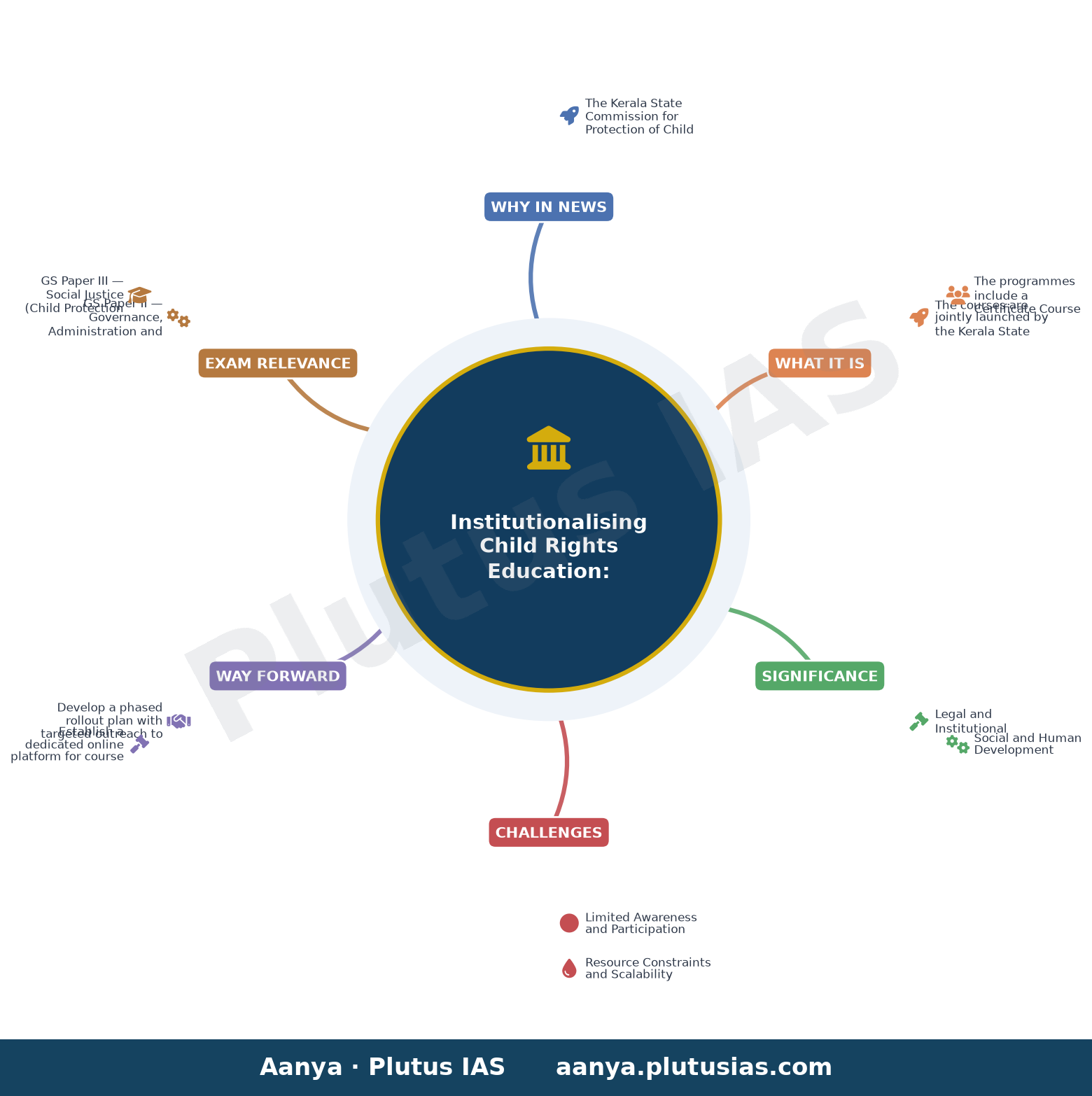
The Kerala State Commission for Protection of Child Rights (KSCPCR) and the Sree Narayana Guru Open University have announced the launch of certificate and diploma courses on child rights and protection laws. Scheduled for formal inauguration on 11 August 2026, these programmes aim to equip teachers, students, officials, and the general public with practical and academic knowledge of constitutional protections, statutory frameworks, and child protection systems. This initiative is significant in the context of rising incidents of violence, exploitation, neglect, and cyber threats against children, underscoring the need for institutionalised capacity-building in child rights governance.
Background
- The Constitution of India, through Articles 15(3), 21A, 39(e), 39(f), and 45, guarantees special protections and rights to children, including the right to education, protection from exploitation, and development.
- India has enacted several key legislations to operationalise these constitutional mandates, including the Right to Education (RTE) Act, 2009; the Juvenile Justice (Care and Protection of Children) Act, 2015; the Protection of Children from Sexual Offences (POCSO) Act, 2012; the Prohibition of Child Marriage Act, 2006; and the Prohibition of Child Labour Act, as amended.
- State Commissions for Protection of Child Rights (SCPCRs) are statutory bodies established under the Commissions for Protection of Child Rights Act, 2005, to monitor the implementation of child rights and investigate complaints of violations.
- The increasing prevalence of cyber threats, online exploitation, and gender-based violence against children has necessitated multi-stakeholder interventions, including education and awareness programmes.
- Open universities in India, such as the Sree Narayana Guru Open University, play a critical role in democratising education and extending learning opportunities to diverse segments of the population, including officials and grassroots workers.
What are the Certificate and Diploma Courses on Child Rights?
- The courses are jointly launched by the Kerala State Commission for Protection of Child Rights (KSCPCR) and the Sree Narayana Guru Open University, Kollam, under a formal Memorandum of Understanding (MoU).
- The programmes include a Certificate Course in Child Rights and a Diploma in Child Rights and Protection Laws, designed to cater to different levels of learners, from general public to professionals.
- The curriculum covers constitutional provisions (Articles 15(3), 21A, 39(e), 39(f), 45), statutory frameworks (RTE Act, 2009; JJ Act, 2015; POCSO Act, 2012; Prohibition of Child Marriage Act, 2006; Prohibition of Child Labour Act), and child protection mechanisms.
- The courses aim to provide both theoretical knowledge and practical insights, including case studies, legal frameworks, and best practices in child protection and rights advocacy.
- Target beneficiaries include teachers, students, government officials, social workers, parents, and community leaders, reflecting a multi-stakeholder approach to child rights governance.
- The initiative aligns with the global agenda on child rights, particularly the United Nations Convention on the Rights of the Child (UNCRC), 1989, which India ratified in 1992.
- The courses are designed to address contemporary challenges such as cyber threats, online exploitation, and gender-based violence against children, integrating modern pedagogical tools and digital literacy components.
- Upon completion, participants are expected to gain competencies in identifying, reporting, and preventing child rights violations, thereby strengthening the child protection ecosystem at the grassroots level.
Key Features
| Feature | Significance |
|---|---|
| Certificate and Diploma Courses on Child Rights | Provides structured academic and practical training to stakeholders on child rights frameworks, enhancing their capacity to identify, report, and address violations. |
| Joint Initiative by KSCPCR and SNG Open University | Leverages institutional collaboration to standardise training content, ensuring alignment with national and state-level child protection policies. |
| Coverage of Key Legislations (POCSO, RTE, JJ Act, etc.) | Ensures comprehensive understanding of legal provisions governing child protection, enabling effective implementation and advocacy. |
| Target Audience: General Public, Teachers, Students, and Officials | Broadens the base of informed stakeholders, fostering a societal culture of child rights awareness and vigilance. |
| Focus on Emerging Threats (Cyber Exploitation, Neglect) | Addresses contemporary challenges in child protection, equipping participants with tools to mitigate risks in digital and social domains. |
Why it Matters
Legal and Institutional
- Strengthens the institutional framework for child rights by integrating academic training with statutory bodies, enhancing the efficacy of the Kerala State Commission for Protection of Child Rights (KSCPCR).
- Promotes adherence to constitutional and statutory obligations under the Directive Principles of State Policy (Article 39) and the Right to Education (Article 21A), ensuring compliance with national child protection laws.
- Facilitates the operationalisation of the Juvenile Justice (Care and Protection of Children) Act, 2015, and the Protection of Children from Sexual Offences (POCSO) Act, 2012, through capacity-building.
Social and Human Development
- Enhances societal awareness of child rights, reducing incidents of exploitation, neglect, and violence by empowering communities with knowledge of legal safeguards.
- Supports the realisation of Sustainable Development Goal 16.2 (end abuse, exploitation, trafficking, and all forms of violence against and torture of children).
- Fosters intergenerational learning by engaging students and teachers, embedding child rights education within the formal and informal education systems.
Governance and Policy Implementation
- Improves the implementation of child protection policies by training officials and functionaries, ensuring that statutory provisions translate into ground-level action.
- Encourages multi-stakeholder coordination between statutory commissions, educational institutions, and civil society, enhancing the efficacy of child protection mechanisms.
Challenges
1. Limited Awareness and Participation
- Ensuring equitable access to the courses across rural and urban areas, particularly among marginalised communities, to prevent knowledge gaps.
- Addressing scepticism or indifference among stakeholders who may perceive child rights training as non-essential or bureaucratic.
UPSC Link: GS Paper 2: Governance, Issues relating to development and management of Social Sector/Services
2. Resource Constraints and Scalability
- Balancing the quality of training with the need for scalability, especially given the diverse backgrounds of participants (students, teachers, officials).
- Securing sustained funding and institutional support for course maintenance, updates, and expansion.
UPSC Link: GS Paper 2: Government policies and interventions for development in various sectors
3. Cyber Threats and Digital Literacy Gaps
- Addressing the rapid evolution of online risks (e.g., cyberbullying, grooming, exploitation) requires continuous updates to course content and faculty training.
- Bridging digital literacy gaps among participants to ensure effective utilisation of cyber safety tools and reporting mechanisms.
UPSC Link: GS Paper 3: Challenges to internal security through communication networks
4. Inter-Institutional Coordination
- Ensuring seamless collaboration between KSCPCR, SNG Open University, and other stakeholders to avoid duplication or gaps in course delivery.
- Harmonising the courses with existing child protection initiatives (e.g., Sagarmitra, Bal Suraksha Kendras) to avoid redundancy.
UPSC Link: GS Paper 2: Role of Civil Services in a Democracy
5. Monitoring and Evaluation
- Developing robust assessment mechanisms to measure the impact of training on participants’ knowledge, behaviour, and reporting of child rights violations.
- Establishing feedback loops to refine course content based on real-world applicability and emerging threats.
UPSC Link: GS Paper 4: Ethics and Integrity in Governance
Challenges — UPSC Perspective
| Issue | Concern |
|---|---|
| Equity in Access | Risk of urban-centric participation, leaving rural and tribal communities underserved. |
| Content Relevance | Need for periodic updates to address emerging issues like AI-driven exploitation or new forms of cybercrime. |
| Faculty Capacity | Ensuring trainers are well-versed in both legal frameworks and pedagogical methods for diverse audiences. |
| Data Privacy | Balancing the need for participant data (for assessment) with privacy protections under the Digital Personal Data Protection Act, 2023. |
| Multi-Lingual Delivery | Ensuring courses are accessible in regional languages to cater to Kerala’s linguistic diversity. |
Way Forward
- Develop a phased rollout plan with targeted outreach to rural and tribal districts, leveraging local self-government institutions (Panchayats, Municipalities).
- Establish a dedicated online platform for course dissemination, including webinars, case studies, and interactive modules to enhance engagement.
- Incorporate mandatory modules on cyber safety and digital ethics, in alignment with the National Cyber Security Strategy and IT Rules, 2021.
- Partner with NGOs and child welfare organisations to pilot the courses in community settings, ensuring grassroots-level participation.
- Introduce certification pathways for professionals (e.g., teachers, social workers) to incentivise participation and career advancement.
- Conduct periodic impact assessments through surveys and case studies to refine content and measure behavioural change.
- Integrate the courses with existing child protection initiatives (e.g., Sagarmitra, Bal Suraksha Kendras) to create a unified ecosystem.
- Explore MoUs with other state commissions and universities to replicate the model, fostering national-level standardisation.
UPSC Value Addition
Keywords for Mains Answer-Writing
Child Rights Commission · Kerala State Commission for Protection of Child Rights (KSCPCR) · Sree Narayana Guru Open University · certificate and diploma courses on child rights · Juvenile Justice Act, 2015 · Protection of Children from Sexual Offences (POCSO) Act, 2012 · Prohibition of Child Marriage Act, 2006 · Right to Education (RTE) Act, 2009 · child protection mechanisms · cyber threats against children · institutional capacity building · multi-stakeholder governance · convergence of education and child protection · child rights jurisprudence
Constitutional & Policy Linkages
- Article 39(f): Directive Principle to provide opportunities and facilities to children to develop in a healthy manner.
- Article 21A: Right to Education as a fundamental right for children aged 6–14 years.
- Article 15(3): Empowers the State to make special provisions for children.
Concept Flow
Increasing incidents of child exploitation and cyber threats → Recognition of knowledge gaps among stakeholders → Need for structured training → Collaboration between KSCPCR and SNG Open University → Launch of certificate/diploma courses → Capacity-building of teachers, officials, and public → Enhanced reporting and protection mechanisms → Reduced violations and improved child welfare.
Prelims Practice Questions
Q1. Consider the following statements regarding the Kerala State Commission for Protection of Child Rights (KSCPCR):
1. It is a statutory body constituted under the Commissions for Protection of Child Rights Act, 2005.
2. It is mandated to monitor the implementation of the Right to Education (RTE) Act, 2009.
3. It can suo-motu take cognizance of violations of child rights and recommend action to authorities.
4. It is chaired by the Chief Minister of Kerala.
How many of the above statements are correct?
- Only one
- Only two
- Only three
- All four
Answer: Only three — Statements 1, 2, and 3 are correct as per the Commissions for Protection of Child Rights Act, 2005. Statement 4 is incorrect as the chairperson is appointed by the state government, not the Chief Minister.
Q2. Assertion (A): The Protection of Children from Sexual Offences (POCSO) Act, 2012, mandates the establishment of Special Courts for the speedy trial of offences under the Act.
Reason (R): The POCSO Act, 2012, was enacted to address the rising incidents of sexual offences against children and ensure their protection through a child-friendly justice system.
- Both A and R are true, and R is the correct explanation of A
- Both A and R are true, but R is not the correct explanation of A
- A is true, but R is false
- A is false, but R is true
Answer: Both A and R are true, but R is not the correct explanation of A — Both the Assertion and Reason are correct, and the Reason correctly explains the Assertion. The POCSO Act, 2012, indeed mandates the establishment of Special Courts (Section 28) to ensure speedy trials, and the Act was enacted to address sexual offences against children.
Q3. Which of the following Acts is NOT directly related to the prevention of child labour in India?
- The Prohibition of Child Marriage Act, 2006
- The Child Labour (Prohibition and Regulation) Act, 1986
- The Right of Children to Free and Compulsory Education (RTE) Act, 2009
- The Factories Act, 1948
Answer: The Prohibition of Child Marriage Act, 2006 — The Prohibition of Child Marriage Act, 2006, addresses child marriage, not child labour. The other three Acts are directly related to the prevention of child labour.
Mains Practice Question
✍ The Kerala State Commission for Protection of Child Rights (KSCPCR) has collaborated with the Sree Narayana Guru Open University to launch certificate and diploma courses on child rights. Critically examine the significance of such institutional capacity-building initiatives in addressing contemporary challenges to child rights in India. (15 Marks)
Approach: MODEL-ANSWER SKELETON:
1. **Introduction**: Define child rights and the role of commissions like KSCPCR under the Commissions for Protection of Child Rights Act, 2005.
2. **Contemporary Challenges**: Highlight rising incidents of violence, exploitation, neglect, and cyber threats against children, citing recent data or reports (e.g., NCRB, NCPCR annual reports).
3. **Role of Capacity-Building Initiatives**:
– **Multi-Stakeholder Engagement**: Explain how such courses bridge gaps between general public, teachers, students, and officials.
– **Legal Literacy**: Emphasise the inclusion of key legislations (POCSO Act, 2012; Juvenile Justice Act, 2015; RTE Act, 2009) and their practical application.
– **Institutional Mechanisms**: Discuss how these courses strengthen child protection systems, including the role of Special Courts under POCSO.
4. **Challenges and Limitations**:
– **Implementation Gaps**: Address issues like low awareness, resource constraints, and inter-state variations in child protection mechanisms.
– **Cyber Threats**: Highlight the need for digital literacy and awareness of online risks (e.g., cyberbullying, grooming).
5. **Comparative Perspective**: Briefly compare with similar initiatives in other states (e.g., Tamil Nadu’s Child Rights Education Programme).
6. **Conclusion**: Argue that while capacity-building is essential, it must be complemented by robust enforcement, inter-departmental coordination, and community participation. Suggest measures like mandatory training for teachers and periodic audits of child protection systems.
Source: The Indian Express
Generated by AanyaAi for educational purpose.

- KWML’s Feasibility Reports for Water Metro in 18 Cities: UPSC & PCS Insights - October 3, 2026
- ओडिशा में वन्यजीव अनुसंधान अनुदान कार्यक्रम शुरू, सिमिलिपाल में 300 कैमरे और बढ़ेंगे - October 3, 2026
- India Summons Pakistan High Commission Official Over Violation - October 3, 2026

No Comments