


13 Aug Kerala Rejects NEP 2020 Approval: KSHEC Clarifies Policy Misconceptions
✎ Kerala’s higher education governance, through the KSHEC, operates within the framework of cooperative federalism, where state-level committees review and modify centrally-recommended reforms (e.g., FYUGP) without altering the…
Subject Relevance — Where This Topic Fits
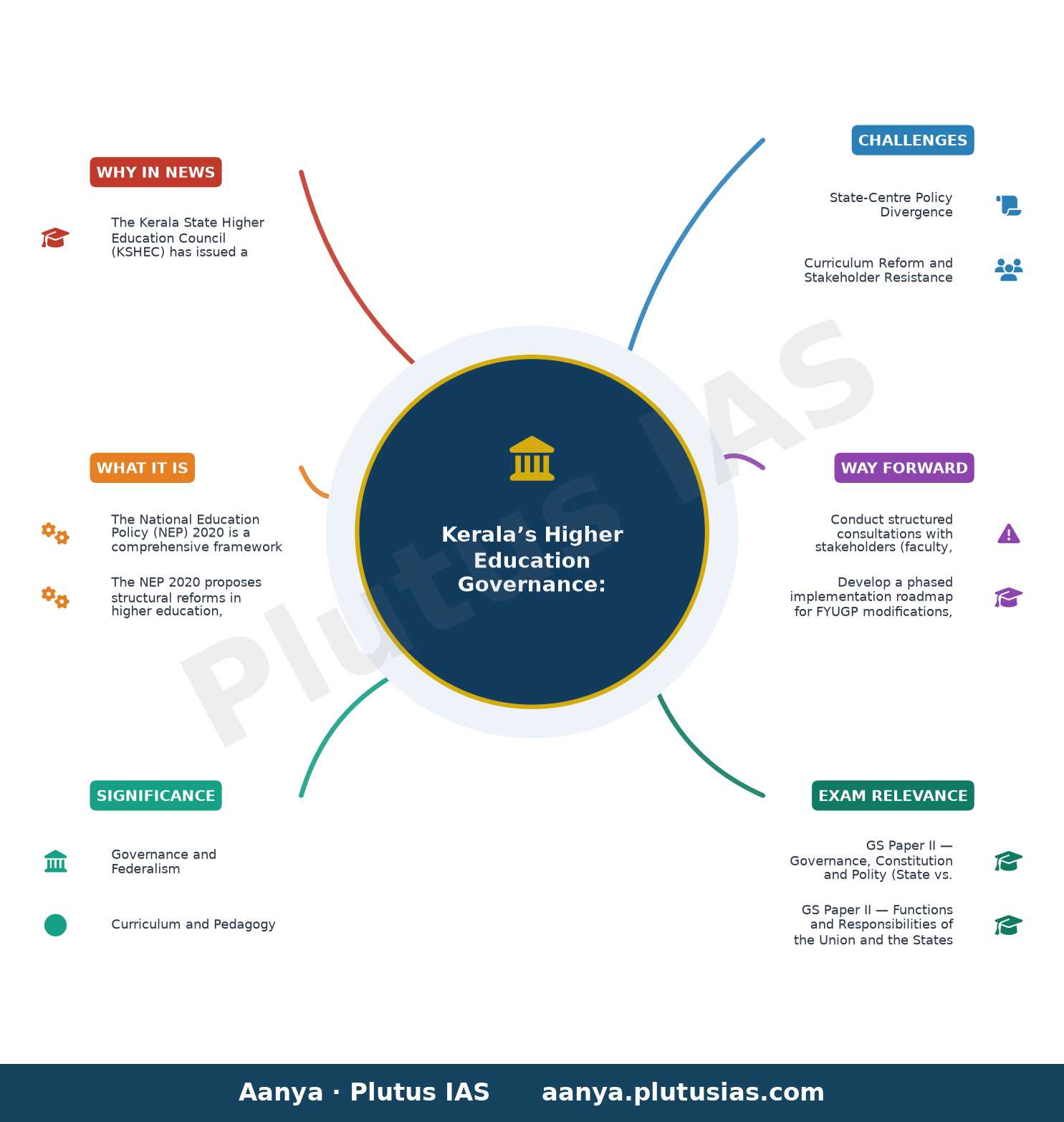
- GS Paper II — Governance, Constitution and Polity (State vs. Central Relations in Education) | GS Paper II — Functions and Responsibilities of the Union and the States
- Prelims: National Education Policy 2020, Kerala State Higher Education Council (KSHEC), Four-Year Undergraduate Programme (FYUGP), State-UT relations in education policy, Concurrent List (Education) under Seventh Schedule
- Essay: Federalism and cooperative governance in India’s education system, Autonomy of states in implementing centrally-sponsored educational reforms
Quick Revision: Kerala’s higher education governance, through the KSHEC, operates within the framework of cooperative federalism, where state-level committees review and modify centrally-recommended reforms (e.g., FYUGP) without altering the constitutional autonomy of states in education policy.
Why is this in the news?
The Kerala State Higher Education Council (KSHEC) has issued a clarification to dispel misinformation regarding the alleged approval of the National Education Policy (NEP) 2020 in Kerala. The council stated that a committee constituted to review the Four-Year Undergraduate Programme (FYUGP) does not possess the authority to approve or recommend the NEP 2020, underscoring the procedural and institutional safeguards in Kerala’s higher education governance.
Background
- The National Education Policy (NEP) 2020, approved by the Union Cabinet in July 2020, proposes sweeping reforms in India’s education system, including structural changes to higher education such as the Four-Year Undergraduate Programme (FYUGP).
- Kerala has been implementing the FYUGP under its own higher education reforms since 2023, aligning it with the NEP 2020’s structural recommendations while retaining state-specific academic and administrative autonomy.
- The KSHEC, constituted under the Kerala State Higher Education Council Act, 1976, serves as the apex advisory body for higher education in the state, responsible for policy formulation, coordination, and quality assurance.
- Reports suggesting that a KSHEC committee had approved the NEP 2020 were erroneous, as the committee’s mandate was limited to reviewing the FYUGP’s implementation and suggesting modifications.
- The clarification by KSHEC vice-chairperson Achuthsankar S. Nair reaffirms the state’s constitutional right to determine its higher education policies within the framework of cooperative federalism.
- The NEP 2020 operates within the Concurrent List (Entry 25 of the Seventh Schedule), allowing both the Union and state governments to legislate and implement education policies, subject to constitutional provisions.
What is the National Education Policy (NEP) 2020 and Kerala’s Higher Education Governance?
- The National Education Policy (NEP) 2020 is a comprehensive framework for transforming India’s education system, encompassing school, higher, and vocational education, with a focus on equity, accessibility, and multidisciplinary learning.
- The NEP 2020 proposes structural reforms in higher education, including the adoption of a Four-Year Undergraduate Programme (FYUGP) with multiple exit and entry points, flexibility in curricular design, and integration of vocational education.
- Kerala’s higher education system is governed by the Kerala State Higher Education Council (KSHEC), established under the Kerala State Higher Education Council Act, 1976, to advise the state government on policy matters, coordinate between universities, and ensure quality assurance.
- The KSHEC’s role is advisory, and its decisions are subject to approval by the state government, reflecting the principle of cooperative federalism where states retain autonomy in implementing centrally-sponsored policies.
- The FYUGP, introduced in Kerala in 2023, aligns with the NEP 2020’s structural recommendations but is implemented under the state’s own governance framework, ensuring alignment with local academic and administrative needs.
- The NEP 2020’s implementation in states is not mandatory; it is a recommendatory framework that states may adopt partially or fully, depending on their constitutional and administrative capacities.
- Kerala’s clarification underscores the procedural integrity of its higher education governance, where committees constituted for specific reviews (e.g., FYUGP) do not possess the authority to approve or reject national-level policies like the NEP 2020.
- The NEP 2020’s provisions on higher education (e.g., FYUGP, multidisciplinary universities) are located within the Concurrent List (Entry 25 of the Seventh Schedule), enabling both the Union and state governments to legislate and implement policies in this domain.
Key Features
| Feature | Significance |
|---|---|
| Four-Year Undergraduate Programme (FYUGP) | Kerala’s FYUGP, operational for three years, is the state-level framework that the KSHEC committee is reviewing for structural corrections and modifications, not the NEP 2020 itself. |
| KSHEC Committee on FYUGP | Constituted to recommend immediate corrections to FYUGP; lacks authority to approve or reject the NEP 2020, clarifying its limited mandate. |
| Interim Report | The committee’s interim report on FYUGP structural aspects is under discussion; it becomes official only after approval by the KSHEC executive committee. |
| State-Level Autonomy in Education | Kerala’s decision-making process in higher education policy reflects the constitutional principle of federalism, where states retain autonomy in educational governance under Article 29(2) and the Seventh Schedule. |
| Selective Implementation of NEP 2020 | Kerala is implementing only the structural components of NEP 2020 (e.g., FYUGP), while explicitly rejecting other aspects, demonstrating a nuanced policy approach. |
Why it Matters
Governance and Federalism
- The clarification by KSHEC underscores the constitutional principle of cooperative federalism, where states exercise autonomy in educational policy formulation within the framework of the Constitution.
- The KSHEC’s role highlights the institutional mechanism through which state-level higher education governance operates, distinct from centralised policy frameworks like the NEP.
- Kerala’s selective implementation approach exemplifies how states may adopt or reject components of centrally framed policies based on local educational priorities and administrative feasibility.
Curriculum and Pedagogy
- The review of FYUGP by the KSHEC committee signifies the importance of state-level curriculum reforms in aligning higher education with evolving pedagogical needs and local socio-economic contexts.
- Structural modifications to FYUGP, such as duration, credit framework, or interdisciplinary components, can enhance employability and academic flexibility without necessitating full NEP adoption.
- The interim report’s discussion process reflects a deliberative approach to educational reforms, ensuring stakeholder consultations and evidence-based decision-making.
Policy Implementation and Compliance
- The KSHEC’s clarification distinguishes between policy recommendations and executive decisions, reinforcing the hierarchical structure of governance in higher education.
- States may implement structural aspects of national policies (e.g., FYUGP) while reserving the right to reject ideological or contentious components, ensuring policy coherence at the state level.
- The interim report’s pending approval process demonstrates the procedural rigour required in educational governance, balancing innovation with accountability.
Challenges
1. State-Centre Policy Divergence
- Divergence between state-level educational policies and centrally framed frameworks (e.g., NEP 2020) may create inconsistencies in national educational standards and hinder inter-state mobility of students.
- Lack of uniform implementation across states could exacerbate disparities in higher education quality and access, particularly for marginalised communities.
- Legal ambiguities regarding the extent of state autonomy in rejecting components of centrally sponsored policies may lead to constitutional challenges or policy conflicts.
UPSC Link: GS-II: Federalism and Education Policy
2. Curriculum Reform and Stakeholder Resistance
- Structural reforms in higher education (e.g., FYUGP) often face resistance from faculty, students, or administrative bodies due to unfamiliarity, workload concerns, or perceived misalignment with traditional academic structures.
- Ensuring seamless integration of structural reforms with existing academic calendars, examination systems, and accreditation frameworks poses logistical challenges.
- Balancing innovation with the preservation of academic rigour and equity in curriculum design remains a persistent challenge in state-level educational reforms.
UPSC Link: GS-II: Education and Curriculum Development
3. Resource Allocation and Implementation Gaps
- Structural reforms in higher education require significant financial, human, and infrastructural resources, which may strain state budgets, particularly in fiscally constrained regions.
- Delays in approval processes or inadequate capacity-building measures can impede the effective implementation of reforms, leading to suboptimal outcomes.
- Ensuring equitable access to reformed programmes across rural, urban, and socio-economically diverse regions within a state remains a critical implementation challenge.
UPSC Link: GS-III: Resource Mobilisation and Education
4. Policy Communication and Public Perception
- Misinterpretation or miscommunication of state-level educational policies (e.g., NEP 2020 vs. FYUGP) can lead to public confusion, political polarisation, or erosion of trust in governance institutions.
- Lack of transparent consultation processes with stakeholders (e.g., students, faculty, industry) may result in policy backlash or resistance to reforms.
- Media narratives often simplify complex educational reforms, risking the reduction of nuanced policy debates to binary political or ideological positions.
UPSC Link: GS-II: Governance and Policy Communication
5. Accreditation and Quality Assurance
- Structural reforms in higher education must align with national accreditation frameworks (e.g., NAAC, NBA) to ensure recognition and credibility, posing challenges in maintaining quality standards.
- Inconsistencies between state-level reforms and national accreditation criteria may hinder student mobility, employability, and institutional rankings.
- Ensuring that structural reforms do not compromise academic standards or dilute the rigour of higher education programmes remains a persistent concern.
UPSC Link: GS-II: Higher Education Quality Assurance
Challenges — UPSC Perspective
| Issue | Concern |
|---|---|
| State-Centre Policy Divergence | Risk of inconsistencies in educational standards and inter-state mobility of students. |
| Curriculum Reform Resistance | Faculty, student, or administrative pushback due to unfamiliarity or workload concerns. |
| Resource Constraints | Financial and infrastructural limitations may hinder effective implementation of reforms. |
| Policy Communication Gaps | Public confusion or political polarisation due to misinterpretation of policy goals. |
| Accreditation Alignment | Mismatch between state-level reforms and national accreditation frameworks affecting credibility. |
Way Forward
- Conduct structured consultations with stakeholders (faculty, students, industry) to address concerns and build consensus on structural reforms like FYUGP.
- Develop a phased implementation roadmap for FYUGP modifications, aligning with academic calendars and accreditation timelines.
- Enhance inter-state coordination mechanisms to ensure consistency in higher education reforms while preserving state autonomy.
- Strengthen institutional capacity for curriculum design, faculty training, and resource mobilisation to support reforms.
- Establish transparent communication channels to clarify policy goals, address misconceptions, and foster public trust in educational governance.
- Integrate structural reforms with national accreditation frameworks (e.g., NAAC, NBA) to ensure recognition and mobility of students.
- Monitor and evaluate the impact of reforms through data-driven assessments to inform iterative improvements and policy adjustments.
UPSC Value Addition
Keywords for Mains Answer-Writing
National Education Policy 2020 · Kerala State Higher Education Council (KSHEC) · Four-Year Undergraduate Programme (FYUGP) · State-level autonomy in education policy · Academic governance and decision-making · Interim reports and executive committees · Structural implementation of NEP 2020 · Policy approval processes in higher education · State vs. Central policy alignment · Academic reforms in undergraduate education
Constitutional & Policy Linkages
- Article 29(2): Right against discrimination in educational institutions, relevant to ensuring equity in reforms.
- Seventh Schedule: Division of powers between the Union and States in education (List I, Entry 66; List III, Entry 25).
Concept Flow
State-level higher education governance (KSHEC) → Committee review of FYUGP → Interim report on structural modifications → Executive committee approval → Implementation of selected NEP 2020 structural aspects. → Constitutional framework (Seventh Schedule) → State autonomy in education policy → Selective implementation of central frameworks → Policy divergence and governance challenges. → Curriculum reform (FYUGP) → Stakeholder consultations → Resource allocation → Implementation gaps → Quality assurance and accreditation alignment. → Policy communication → Public perception → Media narratives → Political discourse → Governance trust and transparency. → Accreditation frameworks (NAAC/NBA) → State-level reforms → Recognition and mobility of students → Inter-state consistency in standards.
Prelims Practice Questions
Q1. Consider the following statements regarding the National Education Policy (NEP) 2020 and its implementation in Kerala:
1. The Kerala State Higher Education Council (KSHEC) has approved the implementation of the NEP 2020 in Kerala.
2. A committee appointed by KSHEC was constituted to recommend corrections to the Four-Year Undergraduate Programme (FYUGP).
3. The structural aspects of the NEP 2020 are currently being implemented in Kerala.
4. The committee has the authority to take policy decisions such as approving the NEP 2020.
How many of the above statements are correct?
- Only one
- Only two
- Only three
- All
Answer: Only two — Only statement 2 and 3 are correct. Statement 1 is incorrect as KSHEC has clarified that no approval for NEP 2020 has been given. Statement 4 is incorrect as the committee lacks the authority to approve policy decisions.
Q2. Assertion (A): The Four-Year Undergraduate Programme (FYUGP) in Kerala has been under implementation for the past three years.
Reason (R): The Kerala State Higher Education Council (KSHEC) has constituted a committee to recommend immediate corrections to the FYUGP.
Options:
A. Both A and R are true, and R is the correct explanation of A.
B. Both A and R are true, but R is not the correct explanation of A.
C. A is true, but R is false.
D. A is false, but R is true.
Answer: ? — Assertion (A) is true as the FYUGP has been implemented in Kerala for three years. Reason (R) is also true, but it does not explain why the FYUGP has been under implementation; rather, it describes a separate committee’s role.
Q3. Which of the following best describes the current status of the National Education Policy (NEP) 2020 in Kerala?
A. Fully approved and implemented.
B. Partially implemented in structural aspects only.
C. Rejected by the Kerala State Higher Education Council.
D. Under review by a parliamentary committee.
- A
- B
- C
- D
Answer: B — The Kerala State Higher Education Council (KSHEC) has clarified that only the structural aspects of the NEP 2020 are currently being implemented in Kerala, and no formal approval for the policy has been given.
Mains Practice Question
✍ Critically examine the constitutional and institutional dimensions of state autonomy in higher education policy implementation, with reference to the National Education Policy (NEP) 2020 and the recent clarification by the Kerala State Higher Education Council (KSHEC). Also, analyse the implications of such state-level decisions on the uniformity of educational reforms in India. (15 Marks)
Approach: MODEL-ANSWER SKELETON:
1. **Introduction (2 marks)**
– Briefly define the National Education Policy (NEP) 2020 as a centrally framed policy document aimed at transforming India’s education system.
– Mention the constitutional provisions governing education: Entry 66 of List I (Union List) and Entry 25 of List III (Concurrent List) under the Seventh Schedule of the Constitution.
– Highlight the tension between central policy initiatives and state autonomy in education.
2. **State Autonomy in Higher Education (4 marks)**
– Discuss the constitutional basis for state autonomy in education, including the role of state governments in curriculum design, governance, and implementation.
– Reference the **Kerala State Higher Education Council (KSHEC)** as an institutional mechanism for state-level decision-making in higher education.
– Explain the **Four-Year Undergraduate Programme (FYUGP)** as a state-level reform initiative in Kerala, distinct from NEP 2020.
– Clarify the KSHEC’s clarification regarding the committee’s mandate: to recommend corrections to FYUGP, not to approve NEP 2020.
3. **Institutional Processes and Policy Implementation (5 marks)**
– Describe the **KSHEC’s decision-making structure**: the role of the executive committee, interim reports, and the requirement for approval by the decision-making body.
– Analyse the **procedural legitimacy** of state-level decisions in higher education, including the need for transparency and stakeholder consultation.
– Discuss the **limits of state autonomy** when aligning with centrally sponsored policies, particularly in areas like structural reforms and curriculum design.
– Reference the **Supreme Court’s observations** on the balance between central and state powers in education (e.g., **T.M.A. Pai Foundation v. State of Karnataka**, 2002).
4. **Implications for Educational Reforms (4 marks)**
– Evaluate the **advantages of state-level flexibility** in tailoring reforms to local needs (e.g., Kerala’s focus on FYUGP).
– Critique the **risks of fragmentation** in national educational reforms due to divergent state-level decisions.
– Discuss the **role of the University Grants Commission (UGC)** in maintaining minimum standards and the potential for conflicts between state and central authorities.
– Conclude with a balanced view: while state autonomy is constitutionally valid, the lack of uniform implementation may hinder the NEP 2020’s goals of equity and quality.
Source: The Hindu
Generated by AanyaAi for educational purpose.

- मद्रास उच्च न्यायालय में ‘वेट्ट्री पयणम’ योजना को असंवैधानिक घोषित करने की मांग - October 4, 2026
- Gurugram’s groundwater extraction exceeds limit by 212%; HC seeks ban - October 4, 2026
- स्वतंत्रता सेनानी श्यामजी कृष्ण वर्मा की जन्म जयंती पर पीएम का श्रद्धांजलि - October 4, 2026

No Comments