


07 Sep Kerala to Decide on PM-SHRI Scheme After Cabinet Panel Report
✎ The PM-SHRI scheme is a centrally sponsored programme under NEP 2020 to upgrade 14,500 schools into model institutions, with funding shared between the Union and States, subject to federal cooperation and state discretion in…
Subject Relevance — Where This Topic Fits
- GS Paper II — Federalism | GS Paper II — Functions and Responsibilities of the Union and the States | GS Paper II — Government Policies and Interventions for Development in various sectors | GS Paper III — Education
- Prelims: PM-SHRI scheme, Cooperative federalism, Union-State relations in education, National Education Policy 2020, Rashtriya Madhyamik Shiksha Abhiyan (RMSA)
- Essay: The principle of cooperative federalism in India: Balancing uniformity and regional autonomy, Education as a shared responsibility: Centre-State dynamics in policy implementation
Quick Revision: The PM-SHRI scheme is a centrally sponsored programme under NEP 2020 to upgrade 14,500 schools into model institutions, with funding shared between the Union and States, subject to federal cooperation and state discretion in implementation.
Why is this in the news?
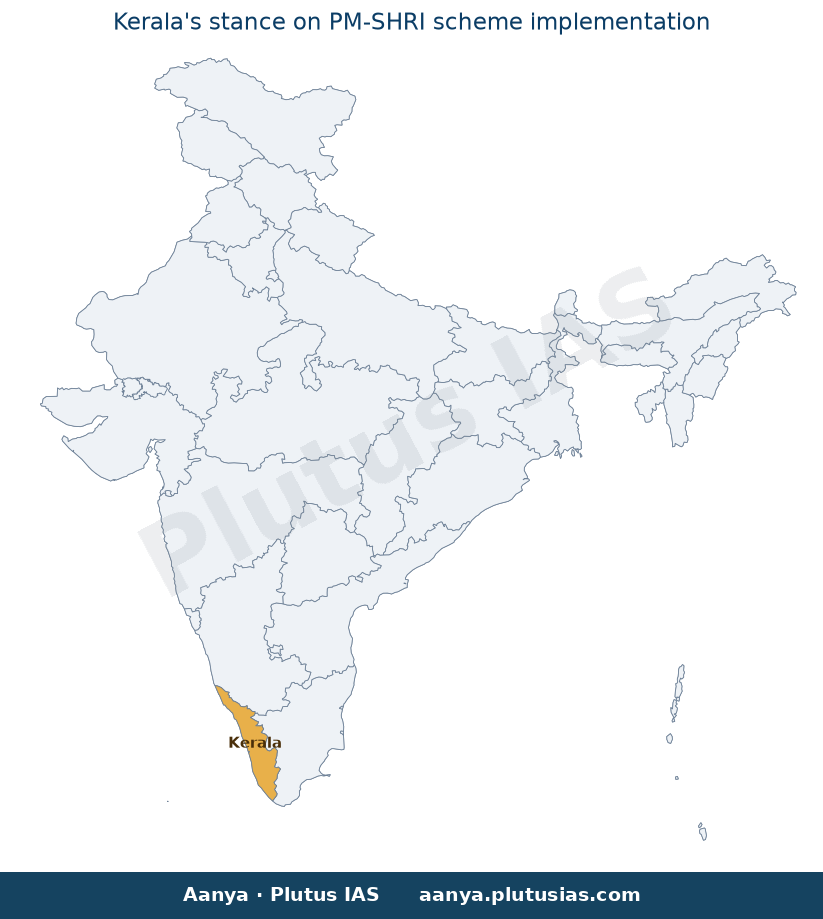
The Kerala government has deferred a decision on the implementation of the Pradhan Mantri Schools for Rising India (PM-SHRI) scheme until the submission of a report by a Cabinet sub-committee examining the scheme’s alignment with state priorities and constitutional provisions. This development highlights the procedural and substantive dimensions of federal cooperation in education policy, particularly in the context of the National Education Policy (NEP) 2020 and the Centre-State dynamics under India’s federal structure.
Background
- The PM-SHRI scheme, launched in 2022, aims to upgrade 14,500 existing schools across India into model schools, aligning with the objectives of the National Education Policy (NEP) 2020.
- The scheme is centrally sponsored, with the Union Ministry of Education providing 60% of the funding for states and union territories, and 90% for union territories without legislatures.
- Kerala, under its previous Left Democratic Front (LDF) government, had signed a Memorandum of Understanding (MoU) with the Centre to implement the PM-SHRI scheme.
- The subsequent United Democratic Front (UDF) government, which had opposed the scheme during its campaign, formed a Cabinet sub-committee to reassess its implementation, citing concerns over autonomy and alignment with state education priorities.
- The Centre and State have reportedly differed on the scheme’s implementation modalities, including funding patterns, curriculum alignment, and administrative control.
- This episode underscores the constitutional principle of cooperative federalism, where the Union and States must collaborate while respecting the federal balance enshrined in the Constitution.
What is the PM-SHRI Scheme?
- The Pradhan Mantri Schools for Rising India (PM-SHRI) scheme is a centrally sponsored initiative launched in September 2022 under the aegis of the National Education Policy (NEP) 2020.
- The scheme aims to transform 14,500 existing government schools across India into ‘model schools’ showcasing the implementation of NEP 2020, with a focus on quality, equity, and accessibility.
- Key objectives include enhancing infrastructure, teacher training, and pedagogical practices to align with the NEP 2020’s vision of holistic and experiential learning.
- The scheme integrates elements of the erstwhile Rashtriya Madhyamik Shiksha Abhiyan (RMSA), Samagra Shiksha Abhiyan, and other centrally sponsored schemes to ensure a unified approach to school education reform.
- PM-SHRI schools are expected to serve as exemplars for other schools, demonstrating best practices in governance, curriculum design, and community engagement.
- The scheme operates on a competitive selection process, where states and union territories submit proposals for upgrading schools, which are then evaluated by the Ministry of Education.
- Implementation is subject to the compliance of states with the scheme’s guidelines, which include adherence to NEP 2020 principles, digital infrastructure, and inclusive education practices.
Key Features
| Feature | Significance |
|---|---|
| PM-SHRI Scheme | A centrally sponsored scheme aimed at upgrading existing government schools into model schools, focusing on quality education, infrastructure, and digital resources. |
| Cabinet Sub-Committee | A State-level body constituted to examine the feasibility and implications of implementing the PM-SHRI scheme, ensuring alignment with State priorities. |
| Previous Government Agreement | The Left Democratic Front (LDF) government had signed a Memorandum of Understanding (MoU) with the Centre to implement the scheme, indicating prior commitment. |
| Current Government Review | The United Democratic Front (UDF) government, which had opposed the scheme initially, has reassessed its stance and formed a sub-committee for a detailed examination. |
| State-Centre Differences | Divergences over implementation modalities, funding mechanisms, or curriculum autonomy have led to a cautious approach by the State government. |
Why it Matters
Governance and Policy Process
- Demonstrates the dynamic nature of inter-governmental coordination in implementing centrally sponsored schemes, particularly in education, where State autonomy is significant.
- Highlights the role of State-level committees in reviewing and re-evaluating policy decisions made by previous administrations, ensuring continuity and accountability.
- Showcases the procedural aspect of governance, where decisions are deferred pending expert or committee reports, reflecting a methodical approach to policy implementation.
Education Sector Reforms
- The PM-SHRI scheme is a flagship initiative under the National Education Policy (NEP) 2020, aiming to transform government schools into centres of excellence.
- The State’s deliberation on the scheme underscores the importance of localising national education policies to address regional needs and constraints.
- Potential implications for teacher training, infrastructure development, and student outcomes in Keralam, contingent on the scheme’s implementation.
Federalism and Centre-State Relations
- Illustrates the tensions inherent in cooperative federalism, where States may reassess commitments made by previous governments due to changing political or administrative priorities.
- Raises questions about the balance between national uniformity in education standards and State-level flexibility in implementation.
- Emphasises the need for structured dialogue mechanisms between the Centre and States to resolve differences in policy execution.
Challenges
1. State-Centre Policy Alignment
- Divergences in policy priorities between the State and the Centre may delay or alter the implementation of the PM-SHRI scheme.
- The need to reconcile the State’s education vision with the Centre’s requirements under the scheme, particularly in areas like curriculum design or assessment frameworks.
UPSC Link: GS-II: Centre-State Relations
2. Political and Administrative Continuity
- Changes in government may lead to reassessment of prior agreements, creating uncertainty in long-term policy implementation.
- The risk of policy whiplash, where successive governments reverse or modify decisions made by predecessors, undermining stability in governance.
UPSC Link: GS-II: Functions and Responsibilities of the Union and the States
3. Resource Allocation and Funding
- The financial implications of the PM-SHRI scheme, including the Centre’s contribution and the State’s matching requirements, may pose challenges.
- Potential strain on State resources, especially if the scheme requires additional investments in infrastructure, teacher training, or digital resources.
UPSC Link: GS-III: Government Budgeting and Fiscal Policy
4. Stakeholder Consensus
- Building consensus among political parties, educationists, and civil society on the scheme’s implementation may be complex.
- Addressing concerns from within the ruling coalition or opposition regarding the scheme’s alignment with local educational needs.
UPSC Link: GS-II: Role of Civil Society in Governance
5. Implementation Logistics
- The practical challenges of upgrading existing schools to meet the PM-SHRI standards, including timeframes, manpower, and regulatory approvals.
- Ensuring that the scheme’s benefits reach all sections of society, particularly marginalised communities, without exacerbating regional disparities.
UPSC Link: GS-II: Welfare Schemes for Vulnerable Sections
Challenges — UPSC Perspective
| Issue | Concern |
|---|---|
| Policy Reassessment | Potential delays in implementation due to the State’s reconsideration of a prior agreement. |
| Funding Constraints | Risk of inadequate resources to meet the scheme’s requirements, especially if the State’s financial capacity is limited. |
| Curriculum Autonomy | Tensions between the Centre’s prescribed curriculum and the State’s educational priorities. |
| Stakeholder Opposition | Internal dissent within the ruling coalition or from opposition parties may hinder smooth implementation. |
| Infrastructure Gaps | Existing school infrastructure may not meet the scheme’s standards, requiring significant upgrades. |
Way Forward
- Conduct a detailed cost-benefit analysis of the PM-SHRI scheme, assessing its financial, administrative, and educational viability for Keralam.
- Engage in structured dialogue with the Centre to address concerns related to funding, curriculum, and implementation modalities.
- Formulate a State-specific implementation plan that aligns the scheme’s objectives with local educational needs and priorities.
- Ensure transparency in the decision-making process by sharing the Cabinet sub-committee’s findings with stakeholders, including educationists and civil society.
- Develop a phased rollout plan for the scheme, prioritising schools in under-served regions to ensure equitable access to quality education.
- Strengthen inter-departmental coordination within the State government to streamline the implementation process.
- Monitor and evaluate the scheme’s progress through periodic reviews, incorporating feedback from teachers, students, and parents.
UPSC Value Addition
Keywords for Mains Answer-Writing
PM-SHRI scheme · Centre-State relations · cooperative federalism · education policy · school education governance · Cabinet sub-committee · implementation of centrally sponsored schemes · federal tensions in policy execution · NEP 2020 · school infrastructure development
Concept Flow
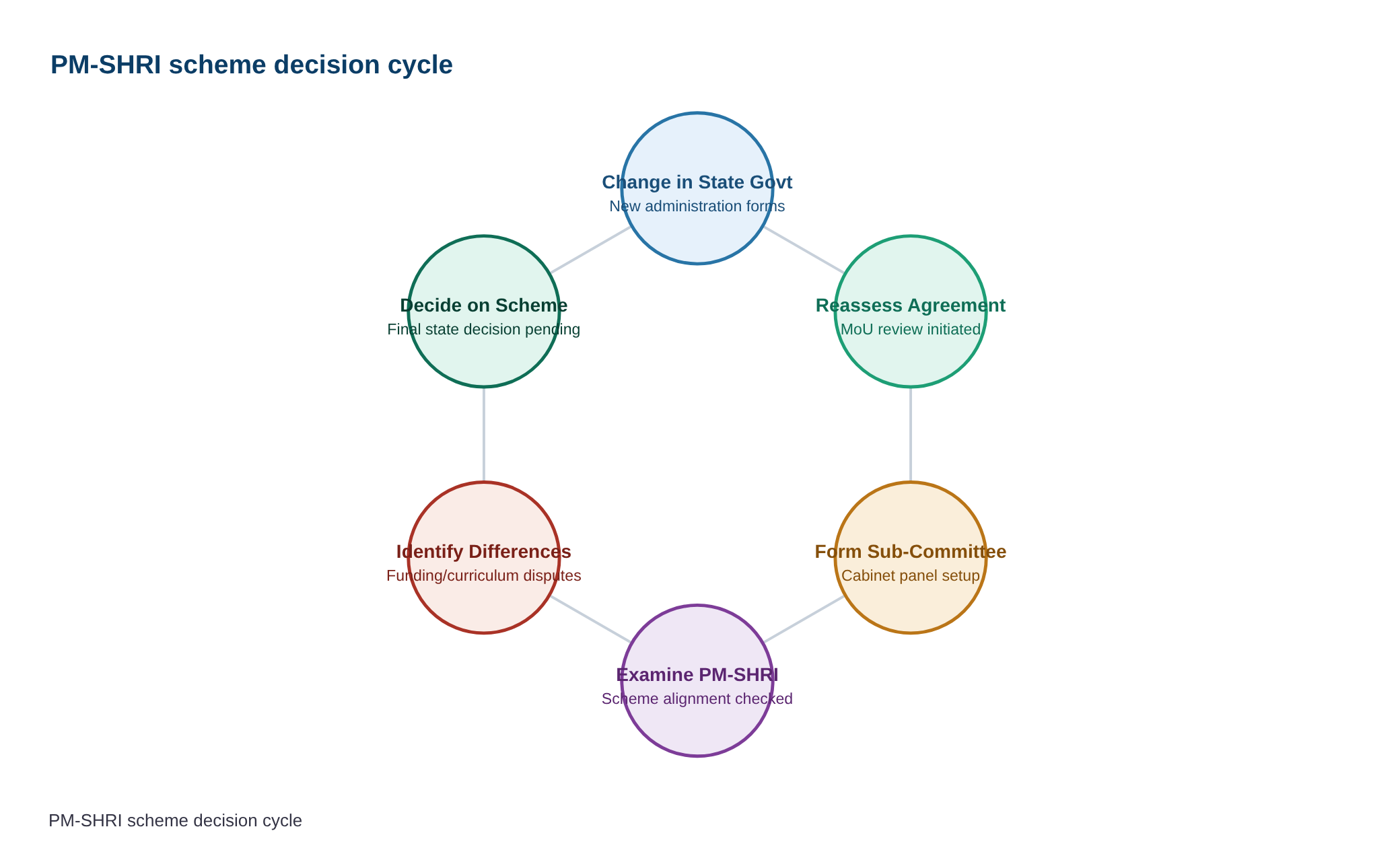
Change in State Government → Reassessment of Prior Agreements → Formation of Cabinet Sub-Committee → Examination of PM-SHRI Scheme → Identification of Centre-State Differences → Decision on Implementation → Potential Policy Adjustments
Prelims Practice Questions
Q1. Consider the following statements regarding the PM-SHRI scheme:
1. It is a centrally sponsored scheme aimed at transforming existing government schools into model schools.
2. The scheme is aligned with the National Education Policy (NEP) 2020.
3. The implementation of the scheme is entirely under the discretion of State governments without any central oversight.
How many of the above statements are correct?
- Only one
- Only two
- All three
- None
Answer: Only two — Statements 1 and 2 are correct as the PM-SHRI scheme is a centrally sponsored initiative to upgrade government schools in line with NEP 2020. Statement 3 is incorrect because the scheme involves central funding and monitoring mechanisms, limiting complete state discretion.
Q2. Assertion (A): The PM-SHRI scheme requires States to sign a Memorandum of Understanding (MoU) with the Central Government before implementation.
Reason (R): The scheme is funded entirely by the Central Government, and States are merely implementing agencies.
In the context of the above statements, which of the following is correct?
- Both A and R are true, and R is the correct explanation of A.
- Both A and R are true, but R is not the correct explanation of A.
- A is true, but R is false.
- A is false, but R is true.
Answer: A is true, but R is false. — Assertion (A) is true as States must sign an MoU to access central funds under the scheme. Reason (R) is incorrect because while the scheme is centrally funded, States contribute to implementation and have some autonomy in execution.
Q3. Match the following schemes with their primary objectives:
List I (Scheme) | List II (Objective)
— | —
A. PM-SHRI | 1. Universal access to quality education for all children aged 3-18 years
B. Sarva Shiksha Abhiyan (SSA) | 2. Transforming existing government schools into model schools
C. Rashtriya Madhyamik Shiksha Abhiyan (RMSA) | 3. Enhancing secondary school access and quality
D. Samagra Shiksha Abhiyan | 4. Providing inclusive and equitable quality education from pre-primary to senior secondary levels
Select the correct match:
- A-2, B-1, C-3, D-4
- A-1, B-2, C-4, D-3
- A-3, B-4, C-1, D-2
- A-4, B-3, C-2, D-1
Answer: A-2, B-1, C-3, D-4 — Correct matches: PM-SHRI (A-2) aims to transform existing schools; SSA (B-1) focuses on universal access to education; RMSA (C-3) enhances secondary school access; Samagra Shiksha Abhiyan (D-4) provides inclusive education from pre-primary to senior secondary levels.
Mains Practice Question
✍ The PM-SHRI scheme, a flagship initiative under the National Education Policy 2020, seeks to transform existing government schools into ‘model schools’ through enhanced infrastructure and pedagogical reforms. Critically examine the challenges in its implementation, with particular reference to Centre-State relations and the federal structure of India. Also, assess the role of State governments in ensuring the scheme’s effectiveness while balancing local educational priorities. (15 Marks)
Approach: MODEL-ANSWER SKELETON:
1. **Introduction (2 marks)**
– Briefly define PM-SHRI: centrally sponsored scheme under NEP 2020 to upgrade 14,500+ schools.
– Mention its alignment with SDG 4 (Quality Education) and the constitutional provision (Article 21A) guaranteeing education as a fundamental right.
2. **Centre-State Relations and Federal Challenges (5 marks)**
– **Constitutional Framework**: Distribution of subjects under Seventh Schedule (Education in Concurrent List).
– **Cooperative Federalism**: Need for consensus between Centre and States for scheme implementation (e.g., MoU requirements, funding mechanisms).
– **Recent Tensions**: Cite the Kerala case as an example of State-level opposition due to perceived encroachment on autonomy or mismatches with local priorities.
– **Legal Basis**: Reference to Article 292 (borrowing powers of States) and Article 282 (grants-in-aid) for Centre-State financial cooperation.
– **Judicial Precedents**: Mention cases like *State of West Bengal v. Union of India* (1963) on Centre-State financial relations.
3. **Role of State Governments (4 marks)**
– **Autonomy vs. Accountability**: States must balance local educational needs with central guidelines (e.g., curriculum, infrastructure standards).
– **Implementation Mechanisms**: Role of State Education Departments, District Institutes of Education and Training (DIETs), and School Management Committees (SMCs).
– **Challenges**: Resource constraints, bureaucratic delays, and resistance from teacher unions or local bodies.
– **Best Practices**: Highlight States like Tamil Nadu or Odisha for successful decentralized implementation of similar schemes.
4. **Balancing Local Priorities (3 marks)**
– **Curriculum Flexibility**: States may adapt content to local languages/cultures while adhering to NEP 2020.
– **Infrastructure Gaps**: Addressing regional disparities in school infrastructure (e.g., tribal vs. urban areas).
– **Community Participation**: Role of Panchayati Raj Institutions (PRIs) and NGOs in monitoring scheme progress.
5. **Conclusion (1 mark)**
– Emphasize the need for a collaborative model where Centre provides funding and technical support, while States retain implementation flexibility to ensure inclusivity and effectiveness.
Source: The Hindu
Generated by AanyaAi for educational purpose.
Related guides on our sites
- Best PSIR optional coaching for upsc
- Best PSIR optional teacher for upsc
- Best teacher of PSIR optional for upsc
- Best PSIR optional coaching in delhi for UPSC

- Kerala to Decide on PM-SHRI Scheme After Cabinet Panel Report - September 7, 2026
- तमिलनाडु में पूमपुहार तट पर तीसरे चरण की जलमग्न पुरातत्व खोज शुरू - September 6, 2026
- Tamil Nadu’s Underwater Archaeology: Poompuhar’s 3rd Phase Explained for UPSC - September 6, 2026

No Comments