


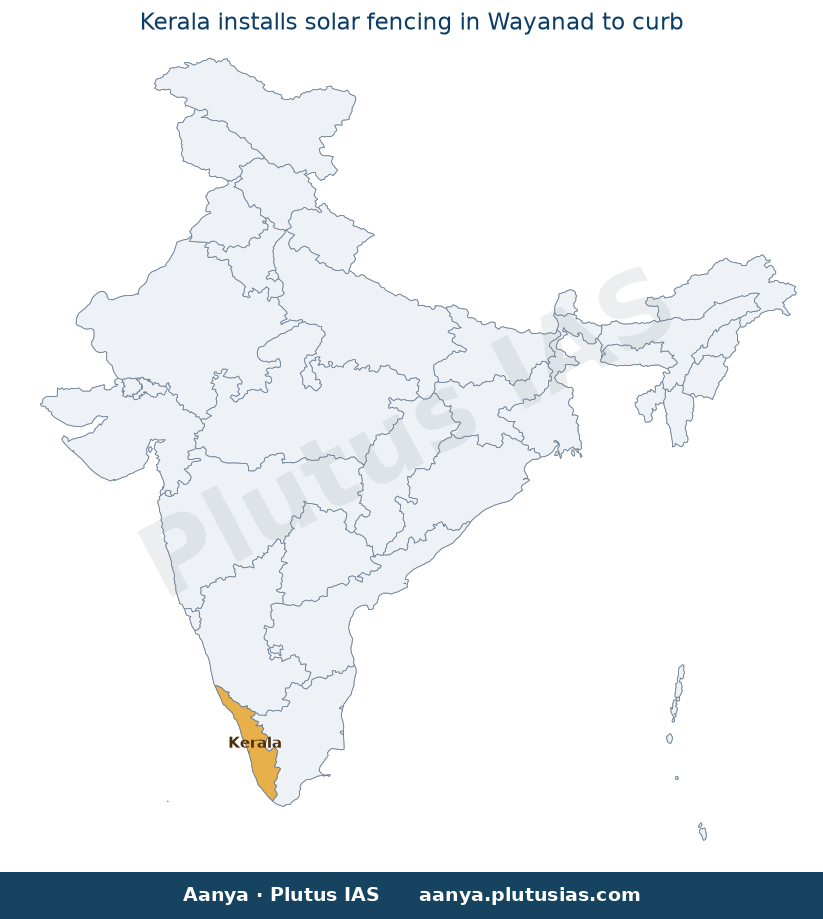
08 Aug Kerala to Install 60 km Solar Fencing in Wayanad to Reduce Human-Wildlife Conflict
✎ Solar fencing in Wayanad is a non-lethal, solar-powered barrier system designed to deter elephants and tigers from entering human settlements, reducing human-wildlife conflict while supporting ecological carrying capacity…
Subject Relevance — Where This Topic Fits
- GS Paper III — Environment, Forestry and Wildlife Conservation | GS Paper III — Science and Technology (Applications in Environmental Management)
- Prelims: Human-Wildlife Conflict (HWC), Solar Fencing Technology, Waynad Wildlife Sanctuary, Tiger Relocation Policy, Carrying Capacity of Forests, Rapid Response Teams in Wildlife Management, Forest Rights Act, 2006, Wildlife Institute of India (WII), National Tiger Conservation Authority (NTCA), Compensatory Afforestation Fund Management and Planning Authority (CAMPA)
- Essay: Human-Wildlife Coexistence: Balancing Conservation with Human Development, Technological Innovations in Environmental Governance: Case of Solar Fencing in Wayanad
Quick Revision: Solar fencing in Wayanad is a non-lethal, solar-powered barrier system designed to deter elephants and tigers from entering human settlements, reducing human-wildlife conflict while supporting ecological carrying capacity assessments.
Why is this in the news?
The Kerala government’s decision to install 60 km of solar fencing in Wayanad district, along with repair works on existing 25 km of fencing, underscores the escalating human-wildlife conflict (HWC) in the region. This initiative, part of the State’s 100-day action programme, is a direct response to the district’s designation as the worst affected by HWC in Kerala. The move is significant as it integrates technological intervention with ecological assessment, involving institutions like the Wildlife Institute of India (WII) for carrying capacity studies, and aligns with broader national strategies for wildlife conservation and human-wildlife coexistence.
Background
- Wayanad district in Kerala is a biodiversity hotspot, home to the Wayanad Wildlife Sanctuary (WWS), a key component of the Nilgiri Biosphere Reserve. The sanctuary supports populations of tigers (Panthera tigris), Asian elephants (Elephas maximus), and other wildlife species.
- Human-wildlife conflict (HWC) in Wayanad has intensified due to the expansion of agricultural lands, human settlements, and infrastructure into forest fringes, leading to increased interactions between humans and wildlife, particularly elephants and tigers.
- The Kerala Forest Department has previously implemented measures such as physical barriers, early warning systems, and compensation schemes to mitigate HWC, but the persistence of conflicts necessitates innovative and sustainable solutions.
- The Wildlife Institute of India (WII), an autonomous institution under the Ministry of Environment, Forest and Climate Change (MoEFCC), has been tasked with conducting a carrying capacity study of Wayanad’s forests to assess the ecological limits of wildlife populations in relation to human habitation.
- The National Tiger Conservation Authority (NTCA) and State Forest Departments have emphasized the need for coordinated efforts, including habitat management and community participation, to address HWC effectively.
- Solar fencing technology has gained prominence in India as a non-lethal, cost-effective, and sustainable method to deter wildlife from entering human settlements, particularly in regions with high elephant and tiger populations.
What is Solar Fencing and How Does It Address Human-Wildlife Conflict?
- Solar fencing is an electrified barrier system powered by solar energy, designed to create a psychological deterrent for wildlife attempting to enter human settlements or agricultural lands. The system uses low-voltage electric pulses (typically 5-6 kV) that are harmless but unpleasant to animals, encouraging them to avoid the area.
- The technology operates on a pulsed electric current, ensuring minimal harm to wildlife while providing a reliable and low-maintenance solution compared to traditional physical barriers like trenches or stone walls. It is particularly effective against large mammals such as elephants and tigers.
- In Wayanad, the solar fencing will be installed along 60 km of forest fringes, complementing the repair of existing 25 km of fencing. This expansion aims to create a contiguous barrier in high-conflict zones, reducing crop raiding and human casualties.
- The initiative is part of a broader strategy that includes habitat management, community engagement, and rapid response teams to address HWC. The Kerala government’s 100-day action programme also includes vegetation clearance along 100 km of forest department roads and the deployment of four Rapid Response Teams in Wayanad.
- The carrying capacity study by the Wildlife Institute of India (WII) will assess the ecological limits of Wayanad’s forests, considering factors such as prey availability, habitat fragmentation, and human settlements. This study will inform future conservation policies and land-use planning.
- The technology is scalable and has been successfully implemented in other Indian states, such as West Bengal, Odisha, and Karnataka, where it has significantly reduced HWC incidents. However, its effectiveness depends on proper maintenance, community participation, and integration with other conservation measures.
- The Kerala government’s decision to involve multiple stakeholders, including farmers, local self-government institutions, and public vigilance committees, reflects a participatory approach to wildlife management, ensuring that conservation efforts are inclusive and sustainable.
UPSC Value Addition
Keywords for Mains Answer-Writing
Human-Wildlife Conflict (HWC) · Solar fencing technology · Waynad district ecological landscape · Wildlife Institute of India (WII) · Carrying capacity of forests · Relocation of tigers · Rapid Response Teams in wildlife management · Community-based conservation · Forest Rights Act, 2006 · National Tiger Conservation Authority (NTCA) · 100-day action programme · Kerala Forest Department · Elephant and tiger population assessment · Forest fringe human settlements
Prelims Practice Questions
Q1. Consider the following statements regarding human-wildlife conflict (HWC) in India:
1. The Wildlife Institute of India (WII) is mandated to conduct carrying capacity studies for forests.
2. Solar fencing is an eco-friendly and non-lethal method to mitigate HWC.
3. The Forest Rights Act, 2006, explicitly prohibits any relocation of tribal communities from forest areas.
4. The National Tiger Conservation Authority (NTCA) is responsible for the relocation of tigers across tiger reserves.
How many of the above statements are correct?
- Only one
- Only two
- Only three
- All four
Answer: Only three — Statements 1 and 2 are correct. Statement 3 is incorrect as the Forest Rights Act, 2006, provides for the diversion of forest land for public utility projects with the consent of Gram Sabhas, subject to conditions. Statement 4 is incorrect as the NTCA does not directly relocate tigers; relocation is managed by state forest departments in coordination with the NTCA.
Q2. Assertion (A): Solar fencing is a sustainable and humane method to mitigate human-wildlife conflict.
Reason (R): It uses low-voltage electric pulses to deter animals without causing harm, thereby balancing conservation and livelihood security.
- Both A and R are true, and R is the correct explanation of A.
- Both A and R are true, but R is NOT the correct explanation of A.
- A is true, but R is false.
- A is false, but R is true.
Answer: Both A and R are true, and R is the correct explanation of A. — Both the assertion and reason are correct, and the reason accurately explains the assertion. Solar fencing uses low-voltage electric pulses that deter animals without causing physical harm, making it a humane and sustainable solution for mitigating human-wildlife conflict.
Q3. Which of the following is NOT a primary objective of the ‘100-day action programme’ announced by the Kerala government for Wayanad district?
- Installation of 60 km of solar fencing along forest fringes
- Repair of existing 25 km of solar fencing
- Conducting a carrying capacity study of forests by the Wildlife Institute of India
- Relocating all tigers from Wayanad to other tiger reserves
Answer: Relocating all tigers from Wayanad to other tiger reserves — The relocation of all tigers from Wayanad to other tiger reserves is not a stated objective of the 100-day action programme. The programme focuses on installing and repairing solar fencing, conducting carrying capacity studies, and strengthening wildlife management, but relocation is a selective and case-specific measure, not a blanket policy.
Mains Practice Question
✍ The Government of Kerala has initiated a 100-day action programme to mitigate human-wildlife conflict in Wayanad district through the installation of solar fencing and other measures. Critically examine the efficacy of solar fencing as a tool for conservation in the context of India’s legal and policy framework for wildlife management. (15 Marks)
Approach: MODEL-ANSWER SKELETON:
1. **Introduction (2 Marks)**
– Define human-wildlife conflict (HWC) and its socio-economic and ecological dimensions in India, with a focus on Wayanad’s ecological landscape (Western Ghats biodiversity hotspot, high human settlements near forest fringes).
2. **Solar Fencing as a Mitigation Tool (4 Marks)**
– Explain the mechanism of solar fencing: low-voltage electric pulses deterring animals without harm.
– Compare with traditional methods (e.g., trenches, physical barriers, community vigilance) highlighting advantages (non-lethal, scalable, cost-effective).
– Cite Kerala’s initiative: 60 km installation + repair of 25 km existing fencing under the 100-day programme.
3. **Legal and Policy Framework (5 Marks)**
– **Wildlife Protection Act, 1972 (WPA)**: Provisions for protection of wildlife (Sections 9, 35, 38) and mitigation of conflict (Section 66B).
– **Forest Rights Act, 2006 (FRA)**: Recognition of forest dwellers’ rights and provisions for diversion of forest land for public utility (Section 3(2)), balancing livelihood and conservation.
– **National Tiger Conservation Authority (NTCA) Guidelines**: Protocols for tiger relocation and habitat management.
– **Kerala State Forest Policy**: Emphasis on community participation and eco-friendly mitigation strategies.
4. **Challenges and Criticisms (3 Marks)**
– **Ecological Concerns**: Potential disruption of animal movement corridors and long-term behavioural changes in wildlife.
– **Community Dynamics**: Land ownership conflicts, displacement of tribal communities, and lack of consensus on relocation.
– **Implementation Gaps**: Maintenance of solar fencing, sustainability of funding, and coordination between stakeholders (Forest Department, Gram Sabhas, local self-governments).
5. **Conclusion (1 Mark)**
– Solar fencing is a pragmatic, short-to-medium-term solution but must be integrated with broader conservation strategies (habitat restoration, community-based monitoring, and policy enforcement). Emphasise the need for adaptive management and stakeholder collaboration.
Source: The Hindu
Generated by AanyaAi for educational purpose.

- यूपी में पहली बार तेंदुओं का बधियाकरण: मानव-वन्यजीव संघर्ष रोकेगा अभियान - September 24, 2026
- UP’s Groundbreaking Leopard Sterilization Plan to Curb Human-Wildlife Conflict - September 24, 2026
- महाराष्ट्र में त्योहार जुलूसों पर बॉम्बे हाईकोर्ट का बड़ा फैसला: पटाखे, लेजर और संगीत पर रोक - September 24, 2026

No Comments