


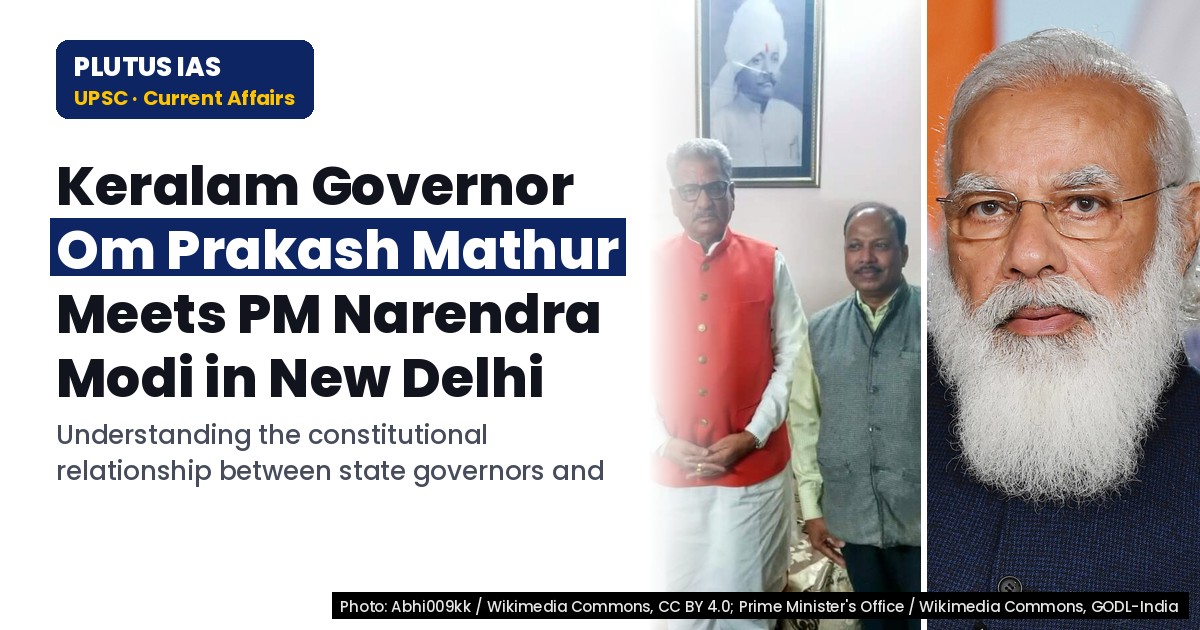
05 Nov Keralam Governor Meets PM: Key Constitutional Roles
✎ The Governor serves as the constitutional head of a state, appointed by the President, acting as a crucial link between the Union and State governments within India's federal framework.
Subject Relevance — Where This Topic Fits
- GS Paper II — Indian Polity and Governance: Functions and Responsibilities of the Union and the States, Issues and Challenges Pertaining to the Federal Structure, Appointment to various Constitutional Posts, Powers, Functions and Responsibilities of various Constitutional Bodies.
- Prelims: Governor’s appointment, Prime Minister’s role, Centre-State relations, Article 153, Article 155, Constitutional Head of State, Executive Head of Government, Federalism in India
- Essay: The evolving dynamics of federalism in India: Challenges and opportunities., Constitutional offices and their role in upholding democratic principles.
Quick Revision: The Governor serves as the constitutional head of a state, appointed by the President, acting as a crucial link between the Union and State governments within India’s federal framework.
Why is this in the news?
The Governor of Keralam, Shri Om Prakash Mathur, met the Prime Minister, Shri Narendra Modi, in New Delhi. Such meetings are a routine aspect of inter-institutional communication within India’s federal structure, facilitating discussions on state-specific matters, policy implementation, and general governance issues.
Background
- The Governor is the constitutional head of a state, appointed by the President of India, and acts as a vital link between the Union Government and the State Government.
- Article 153 of the Constitution mandates that there shall be a Governor for each state, while Article 155 specifies that the Governor of a state shall be appointed by the President by warrant under his hand and seal.
- The Governor’s office is crucial for maintaining the federal balance, ensuring constitutional propriety, and overseeing the administration of the state.
- The Prime Minister is the head of the Union Government, holding the executive power and responsible for the overall governance of the nation.
- Meetings between Governors and the Prime Minister are part of the established protocol, allowing for direct communication on matters of mutual interest, including state development, law and order, and the implementation of central schemes.
- These interactions underscore the cooperative federalism framework, where both Union and State functionaries engage to address governance challenges and promote national objectives.
The Constitutional Office of the Governor
- The Governor is the nominal head of the state executive, while the real executive power rests with the Chief Minister and the Council of Ministers.
- Key functions include appointing the Chief Minister and other ministers, summoning and proroguing the state legislature, and assenting to bills passed by the state legislature.
- The Governor also serves as the Chancellor of state universities, holding significant influence over higher education in the state.
- Discretionary powers of the Governor include reserving a bill for the consideration of the President, recommending the imposition of President’s Rule in the state, and seeking information from the Chief Minister regarding administrative affairs.
- The office of the Governor has been a subject of debate regarding its role in Centre-State relations, particularly concerning appointments, dismissals, and the exercise of discretionary powers.
- Various commissions, such as the Sarkaria Commission and the Punchhi Commission, have examined the role and powers of the Governor, offering recommendations to strengthen federalism and ensure constitutional impartiality.
Key Features
| Feature | Significance |
|---|---|
| Governor’s Role as Constitutional Head | The Governor serves as the nominal head of the state executive, acting on the aid and advice of the Council of Ministers, except in matters where the Constitution requires discretion. |
| Appointment by President | The Governor is appointed by the President of India, signifying their role as a link between the Union and State governments, ensuring constitutional propriety. |
| Dual Capacity | The Governor functions both as the constitutional head of the state and as a representative of the Union government, necessitating a balance in their discharge of duties. |
| Interaction with Prime Minister | Meetings between a Governor and the Prime Minister facilitate communication on state-specific issues, policy implementation, and matters requiring Union government intervention or coordination. |
| Constitutional Discretion | While generally bound by ministerial advice, the Governor possesses certain discretionary powers, particularly in situations of political instability or constitutional breakdown. |
Why it Matters
Governance and Federalism
- The interaction underscores the operational aspects of India’s federal structure, where state and Union functionaries engage to address administrative and policy matters.
- It highlights the Governor’s role as a crucial interface between state administration and the central government, facilitating dialogue on state-specific concerns.
- Such meetings can be instrumental in resolving inter-state disputes or issues requiring coordinated efforts between the Union and state governments.
Constitutional Propriety
- The meeting reaffirms the constitutional position of the Governor as a representative of the President in the state, ensuring adherence to constitutional provisions.
- It provides an opportunity for the Governor to apprise the Prime Minister of the state’s administrative status, legislative developments, and any challenges faced.
- This engagement is a standard practice in parliamentary democracy, allowing for informal consultations on matters of mutual interest and governance.
Policy Implementation and Coordination
- Discussions during such meetings can pertain to the implementation of Union-sponsored schemes and policies within the state, assessing progress and identifying bottlenecks.
- It allows for the communication of state-specific needs and developmental priorities to the highest executive authority at the Union level.
- Such interactions contribute to better coordination between Union and state agencies, particularly in areas requiring joint action like disaster management or infrastructure development.
Challenges
1. Balancing Dual Roles
- The Governor’s position requires a delicate balance between acting as the constitutional head of the state and as a representative of the Union government.
- Potential for perceived bias or overreach when discretionary powers are exercised, leading to friction with the elected state government.
UPSC Link: Indian Constitution – Centre-State Relations
2. Scope of Discretionary Powers
- The precise extent and application of the Governor’s discretionary powers remain a subject of debate and judicial interpretation.
- Ambiguity can lead to constitutional crises, especially in situations of hung assemblies or political instability.
UPSC Link: Constitutional Bodies – Governor
3. Political Neutrality
- Maintaining strict political neutrality is paramount for the Governor to uphold the sanctity of the office and ensure public trust.
- Allegations of partisan behaviour can undermine the constitutional authority and effectiveness of the Governor’s office.
UPSC Link: Indian Polity – Constitutional Morality
4. Centre-State Tensions
- The Governor’s office can become a point of contention in Centre-State relations, particularly when different political parties are in power at the Union and state levels.
- Disagreements over legislative assent, summoning/dissolving assemblies, or recommending President’s Rule can strain federal ties.
UPSC Link: Federalism – Challenges to Indian Federalism
Challenges — UPSC Perspective
| Issue | Concern |
|---|---|
| Governor’s Appointment Process | Lack of a clear, transparent process for appointment can lead to perceptions of political patronage rather than merit, impacting the office’s credibility. |
| Removal of Governor | The ‘pleasure of the President’ doctrine for removal lacks explicit constitutional guidelines, raising concerns about security of tenure and potential for arbitrary dismissal. |
| Assent to Bills | Delays or withholding of assent to state legislative bills can impede governance and lead to legislative stalemates, challenging the democratic process. |
| Recommendation of President’s Rule | The power to recommend President’s Rule (Article 356) has historically been a contentious issue, often perceived as an instrument for political interference by the Union government. |
| Role in University Administration | In many states, the Governor acts as the Chancellor of state universities, leading to potential conflicts with the elected government over appointments and academic autonomy. |
Way Forward
- Implement recommendations of various commissions (e.g., Sarkaria, Punchhi) regarding the Governor’s appointment and tenure to ensure greater transparency and impartiality.
- Develop a clear code of conduct and guidelines for the exercise of discretionary powers by Governors, minimizing ambiguity and potential for misuse.
- Foster a spirit of cooperative federalism, encouraging regular and constructive dialogue between the Union and state governments, including through the Governor’s office.
- Strengthen inter-state council mechanisms to provide a formal platform for resolving Centre-State and inter-state issues, reducing reliance on informal channels.
- Ensure timely disposal of state legislative bills by the Governor, adhering to constitutional timelines and principles of legislative supremacy.
- Promote constitutional literacy among all stakeholders to enhance understanding of the Governor’s role and responsibilities, fostering respect for constitutional institutions.
- Consider constitutional amendments to clarify the ‘pleasure of the President’ doctrine for Governor’s removal, providing greater security of tenure.
UPSC Value Addition
Keywords for Mains Answer-Writing
Governor’s role · Centre-State relations · Constitutional office · Article 153 · Article 154 · Article 163 · Discretionary powers · Federalism · Parliamentary democracy · Sarkaria Commission · Punchhi Commission · Rajamannar Committee
Constitutional & Policy Linkages
- {‘article’: ‘Article 153’, ‘note’: ‘Governors of States’}
- {‘article’: ‘Article 154’, ‘note’: ‘Executive Power of State’}
- {‘article’: ‘Article 155’, ‘note’: ‘Appointment of Governor’}
- {‘article’: ‘Article 156’, ‘note’: “Term of Governor’s Office”}
- {‘article’: ‘Article 163’, ‘note’: ‘Aid and Advice to Governor’}
- {‘article’: ‘Article 200’, ‘note’: ‘Assent to Bills’}
- {‘article’: ‘Article 356’, ‘note’: “President’s Rule”}
Concept Flow
Governor appointed by President → Governor acts as state’s constitutional head → Governor represents Union in state → Meeting with Prime Minister occurs → Discussions on state affairs and policies → Facilitates Centre-State coordination
Prelims Practice Questions
Q1. Consider the following statements regarding the office of the Governor in India:
1. The Governor is appointed by the President of India and holds office during the pleasure of the President.
2. The Governor acts as the constitutional head of the state and also as a representative of the Union Government.
3. The Constitution specifies the procedure for the removal of the Governor, similar to that of a Supreme Court judge.
How many of the above statements are correct?
- Only one
- Only two
- Only three
- None
Answer: Only two — Statement 1 is correct: Article 155 and 156 stipulate the appointment by the President and holding office during the President’s pleasure. Statement 2 is correct: The Governor performs a dual role as the constitutional head of the state executive (Article 154) and as a link between the Centre and the State. Statement 3 is incorrect: The Constitution does not specify the procedure for the removal of the Governor; they can be removed by the President at any time without assigning any reason.
Q2. Which of the following Articles of the Indian Constitution deals with the discretionary powers of the Governor?
- Article 153
- Article 154
- Article 163
- Article 164
Answer: Article 163 — Article 163(1) states that there shall be a Council of Ministers with the Chief Minister at the head to aid and advise the Governor in the exercise of his functions, except in so far as he is by or under this Constitution required to exercise his functions or any of them in his discretion. This article explicitly mentions the discretionary powers of the Governor.
Mains Practice Question
✍ Critically examine the dual role of the Governor as a constitutional head of the state and a representative of the Union Government. Discuss the challenges arising from this dual role in contemporary Indian federalism. (15 Marks)
Approach: MODEL-ANSWER SKELETON:
1. **Introduction:** Briefly define the Governor’s office as established by Article 153, highlighting its dual nature.
2. **Constitutional Head Role:** Explain the Governor’s functions as the nominal executive head of the state, acting on the aid and advice of the Council of Ministers (Article 163, 164). Mention powers related to summoning/proroguing legislature, assenting to bills (Article 200), and administrative functions.
3. **Representative of the Union Role:** Detail the Governor’s role as a link between the Centre and the State, particularly in reporting on the state’s constitutional machinery (Article 356) and reserving bills for Presidential consideration (Article 200, 201).
4. **Challenges Arising from Dual Role:**
* **Political Neutrality:** Issues of perceived partisan behaviour, especially when different political parties govern at the Centre and State.
* **Discretionary Powers:** Controversies surrounding the exercise of discretionary powers (e.g., appointment of Chief Minister, dismissal of ministry, dissolution of assembly, assent to bills, recommending President’s Rule) and their potential misuse.
* **Federal Tensions:** How the Governor’s actions can exacerbate Centre-State conflicts, particularly in matters of legislation and governance.
* **Accountability:** Lack of clear accountability mechanisms for the Governor’s actions, given the ‘pleasure of the President’ doctrine.
5. **Recommendations/Judicial Pronouncements:** Refer to key committee recommendations (Sarkaria Commission, Punchhi Commission, Rajamannar Committee) and Supreme Court judgments (e.g., S.R. Bommai case, Rameshwar Prasad case) that have sought to define and limit the Governor’s powers.
6. **Conclusion:** Summarise the importance of maintaining the delicate balance in the Governor’s role for the effective functioning of Indian federalism and constitutional democracy, suggesting the need for greater clarity and adherence to constitutional conventions.
Source: PIB (Press Information Bureau)
Kerala PCS (Kerala PSC (KAS)) — State PCS Practice
Prelims: Which of the following statements is/are correct regarding the recent meeting between the Governor of Kerala and the Prime Minister of India?
1. Such meetings are part of the routine constitutional interactions between the head of a state and the head of the Union government.
2. The Governor acts as a crucial link between the State and the Centre, facilitating communication on matters of mutual interest.
3. The meeting primarily focuses on legislative matters requiring presidential assent.
Select the correct option using the codes given below:
- A. 1 only
- B. 2 only
- C. 1 and 2 only
- D. 1, 2 and 3
Answer: C. 1 and 2 only — The Governor’s role involves routine constitutional interactions and acting as a link between the state and the centre, but such meetings are not primarily focused on legislative matters requiring presidential assent, which is a more formal process.
Mains: Discuss the constitutional role and significance of the Governor in fostering cooperative federalism, with specific reference to instances of interaction between the Governor of a State and the Prime Minister of India.
Generated by AanyaAi for educational purpose.
Related guides on our sites
- Current affairs for upsc 2026
- Best PSIR optional coaching for upsc
- Best PSIR optional teacher for upsc
- Best teacher of PSIR optional for upsc

- Keralam Governor Meets PM: Key Constitutional Roles - November 5, 2026
- एनएलएमसी द्वारा आरआईएनएल भूमि ई-नीलामी: एक सफल मौद्रीकरण पहल - November 5, 2026
- UP Voter List Discrepancy: EC Orders Matching Rolls - November 5, 2026

No Comments