


08 Aug Kerala’s 60 km solar fencing plan to curb human-wildlife conflict in Wayanad
✎ Solar fencing is a non-lethal, solar-powered electric barrier used to deter wild animals from entering human settlements, thereby mitigating human-wildlife conflict while ensuring animal welfare and ecological balance.
Subject Relevance — Where This Topic Fits
- GS Paper III — Environment, Ecology, Biodiversity and Climate Change | GS Paper III — Disaster Management
- Prelims: Human-Wildlife Conflict (HWC), Solar fencing, Carrying Capacity, Wildlife Institute of India (WII), Project Tiger, Elephant corridors, Rapid Response Teams (RRTs), 100-day action plan
- Essay: Human-Wildlife Conflict: Balancing Conservation and Livelihoods, Technological Innovations in Wildlife Management: A Path to Sustainable Coexistence
Quick Revision: Solar fencing is a non-lethal, solar-powered electric barrier used to deter wild animals from entering human settlements, thereby mitigating human-wildlife conflict while ensuring animal welfare and ecological balance.
Why is this in the news?
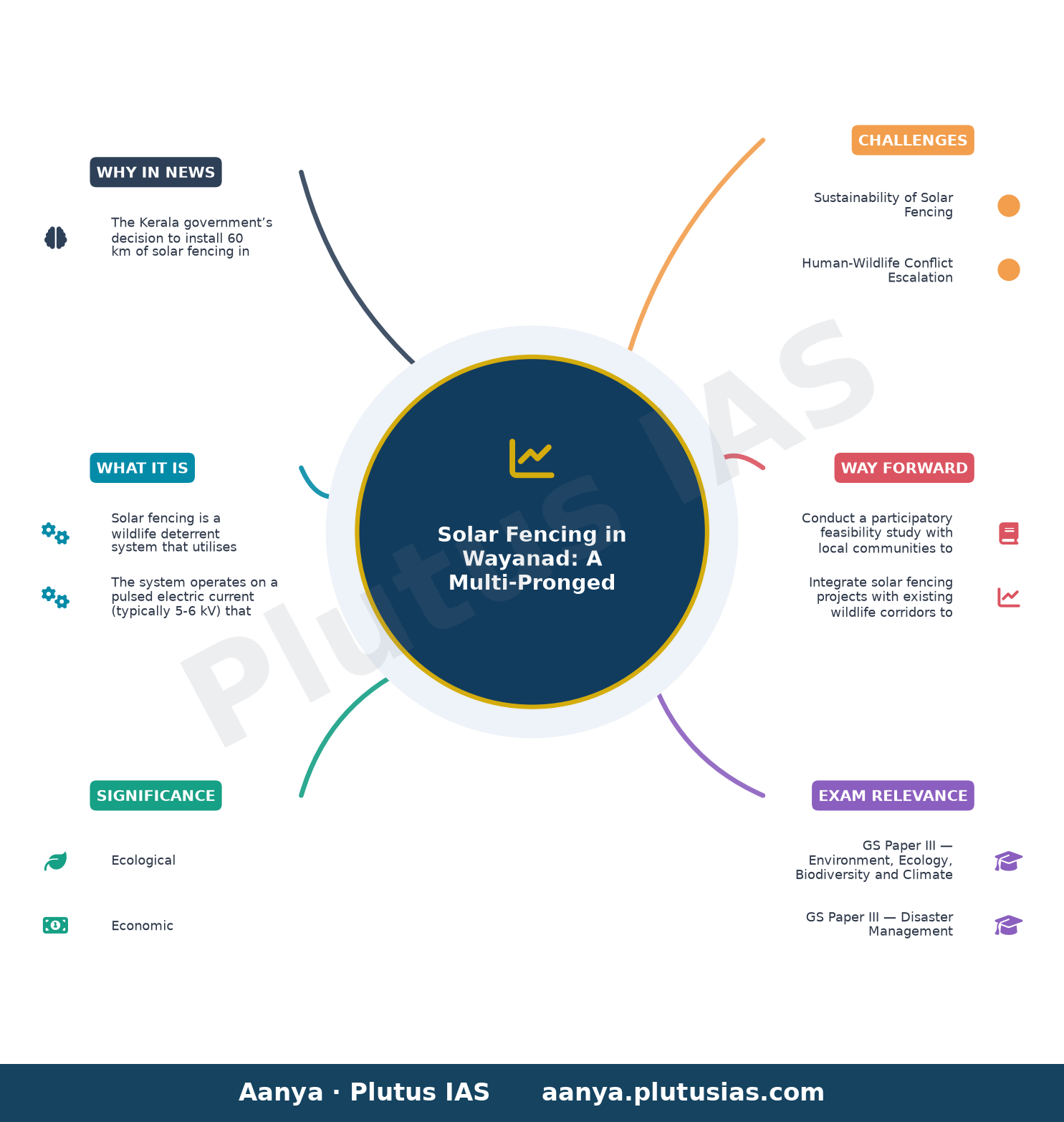
The Kerala government’s decision to install 60 km of solar fencing in Wayanad district, along with a carrying capacity study by the Wildlife Institute of India (WII) and the deployment of Rapid Response Teams (RRTs), underscores the escalating human-wildlife conflict (HWC) in the region. This initiative is part of the state’s 100-day action programme and reflects a structured approach to mitigating HWC through technological, administrative, and ecological interventions. The announcement highlights the intersection of conservation policies, livelihood protection, and inter-governmental coordination in addressing a critical environmental governance challenge.
Background
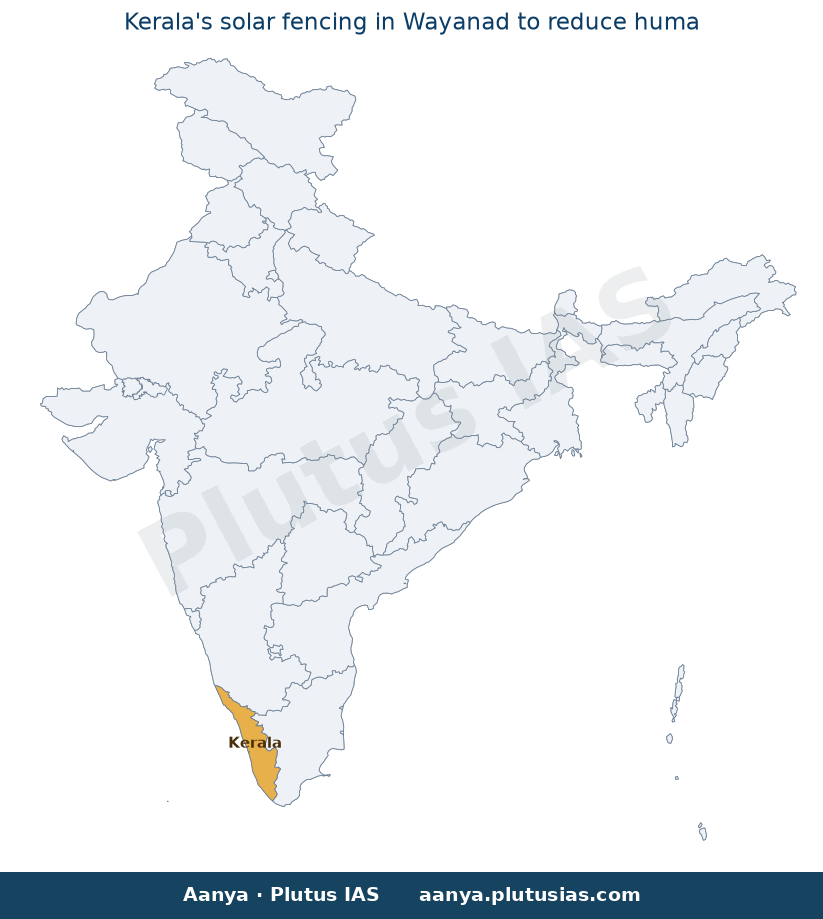
- Wayanad district in Kerala is one of the most human-wildlife conflict-prone regions in India, owing to its dense forest cover, fragmented habitats, and proximity of human settlements to wildlife corridors.
- Human-wildlife conflict (HWC) in India primarily involves large mammals such as elephants, tigers, leopards, and wild boars, leading to crop raiding, livestock predation, and human casualties, thereby threatening rural livelihoods and conservation efforts.
- The Wildlife Institute of India (WII), an autonomous institution under the Ministry of Environment, Forest and Climate Change (MoEFCC), conducts scientific studies on wildlife populations, habitat carrying capacity, and conflict mitigation strategies.
- Solar fencing is an eco-friendly, non-lethal method of deterring wild animals from entering human settlements, using low-voltage electric pulses that do not harm the animals but create a psychological barrier.
- Kerala’s 100-day action programme is a state-led initiative aimed at expediting administrative reforms and infrastructure development, often leveraging inter-departmental coordination and community participation.
- The relocation of conflict-prone tigers to designated tiger reserves is a strategy under Project Tiger, governed by the National Tiger Conservation Authority (NTCA), to reduce HWC and enhance tiger conservation.
What is Solar Fencing and How Does It Address Human-Wildlife Conflict?
- Solar fencing is a wildlife deterrent system that utilises solar-powered electric fences to create a low-voltage barrier between human settlements and forest fringes, preventing wild animals from entering agricultural or residential areas.
- The system operates on a pulsed electric current (typically 5-6 kV) that delivers a mild shock to deter animals without causing physical harm, ensuring compliance with animal welfare standards and the Wildlife Protection Act, 1972.
- Solar fencing is particularly effective in mitigating conflicts involving elephants, wild boars, and tigers, as it provides a psychological barrier while allowing animals to move freely within their natural habitats.
- The Kerala government’s initiative to install 60 km of solar fencing in Wayanad is a proactive measure to protect crops, livestock, and human lives, while also reducing retaliatory killings of wildlife.
- The project includes the repair of existing 25 km of solar fencing, indicating a commitment to maintaining and upgrading existing infrastructure to enhance its efficacy.
- Solar fencing is part of a broader strategy that includes habitat management, community awareness, and rapid response mechanisms to address HWC holistically.
- The deployment of Rapid Response Teams (RRTs) in Wayanad within 100 days will enhance the Forest Department’s capacity to respond to wildlife emergencies, such as animal intrusions or attacks, thereby reducing human casualties and property damage.
- The initiative aligns with the principles of coexistence, ensuring that conservation efforts do not compromise the livelihoods of local communities while protecting wildlife.
Key Features
| Feature | Significance |
|---|---|
| Installation of 60 km solar fencing | Mitigates human-wildlife conflict by creating a physical barrier that deters wild animals from entering human settlements while allowing safe passage for humans. |
| Repair of existing 25 km solar fencing | Ensures functional continuity of existing mitigation infrastructure, reducing immediate risks of human-wildlife encounters. |
| Wildlife Institute of India (WII) carrying capacity study | Assesses ecological limits of forest ecosystems in Wayanad to inform sustainable land-use policies and wildlife management strategies. |
| Deployment of four Rapid Response Teams | Enhances emergency response capabilities for immediate mitigation of human-wildlife conflicts and wildlife-related emergencies. |
| Vegetation clearance along 100 km of forest roads | Improves visibility and mobility for forest personnel, reducing ambush risks from wildlife and facilitating patrolling. |
Why it Matters
Ecological
- Balances conservation imperatives with human safety by reducing retaliatory killings of wildlife due to crop raiding or human casualties.
- Supports biodiversity preservation in Wayanad’s forests, a critical corridor for elephant and tiger populations in the Western Ghats.
- Enhances habitat integrity by integrating human settlements with forest edges, reducing fragmentation pressures.
Economic
- Protects agricultural livelihoods in Wayanad, a region heavily dependent on cash crops such as coffee, pepper, and cardamom.
- Reduces financial losses to farmers from wildlife-induced crop damage, thereby supporting rural incomes and food security.
- Lowers long-term costs associated with wildlife-related compensation claims and emergency interventions.
Administrative
- Demonstrates state-led proactive governance in addressing human-wildlife conflict, aligning with the 100-day action programme’s emphasis on tangible outcomes.
- Strengthens inter-departmental coordination between the Forest Department, local self-governments, and scientific institutions like WII.
- Institutionalises multi-stakeholder engagement, including farmers, elected representatives, and vigilance committees, for sustainable solutions.
Scientific
- The carrying capacity study by WII provides empirical data to guide future wildlife management policies, avoiding ad-hoc interventions.
- Incorporates population assessments of keystone species (tigers and elephants) to inform conservation strategies.
- Leverages modern mitigation technologies (solar fencing) to reduce human-wildlife conflict without resorting to lethal measures.
Challenges
1. Sustainability of Solar Fencing
- High initial capital and maintenance costs may strain state exchequers, particularly in ecologically sensitive regions.
- Potential unintended consequences such as disruption of wildlife corridors or behavioural adaptations by animals.
- Dependence on uninterrupted power supply for solar fencing, which may be unreliable in remote forest fringes.
UPSC Link: GS-III: Environmental Conservation
2. Human-Wildlife Conflict Escalation
- Increasing encroachment into forest peripheries due to agricultural expansion and developmental activities exacerbates conflicts.
- Climate change-induced habitat degradation may intensify resource competition between humans and wildlife.
- Retaliatory killings or poisoning of wildlife by affected communities remain a persistent challenge despite mitigation measures.
UPSC Link: GS-III: Disaster Management
3. Ecological and Ethical Concerns
- Relocation of tigers to other reserves, as discussed, poses risks of ecological imbalance and human-wildlife conflict displacement.
- Fragmentation of habitats due to fencing may isolate wildlife populations, increasing inbreeding and genetic vulnerabilities.
- Ethical dilemmas arise in balancing conservation goals with the rights of indigenous and local communities dependent on forest resources.
UPSC Link: GS-III: Biodiversity
4. Implementation and Monitoring Challenges
- Ensuring community participation and buy-in for solar fencing projects, given potential land-use restrictions.
- Monitoring and evaluating the effectiveness of fencing over time to assess long-term viability.
- Coordination between central and state agencies (e.g., WII and Kerala Forest Department) may face bureaucratic delays.
UPSC Link: GS-II: Centre-State Relations
5. Land Tenure and Legal Ambiguities
- Ambiguities in land ownership between forest departments and local communities may hinder fencing implementation.
- Legal frameworks governing wildlife corridors and buffer zones require strengthening to align with ecological realities.
- Compensation mechanisms for land-use restrictions must be transparent and equitable to prevent conflicts.
UPSC Link: GS-II: Constitutional Provisions
Challenges — UPSC Perspective
| Issue | Concern |
|---|---|
| High maintenance costs | Long-term financial sustainability of solar fencing projects in resource-constrained states. |
| Wildlife corridor disruption | Risk of isolating animal populations, leading to genetic bottlenecks and reduced resilience. |
| Community resistance | Potential opposition from farmers due to perceived restrictions on land use or livelihoods. |
| Power supply dependency | Unreliable electricity in remote areas may compromise the effectiveness of solar fencing. |
| Relocation of tigers | Ethical and ecological risks associated with translocating apex predators to new habitats. |
| Monitoring gaps | Lack of real-time data on wildlife movements and conflict hotspots to guide adaptive management. |
Way Forward
- Conduct a participatory feasibility study with local communities to identify optimal locations for solar fencing, ensuring minimal disruption to livelihoods.
- Integrate solar fencing projects with existing wildlife corridors to maintain ecological connectivity and reduce fragmentation.
- Establish a dedicated fund for the maintenance and repair of solar fencing, with contributions from state and central governments.
- Develop a robust monitoring framework using GIS and remote sensing to track wildlife movements and assess the impact of fencing.
- Strengthen compensation mechanisms for crop damage and human casualties to build trust and cooperation among affected communities.
- Collaborate with scientific institutions like WII to conduct periodic carrying capacity assessments and update wildlife management plans.
- Launch awareness campaigns to educate farmers and local communities on the benefits of solar fencing and coexistence strategies.
- Explore hybrid solutions, such as combining solar fencing with traditional deterrents (e.g., chilli fences or bio-fencing), for enhanced effectiveness.
UPSC Value Addition
Keywords for Mains Answer-Writing
Human-Wildlife Conflict (HWC) · Solar Fencing · Wayanad District · Wildlife Institute of India (WII) · Carrying Capacity Study · 100-Day Action Programme · Wildlife Conservation Strategy · Mitigation Measures · Forest-Fringe Communities · Rapid Response Teams · Relocation of Tigers · Coordinated Governance · Wildlife Protection Act, 1972 · Project Tiger
Constitutional & Policy Linkages
- Article 48A (Directive Principles of State Policy) – Protection and improvement of environment and safeguarding of forests and wildlife.
Concept Flow
Human settlements encroaching into forest peripheries in Wayanad → Increased human-wildlife interactions and conflict → Retaliatory killings and crop damage → Escalation of ecological and economic losses → State intervention via solar fencing installation → Mitigation of immediate conflicts while assessing long-term ecological impacts → Carrying capacity study by WII to inform sustainable land-use policies → Integration of scientific data with community participation for adaptive management → Balancing conservation goals with livelihood protection.
Prelims Practice Questions
Q1. Consider the following statements regarding human-wildlife conflict (HWC) in India:
1. Human-wildlife conflict is primarily a rural phenomenon in India, with forest-fringe communities being the most affected.
2. The Wildlife Protection Act, 1972, provides the legal framework for mitigating HWC by empowering state governments to declare protected areas.
3. Solar fencing is a globally recognised non-lethal method for mitigating HWC, particularly for large mammals like elephants and tigers.
How many of the above statements are correct?
- Only one
- Only two
- All three
- None
Answer: All three — Statements 1 and 3 are correct. Statement 2 is incorrect because the Wildlife Protection Act, 1972, focuses on wildlife conservation and protection of habitats but does not explicitly empower state governments to declare protected areas; this is done under the Environment Protection Act, 1986, or state-specific notifications.
Q2. Assertion (A): The Wildlife Institute of India (WII) is mandated to conduct carrying capacity studies for forest ecosystems in India.
Reason (R): Carrying capacity studies are essential to determine the maximum sustainable population of wildlife species without causing ecological imbalance or human-wildlife conflict.
- Both A and R are true, and R is the correct explanation of A
- Both A and R are true, but R is NOT the correct explanation of A
- A is true, but R is false
- A is false, but R is true
Answer: Both A and R are true, and R is the correct explanation of A — Both Assertion (A) and Reason (R) are true, and Reason (R) correctly explains Assertion (A). The WII, an autonomous institution under the Ministry of Environment, Forest and Climate Change, conducts carrying capacity studies to assess the ecological limits of forest ecosystems and inform wildlife management policies.
Q3. Which of the following is NOT a measure typically adopted to mitigate human-wildlife conflict in India?
- Installation of solar fencing along forest fringes
- Relocation of wildlife species to designated reserves
- Promotion of monoculture plantations in forest buffer zones
- Deployment of Rapid Response Teams for emergency wildlife management
Answer: Promotion of monoculture plantations in forest buffer zones — Promotion of monoculture plantations in forest buffer zones is not a measure to mitigate human-wildlife conflict. Monoculture plantations often reduce biodiversity and can exacerbate conflicts by attracting herbivores to human settlements. The other options are standard mitigation strategies.
Mains Practice Question
✍ Critically examine the efficacy of solar fencing as a non-lethal strategy for mitigating human-wildlife conflict in India, with particular reference to the initiative in Wayanad, Kerala. Also, analyse the role of carrying capacity studies in informing such interventions. (15 Marks)
Approach: MODEL-ANSWER SKELETON:
1. **Introduction (2 Marks)**: Define human-wildlife conflict (HWC) and its socio-ecological dimensions in India, highlighting the vulnerability of forest-fringe communities. Mention the Kerala government’s initiative in Wayanad as a contemporary case.
2. **Solar Fencing: Mechanism and Advantages (4 Marks)**:
– Explain the working of solar fencing (electric deterrence, low voltage, animal-safe design).
– Highlight its non-lethal nature and effectiveness in deterring large mammals (e.g., elephants, tigers).
– Cite global examples (e.g., Sri Lanka, Kenya) where solar fencing has reduced HWC.
– Note its cost-effectiveness and scalability compared to physical barriers.
3. **Challenges and Limitations (4 Marks)**:
– Discuss ecological concerns: potential disruption to wildlife corridors and migration patterns.
– Highlight socio-economic issues: land tenure conflicts, farmer resistance, and maintenance costs.
– Address technical challenges: power reliability, wildlife habituation to deterrents, and vandalism.
– Reference the Kerala case: repair of existing 25 km solar fencing and expansion to 60 km.
4. **Role of Carrying Capacity Studies (3 Marks)**:
– Define carrying capacity and its relevance to HWC mitigation.
– Explain how the Wildlife Institute of India (WII) conducts such studies (e.g., population estimation, habitat assessment, human settlement mapping).
– Link carrying capacity data to policy decisions: zoning of buffer areas, relocation of settlements, and habitat restoration.
5. **Balanced Conclusion (2 Marks)**:
– Conclude that solar fencing is a valuable but partial solution; it must be integrated with broader strategies (e.g., habitat management, community engagement, rapid response teams).
– Emphasise the need for evidence-based interventions, as informed by carrying capacity studies, to ensure ecological sustainability and social equity.
Source: The Hindu
Generated by AanyaAi for educational purpose.

- राजस्थान पंचायत चुनाव 2026: सरपंच-वार्ड पदों की आरक्षण लॉटरी आज, जानिए आरक्षण तय करने की प्रक्रिया - September 24, 2026
- Rajasthan Panchayat Polls 2026: Reservation Lottery for Sarpanch & Ward Panch Seats Today - September 24, 2026
- यूपी में पहली बार तेंदुओं का बधियाकरण: मानव-वन्यजीव संघर्ष रोकेगा अभियान - September 24, 2026

No Comments