


27 Sep Kerala’s AI-Driven Tourism Revolution: UPSC & State PCS Guide 2026
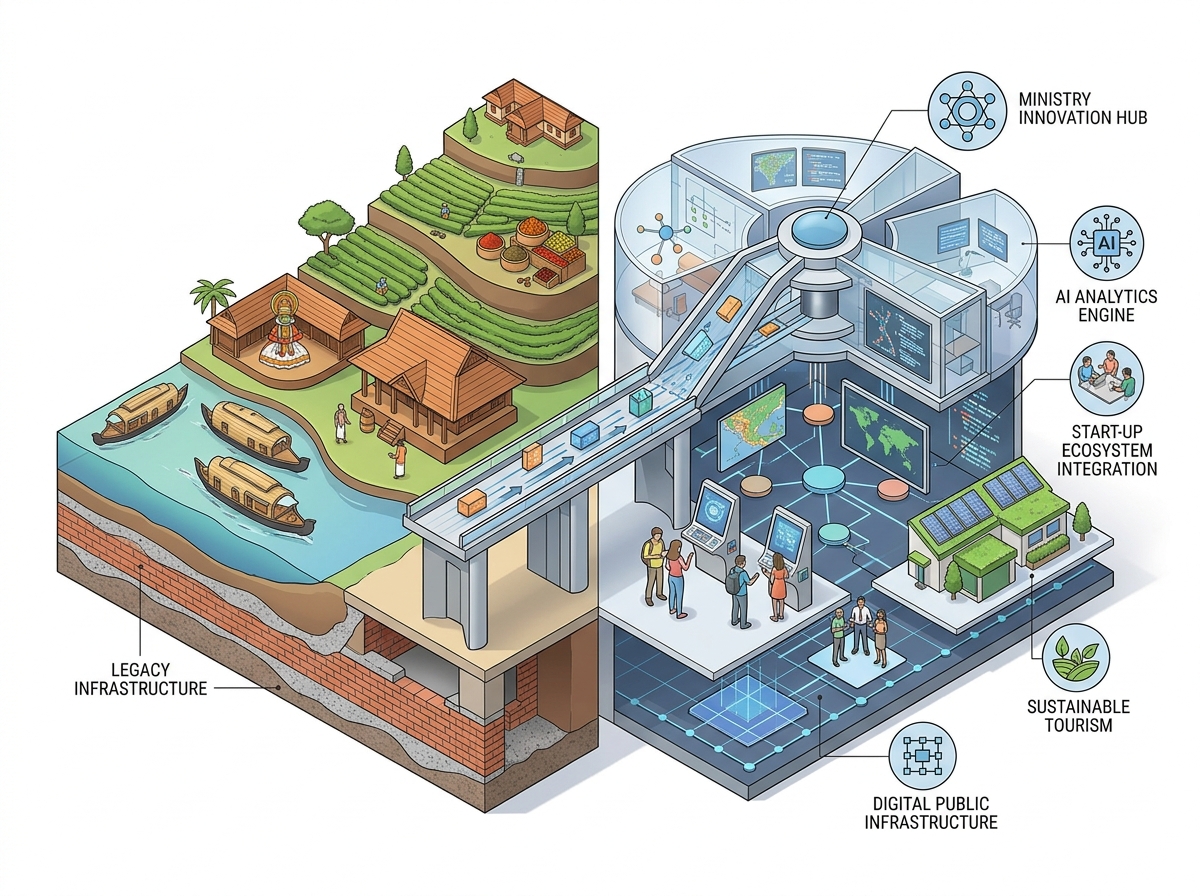
✎ Kerala’s AI-driven tourism transformation leverages digital public infrastructure to create a unified, sustainable, and inclusive tourism ecosystem, aligning with global best practices.
Subject Relevance — Where This Topic Fits
- GS Paper II — Governance, Constitution, Polity, Social Justice and International Relations (Role of State in promoting inclusive tourism) | GS Paper III — Economy (Role of technology in economic sectors, start-ups, and innovation ecosystems)
- Prelims: Artificial Intelligence (AI), Digital Public Infrastructure (DPI), Start-up India, Tourism Policy, Industry Status for Tourism, Sustainable Tourism, Barrier-free Access, Experiential Tourism
- Essay: The Role of Technology in Shaping India’s Tourism Sector: Opportunities and Challenges, Sustainable Development through Digital Innovation: A Case Study of Kerala’s Tourism Model
Quick Revision: Kerala’s AI-driven tourism transformation leverages digital public infrastructure to create a unified, sustainable, and inclusive tourism ecosystem, aligning with global best practices.
Why is this in the news?
Kerala’s Tourism Minister announced the integration of Artificial Intelligence (AI) and advanced digital tools to transform the state’s tourism sector into a globally competitive, sustainable, and inclusive ecosystem. This initiative, unveiled ahead of World Tourism Day, aims to shift from fragmented destination-based promotions to a unified, technology-driven experiential tourism model, leveraging Kerala’s robust start-up ecosystem and digital public infrastructure.
Background
- Kerala, a globally recognized tourism destination, has historically promoted its tourism through destination-specific packages and products, such as backwaters, hill stations, and cultural festivals.
- The COVID-19 pandemic and evolving tourist preferences have necessitated a shift toward sustainable, inclusive, and technology-enabled tourism models to enhance visitor experience and economic resilience.
- Global trends indicate a rising demand for personalized, seamless, and eco-friendly tourism experiences, driven by digital transformation and AI applications in service delivery and destination management.
What is the Kerala Tourism Digital Transformation Initiative?
- The initiative aims to integrate AI and digital tools to create a unified, experiential tourism ecosystem in Kerala, replacing the traditional approach of promoting isolated destinations and products.
- Key objectives include enhancing tourist experience through personalized services, improving destination management, and ensuring sustainability and inclusivity in tourism practices.
- The State Tourism Department is collaborating with stakeholders to develop smart solutions, including AI-driven chatbots for real-time tourist assistance, predictive analytics for demand forecasting, and digital platforms for seamless service delivery.
- Barrier-free access is a critical component, ensuring that tourism infrastructure and services are accessible to persons with disabilities, elderly tourists, and other marginalized groups.
- The initiative encourages the development of start-ups in tourism by providing mentorship, funding, and access to digital platforms, thereby fostering youth engagement and innovation in the sector.
- Homestays and small tourism enterprises are being supported to adopt technology-driven management practices, improving service quality and competitiveness.
- The upcoming Kerala Tourism Policy will prioritize these digital transformation initiatives, aligning with global best practices in tourism governance and sustainability.
- The integration of AI and digital tools is expected to enhance the state’s competitiveness in the global tourism market while ensuring environmental sustainability and socio-economic inclusivity.
Key Features
| Feature | Significance |
|---|---|
| Integration of Artificial Intelligence (AI) | Enables hyper-personalisation of tourist experiences by analysing preferences, past behaviour, and real-time data to offer tailored itineraries, recommendations, and services. |
| Digital Ecosystem for Tourism | Facilitates seamless integration of stakeholders—hotels, homestays, transport, and guides—into a unified platform for efficient service delivery and resource allocation. |
| Industry Status for Tourism | Constitutes a formal recognition of tourism as an economic activity, unlocking institutional financing, tax incentives, and policy support for sectoral growth. |
| Start-up Promotion in Tourism | Encourages innovation in tourism services through funding, mentorship, and incubation, fostering youth participation and technological adoption. |
| Barrier-Free Tourism Access | Ensures universal accessibility in tourism infrastructure, aligning with global standards for inclusivity and compliance with the Rights of Persons with Disabilities Act, 2016. |
| Homestay Technology Adoption Programme | Digitises homestay management systems to enhance service quality, safety, and compliance with regulatory standards, improving tourist satisfaction. |
Why it Matters
Economic Transformation
- Elevates Kerala’s tourism sector from a traditional, fragmented model to a high-value, experiential economy, increasing average tourist spending and length of stay.
- Stimulates ancillary industries such as hospitality technology, digital marketing, and local crafts, creating employment across urban and rural areas.
- Positions Kerala as a global benchmark for sustainable and inclusive tourism, attracting high-spending international tourists and investment.
- Leverages the state’s robust start-up ecosystem to drive innovation, reducing dependency on conventional tourism models.
Governance and Policy Innovation
- Demonstrates a shift from supply-driven to demand-driven tourism governance, utilising data analytics to align policy with tourist preferences.
- Institutionalises tourism as a formal economic sector, enabling long-term planning, investment, and regulatory reforms.
- Promotes public-private partnerships (PPPs) to co-develop digital infrastructure, ensuring scalability and sustainability.
- Aligns with the National Tourism Policy 2022’s emphasis on technology adoption, sustainability, and skill development.
Socio-Cultural and Environmental Impact
- Enhances cultural preservation by integrating local traditions, cuisine, and art into curated experiences, fostering community pride and economic benefits.
- Promotes sustainable tourism practices through AI-driven demand forecasting, reducing over-tourism in fragile ecosystems and supporting eco-friendly initiatives.
- Improves tourist satisfaction and safety through real-time monitoring, emergency response systems, and standardised service delivery.
- Encourages rural entrepreneurship via homestay digitisation, distributing tourism benefits equitably across regions.
Challenges
1. Digital Divide and Infrastructure Gaps
- Rural and remote tourism destinations may lack the digital infrastructure required for AI integration, exacerbating regional disparities.
- High-speed internet connectivity and cloud computing capabilities are prerequisites but may be unevenly distributed across the state.
- Training and upskilling of local stakeholders—homestay owners, tour operators, and artisans—in digital tools pose a significant capacity-building challenge.
UPSC Link: GS-III: Infrastructure – Digital Divide
2. Data Privacy and Security Risks
- Collection and utilisation of tourist data for personalisation raise concerns about data privacy, consent, and compliance with the Digital Personal Data Protection Act, 2023.
- Cybersecurity threats to tourism platforms could disrupt services, erode trust, and deter international tourists.
- Balancing personalisation with anonymisation to protect sensitive tourist information is a critical governance challenge.
UPSC Link: GS-II: Government Policies and Interventions – Data Governance
3. Sustainability vs. Commercialisation
- AI-driven demand forecasting may inadvertently concentrate tourist flows in popular destinations, leading to over-tourism and environmental degradation.
- Balancing commercial viability with sustainable tourism practices, such as limiting visitor numbers or enforcing carrying capacities, is complex.
- Ensuring that digital tools do not marginalise traditional tourism stakeholders—local guides, artisans, and small businesses—is essential.
UPSC Link: GS-III: Environment and Biodiversity – Sustainable Tourism
4. Regulatory and Ethical Concerns
- Lack of standardised guidelines for AI-driven tourism services may lead to inconsistent quality and consumer protection issues.
- Ethical considerations in AI—such as algorithmic bias in personalisation or the use of surveillance technologies—require robust oversight.
- Coordinating between multiple agencies (Tourism Department, IT Department, local bodies) for policy implementation is a bureaucratic hurdle.
UPSC Link: GS-II: Governance – Ethical AI
5. Financial Viability and ROI
- High initial investments in AI infrastructure, digital platforms, and training may strain state finances, requiring innovative funding models.
- Measuring the return on investment (ROI) for digital interventions in tourism is challenging due to intangible benefits like brand reputation.
- Ensuring equitable access to digital tools for small and medium tourism enterprises (SMTEs) is critical to avoid market monopolisation.
UPSC Link: GS-III: Mobilisation of Resources – Public-Private Partnerships
Challenges — UPSC Perspective
| Issue | Concern |
|---|---|
| Digital Infrastructure Gaps | Uneven access to high-speed internet and cloud services may hinder AI adoption in rural areas. |
| Data Privacy Risks | Tourist data collection for personalisation raises compliance challenges under the Digital Personal Data Protection Act, 2023. |
| Over-Tourism Risks | AI-driven demand forecasting may concentrate tourists in popular destinations, leading to environmental strain. |
| Capacity Building | Lack of digital literacy among local stakeholders—homestay owners, tour guides—limits effective utilisation of new tools. |
| Regulatory Fragmentation | Multiple agencies overseeing tourism and digital initiatives may lead to coordination challenges and policy inconsistencies. |
| Financial Sustainability | High upfront costs for AI integration and digital platforms may deter small-scale tourism enterprises from participation. |
Way Forward
- Develop a phased roadmap for AI integration, prioritising high-impact areas such as personalised itineraries and demand forecasting.
- Establish a state-level digital tourism council to coordinate between the Tourism Department, IT Department, and private stakeholders.
- Launch capacity-building programmes in collaboration with KSUM to train local stakeholders in digital tools and AI-driven decision-making.
- Create a unified tourism data platform to aggregate tourist preferences, feedback, and service utilisation for evidence-based policymaking.
- Implement pilot projects in select destinations to test AI-driven tourism models before scaling up, ensuring lessons learned inform broader rollout.
- Enforce standardised quality benchmarks for digital tourism services, including cybersecurity protocols and data privacy safeguards.
- Promote public-private partnerships to co-finance digital infrastructure, particularly in rural and remote tourism hubs.
- Integrate sustainability metrics into AI algorithms to balance commercial goals with environmental and cultural preservation.
UPSC Value Addition
Keywords for Mains Answer-Writing
Digital Public Infrastructure · Artificial Intelligence in Governance · Tourism Policy · Industry Status to Tourism · Start-up Ecosystem · Experiential Tourism · Sustainable Tourism · Barrier-free Tourism Access · Digital Transformation in Public Services · State-Level Innovation Policy · Inclusive Tourism · Tourism Start-ups · Wholesome Tourist Experience · Kerala Model of Governance · UN Sustainable Development Goal 8 (Decent Work and Economic Growth) · UN Sustainable Development Goal 12 (Responsible Consumption and Production)
Concept Flow
Tourist preferences and behaviours → Data collection via digital platforms → AI-driven analysis and personalisation → Tailored tourism experiences → Enhanced tourist satisfaction and spending → Economic growth in tourism sector → Job creation and rural entrepreneurship. → State recognises tourism as an industry → Formal policy and regulatory support → Industry status unlocks financing and incentives → Investment in digital infrastructure → Adoption of AI and cutting-edge tools → Scalable and inclusive tourism ecosystem. → Homestay owners and local guides lack digital tools → Capacity-building initiatives → Adoption of technology-driven management systems → Improved service quality and safety → Increased tourist trust and repeat visits. → Tourism data collected for personalisation → Compliance with data privacy laws → Implementation of cybersecurity measures → Trust in digital tourism platforms → Higher adoption rates among tourists and service providers. → AI-driven demand forecasting → Identification of over-tourism risks → Implementation of carrying capacity measures → Sustainable tourism practices → Long-term preservation of cultural and natural heritage.
Prelims Practice Questions
Q1. Consider the following statements regarding the integration of Artificial Intelligence (AI) in the tourism sector as reported in Kerala:
1. Kerala has accorded industry status to the tourism sector to expedite the adoption of AI-driven solutions.
2. The State Tourism Department is collaborating with stakeholders to develop smart solutions for homestays using AI.
3. Kerala’s tourism policy explicitly mandates the use of AI in all tourism-related services without exception.
How many of the above statements are correct?
- Only one
- Only two
- All three
- None
Answer: Only two — Statement 1 is correct as the news mentions the government’s decision to accord industry status to the tourism sector. Statement 2 is correct as the Tourism Department is working to help homestays adopt technology-driven management practices. Statement 3 is incorrect as the policy does not mandate AI use in all services; it encourages smart solutions.
Q2. Assertion (A): The integration of AI in tourism is primarily aimed at enhancing the efficiency of service delivery.
Reason (R): AI tools are being leveraged to manage tourism destinations and infrastructure in Kerala, ensuring adherence to global standards and best practices.
- Both A and R are true, and R is the correct explanation of A.
- Both A and R are true, but R is not the correct explanation of A.
- A is true, but R is false.
- A is false, but R is true.
Answer: Both A and R are true, and R is the correct explanation of A. — Both the assertion and reason are true. The integration of AI in tourism is indeed aimed at enhancing efficiency, and the reason correctly explains this by citing the use of AI for managing destinations and infrastructure.
Q3. Match the following initiatives in Kerala’s tourism sector with their respective objectives:
| Column I (Initiative) | Column II (Objective) |
|——————————————|———————————————–|
| A. Industry status to tourism | 1. To expedite adoption of AI and digital tools |
| B. Start-up promotion programmes | 2. To encourage youth engagement in tourism |
| C. Homestay technology adoption | 3. To improve quality and management practices |
| D. Barrier-free tourism access | 4. To ensure inclusivity and accessibility |
- A-1, B-2, C-3, D-4; A-2, B-1, C-4, D-3; A-3, B-4, C-1, D-2; A-4, B-3, C-2, D-1
- answer_array_indexes_in_order_of_columns_A_B_C_D
Answer: ? — A-1: Industry status expedites AI adoption; B-2: Start-up programmes aim to engage youth; C-3: Homestay adoption improves quality; D-4: Barrier-free access ensures inclusivity.
Mains Practice Question
✍ Critically examine the role of Digital Public Infrastructure (DPI), particularly Artificial Intelligence (AI), in transforming the tourism sector in India. How far has Kerala’s approach of integrating AI and digital tools in tourism aligned with global best practices? Substantiate your answer with relevant examples. (15 Marks)
Approach: MODEL-ANSWER SKELETON:
1. **Definition and Significance of DPI in Tourism** (2 Marks)
– Define Digital Public Infrastructure (DPI) as a shared digital infrastructure enabling efficient delivery of public services (e.g., Aadhaar, UPI).
– Highlight the role of DPI in enhancing service delivery, reducing transaction costs, and promoting inclusivity in tourism.
2. **AI in Tourism: Global Best Practices** (4 Marks)
– Cite examples of AI applications in tourism globally: chatbots for customer service (e.g., Singapore’s Ask Jamie), AI-driven personalization (e.g., Marriott’s AI concierge), and predictive analytics for demand forecasting (e.g., Airbnb).
– Discuss how these practices improve tourist experience, sustainability, and operational efficiency.
3. **Kerala’s AI-Driven Tourism Strategy** (4 Marks)
– Outline Kerala’s initiatives: industry status to tourism, start-up promotion, homestay technology adoption, and barrier-free access.
– Explain how these measures align with global best practices, particularly in promoting inclusivity (e.g., barrier-free access) and sustainability (e.g., smart homestays).
4. **Challenges and Critiques** (3 Marks)
– Discuss potential challenges: data privacy concerns, digital divide, and resistance to adoption among small stakeholders.
– Critically assess whether Kerala’s approach sufficiently addresses these challenges or requires further refinement.
5. **Conclusion and Way Forward** (2 Marks)
– Summarize the transformative potential of AI and DPI in tourism.
– Suggest measures for scaling up Kerala’s model: public-private partnerships, capacity-building for stakeholders, and integration with national DPI frameworks (e.g., IndiaAI Mission).
Source: The Hindu
Generated by AanyaAi for educational purpose.
Related guides on our sites
- Best PSIR optional coaching for upsc
- Best PSIR optional teacher for upsc
- Best teacher of PSIR optional for upsc
- Best PSIR optional coaching in delhi for UPSC

- यूक्रेन का रोबोट सेना अभियान: युद्ध में मानव हानि कम करने की रणनीति - September 27, 2026
- Ukraine’s ‘Army of Robots’: A Game-Changer for UPSC Mains 2026 Polity & Governance - September 27, 2026
- रूस ने भारत-ब्राजील को दिया UNSC स्थायी सदस्यता का समर्थन, जर्मनी-जापान विरोध में - September 27, 2026

No Comments