


25 Sep Kerala’s Cultural Memorabilia Auction in PM Memeto e-Auction 2026: Key Facts for UPSC
✎ The PM Memento e-Auction is a digital platform by the Ministry of Culture to auction culturally significant memorabilia, with Kerala’s 32 artisanal items featured in 2026 to highlight its intangible heritage.
Subject Relevance — Where This Topic Fits
- GS Paper I — Indian Heritage and Culture
- Prelims: Cultural Heritage, Memorabilia, E-Auction, Kerala, Traditional Crafts, Performing Arts, UNESCO Intangible Cultural Heritage
- Essay: The Role of Digital Platforms in Preserving and Promoting Cultural Heritage
Quick Revision: The PM Memento e-Auction is a digital platform by the Ministry of Culture to auction culturally significant memorabilia, with Kerala’s 32 artisanal items featured in 2026 to highlight its intangible heritage.
Why is this in the news?
The Press Information Bureau (PIB) has announced the inclusion of 32 culturally significant memorabilia from Kerala in the PM Memento e-Auction 2026, scheduled for 2 October 2026. This initiative, under the aegis of the Ministry of Culture, aims to highlight the state’s rich artistic, craftsmanship, performative, maritime, and spiritual traditions through a curated digital auction platform.
Background
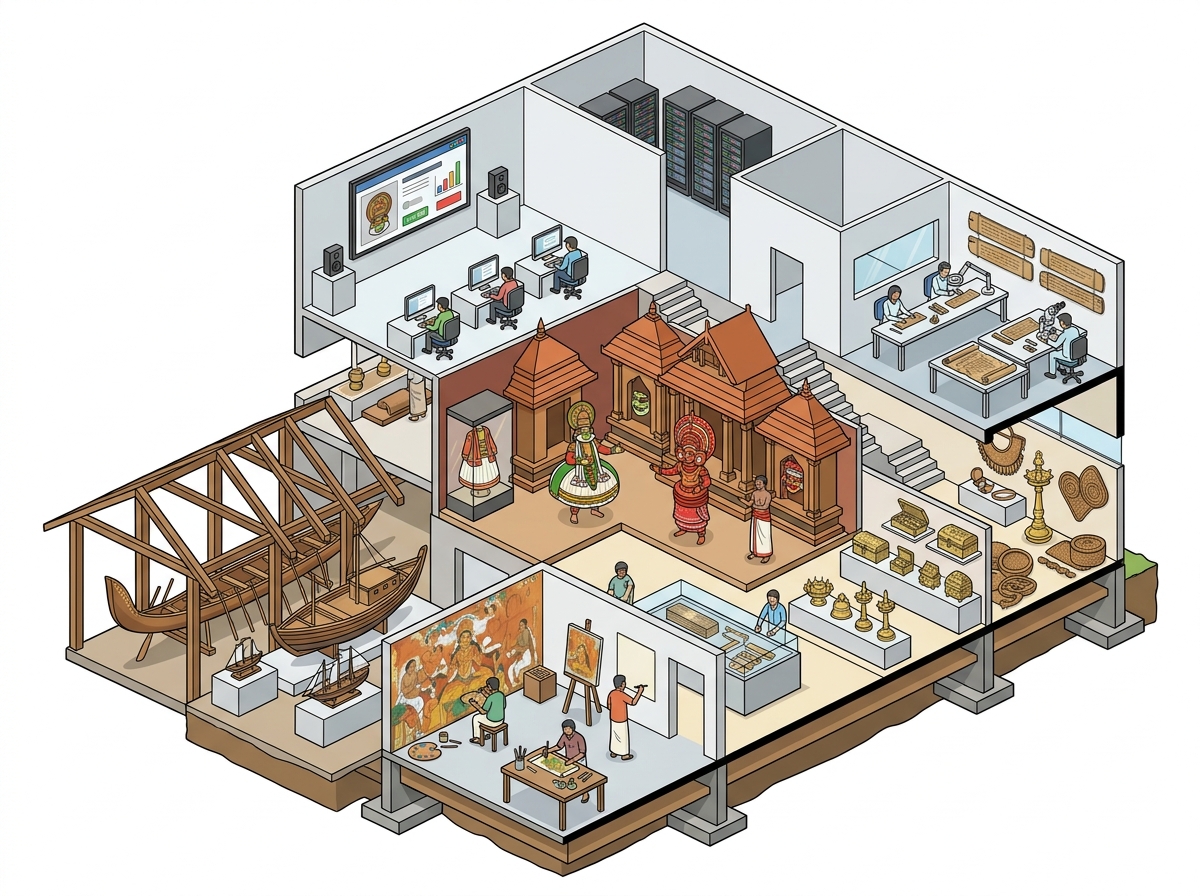
- Kerala, a UNESCO-recognised hub of intangible cultural heritage, is home to traditions such as Kathakali, Theyyam, mural painting, and traditional boat-building (e.g., Chundan Vallam and Beypore Uru).
- The auction leverages digital governance to democratise access to cultural artefacts, ensuring transparency and wider participation in heritage preservation.
- The selection of memorabilia reflects Kerala’s syncretic cultural ethos, blending Dravidian, Aryan, and maritime influences over centuries.
- The inclusion of items crafted by institutions like the National Skill Training Institute (NSTI), Calicut, underscores the intersection of skill development and cultural preservation.
What is the PM Memento e-Auction?
- The auction serves dual purposes: commemorative (honouring national leaders) and cultural (showcasing indigenous art and craftsmanship).
- Memorabilia are selected through a rigorous curatorial process, ensuring representation of regional diversity, traditional techniques, and historical significance.
- The 2026 edition highlights Kerala’s cultural heritage, with 32 items spanning traditional crafts, performing arts, maritime traditions, and spiritual symbolism.
- The auction platform (pmmementos.gov.in) adheres to principles of e-governance, ensuring accessibility, transparency, and participation from diverse stakeholders.
- Proceeds from the auction are often directed towards conservation projects, skill development, or cultural institutions, aligning with the Ministry’s objectives.
- The initiative integrates modern digital tools (e.g., high-resolution imagery, virtual catalogues) to enhance the auction experience while preserving authenticity.
- Kerala’s inclusion reflects the state’s role as a custodian of India’s intangible cultural heritage, recognised by UNESCO for traditions like Kathakali and Theyyam.
Key Features
| Feature | Significance |
|---|---|
| Traditional Nettoor Petty (Jewellery Box) | Represents Kerala’s craftsmanship in wood carving and metalwork, historically used by elite households for storing jewels and sacred objects. |
| Miniature Chundan Vallam (Snake Boat) | Showcases Kerala’s maritime heritage and traditional boat-building skills, linked to cultural festivals like Onam. |
| Kathakali and Theyyam Artifacts | Preserves classical and ritualistic performing arts, highlighting Kerala’s unique dance-drama traditions and iconography. |
| Kerala Mural Art (Radha, Krishna, Gopika) | Exemplifies the state’s mural painting tradition, using the traditional Panchavarna (five-colour) technique on cement sheets. |
| Handcrafted Model of Beypore Uru (Wooden Ship) | Demonstrates traditional carpentry skills, produced by NSTI Calicut under the Ministry of Skill Development and Entrepreneurship. |
Why it Matters
Cultural Diplomacy and Soft Power
- Showcases Kerala’s diverse cultural heritage globally through curated memorabilia, enhancing India’s soft power in arts and crafts.
- Promotes intangible cultural heritage (ICH) of Kerala, aligning with UNESCO’s 2003 Convention for the Safeguarding of the Intangible Cultural Heritage.
- Facilitates cross-cultural exchanges by presenting traditional art forms in an accessible digital auction format.
Economic and Skill Development
- Supports local artisans, craftsmen, and performers by providing a platform for commercialising traditional skills and artworks.
- Links cultural preservation with livelihood generation, particularly for marginalised communities engaged in performing and visual arts.
- Encourages skill upgradation through collaborations with institutions like NSTI Calicut for crafting replicas of heritage items.
Policy and Institutional Framework
- Demonstrates the role of the Ministry of Culture in preserving and promoting India’s cultural assets through digital and auction-based initiatives.
- Highlights the integration of skill development (Ministry of Skill Development and Entrepreneurship) with cultural preservation.
- Illustrates the use of e-auctions as a modern mechanism for heritage monetisation while ensuring authenticity and provenance.
Tourism and Heritage Conservation
- Acts as a cultural tourism catalyst by offering memorabilia that tourists can purchase, indirectly promoting Kerala’s heritage destinations.
- Raises awareness about endangered art forms and traditional crafts, fostering public interest in conservation efforts.
- Supports the documentation and digitisation of cultural artifacts, aiding in their preservation for future generations.
Challenges
1. Authenticity and Provenance Verification
- Risk of counterfeit memorabilia entering the auction, undermining the value of genuine cultural artifacts.
- Need for robust authentication mechanisms to ensure the origin and craftsmanship of each item.
- Potential challenges in verifying the cultural and historical accuracy of replicas or artworks.
UPSC Link: GS Paper 1: Indian Culture
2. Sustainability of Artisan Livelihoods
- Dependence on seasonal or festival-based demand for cultural memorabilia may lead to income instability for artisans.
- Lack of formal training and market access for many traditional craftsmen, limiting their participation in high-value auctions.
- Need for policy interventions to provide financial security and skill upgradation for artisans.
UPSC Link: GS Paper 3: Skill Development
3. Digital Divide and Accessibility
- Limited digital literacy among rural artisans may hinder their ability to participate in or benefit from e-auctions.
- Ensuring equitable access to online platforms for artisans from remote or marginalised communities.
- Technological barriers in digitising and showcasing complex cultural artifacts online.
UPSC Link: GS Paper 2: Governance
4. Balancing Commercialisation and Cultural Integrity
- Risk of commercialisation diluting the cultural significance or traditional essence of memorabilia.
- Need to strike a balance between mass production for auctions and preserving the authenticity of handcrafted items.
- Ethical considerations in pricing cultural artifacts to ensure fair compensation for artisans without exploiting their heritage.
UPSC Link: GS Paper 4: Ethics
5. Climate Change and Material Sourcing
- Climate-induced degradation of raw materials (e.g., wood, metal) used in traditional crafts may affect the quality of memorabilia.
- Need for sustainable sourcing practices to mitigate environmental impact while maintaining craftsmanship standards.
- Potential disruptions in supply chains due to extreme weather events affecting artisans’ access to materials.
UPSC Link: GS Paper 3: Environment
Challenges — UPSC Perspective
| Issue | Concern |
|---|---|
| Counterfeit Memorabilia | Undermines trust in auctions and devalues genuine cultural artifacts. |
| Artisan Livelihood Instability | Seasonal demand and lack of market access threaten financial security. |
| Digital Literacy Gaps | Limits participation of rural artisans in e-auction platforms. |
| Cultural Dilution | Commercialisation may compromise the traditional essence of memorabilia. |
| Climate-Induced Material Shortages | Affects the availability and quality of raw materials for crafts. |
Government Initiatives — Must-Memorise for Prelims
- {‘name’: ‘Scheme for Promoting Traditional Crafts’, ‘description’: ‘Initiatives under the Ministry of Culture to support artisans through funding, training, and market linkages.’}
- {‘name’: ‘Skill India Mission’, ‘description’: ‘Led by the Ministry of Skill Development and Entrepreneurship, it aims to upskill artisans in traditional crafts and modern techniques.’}
- {‘name’: ‘National Mission on Cultural Mapping’, ‘description’: ‘A Ministry of Culture initiative to document and preserve India’s cultural heritage, including intangible cultural practices.’}
Way Forward
- Strengthen authentication protocols for memorabilia through partnerships with cultural institutions and digital verification tools.
- Expand digital literacy programmes for artisans to enhance their participation in e-auctions and online marketplaces.
- Develop sustainable sourcing guidelines for raw materials to mitigate climate change impacts on traditional crafts.
- Establish a dedicated fund under the Ministry of Culture to provide financial security and market access to artisans.
- Promote collaborative projects between cultural institutions (e.g., NSTI) and artisans to improve craftsmanship and innovation.
- Integrate cultural memorabilia auctions with tourism circuits to boost local economies and heritage conservation.
- Encourage research on traditional materials and techniques to preserve cultural integrity while adapting to modern demands.
UPSC Value Addition
Keywords for Mains Answer-Writing
Cultural Heritage Preservation · Digital Public Goods · Intangible Cultural Heritage · PM Mentos e-Auction · Kerala’s Traditional Arts · Craftsmanship and Skill Development · Museum Policy and Governance · Cultural Diplomacy · UNESCO Intangible Cultural Heritage · Digital Archiving of Heritage · Ministry of Culture · National Skill Training Institute (NSTI) · Kathakali · Theyyam · Kerala Mural Art · Bepore Uru · Chundan Vallam · Nettoor Peti · Cultural Commodification · Public-Private Partnership in Heritage
Constitutional & Policy Linkages
- {‘article’: ‘Article 49: Protection of Monuments and Places and Objects of National Importance’, ‘note’: ‘Ensures preservation of cultural heritage.’}
- {‘article’: ‘Article 51A(f): Fundamental Duties’, ‘note’: ‘Obligates citizens to value and preserve cultural heritage.’}
Concept Flow
Kerala’s rich cultural heritage → Ministry of Culture’s initiative to curate memorabilia → Selection of 32 diverse items (crafts, performing arts, maritime traditions, spirituality) → Digital documentation and replication (e.g., Beypore Uru by NSTI) → E-auction platform (pmmementos.gov.in) → Global exposure and commercialisation → Revenue generation for artisans → Reinvestment in skill development and conservation → Preservation of intangible cultural heritage.
Prelims Practice Questions
Q1. Consider the following statements regarding the PM Mentos e-Auction 2026:
1. The PM Mentos e-Auction 2026 is an initiative by the Ministry of Culture to digitally auction cultural memorabilia.
2. The auction includes 32 memorabilia from Kerala, representing traditional crafts, performing arts, maritime traditions, and spiritual heritage.
3. The memorabilia include a miniature model of a Bepore Uru crafted by the National Skill Training Institute (NSTI), Kozhikode.
4. The auction is open to international bidders only.
How many of the above statements are correct?
- Only one
- Only two
- Only three
- All four
Answer: Only three — Statements 1, 2, and 3 are correct as per the PIB release. Statement 4 is incorrect because the auction is open to all bidders, not restricted to international participants.
Q2. Assertion (A): The PM Mentos e-Auction 2026 is part of a broader policy to digitize and monetize India’s intangible cultural heritage.
Reason (R): The auction includes memorabilia from Kerala’s traditional arts such as Kathakali and Theyyam, which are recognized by UNESCO as intangible cultural heritage.
In the context of the above two statements, which one of the following is correct?
- Both A and R are true, and R is the correct explanation of A.
- Both A and R are true, but R is not the correct explanation of A.
- A is true, but R is false.
- A is false, but R is true.
Answer: A is true, but R is false. — Assertion (A) is true as the PM Mentos e-Auction is a digital initiative to monetize cultural memorabilia. Reason (R) is also true as Kathakali and Theyyam are UNESCO-recognized intangible cultural heritage, but the auction’s primary purpose is not directly tied to UNESCO recognition.
Q3. Match the following cultural artifacts from Kerala with their associated traditional art forms or practices:
Column I (Artifact) Column II (Associated Art Form/Practice)
1. Nettoor Peti A. Kathakali
2. Chundan Vallam B. Theyyam
3. Kathakali Doll C. Traditional Jewellery Box
4. Theyyam Sculpture D. Snake Boat Race
Select the correct match:
- 1-C, 2-D, 3-A, 4-B
- 1-A, 2-B, 3-C, 4-D
- 1-D, 2-C, 3-B, 4-A
- 1-B, 2-A, 3-D, 4-C
Answer: 1-C, 2-D, 3-A, 4-B — Nettoor Peti is a traditional jewellery box (1-C). Chundan Vallam is a snake boat used in boat races (2-D). Kathakali doll represents the classical dance-drama Kathakali (3-A). Theyyam sculpture represents the ritualistic art form Theyyam (4-B).
Mains Practice Question
✍ The PM Mentos e-Auction 2026 represents a modern approach to preserving and promoting India’s intangible cultural heritage. Critically examine the role of digital platforms in cultural heritage preservation, with reference to this initiative. (15 Marks)
Approach: A 15-mark answer must balance the following dimensions:
1. **Introduction (2 marks)**: Define intangible cultural heritage (ICH) as per UNESCO’s 2003 Convention and contextualise the PM Mentos e-Auction as a digital public good initiative.
2. **Digital Platforms and Heritage Preservation (5 marks)**:
– Explain how digital platforms (e-auctions, virtual museums, NFTs) democratise access to heritage.
– Discuss the role of the PM Mentos e-Auction in monetising and sustaining traditional crafts (e.g., Kathakali, Theyyam, Kerala mural art).
– Highlight the inclusion of skill development (e.g., NSTI’s miniature Bepore Uru) in linking heritage with contemporary livelihoods.
– Cite examples of global initiatives (e.g., Google Arts & Culture, UNESCO’s ICH database).
3. **Challenges and Criticisms (5 marks)**:
– **Commodification vs. Preservation**: Does commercialisation risk trivialising sacred or ritualistic art forms?
– **Authenticity and Standardisation**: How does digital reproduction affect the originality of traditional crafts?
– **Access and Equity**: Are digital platforms inclusive, or do they exclude marginalised artisans due to digital divides?
– **Legal and Ethical Issues**: Copyright, intellectual property rights, and ownership of digitised heritage.
4. **Way Forward (3 marks)**:
– Suggest measures to balance commercialisation with preservation (e.g., revenue-sharing models, community ownership, hybrid physical-digital archives).
– Propose policy interventions (e.g., integrating digital heritage into school curricula, partnerships with cultural institutions).
– Emphasise the role of government (Ministry of Culture, Skill India Mission) in sustaining such initiatives.
**Key Terms to Include**: UNESCO 2003 Convention, Intangible Cultural Heritage, Digital Archiving, Cultural Commodification, Skill Development, Public-Private Partnership, Community-Based Heritage Management.
Source: PIB (Press Information Bureau)
Kerala PCS (Kerala PSC (KAS)) — State PCS Practice
Prelims: Which of the following cultural items from Kerala is NOT included in the PM Memento E-Auction 2026 initiative for auctioning state cultural memorabilia?
- A traditional Kathakali mask from Malabar region
- B) A rare bronze idol of Lord Krishna from Guruvayur Temple
- C) A centuries-old Kathakali script (Attaprakaram) from Travancore
- D) A vintage Kerala mural painting from Padmanabhapuram Palace
Answer: B) A rare bronze idol of Lord Krishna from Guruvayur Temple — The PM Memento E-Auction 2026 initiative includes select cultural items from Kerala, but the rare bronze idol of Lord Krishna from Guruvayur Temple is a sacred deity item and not typically auctioned under such initiatives.
Mains: Discuss the significance of the PM Memento E-Auction 2026 initiative in preserving and promoting Kerala’s cultural heritage. How can this initiative be leveraged to boost tourism and local economies in the state? Elaborate with examples.
Generated by AanyaAi for educational purpose.
Related guides on our sites
- How to prepare for GS paper 1 for UPSC CSE mains exam
- Best UPSC coaching for IFOS exam
- Best mentorship programme for upsc
- UPSC+BA degree

- PM Modi Praises Youth-Led Nasha Mukt Yuva Abhiyan Momentum - September 27, 2026
- राजनाथ सिंह का बड़ा बयान: भारत किसी की ज़मीन कब्ज़ा नहीं करेगा, लेकिन सुरक्षा पर होगा कठोर - September 27, 2026
- Exercise Tarang Shakti 2026: India’s Mega Multi-Nation Air Power Showcase - September 27, 2026

No Comments