


14 Sep Kerala’s EcoSens Scholarships Empower 46,000 Students in Waste Management
✎ EcoSens Scholarships in Kerala integrate waste management education with youth participation under SBM 2.0, promoting source segregation, composting, and resource recovery through practical school-based activities and facility…
Subject Relevance — Where This Topic Fits
- GS Paper II — Governance, Transparency and Accountability | GS Paper III — Environment and Disaster Management
- Prelims: Swachh Bharat Mission 2.0, Solid Waste Management Rules 2016, 3R Principle (Reduce, Reuse, Recycle), Composting, Resource Recovery Facility (RRF), Material Collection Facility (MCF), Local Governance (73rd and 74th Constitutional Amendments)
- Essay: Environmental consciousness and sustainable development: The role of youth in nation-building, Public participation in governance: Case studies from Kerala
Quick Revision: EcoSens Scholarships in Kerala integrate waste management education with youth participation under SBM 2.0, promoting source segregation, composting, and resource recovery through practical school-based activities and facility visits.
Why is this in the news?
The Government of Kerala, under the aegis of the Swachh Bharat Mission-Urban 2.0 (SBM 2.0), has operationalised the EcoSens Scholarship initiative to train 46,000 students in waste management practices. This programme exemplifies a shift from conventional infrastructure-centric approaches to behaviour-driven, youth-led solutions in solid waste management, aligning with the mission’s emphasis on behavioural change and community participation.
Background
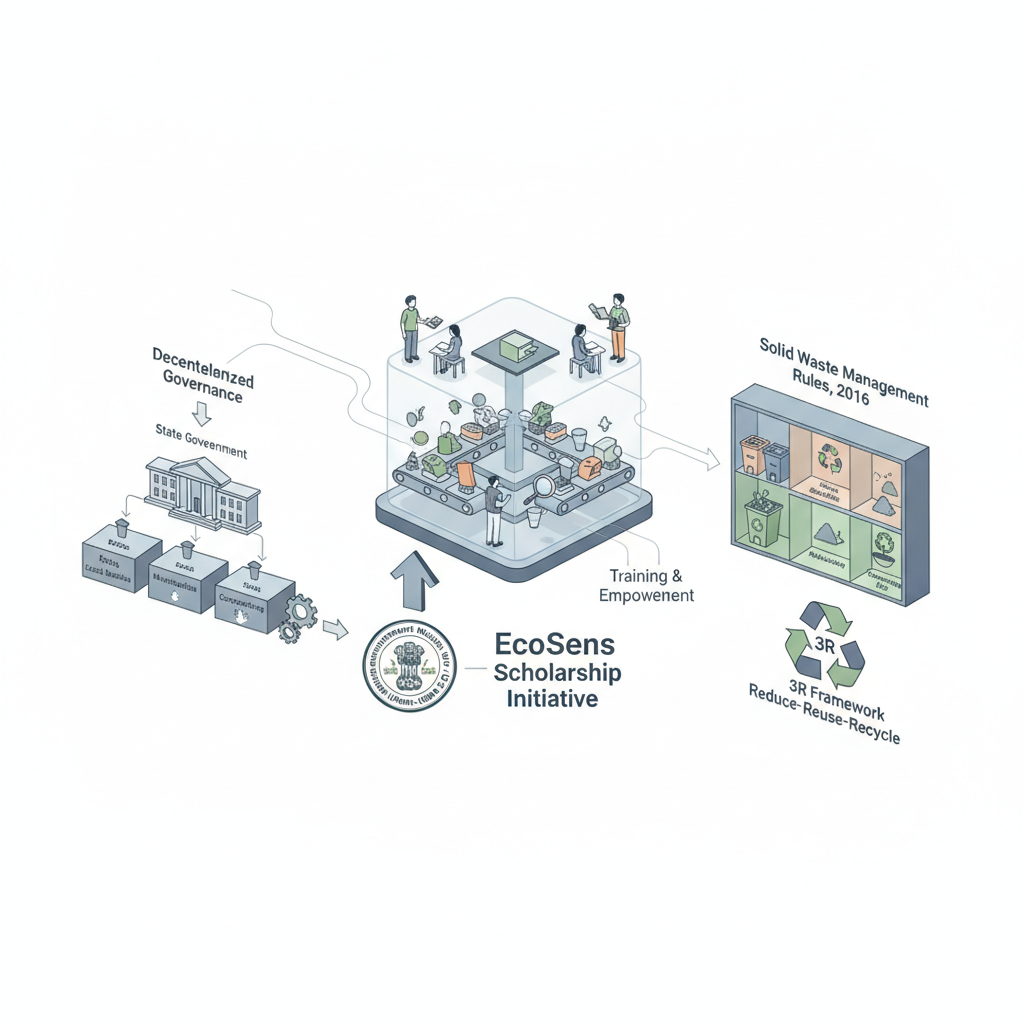
- The Solid Waste Management Rules, 2016, mandate source segregation, waste reduction, and promotion of composting and recycling under the 3R (Reduce, Reuse, Recycle) framework.
- Kerala has been a frontrunner in decentralised governance through the 73rd and 74th Constitutional Amendments, empowering local bodies (Panchayats, Municipalities, Corporations) to implement environmental programmes.
- The EcoSens initiative is implemented by the Local Self-Government Department (LSGD) of Kerala in collaboration with the General Education Department, targeting school students as agents of change.
- The programme is part of a broader state-wide campaign to integrate environmental education into school curricula and extracurricular activities, fostering a culture of sustainability from an early age.
What is the EcoSens Scholarship Programme?
- The EcoSens Scholarship Programme is a state-led initiative in Kerala designed to educate and empower students in scientific waste management practices, including segregation, composting, and resource recovery.
- Under this programme, approximately 46,000 students across 986 local governance institutions (Panchayats, Municipalities, Corporations) receive scholarships of ₹1,500 each, along with certificates recognising their contributions to cleanliness.
- The programme targets students in Grades 6–9 and first-year higher secondary/vocational students, ensuring a cross-section of school-going youth are engaged.
- Each selected student is required to participate in practical waste management activities, such as setting up segregation bins and composting systems, thereby translating theoretical knowledge into action.
- EcoSens fosters creative reuse of waste materials through craft activities and community exchanges, encouraging innovation in waste reduction at the household level.
- The programme aligns with the broader objectives of SBM 2.0 by shifting the focus from top-down infrastructure to bottom-up, youth-driven behavioural change in waste management.
Key Features
| Feature | Significance |
|---|---|
| Student Green Brigade Scholarship – EcoSens | A state-led scholarship programme targeting 50,000 students across Kerala to build green skills and foster environmental responsibility through active waste management participation. |
| Scholarship Amount | ₹1,500 per selected student along with a recognition certificate, incentivising participation and validating contributions to cleanliness. |
| Targeted Classes | Grades 6–7 (Upper Primary), 8–9 (High School), and First Year of Higher Secondary/ Vocational Higher Secondary, ensuring broad student engagement. |
| Selection Criteria | 50 students per Gram Panchayat, 75 per Municipality, and 100 per Municipal Corporation, ensuring equitable distribution across local governance units. |
| Practical Activities | Hands-on waste segregation, composting, repair workshops, green farming, and visits to Material Collection Facilities (MCF) and Resource Recovery Facilities (RRF) to link classroom learning with real-world systems. |
Why it Matters
Environmental Governance
- Demonstrates a shift from infrastructure-centric waste management to behaviour-driven, participatory models under Swachh Bharat Mission-Urban 2.0.
- Integrates environmental education into school curricula, embedding sustainability as a lived practice rather than a theoretical concept.
- Promotes circular economy principles by encouraging waste reduction, reuse, and resource recovery among young citizens.
Institutional Collaboration
- Showcases multi-departmental coordination between the Local Self-Government Department, General Education Department, and schools to implement a statewide initiative.
- Leverages the institutional reach of local governance bodies to ensure grassroots participation and scalability.
Youth Empowerment
- Empowers students as agents of change by providing them with skills, recognition, and platforms to address local waste challenges innovatively.
- Fosters a sense of environmental stewardship and civic responsibility from an early age, aligning with SDG 4 (Quality Education) and SDG 12 (Responsible Consumption and Production).
Scalability and Replicability
- Provides a replicable model for other states to adopt, particularly in integrating waste management education with scholarships and community engagement.
- Highlights the role of local governance in scaling grassroots environmental initiatives without heavy reliance on centralised infrastructure.
Challenges
1. Sustaining Behavioural Change
- Ensuring long-term adoption of waste management practices beyond the scholarship period requires continuous reinforcement through school programs and community campaigns.
- Addressing complacency post-participation to prevent relapse into unsustainable waste disposal habits.
UPSC Link: GS3: Environment & Ecology
2. Resource Constraints
- Limited availability of trained educators and facilitators to guide students in advanced waste management techniques such as composting and resource recovery.
- Inadequate infrastructure in some schools for setting up segregation units, composting pits, or repair workshops.
UPSC Link: GS2: Governance
3. Equitable Access
- Ensuring uniform participation across rural, semi-urban, and urban local governance units, particularly in areas with lower institutional capacity.
- Addressing disparities in access to waste management facilities and educational resources among different socio-economic groups.
UPSC Link: GS1: Social Justice
4. Monitoring and Evaluation
- Developing robust mechanisms to track the long-term impact of the programme on students’ waste management behaviours and community outcomes.
- Balancing quantitative metrics (e.g., number of participants) with qualitative assessments of behavioural change and skill application.
UPSC Link: GS4: Ethics & Governance
5. Waste Management Ecosystem Gaps
- Dependence on Material Collection Facilities (MCF) and Resource Recovery Facilities (RRF) for practical exposure, which may not be uniformly available across all local governance units.
- Limited integration with municipal solid waste management systems to ensure that student-driven initiatives translate into systemic improvements.
UPSC Link: GS3: Environment & Ecology
Challenges — UPSC Perspective
| Issue | Concern |
|---|---|
| Behavioural Relapse | Risk of students reverting to pre-programme waste disposal habits after the scholarship period ends. |
| Educator Training | Shortage of teachers and facilitators trained in advanced waste management and green skills. |
| Infrastructure Gaps | Inadequate facilities in schools for waste segregation, composting, or repair workshops. |
| Equitable Participation | Uneven distribution of benefits across rural and urban local governance units. |
| Monitoring Challenges | Difficulty in measuring long-term behavioural change and programme effectiveness. |
| Systemic Integration | Limited linkage between student initiatives and municipal waste management systems for scalable impact. |
Way Forward
- Expand the scholarship programme to include higher grades and vocational streams to broaden youth participation and skill development.
- Develop a national-level framework for replicating Kerala’s EcoSens model, with guidelines for state-specific adaptations and resource allocation.
- Strengthen educator training programmes through partnerships with environmental NGOs, academic institutions, and municipal bodies to build local capacity.
- Enhance infrastructure support to schools by providing grants for setting up waste segregation units, composting pits, and repair workshops.
- Establish a digital platform for students to document and share their waste management projects, fostering peer learning and community engagement.
- Integrate the programme with municipal solid waste management plans to ensure that student-driven initiatives contribute to systemic improvements.
- Introduce annual awards or recognition for schools demonstrating exemplary waste management practices, incentivising sustained participation.
- Conduct longitudinal studies to assess the programme’s long-term impact on students’ environmental attitudes and community-level waste management outcomes.
UPSC Value Addition
Keywords for Mains Answer-Writing
Swachh Bharat Mission Urban 2.0 · EcoSens Scholarship Programme · waste management education · behavioural change initiatives · student participation in sustainability · solid waste management in Kerala · Green School initiatives · local governance and education collaboration · circular economy principles · community-based environmental action
Concept Flow
State-led initiative under Swachh Bharat Mission-Urban 2.0 shifts focus from infrastructure to behaviour change and youth participation. → Local governance bodies (Gram Panchayats, Municipalities, Corporations) identify and select students, ensuring grassroots involvement. → Students receive scholarships and recognition, incentivising active participation in waste management activities. → Hands-on training in waste segregation, composting, and reuse builds practical skills and environmental awareness. → Visits to Material Collection Facilities (MCF) and Resource Recovery Facilities (RRF) link classroom learning with real-world systems. → Community engagement through school-level initiatives (e.g., repair workshops, green farming) extends impact beyond individual behaviour. → Sustained participation and systemic integration ensure long-term behavioural change and scalable environmental governance.
Prelims Practice Questions
Q1. Consider the following statements regarding the EcoSens Scholarship Programme in Kerala:
1. The programme is implemented under the Swachh Bharat Mission Urban 2.0.
2. It provides financial assistance to students for purchasing electronic devices.
3. The scholarship targets students from Classes 6 to 12.
4. Each selected student receives ₹1,500 along with a recognition certificate.
How many of the above statements are correct?
- Only one
- Only two
- Only three
- All
Answer: All — Statements 1, 3, and 4 are correct. Statement 2 is incorrect as the scholarship is for waste management education and participation, not for purchasing electronic devices.
Q2. Assertion (A): The EcoSens Scholarship Programme in Kerala focuses on creating awareness about waste management rather than practical implementation.
Reason (R): The programme includes activities such as composting, waste segregation, and visits to material collection facilities.
- Both A and R are true, and R is the correct explanation of A.
- Both A and R are true, but R is not the correct explanation of A.
- A is true, but R is false.
- A is false, but R is true.
Answer: ? — Assertion (A) is false because the programme emphasises practical implementation. Reason (R) is true as it describes the programme’s activities.
Q3. Match the following columns related to waste management initiatives in India:
Column I
A. Swachh Bharat Mission Urban 2.0
B. EcoSens Scholarship Programme
C. Material Collection Facility (MCF)
D. Resource Recovery Facility (RRF)
Column II
1. Focuses on infrastructure and system-based waste management
2. Provides scholarships to students for waste management education
3. Aims to reduce waste at source through behavioural change
4. Facilitates segregation and processing of waste materials
Select the correct match:
- A-3, B-2, C-4, D-1
- A-1, B-2, C-4, D-3
- A-2, B-3, C-1, D-4
- A-4, B-1, C-3, D-2
Answer: A-1, B-2, C-4, D-3 — A matches with 3 (Swachh Bharat Mission Urban 2.0 focuses on behavioural change), B matches with 2 (EcoSens Scholarship Programme provides scholarships), C matches with 4 (MCF facilitates segregation and processing), and D matches with 1 (RRF focuses on infrastructure).
Mains Practice Question
✍ Critically examine the role of youth participation in waste management initiatives under the Swachh Bharat Mission Urban 2.0, with specific reference to Kerala’s EcoSens Scholarship Programme. How does this programme align with the broader objectives of behavioural change and sustainable development? (15 Marks)
Approach: MODEL-ANSWER SKELETON:
1. **Introduction (2 Marks)**
– Define Swachh Bharat Mission Urban 2.0 and its shift from infrastructure-centric to people-centric approaches.
– Introduce Kerala’s EcoSens Scholarship Programme as a case study.
2. **Youth Participation in Waste Management (4 Marks)**
– Discuss the rationale for involving students in waste management (e.g., behavioural change, long-term sustainability).
– Cite data: 46,000+ students covered, ₹1,500 scholarship, recognition certificates.
– Explain the programme’s structure: selection criteria (50 per panchayat, 75 per municipality, 100 per corporation), target classes (6-12), and activities (composting, waste segregation, visits to MCF/RRF).
3. **Alignment with Behavioural Change and Sustainable Development (5 Marks)**
– Link the programme to the principles of the circular economy and sustainable development goals (SDG 11, 12).
– Discuss how practical activities (e.g., composting, reuse of materials) foster habit formation and environmental responsibility.
– Highlight the role of local governance (Panchayati Raj Institutions) and education departments in implementation.
4. **Critical Analysis (3 Marks)**
– Strengths: Scalability, grassroots engagement, and measurable outcomes (e.g., 5 lakh students participated).
– Challenges: Sustainability post-scholarship, resource constraints, and ensuring long-term behavioural change.
– Suggestions: Integration with school curricula, community outreach, and monitoring mechanisms.
5. **Conclusion (1 Mark)**
– Summarise the programme’s significance in fostering a culture of waste management among youth and its replicability in other states.
Source: PIB (Press Information Bureau)
Kerala PCS (Kerala PSC (KAS)) — State PCS Practice
Prelims: As part of Kerala’s eco-sensitive initiatives, a scholarship program has empowered over 46,000 students in waste management. Which of the following is the primary objective of this program?
- A. To promote plastic waste recycling in urban areas
- B. To train students in sustainable waste management practices for community-level implementation
- C. To provide financial assistance for higher education in environmental sciences
- D. To establish waste-to-energy plants in rural Kerala
Answer: B. To train students in sustainable waste management practices for community-level implementation — The program focuses on training students in sustainable waste management practices to implement at the community level, aligning with Kerala’s eco-sensitive goals.
Mains: Examine the role of Kerala’s eco-sensitive scholarship programs in waste management as a tool for community empowerment and sustainable development. Discuss the challenges and potential scalability of such initiatives in the state.
Generated by AanyaAi for educational purpose.
Related guides on our sites
- Current affairs for upsc 2026
- How to prepare for GS paper 1 for UPSC CSE mains exam
- Best UPSC coaching for IFOS exam
- Best mentorship programme for upsc

- Kerala’s EcoSens Scholarships Empower 46,000 Students in Waste Management - September 14, 2026
- यूपीएससी तैयारी: गुजरात में गोडावण संरक्षण के लिए नया केंद्र, जानें क्या हुआ - September 14, 2026
- Union Minister launches GIB Soft Release Centre in Kutch, reviews conservation efforts - September 14, 2026

No Comments