


27 Sep Kerala’s Power Crisis: KSEB Revives Coal Linkage Under SHAKTI Policy
✎ The SHAKTI Policy facilitates transparent, auction-based allocation of coal linkages to states and Discoms for long-term power procurement, with Keralam’s current initiative under sub-scheme (iv) aiming to secure 500 MW of RTC…
Subject Relevance — Where This Topic Fits
- GS Paper III — Infrastructure: Energy | GS Paper III — Government Budgeting and Financial Management | GS Paper III — Public-Private Partnerships (PPPs) in Infrastructure
- Prelims: SHAKTI Policy, Koyala (Coal) Transparently in India, Round-The-Clock (RTC) Power, Design-Build-Finance-Own-Operate (DBFOO), Coal India Limited (CIL), Kerala State Electricity Board (KSEB), State Electricity Regulatory Commissions (SERC), Tariff-Based Competitive Bidding (TBCB), Long-Term Power Purchase Agreement (PPA), Peak Power Demand Management
- Essay: Energy security as a cornerstone of national and state-level development, The role of public-private partnerships in addressing critical infrastructure gaps
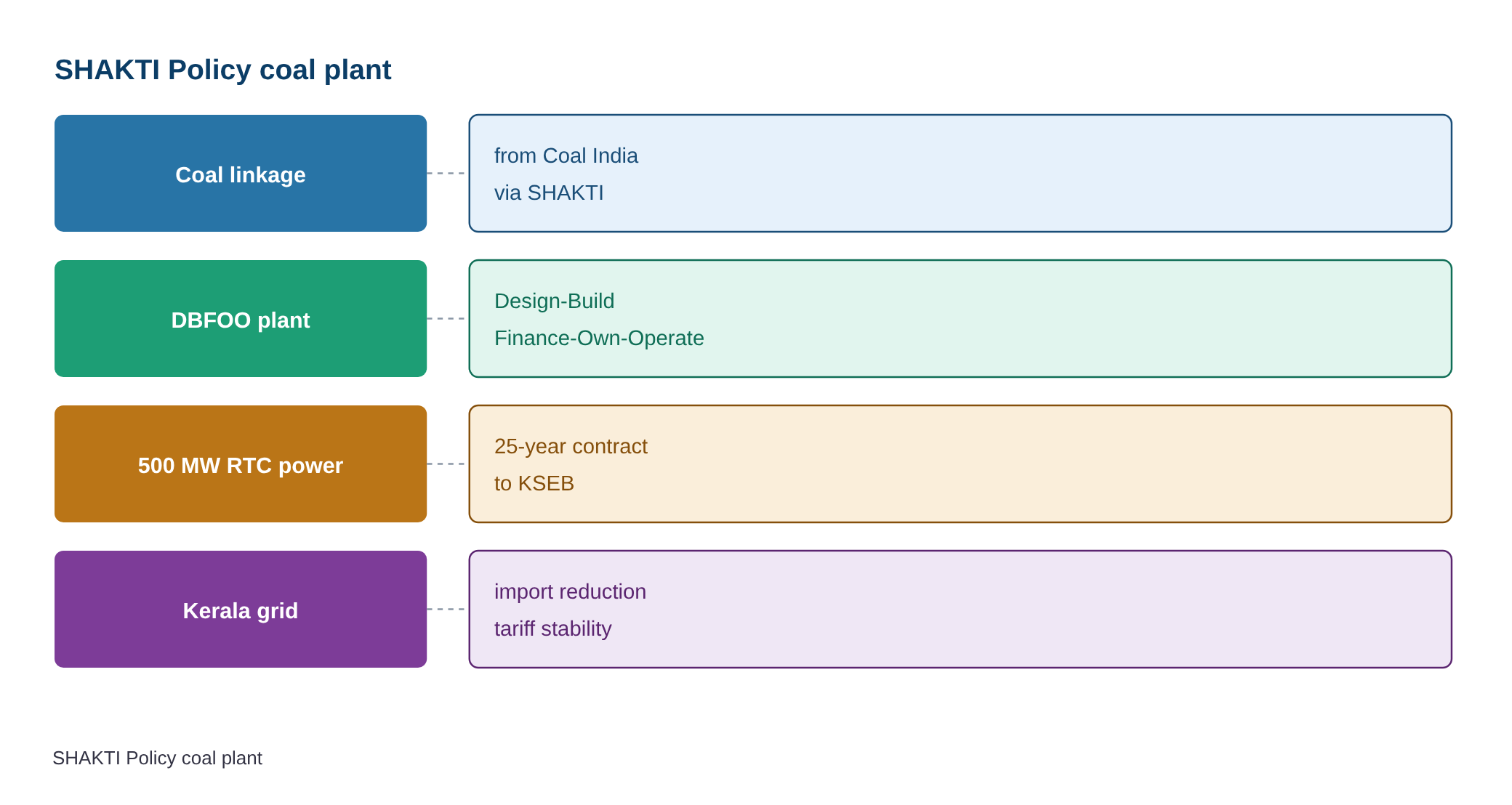
Quick Revision: The SHAKTI Policy facilitates transparent, auction-based allocation of coal linkages to states and Discoms for long-term power procurement, with Keralam’s current initiative under sub-scheme (iv) aiming to secure 500 MW of RTC power for 25 years via a DBFOO-based public-private partnership model.
Why is this in the news?
The Kerala State Electricity Board (KSEB) has initiated a fresh procurement process under the SHAKTI Policy to secure 500 MW of round-the-clock (RTC) power for 25 years, aiming to mitigate Keralam’s recurring power shortages exacerbated during the monsoon season. This move follows the failure of earlier bids under the same policy due to uncompetitive pricing, highlighting systemic challenges in long-term power procurement and the strategic importance of coal linkages in India’s energy mix.
Background
- Keralam’s power sector is heavily reliant on inter-state electricity imports, particularly during peak demand periods, due to limited indigenous fuel resources and insufficient local generation capacity.
- The monsoon season in Keralam often disrupts hydropower generation, exacerbating supply deficits and necessitating emergency measures such as load shedding or power curbs.
- The SHAKTI Policy (Scheme for Harnessing and Allocating Koyala Transparently in India), launched in 2017, was designed to enhance coal-based power procurement efficiency by facilitating transparent allocation of coal linkages to states and distribution companies through competitive bidding.
- The KSEB’s earlier attempt to procure 500 MW under the SHAKTI Policy in 2025 failed due to bids exceeding acceptable tariff ceilings, leading to the annulment of the tender in February 2026.
- Coal remains a critical component of India’s energy mix, accounting for approximately 70% of the country’s electricity generation, despite the push for renewable energy integration.
- The proposed procurement under the SHAKTI Policy will be executed on a Design-Build-Finance-Own-Operate (DBFOO) basis, a model increasingly adopted for large-scale infrastructure projects in India.
What is the SHAKTI Policy and its relevance to Keralam’s power procurement strategy?
- Under the SHAKTI Policy, states or Discoms can apply for long-term or medium-term power procurement by participating in tariff-based competitive bidding (TBCB), where successful bidders are granted coal linkages from Coal India Limited (CIL) or its subsidiaries.
- The SHAKTI Policy mandates that the procurement of power under its framework must adhere to the guidelines issued by the Union Ministry of Power, including norms for tariff determination, bid evaluation, and power purchase agreements (PPAs).
- The policy allows for the procurement of round-the-clock (RTC) power, which ensures a continuous and reliable supply of electricity, addressing the volatility in renewable energy generation and seasonal hydropower deficits.
- The DBFOO model, as proposed in KSEB’s RfQ, involves private sector participation in the entire lifecycle of the power project—design, construction, financing, ownership, and operation—while the state utility retains the power purchase agreement.
- The SHAKTI Policy’s emphasis on long-term PPAs (e.g., 25 years) aligns with the need for stable pricing and supply security, particularly for states like Keralam with limited indigenous fuel resources.
- The policy’s success hinges on competitive bidding to drive down tariffs, as evidenced by the failure of KSEB’s earlier bids due to uncompetitive pricing, underscoring the importance of market-driven procurement mechanisms.
Key Features
| Feature | Significance |
|---|---|
| Round-the-Clock (RTC) Power Procurement | Ensures uninterrupted electricity supply, critical for industrial and domestic consumers, especially during peak demand periods. |
| 25-Year Long-Term Agreement | Provides price stability and supply security, reducing volatility in power costs for the state. |
| SHAKTI Policy (Scheme for Harnessing and Allocating Koyala Transparently in India) | Facilitates transparent coal linkage allocation to states for long-term power procurement, aligning with Union Power Ministry norms. |
| Design, Build, Finance, Own, and Operate (DBFOO) Model | Shifts project risk to private developers while ensuring operational efficiency and timely execution. |
| Competitive Bidding under SHAKTI Policy | Promotes market-driven tariffs, reducing the financial burden on the state while ensuring cost-effective power procurement. |
Why it Matters
Economic
- Reduces Kerala’s dependence on electricity imports, improving energy self-sufficiency and reducing external financial outflows.
- Stabilises power tariffs through long-term contracts, shielding consumers from short-term price volatility.
- Encourages private investment in power generation, contributing to economic growth and employment generation.
Energy Security
- Mitigates seasonal power shortages, particularly during monsoon deficits or peak demand periods.
- Ensures a reliable coal-based power supply, diversifying Kerala’s energy mix beyond hydropower and renewables.
- Supports industrial and agricultural operations by guaranteeing consistent electricity access.
Policy and Governance
- Demonstrates the effective utilisation of central schemes like SHAKTI, aligning state energy policies with national objectives.
- Highlights the role of regulatory oversight (e.g., State Electricity Regulatory Commission) in ensuring fair and transparent procurement.
- Showcases the potential of public-private partnerships (PPPs) in addressing infrastructure gaps in the power sector.
Environmental Considerations
- Coal-based power, while reliable, raises concerns about carbon emissions; necessitates balancing energy security with sustainability goals.
- May necessitate integration with renewable energy sources to meet long-term decarbonisation targets.
Challenges
1. High Bid Tariffs
- Previous bids under SHAKTI were annulled due to prohibitively high tariffs, indicating challenges in balancing cost competitiveness with supply reliability.
- Negotiations failed to sufficiently reduce prices, highlighting the need for better market alignment or alternative procurement strategies.
UPSC Link: GS-III: Energy Security
2. Coal Supply Dependence
- Kerala’s limited domestic coal reserves necessitate reliance on Coal India or its subsidiaries, making supply chains vulnerable to national policy shifts.
- Geopolitical or logistical disruptions in coal supply could impact power generation, despite long-term agreements.
UPSC Link: GS-III: Mineral & Energy Resources
3. Regulatory and Bureaucratic Hurdles
- Delays in tender processes (e.g., annulment of bids in 2026) underscore challenges in streamlining procurement under PPP models.
- Coordination between state (KSEB), central (Coal Ministry), and regulatory bodies may face procedural bottlenecks.
UPSC Link: GS-II: Government Policies & Interventions
4. Grid Stability and Integration
- Large-scale coal-based power procurement requires robust grid infrastructure to manage transmission losses and demand fluctuations.
- Kerala’s existing grid limitations may pose challenges in integrating new capacity without upgrades.
UPSC Link: GS-III: Infrastructure – Energy
5. Public Opposition and Environmental Concerns
- Coal projects may face resistance from local communities or environmental groups, delaying implementation.
- Balancing energy security with sustainability goals (e.g., Paris Agreement commitments) remains a key challenge.
UPSC Link: GS-III: Environmental Pollution & Degradation
6. Financial Viability for KSEB
- Long-term procurement commitments (25 years) may strain KSEB’s financial health if demand projections are inaccurate.
- Subsidies or cross-subsidisation mechanisms may be required to keep tariffs affordable for consumers.
UPSC Link: GS-III: Indian Economy & Issues Relating to Planning
Challenges — UPSC Perspective
| Issue | Concern |
|---|---|
| Tariff Volatility | High bids may lead to unaffordable power costs for consumers or financial strain on KSEB. |
| Coal Supply Chain Risks | Dependence on external coal linkages exposes Kerala to supply disruptions or price fluctuations. |
| Regulatory Delays | Bureaucratic hurdles in tender processes can delay project execution and increase costs. |
| Grid Integration Challenges | Existing infrastructure may struggle to absorb additional 500 MW capacity without upgrades. |
| Environmental Backlash | Local opposition to coal projects could stall implementation or necessitate costly mitigation measures. |
| Financial Sustainability | Long-term commitments may burden KSEB’s balance sheet if revenue streams are unstable. |
Government Initiatives — Must-Memorise for Prelims
- SHAKTI Policy (Scheme for Harnessing and Allocating Koyala Transparently in India)
Way Forward
- Conduct thorough market consultations to align bid expectations with current price realities, avoiding past pitfalls.
- Enhance grid infrastructure through targeted investments in transmission and distribution networks to support new capacity.
- Explore hybrid procurement models combining coal-based RTC power with renewable energy to balance cost and sustainability.
- Strengthen regulatory frameworks to expedite tender processes and reduce bureaucratic delays.
- Develop contingency plans for coal supply disruptions, including diversified fuel sources or strategic reserves.
- Engage with local stakeholders and environmental groups to address concerns and secure project approvals.
- Monitor demand projections closely to ensure long-term agreements align with Kerala’s actual energy needs.
- Leverage central government support under SHAKTI to negotiate favourable terms with Coal India or its subsidiaries.
UPSC Value Addition
Keywords for Mains Answer-Writing
SHAKTI Policy · KSEB · round-the-clock (RTC) power procurement · coal linkage · Design, Build, Finance, Own and Operate (DBFOO) model · tariff-based competitive bidding · public-private partnership (PPP) in power sector · State Electricity Regulatory Commissions (SERCs) · power sector reforms · energy security · long-term power procurement agreements · Coal India Limited (CIL) · Union Power Ministry norms · power sector liberalisation · energy mix diversification
Concept Flow
Kerala’s monsoon-season power crisis exposes vulnerabilities in its energy mix, heavily reliant on imports. → KSEB explores SHAKTI Policy’s coal linkage mechanism to secure long-term, RTC power supply via competitive bidding. → Under DBFOO model, private developers design, build, and operate plants, sourcing coal from Coal India. → Regulatory approval (State Electricity Regulatory Commission) and transparent bidding ensure cost-effective procurement. → Successful implementation stabilises Kerala’s power sector, reduces import dependence, and supports economic growth. → Challenges such as high tariffs, grid integration, and environmental concerns must be addressed for sustainability.
Prelims Practice Questions
Q1. Consider the following statements regarding the SHAKTI Policy:
1. It is a scheme for harnessing and allocating coal transparently in India.
2. It permits States to procure power through tariff-based competitive bidding.
3. It mandates the use of only renewable energy sources for long-term power procurement.
4. The policy is administered by the Union Coal Ministry.
How many of the above statements are correct?
- Only one
- Only two
- Only three
- All
Answer: Only three — Statements 1, 2, and 4 are correct. Statement 3 is incorrect as the SHAKTI Policy does not mandate the use of only renewable energy sources; it allows for coal-based procurement as well.
Q2. Assertion (A): The Design, Build, Finance, Own and Operate (DBFOO) model is a form of public-private partnership (PPP) used in infrastructure projects.
Reason (R): In the DBFOO model, the private entity bears the entire financial risk and operational responsibility for the project throughout its lifecycle.
In the context of the above two statements, which one of the following is correct?
- Both A and R are true, and R is the correct explanation of A.
- Both A and R are true, but R is not the correct explanation of A.
- A is true, but R is false.
- A is false, but R is true.
Answer: A is true, but R is false. — A is true as DBFOO is indeed a PPP model. However, R is not entirely correct because while the private entity bears significant risk, the public authority may share some risks or provide guarantees, depending on the contract terms.
Q3. Match the following pairs related to power sector reforms in India:
Column I (Policy/Scheme) Column II (Key Feature)
A. SHAKTI Policy 1. Allows tariff-based competitive bidding for long-term power procurement
B. UDAY Scheme 2. Focuses on financial turnaround of discoms
C. Electricity Act, 2003 3. Introduced open access and delicensing in power generation
D. National Electricity Policy, 2005 4. Emphasizes energy security and diversification of energy sources
Select the correct match from the options below:
- A-1, B-2, C-3, D-4
- A-2, B-1, C-3, D-4
- A-1, B-3, C-2, D-4
- A-4, B-2, C-3, D-1
Answer: A-1, B-2, C-3, D-4 — The correct matches are: A-1 (SHAKTI Policy allows tariff-based competitive bidding), B-2 (UDAY Scheme focuses on discom turnaround), C-3 (Electricity Act, 2003 introduced open access and delicensing), and D-4 (National Electricity Policy, 2005 emphasizes energy security and diversification).
Mains Practice Question
✍ The Kerala State Electricity Board (KSEB) has initiated a fresh attempt to procure 500 MW of round-the-clock (RTC) power for 25 years under the SHAKTI Policy’s coal linkage mechanism. Critically analyse the efficacy of such long-term power procurement strategies in addressing the structural vulnerabilities of India’s power sector. Also, examine the role of regulatory commissions and the DBFOO model in ensuring sustainable energy security. (15 Marks)
Approach: MODEL-ANSWER SKELETON:
1. **Context and Background**:
– Briefly explain the SHAKTI Policy’s coal linkage mechanism (Union Coal Ministry’s Scheme for Harnessing and Allocating Koyala Transparently in India).
– Highlight KSEB’s attempt to procure 500 MW RTC power under DBFOO model for 25 years, citing the rationale (monsoon-season power crisis, reliance on imports).
2. **Efficacy of Long-Term Power Procurement Strategies**:
– **Advantages**:
– Ensures energy security by reducing dependence on imports.
– Provides price stability through fixed tariffs in competitive bidding.
– Encourages private investment in power generation (PPP model).
– Aligns with the Electricity Act, 2003’s emphasis on open access and competition.
– **Challenges**:
– High upfront costs and long gestation periods.
– Risk of stranded assets if demand projections are inaccurate.
– Regulatory hurdles in tariff determination and dispute resolution.
– Environmental concerns (coal-based procurement vs. renewable energy targets).
3. **Role of Regulatory Commissions (e.g., State Electricity Regulatory Commissions – SERCs)**:
– **Functions**:
– Approve tariffs and procurement processes (e.g., KSEB’s tender approval in June 2025).
– Ensure compliance with Union Power Ministry norms (e.g., SHAKTI Policy guidelines).
– Balance consumer interests (affordability) with investor interests (viability).
– **Limitations**:
– Delays in approvals (e.g., tender annulment in February 2026 due to high bids).
– Lack of uniformity in regulations across states.
– Limited capacity to enforce penalties for non-compliance.
4. **DBFOO Model in Ensuring Sustainable Energy Security**:
– **Mechanism**:
– Private entity designs, builds, finances, owns, and operates the power plant.
– Public authority (KSEB) procures power under a long-term agreement.
– **Strengths**:
– Shifts financial and operational risks to the private sector.
– Encourages efficiency and innovation in project execution.
– Aligns with global best practices in infrastructure development.
– **Challenges**:
– High transaction costs and complex contract negotiations.
– Risk of renegotiations or disputes (e.g., failed negotiations in KSEB’s earlier attempt).
– Limited scalability in smaller states due to resource constraints.
5. **Way Forward**:
– **Policy Interventions**:
– Strengthen SERCs’ capacity for timely approvals and dispute resolution.
– Incentivize renewable energy integration in long-term procurement (e.g., blending coal with biomass).
– Promote state-specific energy mix diversification (e.g., Kerala’s hydropower + coal linkage).
– **Institutional Reforms**:
– Enhance transparency in coal allocation and pricing mechanisms.
– Encourage multi-state power procurement pools to reduce regional disparities.
6. **Conclusion**:
– Long-term procurement strategies like SHAKTI’s coal linkage can enhance energy security but require robust regulatory oversight, adaptive policy frameworks, and a balanced energy mix to mitigate risks.
Source: The Hindu
Generated by AanyaAi for educational purpose.
Related guides on our sites
- Anthropology VS PSIR
- Best PSIR optional coaching
- Best PSIR optional coaching online
- Best PSIR optional teacher

- यूक्रेन का रोबोट सेना अभियान: युद्ध में मानव हानि कम करने की रणनीति - September 27, 2026
- Ukraine’s ‘Army of Robots’: A Game-Changer for UPSC Mains 2026 Polity & Governance - September 27, 2026
- रूस ने भारत-ब्राजील को दिया UNSC स्थायी सदस्यता का समर्थन, जर्मनी-जापान विरोध में - September 27, 2026

No Comments