


16 Aug Kharge challenges RSS on freedom struggle role, defends Karnataka Bill
✎ The Karnataka Regulation of Use of Government Premises and Public Property Bill, 2026, establishes a statutory framework for regulating public space utilisation, ensuring equitable access and preventing misuse, while upholding…
Subject Relevance — Where This Topic Fits
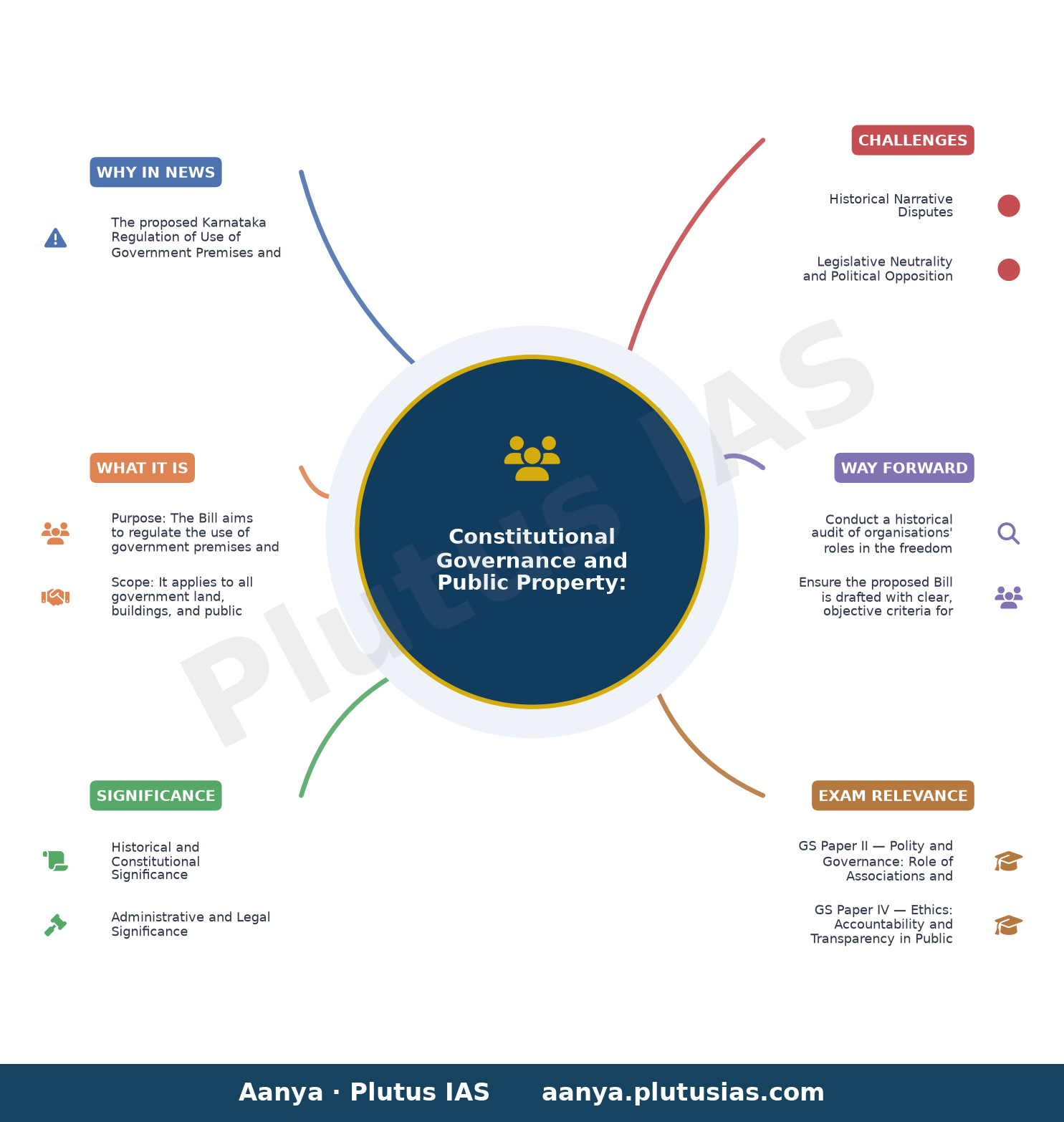
- GS Paper II — Polity and Governance: Role of Associations and Regulation of Public Spaces | GS Paper IV — Ethics: Accountability and Transparency in Public Resource Management
- Prelims: Public Property (Prevention of Damage and Misuse) Act, 1984, Supreme Court directives on public space utilisation, Constitutional provisions on freedom of association (Article 19(1)(c)), Doctrine of Eminent Domain, Competent Authority under administrative law
- Essay: The balance between individual liberties and collective welfare in public space governance, The role of statutory regulation in preserving democratic public institutions
Quick Revision: The Karnataka Regulation of Use of Government Premises and Public Property Bill, 2026, establishes a statutory framework for regulating public space utilisation, ensuring equitable access and preventing misuse, while upholding constitutional rights and judicial precedents.
Why is this in the news?
The proposed Karnataka Regulation of Use of Government Premises and Public Property Bill, 2026, has drawn attention following public statements by the state’s Home Minister challenging the legal status and historical role of the Rashtriya Swayamsevak Sangh (RSS) during India’s freedom struggle. The Bill seeks to establish a statutory framework for regulating the use of public property, aligning with judicial precedents on public space utilisation. The discourse underscores constitutional questions regarding the regulation of associations and the protection of public resources, making it a critical governance issue for civil services aspirants.
Background
- The Rashtriya Swayamsevak Sangh (RSS), founded in 1925, is a socio-cultural organisation with a stated objective of cultural nationalism and social service, though its role in India’s independence movement remains a subject of historical debate.
- India’s freedom struggle (1919–1947) witnessed mass movements such as the Non-Cooperation Movement (1920–22), Civil Disobedience Movement (1930–34), and Quit India Movement (1942), which saw participation from diverse sections of society, including the Indian National Congress and other political formations.
- The Supreme Court of India, in *Himat Lal K. Shah v. Commissioner of Police, Ahmedabad* (1973), upheld the right to hold public meetings in public spaces subject to reasonable restrictions in the interest of public order.
- The Public Property (Prevention of Damage and Misuse) Act, 1984, provides a legal framework for penalising damage to public property, though its enforcement has often been contentious.
- State governments have periodically introduced regulations to manage the use of government premises and public property, often in response to incidents of misuse or unauthorised occupation.
- The Bill aligns with judicial directives emphasising the need for structured regulation of public spaces to prevent encroachment and ensure equitable access.
What is the Karnataka Regulation of Use of Government Premises and Public Property Bill, 2026?
- Purpose: The Bill aims to regulate the use of government premises and public property by organisations, groups, and individuals to prevent misuse, encroachment, and unauthorised occupation.
- Scope: It applies to all government land, buildings, and public spaces under the control of the state government or local authorities, including roads, parks, and open areas.
- Regulatory Mechanism: The Bill empowers a ‘Competent Authority’ to grant or deny permission for programmes, processions, gatherings, or other activities on public property, based on prescribed guidelines.
- Non-Discrimination: The provisions apply uniformly to all organisations, irrespective of their registration status, political affiliation, or ideological orientation, ensuring neutrality in enforcement.
- Statutory Framework: The Bill seeks to codify existing administrative practices and judicial precedents into a formal legal structure, providing clarity and predictability in governance.
- Safeguards: The Bill includes provisions for appeals against decisions of the Competent Authority, ensuring procedural fairness and transparency in regulatory actions.
- Alignment with Constitutional Principles: The Bill is designed to balance the right to freedom of association (Article 19(1)(c)) with the state’s duty to protect public resources and maintain public order.
- Judicial Precedents: The Bill draws from Supreme Court rulings such as *Himat Lal K. Shah v. Commissioner of Police, Ahmedabad* (1973), which recognised the state’s power to regulate public spaces in the interest of public order.
Key Features
| Feature | Significance |
|---|---|
| Criticism of RSS’s role in freedom struggle | Highlights the contested narratives regarding participation of non-Congress organisations in India’s independence movement, relevant for UPSC’s Modern Indian History syllabus (GS Paper-I). |
| Allegation of RSS’s inaction during Partition riots | Raises questions about the organisation’s historical role in communal harmony, a critical dimension of India’s socio-political history (GS Paper-I). |
| Challenge to RSS to furnish names of freedom fighters | Reinforces the debate on historical evidence and documentation of contributions to the freedom struggle, pertinent for GS Paper-I’s analytical requirements. |
| Proposed Karnataka Regulation of Use of Government Premises and Public Property Bill, 2026 | Introduces a legislative framework to regulate public property usage, aligning with principles of good governance and administrative law (GS Paper-II). |
| Statutory framework for regulating public property use | Demonstrates the state’s responsibility to ensure equitable access to public spaces, a governance principle tested in judicial precedents (GS Paper-II). |
Why it Matters
Historical and Constitutional Significance
- The debate over the RSS’s role in the freedom struggle underscores the multiplicity of narratives in India’s struggle for independence, a theme frequently examined in UPSC’s GS Paper-I.
- The proposed Bill reflects the state’s obligation to regulate public property usage in a manner consistent with constitutional principles of equality and non-discrimination (Article 14).
- The controversy highlights the interplay between historical narratives and contemporary governance, a recurring theme in UPSC examinations.
- The Bill’s provisions, if enacted, would set a precedent for state regulation of public spaces, a topic relevant to administrative law (GS Paper-II).
Administrative and Legal Significance
- The Bill aims to provide a statutory basis for regulating public property usage, addressing gaps in existing administrative practices.
- The requirement for prior permission for gatherings on public property aligns with judicial directives on maintaining public order and preventing misuse of public spaces.
- The debate over the Bill’s neutrality—applicable to all organisations—addresses concerns of procedural fairness and non-arbitrariness in governance (Article 14).
- The challenge to the Bill’s intent by political actors underscores the need for evidence-based policymaking and transparent legislative processes.
Socio-Political Significance
- The controversy reflects broader societal debates on historical interpretations and their impact on contemporary politics, a recurring theme in UPSC’s GS Paper-I.
- The Bill’s provisions could influence the conduct of public events, processions, and gatherings, impacting civil society’s engagement with public spaces.
- The discourse on the RSS’s historical role may shape public perceptions of organisations and their contributions to nation-building.
Challenges
1. Historical Narrative Disputes
- The contestation over the RSS’s role in the freedom struggle highlights the challenge of reconciling multiple historical narratives in a pluralistic society.
- Such disputes can polarise public discourse and complicate efforts to foster a shared understanding of India’s past.
- UPSC aspirants must critically evaluate historical claims using primary and secondary sources to develop balanced perspectives.
UPSC Link: GS Paper-I: Modern Indian History
2. Legislative Neutrality and Political Opposition
- The Bill’s neutrality—applicable to all organisations—faces challenges in implementation and perception due to political polarisation.
- Opposition to the Bill, framed as a defence of an organisation, risks undermining the principle of rule of law and procedural fairness.
- The state must ensure that legislative intent is not misrepresented, and that public discourse remains evidence-based.
UPSC Link: GS Paper-II: Governance, Constitution and Polity
3. Regulation of Public Property Usage
- Balancing the right to assemble peacefully (Article 19(1)(b)) with the need to regulate public property usage poses a governance challenge.
- The Bill must ensure that regulations do not disproportionately restrict civil society’s engagement with public spaces.
- Administrative mechanisms for granting permissions must be transparent, accountable, and free from arbitrariness.
UPSC Link: GS Paper-II: Governance and Constitution
4. Judicial Precedents and Administrative Practices
- The Bill’s provisions must align with existing judicial precedents on public order, public property usage, and fundamental rights.
- Administrative practices must be revised to incorporate statutory requirements, ensuring consistency with judicial directives.
UPSC Link: GS Paper-II: Constitution and Polity
5. Public Perception and Trust in Institutions
- Controversies over historical narratives and legislative intent can erode public trust in institutions and governance processes.
- The state must prioritise transparency and evidence-based policymaking to maintain credibility.
UPSC Link: GS Paper-IV: Ethics, Integrity and Aptitude
Challenges — UPSC Perspective
| Issue | Concern |
|---|---|
| Historical narrative disputes | Risk of polarisation and misrepresentation of historical contributions |
| Legislative neutrality | Challenge of ensuring the Bill is perceived as fair and non-discriminatory |
| Regulation of public property usage | Balancing fundamental rights with administrative control |
| Judicial alignment | Ensuring statutory provisions comply with judicial precedents |
| Public trust | Risk of erosion due to politicisation of historical and legislative debates |
Way Forward
- Conduct a historical audit of organisations’ roles in the freedom struggle using primary sources (archives, memoirs, official records) to establish evidence-based narratives.
- Ensure the proposed Bill is drafted with clear, objective criteria for regulating public property usage to avoid ambiguity in implementation.
- Institute a transparent, time-bound process for granting permissions for gatherings on public property, with grievance redressal mechanisms.
- Engage with civil society stakeholders to address concerns about potential misuse of regulatory powers and ensure inclusivity.
- Develop a public awareness campaign to explain the Bill’s provisions and its neutral applicability to all organisations.
- Strengthen administrative capacity to enforce the Bill’s provisions without arbitrariness or discrimination.
- Encourage interdisciplinary research on historical narratives to foster a nuanced understanding of India’s freedom struggle.
- Uphold judicial independence by ensuring that any legal challenges to the Bill are adjudicated impartially.
UPSC Value Addition
Keywords for Mains Answer-Writing
Public property governance · Statutory regulation of public spaces · Supreme Court directives on public property · Constitutional provisions on public property · Role of government in regulating public spaces · Legal status of unregistered organisations · Public property utilisation policy · Statutory framework for public governance · Regulation of processions and gatherings · Government premises regulation · Constitutional governance of public property · Legal status and registration of organisations
Concept Flow
Contestation over historical narratives → Political discourse on freedom struggle contributions → Proposal of regulatory Bill → Debate on Bill’s neutrality → Challenges in implementation → Need for evidence-based governance → Alignment with constitutional principles
Prelims Practice Questions
Q1. Consider the following statements regarding the proposed Karnataka Regulation of Use of Government Premises and Public Property Bill, 2026:
1. The Bill seeks to regulate the use of government premises and public property by organisations and groups.
2. It mandates prior permission from a Competent Authority for programmes, processions, and gatherings on government land.
3. The Bill explicitly bans the Rashtriya Swayamsevak Sangh (RSS) from using public property.
4. The Bill applies exclusively to registered organisations and does not cover unregistered entities.
How many of the above statements are correct?
- Only one
- Only two
- Only three
- All four
Answer: Only three — Statements 1 and 2 are correct as per the Bill’s stated objectives. Statement 3 is incorrect as the Bill does not name any specific organisation. Statement 4 is incorrect as the Bill applies to all organisations irrespective of their registration status.
Q2. Assertion (A): An organisation cannot be subjected to a ban without first establishing its legal status.
Reason (R): The proposed Karnataka Regulation of Use of Government Premises and Public Property Bill, 2026, does not impose a ban on any organisation but regulates the use of public property.
In the context of the above statements, which of the following is correct?
- Both A and R are true, and R is the correct explanation of A.
- Both A and R are true, but R is not the correct explanation of A.
- A is true, but R is false.
- A is false, but R is true.
Answer: A is true, but R is false. — Assertion (A) is true as legal status is a prerequisite for imposing a ban. Reason (R) is also true but does not explain the assertion, as the Bill does not impose a ban but regulates public property use.
Q3. Which of the following constitutional provisions is most directly relevant to the regulation of public property utilisation in India?
- Article 299
- Article 300A
- Article 301
- Article 302
Answer: Article 300A — Article 300A provides that no person shall be deprived of his property save by authority of law, making it directly relevant to the regulation of public property utilisation.
Mains Practice Question
✍ The utilisation of public property in India is increasingly governed by statutory frameworks rather than mere administrative discretion. Critically examine the constitutional and legal dimensions of regulating public property, with reference to recent judicial directives and the proposed Karnataka Regulation of Use of Government Premises and Public Property Bill, 2026. (15 Marks)
Approach: MODEL-ANSWER SKELETON:
1. Constitutional basis: Article 300A (right to property) and Article 299 (contracts in exercise of executive power).
2. Judicial precedents: Supreme Court rulings on public property regulation (e.g., Ramlila Maidan case, 2011; Hema Malini v. Union of India, 2018).
3. Statutory frameworks: Analysis of the proposed Karnataka Bill—its objectives, provisions, and compliance with constitutional principles.
4. Balance between regulation and fundamental rights: Right to assemble (Article 19(1)(a)) vs. public order and property rights.
5. Comparative perspective: Similar regulations in other states (e.g., Maharashtra Public Premises Act, 1974).
6. Challenges: Legal ambiguity in defining ‘public property’, enforcement mechanisms, and potential misuse of regulatory powers.
7. Conclusion: Need for a uniform national framework while respecting federal principles.
Source: The Hindu
Generated by AanyaAi for educational purpose.

- मद्रास उच्च न्यायालय में ‘वेट्ट्री पयणम’ योजना को असंवैधानिक घोषित करने की मांग - October 4, 2026
- Gurugram’s groundwater extraction exceeds limit by 212%; HC seeks ban - October 4, 2026
- स्वतंत्रता सेनानी श्यामजी कृष्ण वर्मा की जन्म जयंती पर पीएम का श्रद्धांजलि - October 4, 2026

No Comments