


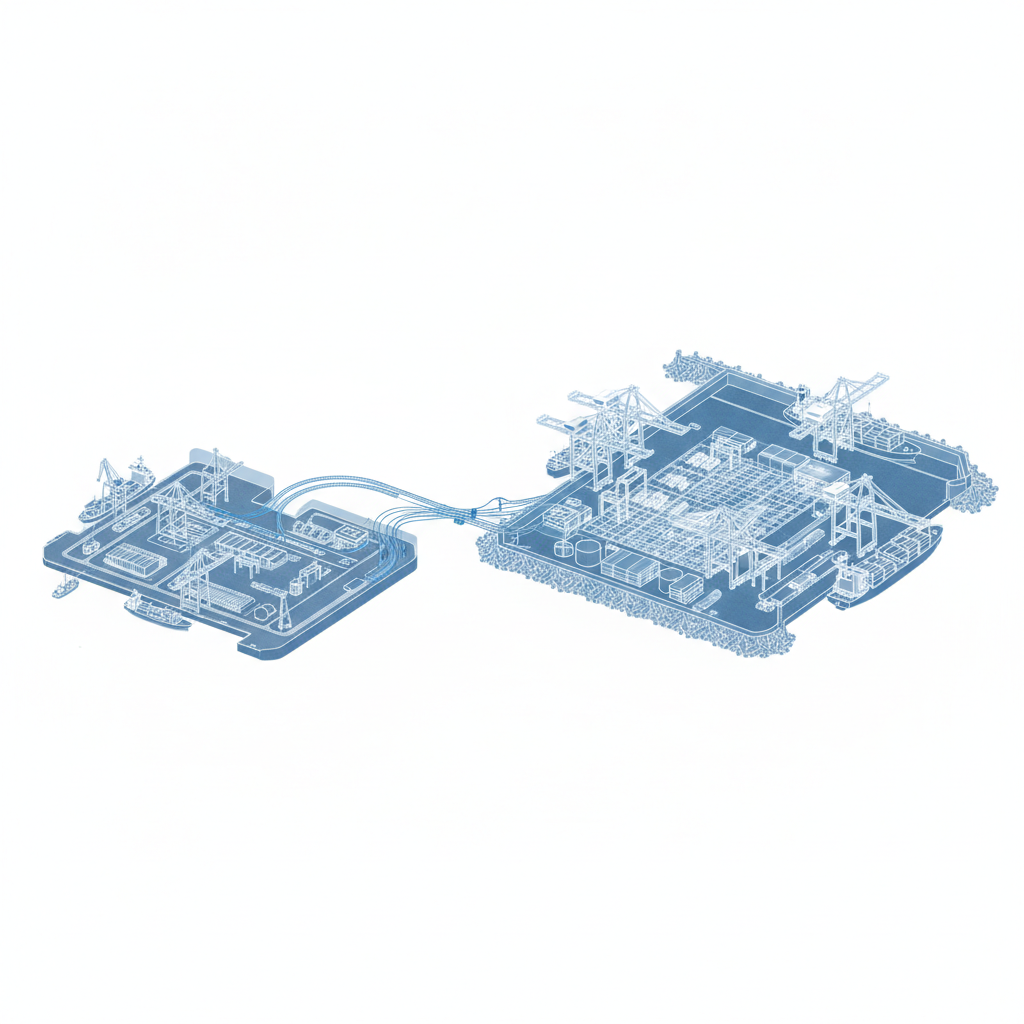
19 Sep Kollam Port to be Developed as Vizhinjam’s Satellite Port: Key UPSC Facts
✎ Satellite ports function as feeder logistics nodes to major international hubs, enhancing coastal shipping efficiency and reducing pressure on primary ports through integrated port development under the Sagarmala initiative.
Subject Relevance — Where This Topic Fits
- GS Paper II — Governance, Constitution and Polity (Institutional Development) | GS Paper III — Infrastructure: Ports, Roads, Railways, Airports and Logistics
- Prelims: Port Development, Vizhinjam International Seaport, Satellite Port, Dredging, Port Health Officer, Coastal Shipping, Logistics Infrastructure, Kerala Ports
- Essay: India’s Port-led Maritime Logistics: Challenges and Opportunities, Balancing Coastal Development and Environmental Sustainability in India
Quick Revision: Satellite ports function as feeder logistics nodes to major international hubs, enhancing coastal shipping efficiency and reducing pressure on primary ports through integrated port development under the Sagarmala initiative.
Why is this in the news?
The Government of Kerala has announced plans to develop Kollam Port as a satellite port to Vizhinjam International Seaport, marking a strategic shift in the state’s maritime infrastructure policy. This initiative aims to enhance cargo handling capacity, integrate feeder logistics, and stimulate coastal trade, while addressing long-standing operational deficiencies at Kollam Port. The announcement follows a high-level inspection and signals renewed administrative focus on Kerala’s port sector after a decade of stagnation.
Background
- Kerala’s coastline spans approximately 590 km, with 18 notified minor ports and two international ports: Cochin Port and Vizhinjam International Seaport (under development).
- Vizhinjam International Seaport, located near Thiruvananthapuram, is being developed as a transshipment hub with a capacity of 4.1 million TEUs, aimed at reducing India’s dependence on Colombo and Singapore ports.
- Kollam Port, historically a minor port, has remained underutilized despite its strategic location between Kochi and Vizhinjam, with limited dredging, inadequate infrastructure, and regulatory bottlenecks persisting since 2016.
- The state government’s 2021 Maritime Policy envisages integrated port development, coastal shipping promotion, and multimodal connectivity to boost Kerala’s logistics competitiveness.
- Kerala’s port sector contributes to approximately 12% of the state’s GSDP, with coastal shipping playing a critical role in reducing road congestion and carbon emissions in logistics.
- The Union Ministry of Ports, Shipping and Waterways (MoPSW) has been promoting the ‘Sagarmala’ initiative since 2015, which includes port modernization, hinterland connectivity, and coastal community development.
What is a Satellite Port and its Role in Maritime Logistics?
- A satellite port is a smaller port strategically located near a larger international hub to handle feeder traffic, transshipment overflow, and regional cargo, thereby enhancing the efficiency of the main port.
- Satellite ports reduce congestion at major ports by distributing cargo handling across multiple facilities, improving turnaround time for vessels and reducing dwell time in logistics chains.
- They serve as critical nodes in coastal shipping networks, enabling last-mile connectivity to hinterlands through road, rail, and inland waterways, particularly in states with long coastlines like Kerala.
- The development of satellite ports is aligned with the Sagarmala Programme’s objective of increasing the share of coastal shipping in India’s modal mix from the current 6% to 10% by 2030.
- Kollam’s role as a satellite to Vizhinjam would involve handling coastal cargo, transshipment overflow, and supporting Vizhinjam’s operations during peak periods, thereby optimizing resource utilization.
- Satellite ports require minimal dredging compared to international hubs but must maintain a navigable depth of at least 8–10 meters for commercial vessels to berth safely.
- The integration of satellite ports with international hubs enhances supply chain resilience, reduces logistics costs, and supports India’s ‘Make in India’ and ‘Atmanirbhar Bharat’ initiatives in manufacturing and exports.
- Environmental considerations, such as sediment management during dredging and protection of mangrove ecosystems, are critical in the development of coastal port infrastructure.
Key Features
| Feature | Significance |
|---|---|
| Satellite port development at Kollam | Enhances hinterland connectivity and reduces pressure on Vizhinjam Port, thereby improving cargo handling efficiency and trade logistics in Kerala. |
| Dredging and depth augmentation | Ensures minimum 8-meter draft for vessel berthing, accommodating larger ships and improving operational feasibility. |
| Establishment of a floating dry dock | Facilitates ship repair and maintenance, reducing downtime and operational costs for maritime stakeholders. |
| Tourist cruise services from the port | Leverages coastal tourism potential, generating revenue and promoting regional economic diversification. |
| Port Health Officer appointment | Mandatory for compliance with international maritime health regulations, ensuring smooth clearance of vessels. |
Why it Matters
Economic
- Augments Kerala’s port infrastructure, reducing congestion at Vizhinjam and enhancing overall cargo throughput.
- Stimulates ancillary industries such as shipbuilding, repair, and tourism, creating employment opportunities.
- Improves trade competitiveness by reducing logistics costs and transit times for exporters and importers.
Strategic
- Strengthens India’s coastal shipping network, aligning with the Sagarmala Programme’s objective of port-led development.
- Enhances maritime security through modernized port infrastructure and upgraded coastal policing assets.
Infrastructural
- Revitalizes underutilized port assets, ensuring optimal utilization of existing maritime infrastructure.
- Integrates port operations with hinterland connectivity, improving multimodal transport linkages.
Environmental
- Sustainable dredging practices mitigate sediment deposition and maintain ecological balance in coastal waters.
Challenges
1. Infrastructural Bottlenecks
- Inadequate wharf depth for modern vessels, necessitating immediate dredging interventions.
- Aging coastal police fleet and non-functional high-mast lights compromise port security and operational safety.
UPSC Link: Port infrastructure challenges
2. Regulatory and Compliance Gaps
- Absence of a dedicated Port Health Officer delays vessel clearance and violates international maritime norms.
- Customs-related bottlenecks hinder seamless cargo movement, increasing transaction costs.
UPSC Link: Maritime regulatory framework
3. Operational Inefficiencies
- Prolonged neglect of port facilities over the past decade has led to stagnation in cargo handling capacity.
- Rising incidents of theft from fishing boats indicate gaps in port security and community engagement.
UPSC Link: Port management and governance
4. Financial Constraints
- High capital expenditure required for dredging, infrastructure upgrades, and fleet modernization.
- Need for public-private partnerships to mobilize resources for sustainable port development.
UPSC Link: Port financing mechanisms
Challenges — UPSC Perspective
| Issue | Concern |
|---|---|
| Wharf depth | Insufficient for modern vessels, limiting cargo capacity and operational efficiency. |
| Coastal policing assets | Aging fleet and non-functional lighting compromise security and emergency response. |
| Port Health Officer vacancy | Delays vessel clearance, risking non-compliance with international health regulations. |
| Customs bottlenecks | Increased clearance time, raising logistics costs and reducing trade competitiveness. |
| Theft incidents | Undermines community trust and deters investment in maritime trade. |
Government Initiatives — Must-Memorise for Prelims
- Sagarmala Programme (for port-led development and hinterland connectivity)
Way Forward
- Conduct a comprehensive hydrographic survey to assess current wharf depth and prioritize dredging activities.
- Accelerate the appointment of a Port Health Officer to ensure compliance with international maritime health standards.
- Upgrade coastal policing infrastructure, including replacement of aging boats and installation of functional high-mast lights.
- Formulate a public-private partnership framework to finance and operationalize the floating dry dock and cruise services.
- Establish a grievance redressal mechanism in collaboration with local fishers and port authorities to address security concerns.
- Integrate Kollam Port with Vizhinjam Port’s digital logistics platform to streamline cargo movement and reduce bottlenecks.
- Undertake capacity-building initiatives for port staff to enhance operational efficiency and crisis management.
UPSC Value Addition
Keywords for Mains Answer-Writing
Port-led development · Satellite port · Coastal shipping · Maritime infrastructure · Port governance · Cabotage policy · Dredging operations · Port Health Organisation · Coastal security · Multi-modal connectivity · Logistics hub · Blue Economy · Sagarmala Programme · Major Port Authorities Act, 2021 · Coastal shipping policy · Maritime clusters · Port-based industrialisation · Inland waterways · Cabotage relaxation · Maritime safety regulations
Concept Flow
Neglect of Kollam Port over the past decade → Stagnation in cargo handling capacity and infrastructure decay → State government prioritizes port development → Announces plans to develop Kollam as a satellite port of Vizhinjam → Infrastructure assessment identifies critical gaps → Dredging, depth augmentation, and security upgrades proposed → Regulatory and operational bottlenecks addressed → Appointment of Port Health Officer and customs reforms initiated → Economic and strategic benefits realized → Enhanced trade competitiveness, employment generation, and maritime security
Prelims Practice Questions
Q1. Consider the following statements regarding the development of Kollam Port as a satellite port of Vizhinjam:
1. Kollam Port is proposed to be developed under the Sagarmala Programme.
2. The development includes the establishment of a floating dry dock and tourist cruise services.
3. Dredging operations at Kollam Port have been regularly conducted over the past decade.
How many of the above statements are correct?
- Only one
- Only two
- All
- None
Answer: Only two — Statement 1 is correct as the Sagarmala Programme aims at port-led development. Statement 2 is correct as the Minister mentioned proposals for a floating dry dock and cruise services. Statement 3 is incorrect as the Minister highlighted that no dredging has been carried out for long.
Q2. Assertion (A): The Major Port Authorities Act, 2021, grants greater autonomy to major ports in India.
Reason (R): The Act replaces the Major Port Trusts Act, 1963, and confers powers to the Boards of Major Ports to fix tariffs and manage their affairs independently.
Options:
A. Both A and R are true, and R is the correct explanation of A.
B. Both A and R are true, but R is not the correct explanation of A.
C. A is true, but R is false.
D. A is false, but R is true.
Answer: ? — Both the Assertion and Reason are true. The Major Port Authorities Act, 2021, indeed enhances autonomy by replacing the 1963 Act and empowering port boards with tariff fixation and administrative independence.
Q3. Which of the following is NOT a function of the Port Health Organisation (PHO) in India?
- Monitoring and controlling the spread of communicable diseases through ships
- Issuing Ship Sanitation Certificates
- Conducting dredging operations in port waters
- Inspecting ships for compliance with health regulations
Answer: Conducting dredging operations in port waters — The Port Health Organisation is responsible for health surveillance, issuance of sanitation certificates, and inspection of ships for health compliance. Dredging operations are handled by port authorities or specialized agencies, not the PHO.
Mains Practice Question
✍ Critically examine the significance of developing satellite ports like Kollam in the context of India’s maritime infrastructure and the Sagarmala Programme. Also, analyse the challenges in port-led development and suggest measures to address them. (15 Marks)
Approach: MODEL-ANSWER SKELETON:
1. **Introduction (2 marks)**: Define satellite ports and their role in enhancing port capacity and reducing congestion at major ports. Briefly introduce the Sagarmala Programme and its objectives (e.g., reducing logistics cost, enhancing connectivity, promoting coastal shipping).
2. **Significance of Satellite Ports (5 marks)**:
– **Capacity Augmentation**: Satellite ports like Kollam can decongest major ports (e.g., Vizhinjam) and handle feeder traffic, improving turnaround time.
– **Coastal Shipping Promotion**: Aligns with the Sagarmala Programme’s focus on promoting coastal and inland waterways to reduce road congestion and carbon footprint.
– **Regional Development**: Enhances hinterland connectivity, fosters industrial clusters, and promotes the Blue Economy (e.g., fisheries, tourism).
– **Multi-modal Connectivity**: Integration with rail, road, and inland waterways for seamless logistics.
– **Cabotage Policy**: Potential to leverage cabotage relaxation (Section 407 of the Merchant Shipping Act, 1958) to boost coastal trade.
3. **Challenges in Port-led Development (5 marks)**:
– **Infrastructure Gaps**: Inadequate depth (e.g., Kollam Port requires dredging to achieve 8 meters), aging fleet (coastal police boats), and non-functional security infrastructure (high-mast lights, cameras).
– **Regulatory Bottlenecks**: Absence of a dedicated Port Health Officer (PHO) and customs-related delays hinder operational efficiency.
– **Financial Constraints**: High capital expenditure for dredging, modernisation, and maintenance; reliance on public-private partnerships (PPPs) or central schemes like Sagarmala.
– **Environmental Concerns**: Dredging and port expansion may impact marine ecosystems; need for Environmental Impact Assessments (EIAs) and sustainable practices.
– **Security and Safety**: Rising incidents of theft from fishing boats and inadequate coastal security infrastructure.
4. **Measures to Address Challenges (3 marks)**:
– **Infrastructure Modernisation**: Prioritise dredging, upgrade wharf infrastructure, and deploy modern surveillance systems (e.g., AI-based monitoring).
– **Streamlining Regulations**: Strengthen the role of PHOs, expedite customs clearances, and simplify regulatory frameworks for coastal shipping.
– **Financial Innovations**: Leverage viability gap funding (VGF) under Sagarmala, explore green financing, and incentivise private investment through tax benefits.
– **Capacity Building**: Train port staff, enhance coastal police fleet, and collaborate with maritime institutes for skill development.
– **Sustainability Integration**: Adopt eco-friendly dredging techniques, promote circular economy models, and integrate disaster resilience in port design.
Source: The Hindu
Generated by AanyaAi for educational purpose.
Related guides on our sites
- Current affairs for upsc 2026
- How to prepare for GS paper 1 for UPSC CSE mains exam
- Best UPSC coaching for IFOS exam
- Best mentorship programme for upsc

- उत्तर तमिलनाडु में विस्तारित स्कूल ब्रेकफास्ट योजना का शुभारंभ, जानें लाभ - September 22, 2026
- केरल में मानव-वन्यजीव संघर्ष मुआवज़े के लिए दिशा-निर्देश तैयार करेगा विशेषज्ञ पैनल - September 22, 2026
- Kerala forms expert panel to streamline wildlife conflict compensation guidelines - September 22, 2026

No Comments