


16 Jul Lakhpati Didi Scheme: Strategy & Roadmap for 6 Crore Women
Subject Relevance — Where This Topic Fits
- GS Paper II — Government Policies and Interventions for Development in various sectors and issues arising out of their design and implementation; Welfare Schemes for Vulnerable Sections of the population by the Centre and States and the performance of these schemes; Mechanisms, Laws, Institutions and Bodies constituted for the Protection and Betterment of these Vulnerable Sections. | GS Paper III — Inclusive Growth and issues arising from it; Indian Economy and issues relating to Planning, Mobilization of Resources, Growth, Development and Employment; Effects of Liberalization on the Economy, Changes in Industrial Policy and their Effects on Industrial Growth.
- Prelims: Lakhpati Didi, Deendayal Antyodaya Yojana-National Rural Livelihoods Mission (DAY-NRLM), Self-Help Groups (SHGs), Rural Livelihoods, Women Empowerment, Poverty Alleviation, Ministry of Rural Development, Bihar Rural Livelihoods Promotion Society (JEEViKA), Bihar Institute of Public Administration & Rural Development (BIPARD), Digital Management Information System (MIS)
- Essay: The transformative power of women’s economic empowerment in achieving inclusive and sustainable development., Leveraging grassroots institutions and digital technologies for poverty alleviation and rural prosperity.
Quick Revision: The ‘Lakhpati Didi’ initiative, under DAY-NRLM, aims to empower 6 crore rural women by enabling them to earn an annual income of ₹1 lakh through diversified livelihoods, leveraging SHGs, digital tools, and convergence for socio-economic transformation.
Why is this in the news?
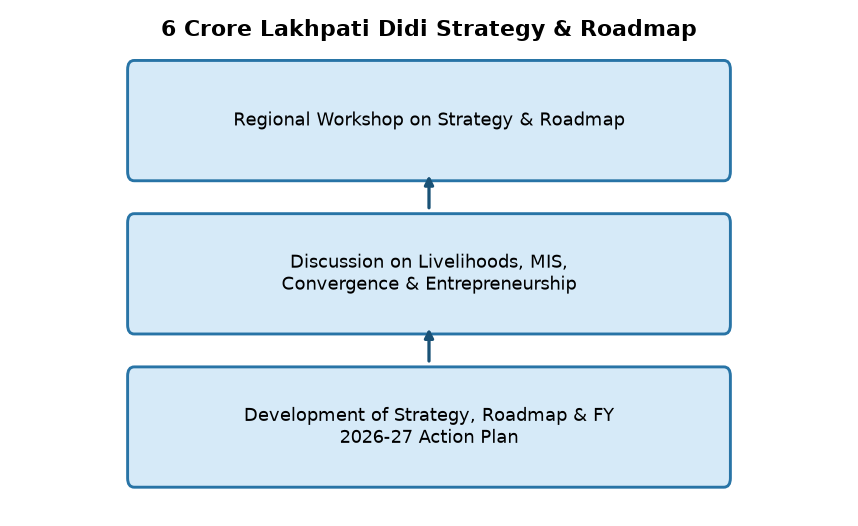
The Ministry of Rural Development, Government of India, in collaboration with the Bihar Rural Livelihoods Promotion Society (JEEViKA), recently organised a two-day regional workshop at the Bihar Institute of Public Administration & Rural Development (BIPARD), Gaya. The workshop focused on formulating a comprehensive strategy and roadmap to achieve the national target of creating 6 crore ‘Lakhpati Didis’ through agricultural, non-agricultural livelihoods, and robust MIS strategies. This significant event brought together key stakeholders to deliberate on long-term strategies for income enhancement, entrepreneurship promotion, and digital management for rural women.
Background
- The ‘Lakhpati Didi’ initiative is a flagship program aimed at empowering rural women by enabling them to earn a sustainable annual income of at least ₹1 lakh.
- It operates under the broader umbrella of the Deendayal Antyodaya Yojana-National Rural Livelihoods Mission (DAY-NRLM), which seeks to reduce poverty by enabling poor households to access gainful self-employment and skilled wage employment opportunities.
- Self-Help Groups (SHGs) form the foundational institutional architecture for the ‘Lakhpati Didi’ initiative, providing a platform for collective action, financial inclusion, and capacity building.
- The initiative focuses on diversifying income sources for rural women, encompassing both farm and non-farm livelihoods, to build resilience and enhance economic stability.
- The target of 6 crore ‘Lakhpati Didis’ signifies a massive scale-up of efforts, aiming for a significant socio-economic transformation across rural India.
- Convergence with various government schemes and market linkages are crucial components for the success and sustainability of the ‘Lakhpati Didi’ model.
What is the ‘Lakhpati Didi’ Initiative?
- The ‘Lakhpati Didi’ initiative is a national campaign under the Deendayal Antyodaya Yojana-National Rural Livelihoods Mission (DAY-NRLM) aimed at economically empowering rural women.
- Its primary objective is to enable at least one woman per household, typically an SHG member, to achieve a sustainable annual income of ₹1,00,000 (one lakh rupees) or more.
- The initiative focuses on enhancing women’s income through a multi-pronged approach, including agricultural livelihoods, non-agricultural enterprises, and skill development.
- It leverages the existing network of Self-Help Groups (SHGs) and their federations, providing them with financial literacy, access to credit, and market linkages.
- Key strategies involve value chain development in various sectors, promotion of entrepreneurship, and adoption of digital tools for better management and monitoring.
- The program emphasizes capacity building, institutional development, and continuous learning processes for women, fostering self-reliance and leadership.
- Convergence with other government schemes and collaboration with development partners are integral to maximizing impact and resource utilization.
- The recent workshop aimed to formulate a detailed strategy and roadmap for achieving the ambitious national target of 6 crore ‘Lakhpati Didis’.
Key Features
| Feature | Significance |
|---|---|
| Targeted Income Threshold | Sets a clear, measurable goal of ₹1 lakh annual income, providing a tangible benchmark for economic empowerment. |
| SHG-centric Approach | Utilizes the established network and social capital of SHGs, fostering collective action, peer learning, and mutual support among women. |
| Diversified Livelihoods | Promotes both agricultural (e.g., improved farming, livestock) and non-agricultural (e.g., handicrafts, services, micro-enterprises) income streams, ensuring resilience. |
| Capacity Building & Skill Development | Invests in training, financial literacy, and entrepreneurial skills, equipping women with the tools to manage and grow their enterprises. |
| Digital Management Information System (MIS) | Enables real-time monitoring, data-driven decision-making, and efficient tracking of progress and impact, ensuring transparency and accountability. |
| Convergence and Market Linkages | Facilitates access to government schemes, credit, raw materials, and markets, crucial for the sustainability and scalability of women’s enterprises. |
Why it Matters
Economic Empowerment and Poverty Alleviation
- Directly addresses rural poverty by ensuring a stable and significant income for women, lifting households out of destitution.
- Promotes financial independence and decision-making power for women within their families and communities, improving household welfare.
- Stimulates local economies through increased production, consumption, and investment by women entrepreneurs, fostering inclusive growth.
Social Transformation and Gender Equality
- Enhances women’s social status, self-confidence, and participation in community governance and decision-making processes.
- Challenges traditional gender roles by showcasing women as successful entrepreneurs and economic contributors.
- Contributes to improved health, education, and nutritional outcomes for families, as empowered women often invest more in these areas.
Rural Development and Sustainable Livelihoods
- Strengthens grassroots institutions like SHGs, making them effective vehicles for development interventions and community mobilization.
- Encourages sustainable practices in agriculture and promotes eco-friendly non-farm enterprises, aligning with broader development goals.
- Reduces distress migration by creating viable livelihood opportunities within rural areas, preserving social fabric and local economies.
National Development Goals
- Directly contributes to India’s commitment to achieving Sustainable Development Goals (SDGs), particularly SDG 1 (No Poverty) and SDG 5 (Gender Equality).
- Bolsters the vision of ‘Atmanirbhar Bharat’ by fostering self-reliance and local entrepreneurship at the village level.
- Showcases India’s potential for large-scale social engineering and poverty reduction through community-led initiatives.
Challenges
1. Scaling and Sustainability
- Achieving the target of 6 crore ‘Lakhpati Didis’ requires unprecedented scale and sustained effort across diverse geographical and socio-economic contexts.
- Ensuring the long-term viability of enterprises beyond initial support, especially in competitive markets, remains a critical challenge.
UPSC Link: GS Paper II — Welfare Schemes; GS Paper III — Inclusive Growth
2. Market Access and Value Chain Integration
- Connecting rural women producers to remunerative markets and integrating them into efficient value chains often faces hurdles like poor infrastructure, lack of information, and exploitation by intermediaries.
- Building robust forward and backward linkages for diverse products and services is complex and resource-intensive.
UPSC Link: GS Paper III — Marketing of Agricultural Produce; Industrial Policy
3. Financial Inclusion and Credit Access
- Despite SHG-bank linkages, many women entrepreneurs still face challenges in accessing adequate and timely credit, particularly for scaling up their ventures.
- Financial literacy and digital payment adoption among all beneficiaries need continuous reinforcement.
UPSC Link: GS Paper III — Financial Inclusion; Mobilization of Resources
4. Capacity Building and Skill Gaps
- Ensuring high-quality, relevant skill development and entrepreneurial training for millions of women with varying literacy levels and prior experience is a monumental task.
- Continuous upgrading of skills to adapt to changing market demands is essential.
UPSC Link: GS Paper II — Human Resource Development; GS Paper III — Skill Development
5. Digital Divide and MIS Implementation
- Bridging the digital divide in rural areas, ensuring access to devices, internet connectivity, and digital literacy for effective use of MIS platforms.
- Maintaining data accuracy, real-time updates, and ensuring data-driven decision-making across all levels of implementation.
UPSC Link: GS Paper III — Digital India; E-governance
6. Convergence and Coordination
- Effective convergence with multiple government departments and schemes (e.g., agriculture, MSME, skill development) requires strong inter-ministerial coordination and seamless implementation at the ground level.
- Avoiding duplication of efforts and ensuring optimal resource utilization across various programs.
UPSC Link: GS Paper II — Government Policies and Interventions
Challenges — UPSC Perspective
| Issue | Concern |
|---|---|
| Market Volatility | Fluctuations in demand and prices for products/services can impact the sustainability of women’s enterprises. |
| Infrastructure Deficiencies | Lack of reliable electricity, transportation, and storage facilities hinders production and market access. |
| Social and Cultural Barriers | Patriarchal norms and mobility restrictions can limit women’s participation in economic activities and access to resources. |
| Quality Control and Standardization | Ensuring consistent quality and adherence to standards for products to compete in broader markets. |
| Risk Mitigation | Protecting women entrepreneurs from business risks, natural calamities, and health shocks through insurance and support systems. |
| Policy Implementation Gaps | Discrepancies between policy intent and ground-level execution due to administrative inefficiencies or lack of awareness. |
Government Initiatives — Must-Memorise for Prelims
- Deendayal Antyodaya Yojana-National Rural Livelihoods Mission (DAY-NRLM)
- Pradhan Mantri Kaushal Vikas Yojana (PMKVY)
- Mahila Kisan Sashaktikaran Pariyojana (MKSP)
- Pradhan Mantri Formalisation of Micro Food Processing Enterprises (PMFME) Scheme
- Mudra Yojana
- Startup Village Entrepreneurship Programme (SVEP)
- National Rural Economic Transformation Project (NRETP)
- Gramin Bhandaran Yojana
- e-NAM (National Agriculture Market)
- Mission Shakti (umbrella scheme for women’s safety and empowerment)
Way Forward
- Strengthen the institutional architecture of SHGs and their federations, empowering them as self-sustaining engines of rural development.
- Invest significantly in advanced skill development and entrepreneurial training, tailored to local market demands and emerging sectors.
- Develop robust value chains for diverse products, ensuring fair prices, quality control, and direct market linkages for women producers.
- Leverage digital platforms and data analytics for real-time monitoring, performance tracking, and evidence-based policy adjustments.
- Foster greater convergence among government schemes and departments to provide holistic support, avoiding fragmentation of efforts.
- Promote financial literacy and digital inclusion to enhance women’s access to credit, insurance, and digital payment systems.
- Encourage innovation and adoption of climate-resilient practices in agriculture and sustainable business models in non-farm sectors.
- Create a supportive ecosystem for women entrepreneurs, including mentorship, incubation support, and access to legal and business advisory services.
UPSC Value Addition
Keywords for Mains Answer-Writing
Lakhpati Didi · Women Empowerment · Rural Livelihoods · DAY-NRLM · Self-Help Groups (SHGs) · Inclusive Growth · Poverty Alleviation · Entrepreneurship Promotion · Value Chain Development · Digital Inclusion · Convergence Strategy · Sustainable Development Goals (SDGs)
Constitutional & Policy Linkages
- Article 39(a): Right to an adequate means of livelihood.
- Article 43: Living wage, etc., for workers.
- Article 46: Promotion of educational and economic interests of weaker sections.
- 73rd and 74th Constitutional Amendment Acts: Decentralization and local self-governance, empowering grassroots institutions.
- National Policy for the Empowerment of Women, 2001: Holistic framework for women’s advancement.
Concept Flow
SHG Formation & Mobilization → Capacity Building & Skill Training → Access to Credit & Financial Inclusion → Livelihood Diversification (Farm/Non-Farm) → Value Chain Integration & Market Linkages → Income Enhancement to ₹1 Lakh/Annum → Socio-Economic Empowerment & Poverty Reduction
Prelims Practice Questions
Q1. With reference to the ‘Lakhpati Didi’ initiative, consider the following statements:
1. It aims to enable rural women to earn an annual income of at least ₹1 lakh.
2. It is implemented under the Pradhan Mantri Jan Dhan Yojana.
3. Self-Help Groups (SHGs) are central to its implementation strategy.
Which of the statements given above is/are correct?
- A. 1 only
- B. 1 and 2 only
- C. 1 and 3 only
- D. 1, 2 and 3
Answer: C. 1 and 3 only — Statement 1 is correct as the core objective of ‘Lakhpati Didi’ is to ensure a sustainable annual income of ₹1 lakh for rural women. Statement 2 is incorrect; the initiative is implemented under the Deendayal Antyodaya Yojana-National Rural Livelihoods Mission (DAY-NRLM), not PMJDY. Statement 3 is correct, as SHGs form the foundational institutional framework for the initiative, facilitating collective action and resource access.
Q2. Which of the following are key components of the strategy for achieving the ‘Lakhpati Didi’ target, as discussed in the recent regional workshop?
1. Promotion of agricultural livelihoods.
2. Emphasis on non-agricultural enterprises.
3. Development of a robust Digital Management Information System (MIS).
4. Exclusive focus on urban women entrepreneurs.
Select the correct answer using the code given below:
- A. 1 and 2 only
- B. 3 and 4 only
- C. 1, 2 and 3 only
- D. 1, 2, 3 and 4
Answer: C. 1, 2 and 3 only — Statements 1, 2, and 3 are correct. The workshop explicitly discussed strategies for agricultural livelihoods, non-agricultural livelihoods, and MIS. Statement 4 is incorrect as the ‘Lakhpati Didi’ initiative is primarily focused on empowering rural women, not urban women entrepreneurs.
Mains Practice Question
✍ The ‘Lakhpati Didi’ initiative represents a significant stride towards women’s economic empowerment and poverty alleviation in rural India. Critically analyse the potential of this initiative to transform rural livelihoods, highlighting the key challenges in its implementation and suggesting measures for its successful scaling and sustainability. (250 words, 15 marks)
Approach: Begin by introducing the ‘Lakhpati Didi’ initiative and its overarching goal under DAY-NRLM. Discuss its potential to transform rural livelihoods by fostering economic independence, social empowerment, and contributing to SDGs. Subsequently, critically analyse the challenges such as market access, financial inclusion, capacity building, and digital divide. Conclude by suggesting concrete measures for successful scaling, ensuring sustainability, and enhancing convergence with other development programs, emphasizing a holistic and community-driven approach.
Source: PIB (Press Information Bureau)
Generated by AanyaAi for educational purpose.

- UPSC Alert: 40-Day ‘Khet Bachao Abhiyan’ Launch by Union Minister - October 22, 2026
- भारत ने बताया UN रिपोर्ट में दाऊद इब्राहिम को ‘भारत-आधारित’ बताना ‘गलत’ - October 22, 2026
- GRAP Stage I activated in Delhi-NCR amid rising AQI: Key actions for aspirants - October 22, 2026

No Comments