


16 Jul ई-वीएसपी पोर्टल: हिंदी में विधिक ज्ञान की डिजिटल पहुंच का विस्तार
Subject Relevance — Where This Topic Fits
- GS Paper II — Governance, Constitution, Polity, Social Justice; Government policies and interventions for development in various sectors and issues arising out of their design and implementation. | GS Paper III — Science and Technology- developments and their applications and effects in everyday life; Indigenization of technology and developing new technology.
- Prelims: E-VSP Portal, Vidhi Sahitya Prakashan, Ministry of Law and Justice, Digital India, Official Language Act, Legal literacy, Access to justice, National Informatics Centre (NIC), Rajbhasha Vibhag, Legislative Department
- Essay: Digital Transformation and its Role in Enhancing Governance and Public Service Delivery, Linguistic Diversity and Inclusivity: Pillars of a Robust Democratic Society
Quick Revision: The e-VSP Portal, launched by the Ministry of Law and Justice, is a digital platform providing online access to Hindi legal literature, crucial for enhancing legal literacy, promoting linguistic inclusivity, and strengthening the Digital India mission.
Why is this in the news?
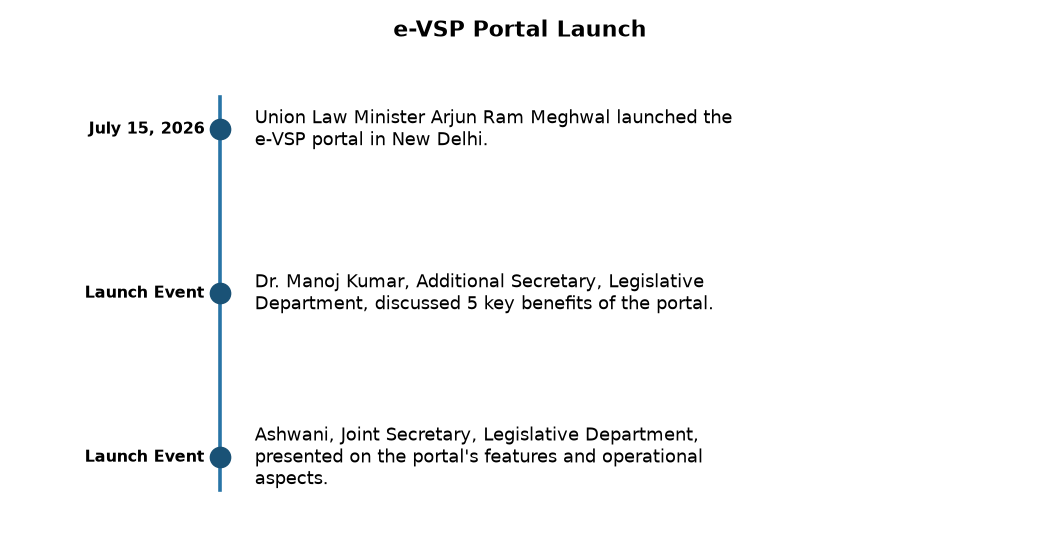
The Union Minister of State (Independent Charge) for Law and Justice, Shri Arjun Ram Meghwal, launched the e-VSP Portal of Vidhi Sahitya Prakashan on July 15, 2026, in New Delhi. This initiative marks a significant stride towards expanding digital access to legal knowledge by making crucial judgments of the Supreme Court and High Courts, legal journals, reference books, and other law-related literature available online in the Hindi language, aligning with the vision of Digital India and promoting citizen-friendly legal discourse.
Background
- India’s legal system, while robust, has historically faced challenges in accessibility for the common citizen, often due to complex legal language and the predominance of English in higher judiciary proceedings.
- The ‘Digital India’ initiative, launched by Prime Minister Shri Narendra Modi, aims to transform India into a digitally empowered society and knowledge economy, emphasizing digital literacy and accessibility of government services.
- The Ministry of Law and Justice, through its various departments, including the Legislative Department and Vidhi Sahitya Prakashan, has been working towards simplifying legal language and promoting the use of Hindi in legal discourse.
- Vidhi Sahitya Prakashan (VSP) has been a key institution responsible for publishing legal literature in Hindi, including judgments, commentaries, and journals, to bridge the linguistic gap.
- The launch of the e-VSP Portal is a culmination of efforts to leverage technology for wider dissemination of this valuable legal content, making it available to a broader audience digitally.
- The move aligns with the broader objective of enhancing legal literacy and ensuring that the legal system is more inclusive and understandable for the general populace, thereby strengthening democratic principles.
What is the E-VSP Portal?
- The e-VSP Portal is a digital platform launched by the Ministry of Law and Justice, Government of India, specifically by Vidhi Sahitya Prakashan.
- It is designed to provide seamless online access to a vast repository of legal literature in the Hindi language.
- The portal hosts significant judgments of the Supreme Court and various High Courts, legal magazines, reference books, and other relevant legal publications.
- It serves as a unified digital platform for law students, teachers, advocates, members of the judiciary, researchers, and other legal stakeholders.
- Users can easily access and download legal journals, law reviews, and reference materials published by Vidhi Sahitya Prakashan.
- The portal is hosted on the domain www.vsp.gov.in and has been developed with technical support from the National Informatics Centre (NIC).
- Its primary objective is to expand the geographical reach of Hindi legal publications and enhance the ease of discovering and obtaining legal knowledge in Hindi.
- The initiative aims to connect Hindi legal publications with a new generation of readers and empower Hindi as a language for legal understanding and professional communication.
Key Features
| Feature | Significance |
|---|---|
| Digital Repository of Hindi Legal Literature | Centralises and provides online access to Supreme Court/High Court judgments, journals, and books in Hindi, overcoming geographical barriers. |
| Seamless Digital Access | Allows law students, teachers, advocates, and researchers to easily obtain and download legal materials from a single platform, enhancing convenience. |
| User-Friendly Interface | Designed for easy navigation and searchability, ensuring that legal information is readily discoverable and usable by all stakeholders. |
| Promotion of Hindi in Legal Discourse | Strengthens Hindi as a language for legal understanding and professional communication, aligning with constitutional provisions for official languages. |
| Expansion of Geographical Reach | Makes Hindi legal publications accessible across India and globally, fostering wider legal literacy beyond traditional print distribution. |
| Support for Digital India Vision | Leverages technology to make government services and knowledge accessible, contributing to a digitally empowered society and knowledge economy. |
Why it Matters
Enhancing Access to Justice and Legal Literacy
- The portal democratises legal knowledge by making complex legal texts and judgments available in Hindi, the language understood by a large segment of the Indian population, thereby bridging the linguistic gap.
- It empowers citizens to better understand their rights and the legal framework, fostering greater legal literacy and enabling more informed participation in the justice system.
- By simplifying access to legal information, it contributes to the constitutional mandate of ensuring ‘justice – social, economic and political’ for all citizens, as enshrined in the Preamble.
Strengthening the Digital India Initiative
- The e-VSP portal is a tangible manifestation of the ‘Digital India’ vision, leveraging technology to deliver public services and information effectively.
- It promotes digital inclusion by ensuring that legal resources are not confined to physical libraries but are available online, even in remote areas with internet connectivity.
- This initiative exemplifies the government’s commitment to using digital platforms for governance, knowledge dissemination, and citizen empowerment.
Promoting Linguistic Inclusivity and Cultural Heritage
- By emphasising the use of simple, accessible Hindi in the legal domain, the portal promotes linguistic inclusivity and respects India’s diverse linguistic landscape.
- It helps in preserving and promoting India’s rich cultural heritage and civilisational values by linking legal literature with the nation’s constitutional ethos and cultural traditions.
- This initiative aligns with the spirit of Article 343 of the Constitution, which designates Hindi in Devanagari script as the official language of the Union, and efforts to promote its use.
Benefiting Legal Professionals and Academia
- Law students, teachers, advocates, and researchers gain unprecedented access to a wealth of Hindi legal literature, facilitating research, education, and professional development.
- The portal streamlines the process of finding and utilising legal references, enhancing efficiency and productivity for legal practitioners and academics.
- It creates a broader ecosystem for the development of Hindi legal publications, encouraging more scholarly work and contributions in the language.
Challenges
1. Digital Divide and Internet Penetration
- Despite significant progress, a substantial portion of India’s population, especially in rural and remote areas, still lacks reliable internet access or digital literacy.
- This digital divide could limit the portal’s reach, preventing those most in need of accessible legal information from utilising it fully.
UPSC Link: GS Paper II — Social Justice (issues relating to development and management of Social Sector/Services relating to Health, Education, Human Resources)
2. Quality and Standardisation of Translations
- Translating complex legal terminology and nuances from English to Hindi accurately and consistently is a significant challenge.
- Ensuring the quality, precision, and standardisation of translated legal content is crucial to maintain its authoritative value and avoid misinterpretations.
UPSC Link: GS Paper II — Governance (transparency and accountability and institutional and other measures)
3. User Adoption and Awareness
- Despite the portal’s launch, widespread awareness among the target audience (citizens, legal professionals) about its existence and utility is essential.
- Encouraging adoption, especially among those accustomed to traditional methods of legal research or English-centric legal education, requires sustained effort.
UPSC Link: GS Paper II — Government policies and interventions for development in various sectors
4. Maintenance and Updates
- The legal landscape is dynamic, with new judgments, amendments, and legal literature constantly emerging.
- Regular and timely updates of the portal with the latest legal information, along with robust technical maintenance, are critical for its continued relevance and reliability.
UPSC Link: GS Paper III — Science and Technology (developments and their applications)
5. Interoperability and Integration
- Integrating the e-VSP portal with other existing legal databases, e-courts initiatives, and digital governance platforms could enhance its utility.
- Lack of seamless interoperability might create silos of information, hindering a holistic digital legal ecosystem.
UPSC Link: GS Paper III — Science and Technology (IT and Computers)
Challenges — UPSC Perspective
| Issue | Concern |
|---|---|
| Digital Divide | Limited internet access and digital literacy in rural areas restrict portal’s reach. |
| Translation Accuracy | Ensuring precise and consistent translation of complex legal terms from English to Hindi. |
| User Awareness | Lack of widespread knowledge about the portal’s existence and benefits among target users. |
| Content Updates | Keeping the portal regularly updated with the latest judgments, laws, and legal literature. |
| Technical Maintenance | Ensuring robust and continuous technical support and security for the digital platform. |
| Linguistic Nuances | Addressing the challenge of conveying subtle legal distinctions effectively in Hindi. |
Government Initiatives — Must-Memorise for Prelims
- Digital India Programme
- e-Courts Project
- National Judicial Data Grid (NJDG)
- Tele-Law Scheme
- Nyaya Bandhu (Pro Bono Legal Services) Scheme
- Legal Services Authorities Act, 1987
- Official Languages Act, 1963
- National e-Governance Plan (NeGP)
- UMANG (Unified Mobile Application for New-age Governance)
- BHASHINI (BHASHa INterface for India)
Way Forward
- Launch comprehensive awareness campaigns, utilising both digital and traditional media, to inform citizens and legal professionals about the e-VSP portal’s availability and benefits.
- Invest in digital literacy initiatives, especially in rural and underserved areas, to equip more citizens with the skills to access and utilise online legal resources.
- Establish a robust mechanism for quality control and standardisation of Hindi legal translations, possibly involving expert committees and AI-powered translation tools.
- Ensure regular and timely updates of the portal with the latest judgments, legislative amendments, and legal commentaries to maintain its relevance and utility.
- Explore integration and interoperability with other digital legal platforms, such as e-Courts and NJDG, to create a seamless and comprehensive digital legal ecosystem.
- Incorporate user feedback mechanisms to continuously improve the portal’s interface, content, and functionality, making it more citizen-centric.
- Promote collaborative efforts between the Ministry of Law and Justice, academic institutions, and legal professionals to enrich the portal’s content and foster legal research in Hindi.
- Consider expanding the portal’s linguistic scope to include other regional languages, where feasible, to further enhance access to justice across diverse linguistic groups.
UPSC Value Addition
Keywords for Mains Answer-Writing
Digital India · Access to Justice · Legal Literacy · Linguistic Inclusivity · Governance Reforms · Citizen-Centric Services · Judicial Reforms · Official Language Policy · E-Governance · Knowledge Economy · Cultural Preservation · Democratic Principles
Constitutional & Policy Linkages
- Article 39A: Equal Justice and Free Legal Aid
- Article 343: Official Language of the Union (Hindi)
- Article 348: Language to be used in the Supreme Court and in the High Courts
- Preamble: Justice – social, economic and political
- Official Languages Act, 1963: Provides for the languages which may be used for the official purposes of the Union
- Digital India Programme: Government’s flagship programme to transform India into a digitally empowered society and knowledge economy.
Concept Flow
Complex Legal Language/English Dominance → Limited Legal Literacy/Access to Justice → Digital India Vision/Need for Inclusivity → Ministry of Law & Justice/Vidhi Sahitya Prakashan Initiative → E-VSP Portal Launch (Hindi Legal Content Online) → Enhanced Legal Literacy/Access to Justice → Strengthened Governance/Digital Empowerment
Prelims Practice Questions
Q1. With reference to the recently launched e-VSP Portal, consider the following statements:
1. The portal has been launched by the Ministry of Law and Justice.
2. It aims to provide digital access to legal literature exclusively in English.
3. The portal includes significant judgments of the Supreme Court and High Courts.
Which of the statements given above is/are correct?
- A. 1 only
- B. 1 and 3 only
- C. 2 and 3 only
- D. 1, 2 and 3
Answer: B. 1 and 3 only — Statement 1 is correct: The e-VSP Portal was launched by the Ministry of Law and Justice. Statement 2 is incorrect: The portal aims to provide digital access to legal literature primarily in Hindi. Statement 3 is correct: It includes important judgments from the Supreme Court and High Courts, along with other legal publications.
Q2. The e-VSP Portal is a significant step towards achieving the objectives of which of the following government initiatives?
1. Digital India
2. Make in India
3. Skill India
4. Swachh Bharat Abhiyan
Select the correct answer using the code given below:
- A. 1 only
- B. 1 and 2 only
- C. 2 and 3 only
- D. 1, 3 and 4
Answer: A. 1 only — The e-VSP Portal directly aligns with the ‘Digital India’ initiative by leveraging technology to provide digital access to legal knowledge and promote a digitally empowered society. While ‘Make in India’ and ‘Skill India’ are important government initiatives, the primary objective and impact of the e-VSP portal are most closely related to ‘Digital India’.
Mains Practice Question
✍ The launch of the e-VSP Portal marks a significant stride towards democratising legal knowledge and enhancing access to justice in India. Discuss the multi-faceted significance of this initiative, critically evaluating the challenges that might impede its full potential. Suggest a comprehensive way forward to ensure its effective implementation and broader impact. (250 words)
Approach: Begin by introducing the e-VSP Portal and its primary objective. In the first part, elaborate on its significance, focusing on aspects like enhancing legal literacy, strengthening Digital India, promoting linguistic inclusivity, and benefiting legal professionals. In the second part, critically evaluate the challenges, such as the digital divide, translation quality, user adoption, and maintenance issues. Conclude with a comprehensive way forward, suggesting measures like awareness campaigns, digital literacy drives, quality control mechanisms, and integration with other digital platforms to maximise its impact.
Source: PIB (Press Information Bureau)

- झारखंड का 1.36 लाख करोड़ का बकाया खत्म! केंद्र बनाम राज्य अब सुप्रीम कोर्ट में - September 14, 2026
- Jharkhand’s ₹1.36 Lakh Crore Dues: Supreme Court Battle Over MMDRA Amendment - September 14, 2026
- गुजरात में स्थापित होंगे भारत के 12 सेमीकंडक्टर संयंत्रों में से 6, जानिए कैसे? - September 14, 2026

No Comments