


27 Jul Lok Sabha Introduces Bill to Curb Paper Leak Scams: Key Provisions Explained
Subject Relevance — Where This Topic Fits
- GS Paper II — Governance, Constitution, Polity, Social Justice and International Relations | GS Paper III — Security Challenges and their Management
- Prelims: Public Examinations (Prevention of Unfair Means) Act, 2024, Fast-track courts, Special Task Force (STF), NEET-UG 2026, Union Public Service Commission (UPSC) reforms
- Essay: The erosion of institutional trust in competitive examinations: Causes and remedies
Quick Revision: The Public Examinations (Prevention of Unfair Means) Amendment Bill, 2026, introduces fast-track courts, expedited trials, and enhanced penalties to combat paper leaks and restore trust in competitive examinations.
Why is this in the news?
The introduction of the Public Examinations (Prevention of Unfair Means) Amendment Bill, 2026, in the Lok Sabha on July 27, 2026, marks a legislative response to the recurring issue of examination paper leaks, notably the NEET-UG 2026 controversy. The Bill seeks to amend the existing 2024 Act by introducing stringent measures, including fast-track courts, enhanced penalties, and expedited trials, to restore public confidence in the examination system amidst widespread protests and demands for systemic reforms.
Background
- The Public Examinations (Prevention of Unfair Means) Act, 2024, was enacted to address malpractices such as paper leaks, impersonation, and other unfair means in public examinations conducted by bodies like UPSC, SSC, and NTA.
- The 2024 Act prescribed penalties ranging from imprisonment of up to 10 years to fines of ₹1 crore, but its implementation faced challenges due to procedural delays and lack of dedicated mechanisms for speedy trials.
- The NEET-UG 2026 controversy, involving allegations of paper leaks and irregularities, triggered nationwide protests by students and opposition parties, demanding accountability and systemic reforms in the examination process.
- The Bill reflects a broader discourse on institutional integrity, transparency, and the need for robust mechanisms to prevent malpractices in competitive examinations.
- Parliamentary proceedings on the Bill occurred amid disruptions, underscoring the political and social urgency of the issue.
What is the Public Examinations (Prevention of Unfair Means) Amendment Bill, 2026?
- The Bill seeks to amend the Public Examinations (Prevention of Unfair Means) Act, 2024, to introduce stricter measures against paper leaks and other malpractices in public examinations.
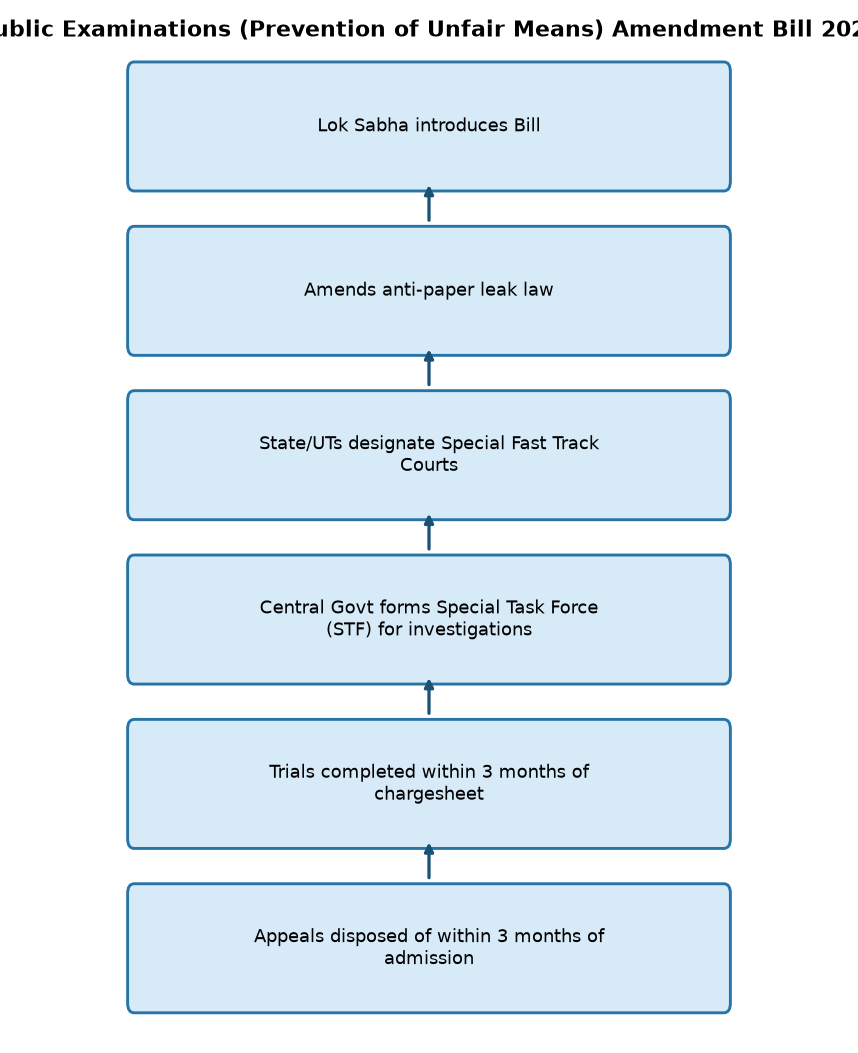
- Key provisions include the establishment of fast-track courts in States and Union Territories to ensure speedy trials, with proceedings to be conducted on a day-to-day basis and trials completed within three months of chargesheet filing.
- The Bill empowers State Governments and Union Territory Administrations to designate any Court of Session as a Special Fast Track Court for trying offences under the Act.
- A Special Task Force (STF) may be constituted by the Central Government to investigate offences under the Act, with investigations to be completed within two months.
- The Bill enhances penalties, including imprisonment terms and fines, for offences committed under the Act, reflecting a zero-tolerance approach to malpractices.
- State Governments and Union Territories are empowered to appoint Special Public Prosecutors for conducting cases under the Act, ensuring dedicated legal representation.
- An appeal mechanism is proposed, wherein appeals against judgments, sentences, or orders would lie before a Division Bench of the High Court and be disposed of within three months of admission.
- The Bill aims to address the erosion of public trust in examination systems by ensuring accountability, transparency, and swift justice in cases of malpractice.
Key Features
| Feature | Significance |
|---|---|
| Fast-track courts in States | Ensures speedy trials for paper leak cases, reducing pendency and enhancing deterrence. |
| Mandatory day-to-day proceedings | Expedites trial completion, ensuring timely justice and reducing delays. |
| Three-month trial completion | Imposes strict timelines for trials, preventing prolonged legal battles. |
| Central Special Task Force (STF) | Facilitates coordinated multi-state investigations into large-scale paper leaks. |
| Two-month investigation deadline | Accelerates probe completion, ensuring swift action against offenders. |
Why it Matters
Institutional Integrity
- Strengthens public trust in examination systems, particularly for competitive exams like NEET-UG and UPSC.
- Deters malpractices by imposing stringent penalties and expedited legal processes.
- Aligns with constitutional values of fairness and equality in public examinations.
Governance and Accountability
- Enhances State and Union Territory capacity to prosecute paper leak cases through designated courts and prosecutors.
- Centralizes investigative authority via STF for inter-state or large-scale leaks.
- Reduces systemic vulnerabilities in examination conduct.
Economic Impact
- Minimizes disruptions to human capital development by ensuring merit-based selection processes.
- Reduces financial losses from re-conducted exams and legal proceedings.
Challenges
1. Implementation Delays
- State-level coordination may hinder the establishment of fast-track courts and STF activation.
- Judicial infrastructure constraints could delay the operationalization of designated courts.
UPSC Link: Judicial reforms and pendency
2. Evidentiary Challenges
- Proving paper leaks often requires digital forensics and multi-agency collaboration, which may be resource-intensive.
- False accusations or political interference could undermine the efficacy of the Act.
UPSC Link: Forensic science in investigations
3. Protest Dynamics
- Student and Opposition mobilizations may escalate, necessitating calibrated responses from authorities.
- Balancing stringent measures with student grievances requires sensitive handling.
UPSC Link: Right to Protest vs Public Order
4. Technological Vulnerabilities
- Digitization of exams introduces new risks (e.g., hacking, data breaches) that the Act must address.
- Cybersecurity measures need strengthening to prevent remote leaks.
UPSC Link: Cybersecurity and governance
Challenges — UPSC Perspective
| Issue | Concern |
|---|---|
| State-Judiciary Coordination | Delays in designating fast-track courts due to administrative bottlenecks. |
| Digital Forensics Capacity | Limited expertise in tracing electronic leaks and evidence preservation. |
| Political Interference | Risk of pressure on investigating agencies or prosecutors. |
| Resource Allocation | States may lack funds or personnel to operationalize STF and special courts. |
| Public Perception | Perceived bias in enforcement could erode trust in the system. |
Way Forward
- Constitute State-level nodal agencies to oversee fast-track court appointments and STF activation.
- Develop standardized protocols for digital evidence collection and forensic analysis.
- Launch awareness campaigns to educate stakeholders on the amended Act’s provisions.
- Strengthen cybersecurity frameworks for examination authorities to prevent digital leaks.
- Establish a grievance redressal mechanism for students to report irregularities transparently.
- Conduct periodic audits of examination centers to identify systemic vulnerabilities.
- Ensure judicial capacity-building through training programs on handling paper leak cases.
- Collaborate with educational institutions to foster a culture of integrity and meritocracy.
UPSC Value Addition
Keywords for Mains Answer-Writing
Public Examinations (Prevention of Unfair Means) Act, 2024 · paper leak menace · examination integrity · fast-track courts · Special Task Force (STF) · Special Public Prosecutors · appeal mechanism under High Courts · institutional credibility · examination reforms · NEET-UG 2026 · examination malpractices · judicial reforms in examination cases
Constitutional & Policy Linkages
- Article 14 (Right to Equality) – Ensures fair and unbiased examination processes.
- Article 21 (Right to Life and Personal Liberty) – Protects against arbitrary delays in justice delivery.
- Article 39A (Equal Justice and Free Legal Aid) – Mandates fair trials for all accused.
- Article 51A (Fundamental Duties) – Upholds the duty to promote scientific temper and integrity.
Concept Flow
Examination irregularities (e.g., NEET-UG paper leaks) → Public outrage and protests → Government introduces amendments to anti-paper leak law → Establishment of fast-track courts and STF → Expedited trials and stricter penalties → Restoration of institutional trust and meritocracy.
Prelims Practice Questions
Q1. Which of the following provisions is NOT included in the Public Examinations (Prevention of Unfair Means) Amendment Bill, 2026?
- A. Empowering State Governments to designate Special Fast Track Courts for trial of offences
- B. Mandating trials to be completed within three months from the date of filing of the chargesheet
- C. Allowing the Central Government to constitute a Special Task Force (STF) for investigation
- D. Introducing provisions for online conduct of all public examinations
Answer: D. Introducing provisions for online conduct of all public examinations — The Amendment Bill focuses on stricter measures against paper leaks and examination malpractices, including fast-track courts and STF, but does not mandate online conduct of examinations as a general provision.
Q2. Under the proposed amendments to the Public Examinations (Prevention of Unfair Means) Act, 2024, what is the maximum time limit prescribed for completion of investigations in paper leak cases?
- A. One month
- B. Two months
- C. Three months
- D. Six months
Answer: B. Two months — The Bill mandates that investigations into paper leak cases must be completed within two months, as specified in the proposed amendments.
Q3. Which of the following is a key objective of the Public Examinations (Prevention of Unfair Means) Amendment Bill, 2026?
- A. To reduce the syllabus burden on students
- B. To enhance punishment for offences related to paper leaks and examination malpractices
- C. To increase the number of examination centres
- D. To promote private examination conducting agencies
Answer: B. To enhance punishment for offences related to paper leaks and examination malpractices — The primary objective of the Amendment Bill is to strengthen the legal framework against paper leaks and examination malpractices by enhancing punishments and expediting trials.
Mains Practice Question
✍ Examine the significance of the Public Examinations (Prevention of Unfair Means) Amendment Bill, 2026, in addressing the menace of paper leaks in public examinations. Discuss the institutional reforms proposed in the Bill and their potential impact on maintaining the integrity of examination systems in India.
Approach: The candidate should first contextualise the issue of paper leaks and their socio-economic implications, citing recent incidents like NEET-UG 2026. Next, analyse the key provisions of the Amendment Bill, including the establishment of fast-track courts, Special Task Force (STF), Special Public Prosecutors, and appeal mechanisms. Highlight the importance of these reforms in restoring public trust in examination systems. Conclude by discussing the challenges in implementation and the need for a multi-stakeholder approach, including technological and administrative measures, to ensure long-term integrity.
Source: The Hindu
Generated by AanyaAi for educational purpose.

- दिल्ली में 99% पीजी में नहीं है फायर एनओसी, 30% को नहीं मिला लेआउट अप्रूवल: एमसीडी सर्वे - September 15, 2026
- महत्वपूर्ण: MSC एल्सा 3 जहाज के डूबने के दीर्घकालिक प्रभावों का आकलन करेगा केंद्र, जानिए पूरा मामला - September 15, 2026
- केरल की इकोसेंस छात्रवृत्तियां: 46,000 छात्रों को अपशिष्ट प्रबंधन में सशक्त बना रही हैं - September 14, 2026

No Comments