


27 Jul Lok Sabha Introduces Bill to Curb Paper Leak Scams: Key Provisions Explained
Subject Relevance — Where This Topic Fits
- GS Paper II — Governance, Transparency and Accountability | GS Paper III — Security Challenges and their Management in Border Areas, Linkages of Organised Crime with Terrorism
- Prelims: Public Examinations (Prevention of Unfair Means) Act, 2024, Fast-track courts, Special Task Force (STF), NEET-UG, Union Public Service Commission (UPSC), Staff Selection Commission (SSC), Central Bureau of Investigation (CBI), Section 120B of the Indian Penal Code (IPC), Section 420 of the Indian Penal Code (IPC), Constitution of India, Article 14 (Right to Equality), Constitution of India, Article 21 (Right to Life and Personal Liberty), Constitution of India, Article 32 (Writs)
- Essay: The erosion of trust in public institutions: Causes and remedies, Balancing accountability and efficiency in governance: The case of examination reforms
Quick Revision: The Public Examinations (Prevention of Unfair Means) Amendment Bill, 2026 introduces fast-track courts, expedited investigations, and enhanced penalties to curb paper leaks and restore trust in India’s examination systems.
Why is this in the news?
The Public Examinations (Prevention of Unfair Means) Amendment Bill, 2026 was introduced in the Lok Sabha on 27 July 2026, following widespread public outrage over the alleged leakage of the NEET-UG 2026 question paper and other examination irregularities. The Bill seeks to amend the two-year-old Public Examinations (Prevention of Unfair Means) Act, 2024 by introducing stricter provisions, including the establishment of fast-track courts, enhanced penalties, and expedited investigations to restore institutional credibility and deter malpractices in public examinations conducted by bodies such as the National Testing Agency (NTA) and UPSC.
Background
- The Public Examinations (Prevention of Unfair Means) Act, 2024 was enacted to address the growing menace of paper leaks and other unfair means in public examinations, which undermine the meritocratic foundation of India’s recruitment and admission processes.
- Examination irregularities, particularly in NEET-UG and other high-stakes tests, have repeatedly sparked nationwide protests, eroding public trust in the integrity of India’s examination systems and institutions.
- The Bill is introduced in the context of sustained parliamentary disruptions and demands for systemic reforms in the examination evaluation process, including greater transparency and accountability in the functioning of bodies like the NTA.
- Historically, paper leaks have been linked to organised crime syndicates, touts, and corrupt officials, necessitating a multi-agency response and stringent legal provisions to curb such activities.
- The amendment reflects a broader trend of legislative intervention to address governance deficits in public institutions, aligning with the constitutional mandate for fair and transparent processes.
What is the Public Examinations (Prevention of Unfair Means) Amendment Bill, 2026?
- The Bill seeks to amend the Public Examinations (Prevention of Unfair Means) Act, 2024, to introduce stricter measures against paper leaks and other unfair practices in public examinations conducted by central and state authorities.
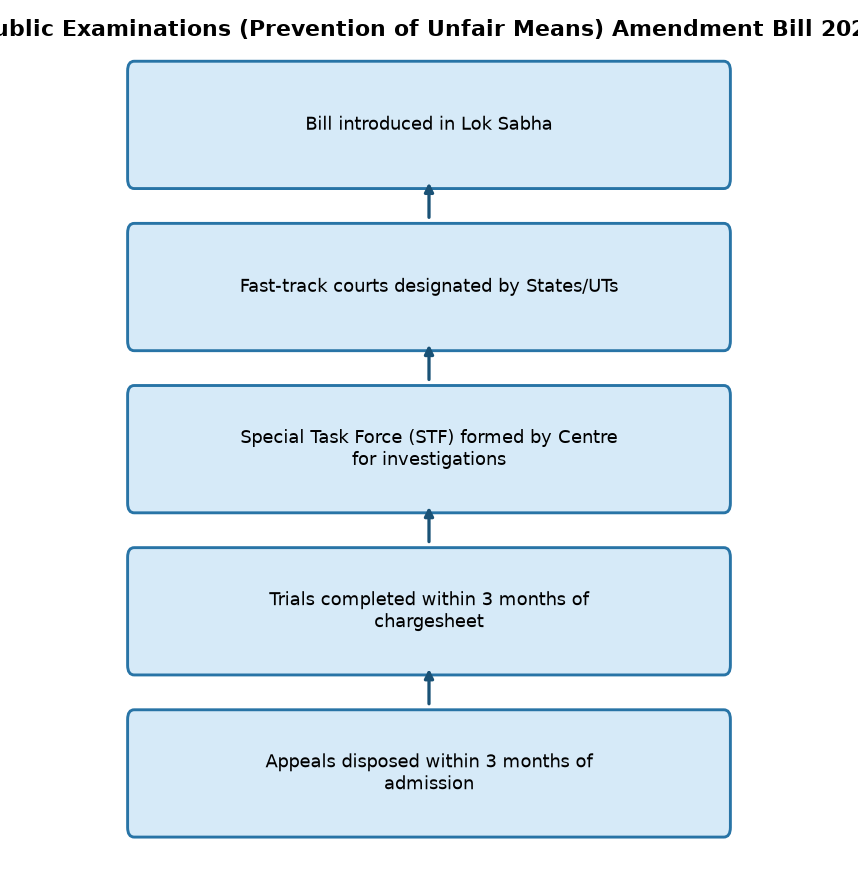
- Key provisions include the establishment of Special Fast Track Courts in every state and union territory to expedite trials of accused individuals, with proceedings to be conducted on a day-to-day basis and trials to be completed within three months of chargesheet filing.
- The Bill empowers the central government to constitute a Special Task Force (STF) for investigating offences under the Act, with a mandate to complete investigations within two months of registration.
- State governments and union territory administrations are authorised to appoint Special Public Prosecutors to handle cases under the Act, ensuring dedicated legal representation for expeditious justice.
- Penalties for offences under the Act are enhanced, with imprisonment terms and fines increased to deter malpractices.
- An appeal mechanism is introduced, allowing appeals against judgments, sentences, or orders to be filed before a Division Bench of the High Court, with a stipulated timeline of three months for disposal of such appeals.
- The Bill underscores the importance of institutional integrity and the need for a robust legal framework to safeguard the sanctity of public examinations, which are critical for merit-based recruitment and admissions.
- The amendments are a legislative response to recurring examination irregularities, particularly in NEET-UG and other high-stakes tests, which have eroded public trust in the examination system.
Key Features
| Feature | Significance |
|---|---|
| Designation of Fast-Track Courts | Ensures expeditious trials by empowering State Governments to designate Sessions Courts as Special Fast-Track Courts, reducing judicial delays in paper leak cases. |
| Day-to-Day Proceedings & Timeline | Mandates continuous hearings and completion of trials within three months of chargesheet filing, enhancing judicial efficiency and deterring malpractices. |
| Special Task Force (STF) | Empowers the Central Government to constitute an STF for investigating offences under the Act, ensuring coordinated and specialized enforcement against organised malpractices. |
| Investigation Timeline | Prescribes a two-month deadline for completing investigations into paper leak cases, reducing procedural bottlenecks and expediting justice. |
| Enhanced Punitive Provisions | Increases terms of imprisonment and fines for offences under the Act, serving as a stronger deterrent against unfair means in public examinations. |
Why it Matters
Institutional Integrity
- Strengthens public trust in examination systems by addressing systemic vulnerabilities exposed in recent NEET-UG paper leak controversies.
- Reinforces the credibility of competitive examinations that serve as gateways for admissions and recruitments across sectors.
- Demonstrates a proactive legislative response to recurring malpractices, aligning with the constitutional mandate of equality in opportunity.
Judicial Efficiency
- Introduces time-bound judicial processes to prevent prolonged litigation, a critical step in restoring faith in the justice delivery system.
- Reduces pendency of cases related to examination malpractices, which have historically suffered from procedural delays.
- Establishes a precedent for expedited trials in other areas of governance where time-sensitive justice is essential.
Governance & Accountability
- Enhances the role of State Governments in ensuring fair conduct of examinations within their jurisdictions.
- Centralizes investigative authority through the STF, ensuring uniformity in enforcement and reducing jurisdictional conflicts.
- Introduces Special Public Prosecutors to streamline prosecution, addressing resource constraints in handling complex cases.
Social Impact
- Mitigates the disproportionate impact of examination malpractices on marginalized and aspirational sections of society.
- Reduces the psychological and economic burden on students who face prolonged uncertainty due to delayed justice in leak cases.
- Promotes a culture of meritocracy by ensuring that examinations remain a fair and transparent mechanism for selection.
Challenges
1. Implementation Bottlenecks
- Coordination challenges between State Governments, Central agencies, and judicial bodies may delay the establishment of Fast-Track Courts.
- Resource constraints, including judicial manpower and infrastructure, could hinder the operationalization of time-bound trials.
- Potential resistance from vested interests, including examination authorities and organised networks involved in malpractices.
UPSC Link: GS-II: Judiciary – Judicial Reforms
2. Legal Ambiguities
- Clarity required on the definition of ‘unfair means’ to avoid subjective interpretations and ensure uniform application of the law.
- Need for safeguards against misuse of the law, particularly in cases of false allegations or politically motivated prosecutions.
- Potential conflicts with existing state laws on examination conduct, requiring harmonization to avoid legal inconsistencies.
UPSC Link: GS-II: Centre-State Relations
3. Technological & Operational Gaps
- Dependence on traditional investigative methods may prove inadequate against sophisticated digital malpractices, such as hacking or data leaks.
- Lack of standardized protocols for digital forensics and cybersecurity in examination systems could undermine enforcement.
- Need for robust IT infrastructure in examination bodies to prevent leaks and ensure secure conduct of examinations.
UPSC Link: GS-III: Science & Technology – Cybersecurity
4. Public Perception & Trust
- Sustained public skepticism towards examination bodies may persist despite legislative reforms, necessitating transparent reforms in examination conduct.
- Risk of perception that the law is reactive rather than preventive, failing to address root causes of malpractices.
- Requirement for continuous monitoring and third-party audits to demonstrate tangible improvements in examination integrity.
UPSC Link: GS-II: Transparency & Accountability
Challenges — UPSC Perspective
| Issue | Concern |
|---|---|
| Judicial Capacity | Insufficient number of judges and infrastructure to handle the additional caseload of Fast-Track Courts. |
| Inter-State Coordination | Lack of standardized protocols for investigation and prosecution across State jurisdictions. |
| Digital Vulnerabilities | Examination systems remain susceptible to cyber threats, including hacking and data breaches. |
| False Positives | Risk of wrongful prosecutions due to ambiguous definitions of ‘unfair means’ or misinterpretation of evidence. |
| Public Trust Deficit | Long-standing skepticism towards examination bodies may undermine the efficacy of the new law. |
| Resource Allocation | State Governments may face fiscal challenges in allocating funds for Special Public Prosecutors and Fast-Track Courts. |
Way Forward
- Constitute State-level committees to oversee the establishment and functioning of Fast-Track Courts, ensuring accountability and resource allocation.
- Develop a national framework for digital forensic standards to address cyber threats in examination systems, in collaboration with CERT-In.
- Launch a public awareness campaign to educate stakeholders—students, parents, and examination bodies—on the provisions of the amended Act.
- Establish a grievance redressal mechanism for students and institutions to report irregularities, ensuring timely intervention.
- Conduct periodic third-party audits of examination bodies to assess compliance with security protocols and identify vulnerabilities.
- Strengthen the role of the STF by providing specialized training in cybercrime investigation and forensic analysis.
- Introduce a whistleblower protection mechanism to encourage insiders to report malpractices without fear of retaliation.
- Harmonize state laws with the amended Act to avoid legal conflicts and ensure uniform enforcement across jurisdictions.
UPSC Value Addition
Keywords for Mains Answer-Writing
Public Examinations (Prevention of Unfair Means) Act, 2024 · NEET-UG paper leak controversy · examination reforms in India · fast-track courts for paper leak cases · Special Task Force for investigation · institutional integrity in examinations · Public Examinations (Prevention of Unfair Means) Amendment Bill, 2026 · appointment of Special Public Prosecutors · appeal mechanism under examination laws · accountability in public examinations
Constitutional & Policy Linkages
- Article 14: Equality before law and equal protection of laws in examination processes.
- Article 21: Right to fair trial and dignity in the context of examination integrity and judicial timelines.
- Article 38: State’s obligation to promote welfare and reduce inequalities in access to opportunities.
Concept Flow
Examination malpractices (e.g., paper leaks) → Loss of public trust in institutional integrity → Legislative response (Public Examinations Act Amendment) → Establishment of Fast-Track Courts and STF → Expedited trials and investigations → Deterrence against future malpractices → Restoration of trust in examination systems.
Prelims Practice Questions
Q1. Which of the following provisions is NOT included in the Public Examinations (Prevention of Unfair Means) Amendment Bill, 2026?
- Constitution of a Special Task Force by the Central Government for investigation of offences.
- Mandatory completion of trials within three months from the date of filing of the chargesheet.
- Appointment of Special Public Prosecutors by State Governments for cases under the Act.
- Provision for a national-level committee to conduct all public examinations.
Answer: Provision for a national-level committee to conduct all public examinations. — The Bill proposes a Special Task Force, fast-track trials, and appointment of Special Public Prosecutors, but does not include a provision for a national-level committee to conduct examinations. The latter is not part of the Bill’s scope.
Q2. Under the proposed amendments to the Public Examinations (Prevention of Unfair Means) Act, 2024, appeals against judgments in paper leak cases will lie before:
- The Supreme Court of India.
- A Division Bench of the High Court.
- The Union Public Service Commission.
- The Central Bureau of Investigation.
Answer: A Division Bench of the High Court. — The Bill specifies that appeals against judgments, sentences, or orders under the Act shall lie before a Division Bench of the High Court, with disposal mandated within three months of admission.
Mains Practice Question
✍ Critically examine the efficacy of the Public Examinations (Prevention of Unfair Means) Amendment Bill, 2026, in addressing the recurring issue of paper leaks in India’s examination system. How does the Bill balance the need for stringent penalties with procedural safeguards for accused individuals?
Approach: Begin with the context of paper leaks, citing recent controversies such as NEET-UG 2026. Analyse the key provisions of the Bill, including fast-track courts, Special Task Force, and enhanced penalties. Evaluate the Bill’s potential to deter malpractice while ensuring fair trial rights. Conclude with suggestions for further reforms, such as technological interventions (AI-based proctoring) and decentralised examination bodies.
Source: The Hindu
Generated by AanyaAi for educational purpose.

- दिल्ली में 99% पीजी में नहीं है फायर एनओसी, 30% को नहीं मिला लेआउट अप्रूवल: एमसीडी सर्वे - September 15, 2026
- महत्वपूर्ण: MSC एल्सा 3 जहाज के डूबने के दीर्घकालिक प्रभावों का आकलन करेगा केंद्र, जानिए पूरा मामला - September 15, 2026
- केरल की इकोसेंस छात्रवृत्तियां: 46,000 छात्रों को अपशिष्ट प्रबंधन में सशक्त बना रही हैं - September 14, 2026

No Comments