


29 Jul Lok Sabha Introduces Bill to Tighten Delayed Birth & Death Registrations
Subject Relevance — Where This Topic Fits
- GS Paper II — Constitutional and Statutory Bodies | GS Paper III — Government Policies and Interventions for Development in various sectors
- Prelims: Registration of Births and Deaths Act, 1969, District Magistrate (DM), Judicial Magistrate, Executive Magistrate, Civil Registration System (CRS), National Population Register (NPR), Aadhaar, Unique Identification Authority of India (UIDAI)
- Essay: The role of administrative efficiency in public service delivery: A case study of civil registration systems
Quick Revision: The Registration of Births and Deaths (Amendment) Bill, 2026, introduces a two-tier approval mechanism for delayed registrations, requiring judicial magistrate approval for delays exceeding two years to enhance scrutiny and reduce fraud.
Why is this in the news?
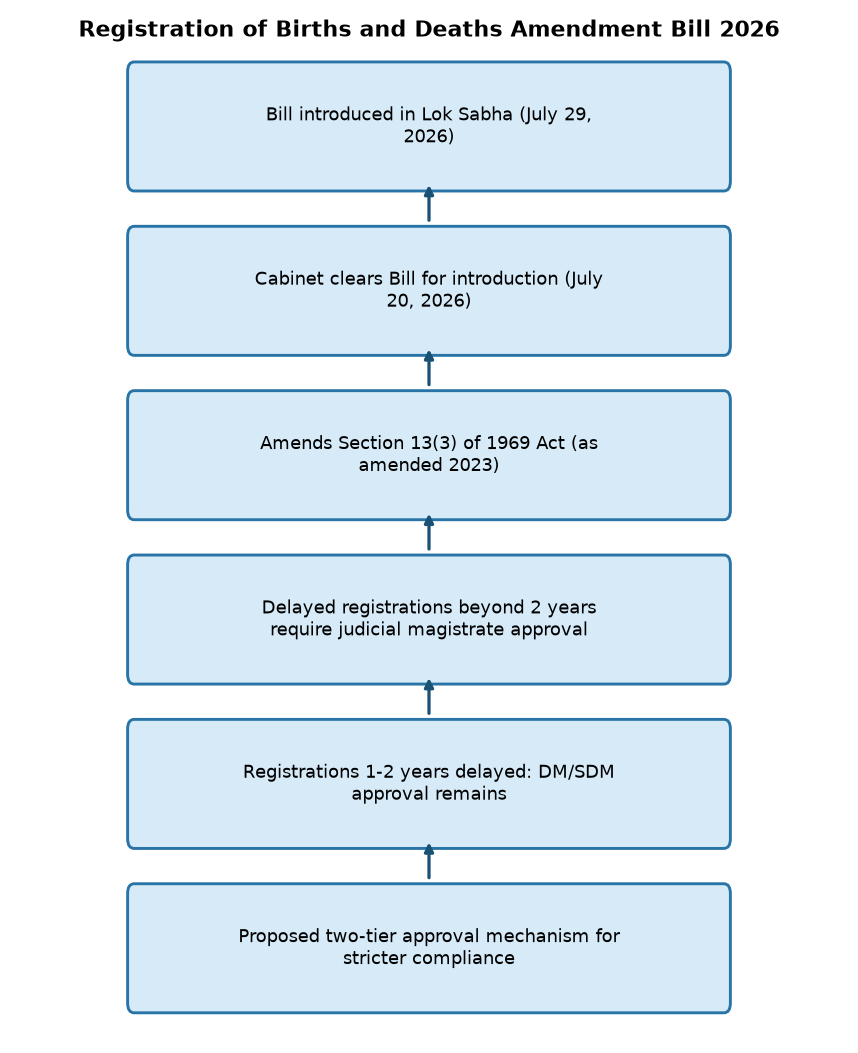
The Registration of Births and Deaths (Amendment) Bill, 2026, introduced in the Lok Sabha on July 29, 2026, seeks to amend Section 13(3) of the Registration of Births and Deaths Act, 1969, to impose stricter provisions for delayed registrations of births and deaths. The Bill introduces a two-tier approval mechanism, shifting authority from executive magistrates to judicial magistrates for registrations delayed beyond two years, thereby enhancing scrutiny and reducing potential misuse of the system.
Background
- The Registration of Births and Deaths Act, 1969, governs the legal framework for the registration of births and deaths in India, ensuring accurate and timely recording of vital events for administrative, legal, and statistical purposes.
- The Act was amended in 2023 to streamline the registration process, including provisions for delayed registrations, which currently require approval from a District Magistrate (DM), Sub-Divisional Magistrate (SDM), or an Executive Magistrate.
- The Civil Registration System (CRS) under the Act is a critical component of India’s demographic data infrastructure, providing essential inputs for policy formulation, welfare schemes, and legal documentation.
- Accurate birth and death records are foundational for the National Population Register (NPR), Aadhaar enrollment, and other citizen-centric services, necessitating robust and tamper-proof registration mechanisms.
- Delays in registration can lead to administrative inefficiencies, legal ambiguities, and potential misuse, such as fraudulent claims or identity theft, underscoring the need for stringent provisions.
What is the Registration of Births and Deaths (Amendment) Bill, 2026?
- The Bill proposes to amend Section 13(3) of the Registration of Births and Deaths Act, 1969, to introduce a two-tier approval mechanism for delayed registrations of births and deaths.
- For registrations delayed by one to two years, the existing system remains largely unchanged, requiring approval from a District Magistrate (DM), Sub-Divisional Magistrate (SDM), or an Executive Magistrate.
- For registrations delayed beyond two years, the Bill mandates approval from a first-class judicial magistrate, shifting the authority from the executive to the judiciary to ensure stricter scrutiny.
- The amendment aims to curb fraudulent or delayed registrations, which can undermine the integrity of vital statistics and legal documentation.
Key Features
| Feature | Significance |
|---|---|
| Two-tier approval mechanism for delayed registrations | Introduces stricter scrutiny for registrations delayed beyond two years, shifting authority from executive to judicial magistrates for very late cases. |
| Current unchanged system for 1-2 year delays | Maintains existing provisions requiring approval from District Magistrate (DM), Sub-Divisional Magistrate (SDM), or Executive Magistrate for registrations delayed by one to two years. |
| Judicial magistrate approval for delays beyond two years | Ensures higher scrutiny and accountability by mandating first-class judicial magistrate approval for registrations delayed beyond two years. |
| Preservation of existing legal framework for timely registrations | No changes proposed for births or deaths registered within one year of occurrence, ensuring continuity in the current system. |
| Amendment to Section 13(3) of the Registration of Births and Deaths Act, 1969 | Strengthens the legal basis for delayed registration provisions, enhancing compliance and reducing fraudulent registrations. |
Why it Matters
Administrative Reforms
- Enhances the integrity of civil registration systems by introducing judicial oversight for severely delayed cases, reducing executive discretion and potential malpractice.
- Strengthens the accountability of local authorities in verifying the authenticity of delayed registrations, thereby improving the reliability of demographic data.
- Aligns with global best practices in civil registration and vital statistics (CRVS) by ensuring robust checks and balances for delayed registrations.
Legal and Governance Implications
- Shifts the burden of approval for very late registrations from administrative to judicial authorities, reinforcing the separation of powers in governance.
- Provides a clearer legal framework for handling delayed registrations, reducing ambiguity and potential disputes in the registration process.
- Supports the implementation of the Registration of Births and Deaths Act, 1969 (as amended in 2023) by addressing gaps in enforcement for delayed cases.
Demographic and Policy Impact
- Improves the accuracy of demographic data by reducing the likelihood of fraudulent or erroneous delayed registrations, which can distort population statistics.
- Facilitates better policy planning and resource allocation by ensuring that birth and death records are reliable and up-to-date.
- Supports the Sustainable Development Goals (SDGs), particularly SDG 16.9 (provide legal identity for all), by ensuring accurate and timely registration of vital events.
Public Trust and Transparency
- Enhances public trust in the civil registration system by reducing opportunities for manipulation or corruption in delayed registrations.
- Promotes transparency in the registration process, particularly for cases where delays exceed two years, ensuring greater scrutiny and fairness.
Challenges
1. Implementation and Enforcement Challenges
- Risk of increased bureaucratic delays due to the additional layer of judicial approval for registrations delayed beyond two years, potentially discouraging timely reporting.
- Possible disparities in the application of the new provisions across different states and union territories, given the federal structure of India’s governance.
- Need for capacity-building among judicial magistrates and local authorities to handle the increased scrutiny and verification requirements efficiently.
UPSC Link: https://niti.gov.in/documents/publications
2. Social and Cultural Barriers
- Persistent social and cultural practices, such as delayed reporting of births or deaths in rural and tribal areas, may pose challenges in ensuring compliance with the new provisions.
- Lack of awareness among marginalized communities about the importance of timely registration and the consequences of delayed reporting.
UPSC Link: https://niti.gov.in/documents/publications
3. Technological and Infrastructure Gaps
- Inadequate digital infrastructure in remote areas may hinder the efficient processing and verification of delayed registrations, particularly in cases requiring judicial approval.
- Need for a robust grievance redressal mechanism to address disputes arising from delayed registrations and ensure timely resolution.
UPSC Link: https://niti.gov.in/documents/publications
Challenges — UPSC Perspective
| Issue | Concern |
|---|---|
| Bureaucratic delays | Additional judicial approval layer may slow down the registration process for very late cases. |
| State-level disparities | Variations in implementation across states may lead to inconsistent enforcement of the new provisions. |
| Capacity constraints | Judicial and administrative authorities may lack the resources or training to handle increased scrutiny effectively. |
| Social and cultural barriers | Traditional practices may impede timely reporting of births or deaths, particularly in rural areas. |
| Awareness gaps | Marginalized communities may remain unaware of the legal requirements and consequences of delayed registrations. |
Way Forward
- Conduct state-wise sensitization programs to educate local authorities and the public about the amended provisions and their implications.
- Strengthen digital infrastructure in remote areas to facilitate the efficient processing and verification of delayed registrations.
- Establish a dedicated grievance redressal mechanism to address disputes arising from delayed registrations and ensure timely resolution.
- Provide capacity-building training for judicial magistrates and local authorities on the new approval processes and verification requirements.
- Collaborate with civil society organizations to raise awareness among marginalized communities about the importance of timely registration.
- Monitor the implementation of the new provisions across states to identify and address disparities in enforcement.
- Integrate the civil registration system with other demographic databases to ensure consistency and reliability of data.
UPSC Value Addition
Keywords for Mains Answer-Writing
Registration of Births and Deaths Act, 1969 · delayed registration of births and deaths · District Magistrate (DM) · Sub-Divisional Magistrate (SDM) · judicial magistrate · two-tier approval mechanism · executive vs judicial authority · civil registration system · demographic data integrity · administrative accountability
Concept Flow
Registration of Births and Deaths Act, 1969 (as amended in 2023) → Current provisions for delayed registrations (DM/SDM approval for 1-2 year delays) → Proposed Amendment (Registration of Births and Deaths (Amendment) Bill, 2026) → Introduction of two-tier approval mechanism → Registrations delayed by 1-2 years → Continued approval by DM/SDM/Executive Magistrate → Registrations delayed beyond 2 years → Approval shifted to first-class judicial magistrate → Judicial oversight → Enhanced scrutiny, reduced executive discretion, improved data integrity → Implementation challenges → Capacity-building, digital infrastructure, awareness programs → Policy impact → Reliable demographic data, better resource allocation, alignment with SDGs
Prelims Practice Questions
Q1. Consider the following statements regarding the Registration of Births and Deaths (Amendment) Bill, 2026:
1. The Bill seeks to amend Section 13(3) of the Registration of Births and Deaths Act, 1969.
2. Registrations delayed beyond two years will require approval from a first-class judicial magistrate.
3. The Bill introduces a two-tier approval mechanism for delayed registrations.
4. The current provisions allow registrations delayed by more than one year without any approval.
How many of the above statements are correct?
- Only one
- Only two
- Only three
- All
Answer: Only three — Statements 1, 2, and 3 are correct. Statement 4 is incorrect as the current provisions require approval from the District Magistrate or Sub-Divisional Magistrate for registrations delayed by more than one year.
Q2. Assertion (A): The Registration of Births and Deaths (Amendment) Bill, 2026, shifts the authority for very late registrations from the executive to the judiciary.
Reason (R): The Bill mandates that registrations delayed beyond two years require approval from a first-class judicial magistrate.
Options:
A. Both A and R are true, and R is the correct explanation of A.
B. Both A and R are true, but R is not the correct explanation of A.
C. A is true, but R is false.
D. A is false, but R is true.
- A
- B
- C
- D
Answer: A — Both the assertion and reason are true, and the reason correctly explains the assertion. The Bill explicitly transfers the authority for delayed registrations beyond two years from executive magistrates to judicial magistrates.
Q3. Match the following columns regarding the approval authorities for delayed registrations under the Registration of Births and Deaths Act, 1969 (as amended):
Column I (Delay Duration) | Column II (Approval Authority)
1. 1 to 2 years | A. District Magistrate (DM) or Sub-Divisional Magistrate (SDM)
2. Beyond 2 years | B. First-class judicial magistrate
3. Within 1 year | C. No approval required
Options:
A. 1-A, 2-B, 3-C
B. 1-B, 2-A, 3-C
C. 1-C, 2-A, 3-B
D. 1-A, 2-C, 3-B
- A
- B
- C
- D
Answer: A — The correct match is: 1-A (1 to 2 years: DM or SDM), 2-B (Beyond 2 years: first-class judicial magistrate), and 3-C (Within 1 year: no approval required).
Mains Practice Question
✍ The Registration of Births and Deaths (Amendment) Bill, 2026, introduces a two-tier approval mechanism for delayed registrations, shifting authority for very late registrations from the executive to the judiciary. Critically examine the implications of this amendment for the civil registration system and administrative accountability in India. (15 Marks)
Approach: MODEL-ANSWER SKELETON:
1. **Introduction (2 marks)**: Define the civil registration system and its importance for demographic data integrity. Mention the purpose of the Registration of Births and Deaths Act, 1969, and the need for amendments.
2. **Provisions of the Amendment Bill (3 marks)**:
– Two-tier approval mechanism: 1-2 years (DM/SDM) and beyond 2 years (judicial magistrate).
– Shift of authority: Executive to judicial for very late registrations.
– Current provisions: Registration delayed by more than one year requires DM/SDM approval.
3. **Implications for the Civil Registration System (5 marks)**:
– **Strengths**: Enhanced scrutiny for delayed registrations, reduced fraud, improved data accuracy, and strengthened administrative accountability.
– **Challenges**: Increased judicial burden, potential delays in registration, and administrative inefficiencies due to prolonged scrutiny.
– **Comparative Perspective**: Contrast with global practices (e.g., UK, USA) where delayed registrations are handled by specialized tribunals or courts.
4. **Administrative Accountability (3 marks)**:
– Role of District Magistrates and Sub-Divisional Magistrates in ensuring timely registrations.
– Judicial oversight: Ensuring fairness and transparency in delayed registrations.
– Potential for corruption or bureaucratic delays in the new system.
5. **Conclusion (2 marks)**: Balance the need for rigorous scrutiny with the practical challenges of implementation. Suggest measures to mitigate delays and ensure efficient functioning of the civil registration system.
Source: The Hindu
Generated by AanyaAi for educational purpose.

- उत्तराखंड राज्यपाल के 5 वर्ष: पांच मिशन और AI क्रांति का लेखा-जोखा - September 15, 2026
- UPSC Focus: Uttarakhand Governor’s 5-Year Journey & 5 Key Missions Explained - September 15, 2026
- AI का वादा और खतरा: क्या मानवता के लिए खतरा है कृत्रिम बुद्धिमत्ता? - September 15, 2026

No Comments