


04 Aug Lok Sabha passes Appropriation Bill 2026; RS clears Births & Deaths Amendment Bill
✎ The Appropriation (No. 3) Bill, 2026 authorises government expenditure for 2026-27, while the Births and Deaths (Amendment) Bill, 2026 tightens delayed registration norms by requiring judicial magistrate approval for…
Subject Relevance — Where This Topic Fits
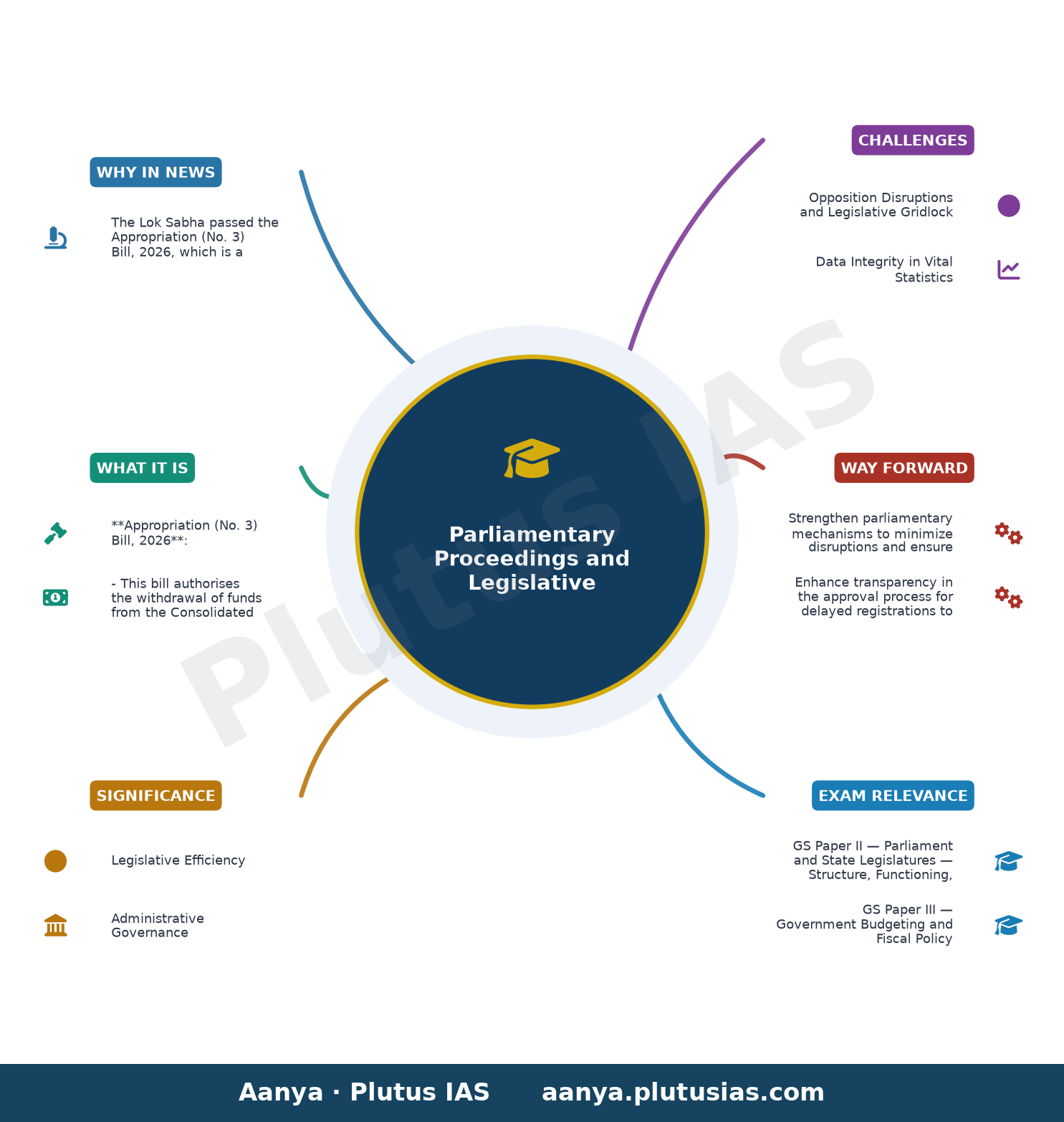
- GS Paper II — Parliament and State Legislatures — Structure, Functioning, Conduct of Business, Powers & Privileges and Issues Arising out of these | GS Paper III — Government Budgeting and Fiscal Policy
- Prelims: Appropriation Bill, Births and Deaths Registration Act, 1969, Judicial Magistrate (First Class), District Magistrate (DM), Sub-Divisional Magistrate (SDM), Parliamentary Proceedings, Voice Vote, Monsoon Session of Parliament
- Essay: The Role of Parliament in Democratic Governance: Challenges and Reforms
Quick Revision: The Appropriation (No. 3) Bill, 2026 authorises government expenditure for 2026-27, while the Births and Deaths (Amendment) Bill, 2026 tightens delayed registration norms by requiring judicial magistrate approval for registrations beyond two years.
Why is this in the news?
The Lok Sabha passed the Appropriation (No. 3) Bill, 2026, which is a critical fiscal instrument enabling the government to draw funds from the Consolidated Fund of India for the financial year 2026-27. Concurrently, the Rajya Sabha passed the Births and Deaths (Amendment) Bill, 2026, aimed at amending the Registration of Births and Deaths Act, 1969, to introduce stricter provisions for delayed registrations. These legislative actions underscore the procedural and substantive dimensions of parliamentary functioning and governance.
Background
- The Appropriation Bill is a constitutional requirement under Article 114(3) of the Constitution of India, mandating parliamentary approval for government expenditure.
- The Registration of Births and Deaths Act, 1969, governs the registration of vital events in India, with the latest amendment in 2023 introducing provisions for delayed registrations.
- The Monsoon Session of Parliament is a critical legislative period, often witnessing the passage of key bills and discussions on policy matters.
- Opposition protests during the session have centred on issues such as the Ram Mandir donations controversy, police action on protesters, and inter-state water disputes like the Cauvery issue.
- The Supreme Court (Number of Judges) Amendment Bill, 2026, passed earlier, reflects ongoing judicial reforms to address the increasing caseload.
- The Micro, Small and Medium Enterprises Development (Amendment) Bill, 2026, highlights the government’s focus on enhancing the ease of doing business for MSMEs.
Key Features of the Appropriation (No. 3) Bill, 2026 and Births and Deaths (Amendment) Bill, 2026
- **Appropriation (No. 3) Bill, 2026**:
- – This bill authorises the withdrawal of funds from the Consolidated Fund of India for the financial year 2026-27, as per constitutional provisions.
- – It is passed after the Finance Bill and is a procedural necessity to enable government expenditure.
- – The bill is typically passed without debate, as it is a formal approval for expenditure already incurred or planned.
- – Opposition protests during its passage reflect broader concerns over fiscal transparency and governance.
- **Births and Deaths (Amendment) Bill, 2026**:
- – The bill seeks to amend the Registration of Births and Deaths Act, 1969, to introduce stricter provisions for delayed registrations.
- – Under current provisions, registrations delayed by more than one year require an order from a judicial magistrate.
- – The proposed legislation seeks to make delayed registration of births and deaths more stringent by requiring an order from a judicial magistrate (first class) for registrations done after two years.
- – The bill aims to improve the accuracy and reliability of vital statistics, which are critical for policy planning, welfare schemes, and demographic analysis.
- – The amendment is part of broader efforts to modernise civil registration systems in India, aligning with global best practices.
- – The Births and Deaths (Amendment) Bill, 2026 was passed in the Lok Sabha last week and then passed in the Rajya Sabha on August 4, 2026.
Key Features
| Feature | Significance |
|---|---|
| Appropriation (No. 3) Bill, 2026 | Facilitates the release of additional financial resources for government expenditure during the fiscal year 2025-26, ensuring continuity of public services and implementation of welfare schemes without disruption. |
| Births and Deaths (Amendment) Bill, 2026 | Strengthens the regulatory framework for delayed registration of births and deaths by introducing judicial oversight for registrations beyond two years, thereby enhancing the integrity of vital statistics. |
| Judicial Magistrate (First Class) Order Requirement | Introduces a higher authority for approval of delayed registrations, ensuring stricter scrutiny and reducing potential fraud or misreporting in vital records. |
| District Magistrate (DM) / Sub-Divisional Magistrate (SDM) Role | Maintains existing approval mechanism for registrations delayed between one and two years, preserving administrative efficiency while addressing moderate delays. |
| Opposition Protests in Parliament | Highlights legislative disruptions and underscores the need for constructive debate, particularly on issues of governance, law enforcement, and inter-state disputes. |
Why it Matters
Legislative Efficiency
- The passage of the Appropriation (No. 3) Bill ensures uninterrupted financial governance, critical for maintaining public expenditure and welfare delivery during the fiscal year.
- The Births and Deaths (Amendment) Bill enhances the reliability of demographic data, which is foundational for policy planning, resource allocation, and social welfare schemes.
- The use of voice votes in both Houses reflects procedural efficiency, though it also underscores the lack of substantive debate on contentious issues.
Administrative Governance
- Stricter provisions for delayed registrations align with the government’s emphasis on data-driven policymaking and reducing bureaucratic inefficiencies.
- The Bill’s focus on judicial oversight for delayed registrations introduces a layer of accountability, mitigating risks of fraudulent or erroneous entries in vital records.
- The maintenance of existing approval mechanisms for moderate delays balances administrative feasibility with regulatory stringency.
Parliamentary Dynamics
- Protests by the Opposition during the Monsoon Session highlight the challenges of legislative consensus in a politically charged environment.
- The adjournments and disruptions reflect broader issues of parliamentary decorum and the need for structured deliberation on contentious matters.
- The passage of key Bills amid protests demonstrates the government’s ability to advance legislative agendas despite opposition, a critical aspect of parliamentary democracy.
Challenges
1. Opposition Disruptions and Legislative Gridlock
- Persistent protests by the Opposition disrupt parliamentary proceedings, delaying the passage of critical Bills and undermining legislative efficiency.
- The lack of substantive debate on contentious issues such as police action on protesters and inter-state disputes exacerbates political polarization.
- The government’s reliance on voice votes to pass Bills risks eroding the quality of legislative scrutiny and public accountability.
UPSC Link: Parliamentary functioning and legislative process
2. Data Integrity in Vital Statistics
- Delayed registrations of births and deaths pose challenges to the accuracy of demographic data, which is essential for policy formulation and welfare schemes.
- The current system’s reliance on administrative approvals (DM/SDM) for moderate delays may not be sufficient to prevent fraudulent or erroneous entries.
- The introduction of judicial oversight for registrations beyond two years addresses this gap but may increase procedural complexity and delays.
UPSC Link: Role of data in governance and policy
3. Inter-State Disputes and Federalism
- The Cauvery water dispute and other inter-state conflicts highlight the challenges of cooperative federalism and equitable resource distribution.
- Parliamentary adjournments over such disputes underscore the need for structured mechanisms to resolve inter-state conflicts without disrupting legislative agendas.
- The lack of consensus on such issues risks undermining national cohesion and economic stability.
UPSC Link: Federalism and inter-state relations
4. Public Trust in Institutions
- Allegations of embezzlement of donations and police action on protesters erode public trust in institutions, particularly the judiciary and law enforcement.
- The absence of transparent investigations and accountability mechanisms exacerbates public skepticism and political instability.
- Restoring public trust requires robust institutional reforms and transparent governance.
UPSC Link: Role of institutions in democracy
Challenges — UPSC Perspective
| Issue | Concern |
|---|---|
| Legislative Disruptions | Parliamentary protests and adjournments delay the passage of critical Bills, undermining legislative efficiency and public service delivery. |
| Data Accuracy in Vital Records | Delayed registrations of births and deaths compromise the integrity of demographic data, affecting policy planning and welfare schemes. |
| Inter-State Conflicts | Disputes such as the Cauvery water issue disrupt parliamentary proceedings and highlight the need for structured conflict resolution mechanisms. |
| Public Trust Erosion | Allegations of institutional misconduct and lack of transparency undermine public confidence in governance and law enforcement. |
| Procedural Complexity | The introduction of judicial oversight for delayed registrations may increase procedural delays and complexity, affecting administrative efficiency. |
| Federalism Challenges | Inter-state disputes and lack of consensus on resource distribution pose risks to national cohesion and economic stability. |
Way Forward
- Strengthen parliamentary mechanisms to minimize disruptions and ensure structured deliberation on contentious issues.
- Enhance transparency in the approval process for delayed registrations to balance regulatory stringency with administrative efficiency.
- Establish independent oversight bodies to investigate allegations of institutional misconduct and restore public trust.
- Develop structured frameworks for resolving inter-state disputes to prevent parliamentary disruptions and uphold cooperative federalism.
- Promote digitalization of vital records to reduce procedural delays and improve the accuracy of demographic data.
- Encourage bipartisan dialogue to address political polarization and foster consensus on legislative agendas.
- Implement periodic reviews of parliamentary procedures to enhance efficiency and accountability in legislative processes.
- Invest in capacity-building for judicial and administrative officials to streamline the approval process for delayed registrations.
UPSC Value Addition
Keywords for Mains Answer-Writing
Appropriation Bill 2026 · Births and Deaths (Amendment) Bill 2026 · Parliamentary financial legislation · Registration of Births and Deaths Act 1969 · Supreme Court judge strength · Parliament Monsoon Session 2026 · Judicial magistrate for delayed registrations · Constitutional amendment process · Parliamentary procedures · Union Budget 2026-27 · Executive-Legislative relations · Judicial scrutiny of executive actions · Parliamentary committees · Financial accountability · Public interest litigation
Concept Flow
Parliamentary Session Disruptions → Opposition Protests → Adjournments → Delayed Legislative Agenda → Births and Deaths Registration Delays → Data Integrity Issues → Proposed Judicial Oversight → Enhanced Regulatory Framework → Inter-State Disputes → Parliamentary Gridlock → Federalism Challenges → Need for Structured Resolution Mechanisms → Allegations of Institutional Misconduct → Erosion of Public Trust → Demand for Transparency → Institutional Reforms
Prelims Practice Questions
Q1. Consider the following statements regarding the Appropriation (No. 3) Bill, 2026:
1. It is a Money Bill passed by the Lok Sabha.
2. It authorises withdrawal of funds from the Consolidated Fund of India for the financial year 2026-27.
3. The Rajya Sabha can only recommend amendments to the Bill but cannot reject it.
4. The Bill requires the President’s assent to become law.
How many of the above statements are correct?
- Only one
- Only two
- Only three
- All four
Answer: All four — Statements 1, 2, and 3 are correct. The Appropriation (No. 3) Bill is a Money Bill, authorises fund withdrawal for 2026-27, and the Rajya Sabha can only recommend amendments. Statement 4 is incorrect as the President’s assent is not required for Money Bills under Article 109(3) of the Constitution.
Q2. Assertion (A): The Births and Deaths (Amendment) Bill, 2026 seeks to amend Section 13(3) of the Registration of Births and Deaths Act, 1969.
Reason (R): The amendment aims to make delayed registration of births and deaths more stringent by requiring a judicial magistrate’s order for registrations delayed beyond two years.
In the context of the above two statements, which one of the following is correct?
- Both A and R are true, and R is the correct explanation of A
- Both A and R are true, but R is not the correct explanation of A
- A is true, but R is false
- A is false, but R is true
Answer: Both A and R are true, but R is not the correct explanation of A — Both the Assertion (A) and Reason (R) are true. The Bill explicitly seeks to amend Section 13(3) of the Registration of Births and Deaths Act, 1969, and the amendment introduces stricter provisions for delayed registrations, including judicial magistrate’s orders for delays beyond two years.
Q3. Match the following Bills with their respective Houses of Parliament where they were passed during the Monsoon Session 2026:
Column I (Bill) | Column II (House)
———————————————|——————-
A. Appropriation (No. 3) Bill, 2026 | 1. Rajya Sabha
B. Births and Deaths (Amendment) Bill, 2026 | 2. Lok Sabha
C. MSME Development (Amendment) Bill, 2026 | 3. Both Houses
D. Supreme Court (Number of Judges) Bill, 2026| 4. Not passed
Select the correct match:
- A-2, B-1, C-1, D-2
- A-2, B-1, C-1, D-4
- A-1, B-2, C-2, D-1
- A-3, B-3, C-3, D-3
Answer: A-2, B-1, C-1, D-4 — The Appropriation (No. 3) Bill, 2026 and the Supreme Court (Number of Judges) Bill, 2026 were passed by the Lok Sabha. The Births and Deaths (Amendment) Bill, 2026 and the MSME Development (Amendment) Bill, 2026 were passed by the Rajya Sabha.
Mains Practice Question
✍ The Parliament, during its Monsoon Session 2026, passed significant legislative measures including the Appropriation (No. 3) Bill, 2026 and the Births and Deaths (Amendment) Bill, 2026. Critically examine the role of Parliament in financial legislation and the implications of the amendments to the Registration of Births and Deaths Act, 1969. (15 Marks)
Approach: MODEL-ANSWER SKELETON:
1. **Financial Legislation in Parliament**:
– Define the Appropriation Bill under Article 114 of the Constitution and its significance in authorising expenditure from the Consolidated Fund of India.
– Explain the distinction between Money Bills and Financial Bills, and the limited role of the Rajya Sabha (Article 109).
– Discuss the accountability mechanisms: Parliamentary committees (e.g., Public Accounts Committee, Estimates Committee) and the Comptroller and Auditor General (CAG).
– Highlight contemporary challenges: delays in passing Appropriation Bills, opposition protests, and the balance between executive prerogative and legislative scrutiny.
2. **Births and Deaths (Amendment) Bill, 2026**:
– Context: Amendments to Section 13(3) of the Registration of Births and Deaths Act, 1969 (as amended in 2023).
– Key provisions: Stricter norms for delayed registrations (judicial magistrate’s order required for delays beyond two years; DM/SDM approval for 1-2 year delays).
– Rationale: Curb fraudulent registrations, improve data accuracy for welfare schemes (e.g., PDS, Ayushman Bharat), and address demographic data gaps.
– Critique: Potential administrative burden on judiciary, delays in registration for marginalised communities, and feasibility concerns in rural areas.
3. **Balancing Act**:
– Discuss the trade-offs between stricter registration norms and ease of doing business for citizens.
– Reference the role of the judiciary in ensuring constitutional validity (e.g., Article 21 rights to dignity and identity).
– Conclude with the need for streamlined grievance redressal mechanisms and digital integration (e.g., Aadhaar-linked birth/death certificates).
4. **Contemporary Relevance**:
– Link to recent Supreme Court judgments on privacy (Puttaswamy case) and data protection (DPDP Act, 2023).
– Reference the National Population Register (NPR) and Census data challenges.
5. **Critical Perspective**:
– Evaluate whether the amendments address systemic issues or merely shift administrative burdens.
– Discuss the role of state governments in implementation (e.g., Karnataka’s model of digital birth registration).
Source: The Hindu
Generated by AanyaAi for educational purpose.

- मध्य प्रदेश: हाईकोर्ट ने बलात्कार मामले में आरोपी को डीएनए सबूत के आधार पर किया दोषमुक्त - September 21, 2026
- MP High Court Acquits Rape Convict Due to Negative DNA Evidence - September 21, 2026
- Odisha Launches Shree Jagannath Darshan Yojana for Senior Citizens Pilgrimage - September 21, 2026

No Comments