


06 Aug Lok Sabha Passes Bill Allowing Banks to Charge UPI Transactions: UPSC/PCS Exam Insights
✎ The Payment and Settlement Systems (Amendment) Bill, 2026, removes the statutory prohibition on charging fees for UPI transactions, enabling the government to introduce Merchant Discount Rates (MDR) on notified electronic payment…
Subject Relevance — Where This Topic Fits
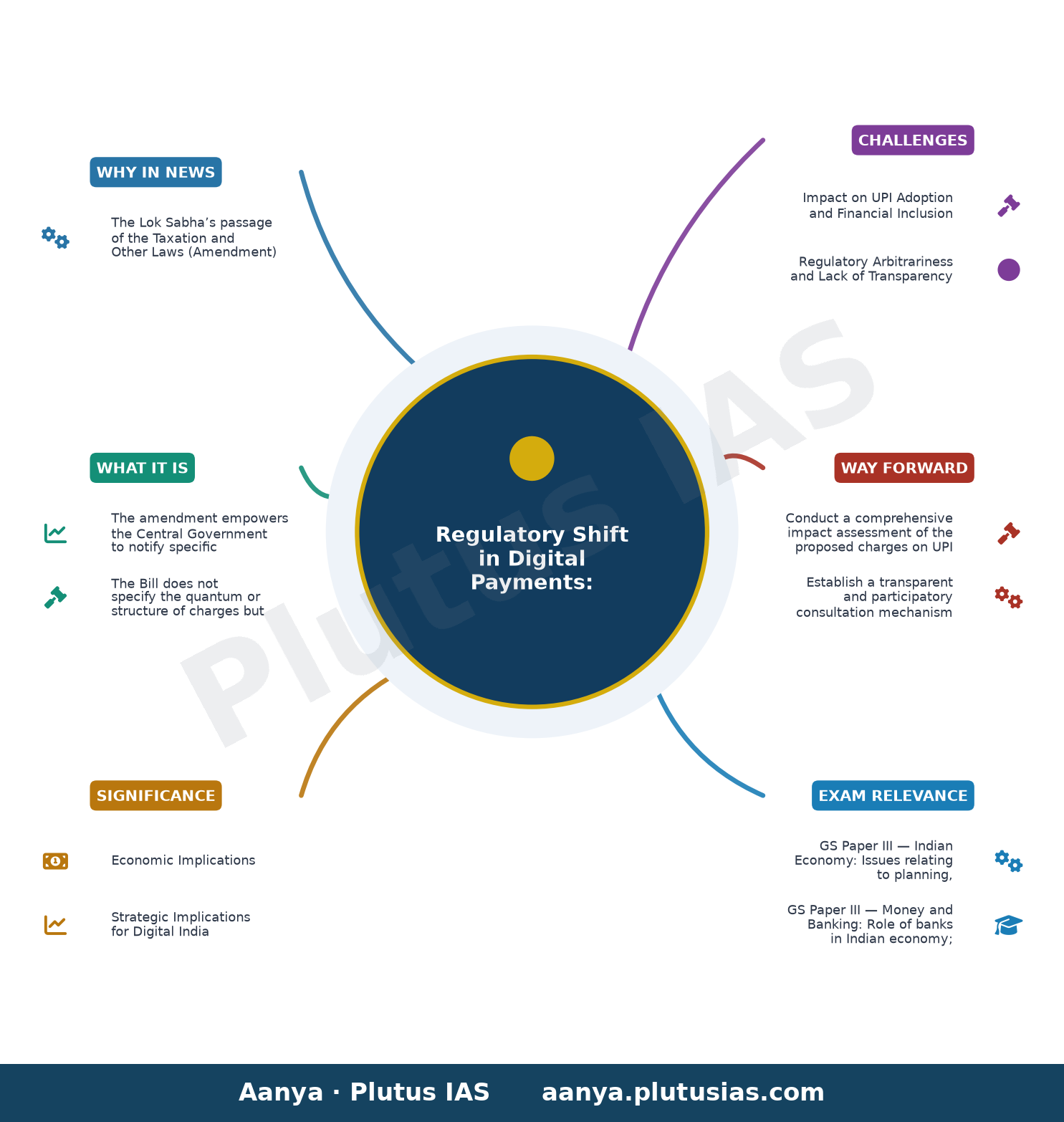
- GS Paper III — Indian Economy: Issues relating to planning, mobilization of resources, growth, development and employment; Inclusive growth and issues arising from it; Government Budgeting | GS Paper III — Money and Banking: Role of banks in Indian economy; Non-Banking Financial Companies (NBFCs); Financial Inclusion
- Prelims: Payment and Settlement Systems Act, 2007, Unified Payments Interface (UPI), Merchant Discount Rate (MDR), Section 10A of the Payment and Settlement Systems Act, 2007, Section 269SU of the Income-tax Act, 1961, Digital payment ecosystem, Financial inclusion, Regulatory arbitrage in fintech
- Essay: The evolving landscape of digital public infrastructure: Balancing innovation, accessibility, and sustainability
Quick Revision: The Payment and Settlement Systems (Amendment) Bill, 2026, removes the statutory prohibition on charging fees for UPI transactions, enabling the government to introduce Merchant Discount Rates (MDR) on notified electronic payment modes to ensure the financial sustainability of the digital payments ecosystem.
Why is this in the news?
The Lok Sabha’s passage of the Taxation and Other Laws (Amendment) Bill, 2026, which amends the Payment and Settlement Systems Act, 2007, has introduced the possibility of levying charges on UPI transactions. This legislative move, though procedural in nature, carries significant implications for India’s rapidly expanding digital payments ecosystem, financial inclusion policies, and the sustainability of payment infrastructure providers. The amendment removes the existing statutory prohibition on banks and payment service providers from charging Merchant Discount Rates (MDR) on notified electronic payment modes, including UPI, thereby potentially altering the cost dynamics of digital transactions for consumers and merchants.
Background
- The Payment and Settlement Systems Act, 2007, was enacted to regulate payment systems in India, ensuring safety, efficiency, and stability in the financial ecosystem.
- Section 269SU of the Income-tax Act, 1961, mandates large businesses (with turnover exceeding ₹50 crore) to accept digital payments through specified electronic modes, including RuPay debit cards and BHIM-UPI QR codes, to curb tax evasion and promote transparency.
- UPI, launched in 2016 by the National Payments Corporation of India (NPCI), has revolutionised digital payments in India by enabling real-time, interoperable transactions without the need for physical cash or cards. Its adoption has surged, with over 140 billion transactions processed in FY 2025-26.
- The zero-MDR regime for UPI transactions has been a cornerstone of India’s digital public infrastructure strategy, incentivising adoption among small merchants and consumers. However, critics argue that this model has placed a financial burden on banks and payment infrastructure providers, necessitating a re-evaluation of revenue streams.
- The proposed amendment aligns with global practices where digital payment systems often involve transaction fees, such as the interchange fees in credit/debit card transactions or the Merchant Discount Rate (MDR) in card-based payments.
- The Bill was passed without debate due to Opposition protests, highlighting the political sensitivity surrounding fiscal policies and their impact on digital inclusion, particularly for small businesses and low-income users.
What is the Payment and Settlement Systems (Amendment) Bill, 2026?
- The amendment empowers the Central Government to notify specific electronic payment modes (e.g., UPI, IMPS, NEFT, RTGS) on which banks and payment service providers (PSPs) may levy charges, such as the Merchant Discount Rate (MDR).
- The Bill does not specify the quantum or structure of charges but provides a legal framework for the government to introduce them through subsequent notifications, ensuring flexibility in implementation.
- The proposed changes are part of a broader legislative package, the Taxation and Other Laws (Amendment) Bill, 2026, which also includes amendments to the Income Tax Act, 2025, and the Finance Act, 2026, aimed at streamlining tax compliance and digital payment ecosystems.
- The amendment does not affect the existing requirement under Section 269SU of the Income-tax Act, which mandates large businesses to accept digital payments, but it may influence the cost dynamics for these businesses when processing UPI transactions.
- The Bill’s passage reflects a shift in policy from subsidising digital payments to ensuring the financial sustainability of the payment infrastructure ecosystem, which includes banks, PSPs, and NPCI.
- The government’s stated objective is to balance consumer affordability with the need to incentivise innovation and investment in digital payment technologies, particularly in rural and semi-urban areas.
- The amendment does not immediately impose charges on UPI transactions but provides the legal basis for future regulatory interventions, subject to public consultation and parliamentary scrutiny.
Key Features
| Feature | Significance |
|---|---|
| Amendment to Section 10A of the Payment and Settlement Systems Act, 2007 | Removes the existing prohibition on banks and payment service providers (PSPs) from levying charges on UPI and other notified electronic payment modes. |
| Substitution of Section 10A text | Replaces reference to Section 269SU of the Income Tax Act, 1961 with a broader mandate for the Central Government to specify electronic modes for charge imposition via notification. |
| Scope expansion beyond Section 269SU | Allows the government to include additional electronic payment modes (e.g., IMPS, NEFT, RTGS) under the ambit of chargeable transactions, beyond the current tax-related mandate. |
| Revenue model sustainability for banks/PSPs | Aims to generate sustainable revenue streams for financial institutions and infrastructure firms by permitting small charges on digital transactions. |
| Exclusion of UPI from Section 269SU | UPI transactions, currently exempt under Section 269SU for tax compliance, may now face charges, altering the cost dynamics for merchants and consumers. |
Why it Matters
Economic Implications
- Potential shift in the digital payments ecosystem from a ‘zero-cost’ model to a ‘cost-incurring’ model, impacting consumer behavior and adoption rates of UPI and other digital payment modes.
- Revenue generation for banks and PSPs, which may improve infrastructure investments and service quality in the long term.
- Risk of reduced competitiveness of UPI compared to cash or other payment modes if charges are perceived as excessive by small businesses and consumers.
- Possible inflationary pressure on small businesses if they pass on the charges to consumers, affecting price stability and purchasing power.
Strategic Implications for Digital India
- Undermines the foundational principle of ‘Digital India’ by introducing friction in the most widely adopted digital payment system (UPI), which has over 800 million users.
- May slow the pace of financial inclusion by increasing transaction costs for low-income users who rely on UPI for daily transactions.
- Could lead to a bifurcation of the digital payments market, where UPI remains dominant for consumers but incurs costs for merchants, altering the competitive landscape.
Fiscal Policy and Taxation
- Aligns with the government’s broader objective of rationalizing digital transaction costs to ensure sustainability of the digital payments ecosystem.
- May reduce the burden on the exchequer by shifting the cost of digital infrastructure maintenance to the users, rather than subsidizing it through tax revenue.
- Raises questions about the equity of the charge structure, particularly whether small businesses and low-income users will bear a disproportionate burden.
Regulatory and Consumer Protection
- Introduces regulatory flexibility for the government to dynamically adjust charges based on market conditions, but risks arbitrary or opaque decision-making without robust consultation mechanisms.
- May necessitate stronger consumer protection measures to prevent exploitative pricing by banks or PSPs, particularly in rural and semi-urban areas.
- Could lead to increased disputes between consumers, merchants, and banks over charge imposition, requiring enhanced grievance redressal mechanisms.
Challenges
1. Impact on UPI Adoption and Financial Inclusion
- Risk of reduced UPI adoption among small businesses and low-income users if charges are introduced, particularly in rural and semi-urban areas where cash remains dominant.
- Potential widening of the digital divide if charges disproportionately affect marginalized sections of society who rely on UPI for daily transactions.
- Possible decline in the growth rate of digital transactions, which has been a key driver of financial inclusion and formalization of the economy.
UPSC Link: GS-III: Digital Payments and Financial Inclusion
2. Regulatory Arbitrariness and Lack of Transparency
- The amendment grants broad discretion to the Central Government to specify electronic modes for charge imposition, raising concerns about regulatory arbitrariness and lack of transparency.
- No clear mechanism for public consultation or stakeholder engagement before charges are imposed, which could lead to resistance from industry bodies and consumer groups.
- Risk of inconsistent or ad-hoc charge structures, which may create confusion and distrust among users and businesses.
UPSC Link: GS-II: Statutory Frameworks and Regulatory Governance
3. Competitiveness of UPI vs. Alternative Payment Modes
- If charges are introduced on UPI, merchants may shift to alternative payment modes (e.g., credit/debit cards, wallets) that offer better pricing or incentives, altering the competitive landscape.
- Risk of reduced innovation in the UPI ecosystem if banks and PSPs prioritize revenue generation over user experience and accessibility.
- Possible fragmentation of the digital payments market, where different modes cater to different segments, reducing the universality of digital payments.
UPSC Link: GS-III: Competition Policy and Digital Markets
4. Inflationary Pressures and Consumer Welfare
- Small businesses may pass on the charges to consumers, leading to higher prices for goods and services, particularly in sectors with thin profit margins.
- Risk of reduced purchasing power for low-income households, which could exacerbate economic inequality and reduce overall welfare.
- Possible decline in consumer confidence in digital payments, leading to a shift back to cash transactions in certain segments.
UPSC Link: GS-III: Inflation and Consumer Welfare
Challenges — UPSC Perspective
| Issue | Concern |
|---|---|
| Impact on UPI adoption | Risk of reduced financial inclusion and slower digital payments growth. |
| Regulatory arbitrariness | Lack of transparency and public consultation in charge imposition. |
| Competitiveness of UPI | Possible shift to alternative payment modes, fragmenting the digital payments ecosystem. |
| Inflationary pressures | Higher prices for consumers if businesses pass on charges. |
| Consumer protection | Need for robust grievance redressal mechanisms to prevent exploitative pricing. |
| Equity and fairness | Disproportionate burden on small businesses and low-income users. |
Way Forward
- Conduct a comprehensive impact assessment of the proposed charges on UPI adoption, particularly in rural and semi-urban areas, to identify potential disruptions to financial inclusion.
- Establish a transparent and participatory consultation mechanism involving banks, PSPs, merchants, consumer groups, and industry bodies before finalizing charge structures.
- Introduce tiered or progressive charge structures to ensure that small businesses and low-income users are not disproportionately affected.
- Strengthen consumer protection frameworks, including grievance redressal mechanisms and dispute resolution processes, to address complaints related to charge imposition.
- Monitor the competitive dynamics of the digital payments market to prevent monopolistic or anti-competitive practices by banks or PSPs.
- Evaluate the long-term fiscal and economic impact of the charges, including their effect on tax compliance, digital transaction volumes, and inflation.
- Ensure that the Central Government’s notification specifying electronic modes for charge imposition is accompanied by clear guidelines and safeguards to prevent arbitrariness.
- Promote financial literacy programs to educate users and businesses about the benefits and costs of digital payments, fostering informed decision-making.
UPSC Value Addition
Keywords for Mains Answer-Writing
Unified Payments Interface (UPI) · Payment and Settlement Systems Act, 2007 · Merchant Discount Rate (MDR) · digital payments ecosystem · Taxation and Other Laws (Amendment) Bill, 2026 · Section 10A of the Payment and Settlement Systems Act, 2007 · Section 269SU of the Income Tax Act, 1961 · financial inclusion · sustainable revenue model for banks · digital payment charges · electronic modes of payment · RTGS and NEFT charges · payment service providers (PSPs) · governance of digital public infrastructure
Concept Flow
Government introduces amendment to Payment and Settlement Systems Act, 2007 via Taxation and Other Laws (Amendment) Bill, 2026. → Amendment removes prohibition on banks/PSPs levying charges on UPI and other notified electronic payment modes. → Central Government gains discretion to specify electronic modes for charge imposition via notification. → Potential imposition of small charges on UPI transactions, altering cost dynamics for merchants and consumers. → Risk of reduced UPI adoption, particularly among small businesses and low-income users, impacting financial inclusion. → Possible shift to alternative payment modes, fragmenting the digital payments ecosystem. → Need for regulatory safeguards, consumer protection, and equitable charge structures to mitigate adverse effects.
Prelims Practice Questions
Q1. Consider the following statements regarding the Payment and Settlement Systems Act, 2007:
1. Section 10A prohibits banks and system providers from imposing any charges on electronic payments.
2. Section 269SU of the Income Tax Act, 1961 mandates large businesses to accept payments through RuPay debit cards and BHIM-UPI QR codes.
3. The Taxation and Other Laws (Amendment) Bill, 2026 seeks to introduce charges on UPI transactions.
How many of the above statements are correct?
- Only one
- Only two
- All
- None
Answer: All — Statements 1 and 2 are correct as per the Act and Income Tax provisions. Statement 3 is correct as the Bill seeks to amend Section 10A to allow charges on UPI transactions.
Q2. Assertion (A): The Payment and Settlement Systems Act, 2007 currently prohibits banks from levying charges on UPI transactions.
Reason (R): The Taxation and Other Laws (Amendment) Bill, 2026 aims to remove this prohibition by amending Section 10A of the Act.
- Both A and R are true, and R is the correct explanation of A.
- Both A and R are true, but R is not the correct explanation of A.
- A is true, but R is false.
- A is false, but R is true.
Answer: ? — Assertion (A) is true as Section 10A currently prohibits charges on UPI transactions. Reason (R) is also true but does not explain the assertion; it merely states the government’s intent to amend the provision.
Q3. Match the following electronic payment modes with their respective regulatory provisions:
Column I
A. UPI
B. RTGS
C. NEFT
D. RuPay debit cards
Column II
1. Section 269SU of the Income Tax Act, 1961
2. Payment and Settlement Systems Act, 2007 (as amended)
3. Reserve Bank of India guidelines
4. Merchant Discount Rate (MDR) framework
- {‘A’: 2, ‘B’: 3, ‘C’: 3, ‘D’: 1}
- {‘A’: 4, ‘B’: 2, ‘C’: 3, ‘D’: 1}
- {‘A’: 2, ‘B’: 3, ‘C’: 2, ‘D’: 4}
- {‘A’: 1, ‘B’: 3, ‘C’: 3, ‘D’: 2}
Answer: {‘A’: 2, ‘B’: 3, ‘C’: 3, ‘D’: 1} — UPI falls under the Payment and Settlement Systems Act, 2007 (as amended). RTGS and NEFT are governed by RBI guidelines. RuPay debit cards are mandated under Section 269SU of the Income Tax Act, 1961.
Mains Practice Question
✍ The Government of India has recently amended the Payment and Settlement Systems Act, 2007 to permit banks to levy charges on UPI transactions. Critically examine the implications of this amendment on financial inclusion, the digital payments ecosystem, and the broader objectives of digital public infrastructure in India. (15 Marks)
Approach: MODEL-ANSWER SKELETON:
1. **Context and Provisions**:
– Brief explanation of the Payment and Settlement Systems Act, 2007 and Section 10A.
– Key changes introduced by the Taxation and Other Laws (Amendment) Bill, 2026.
– Current exemptions for UPI transactions and the rationale for introducing charges.
2. **Implications for Financial Inclusion**:
– UPI’s role in promoting financial inclusion (e.g., ease of use, zero cost, penetration in rural areas).
– Potential impact of charges on low-income users and small businesses.
– Comparison with RTGS/NEFT, which already levy charges.
3. **Digital Payments Ecosystem**:
– Role of UPI in driving digital payments (e.g., 10.56 billion transactions in July 2026).
– Impact on banks, payment service providers (PSPs), and infrastructure firms (e.g., NPCI).
– Sustainability of revenue models for stakeholders.
4. **Broader Objectives of Digital Public Infrastructure (DPI)**:
– DPI’s role in governance, service delivery, and economic growth.
– Balancing commercial viability with public good (e.g., zero-cost transactions as a public policy tool).
– Lessons from global models (e.g., Brazil’s PIX, Singapore’s PayNow).
5. **Critical Analysis and Balanced View**:
– Arguments in favour: Revenue generation for banks, reducing cross-subsidisation, aligning with global practices.
– Arguments against: Regressive impact on marginalised groups, potential slowdown in digital adoption, erosion of DPI’s public good character.
– Suggested safeguards: Tiered pricing, exemptions for small transactions, or revenue-sharing models.
6. **Conclusion**:
– Synthesis of the above points with a reasoned stance on whether the amendment aligns with India’s DPI vision or risks undermining it.
Source: The Hindu
Generated by AanyaAi for educational purpose.

- UPSC Civil Services (Main) Examination 2026 — Geology Optional Paper I: Question Paper | Plutus IAS - September 21, 2026
- विशेष अभियान 6: रेलवे में लंबित मामलों के निपटान और स्वच्छता को संस्थागत रूप देने की तैयारी शुरू, जानिए पूरी योजना - September 21, 2026
- Railway Special Campaign 6: Key Focus Areas for UPSC & State PCS 2026 - September 21, 2026

No Comments