


07 Aug Lok Sabha Passes Bill to Allow MDR on UPI Transactions: Key Changes Explained
✎ The amendment to the Payment and Settlement Systems Act, 2007, removes the zero-MDR framework for UPI transactions, potentially introducing charges for merchants.
Subject Relevance — Where This Topic Fits
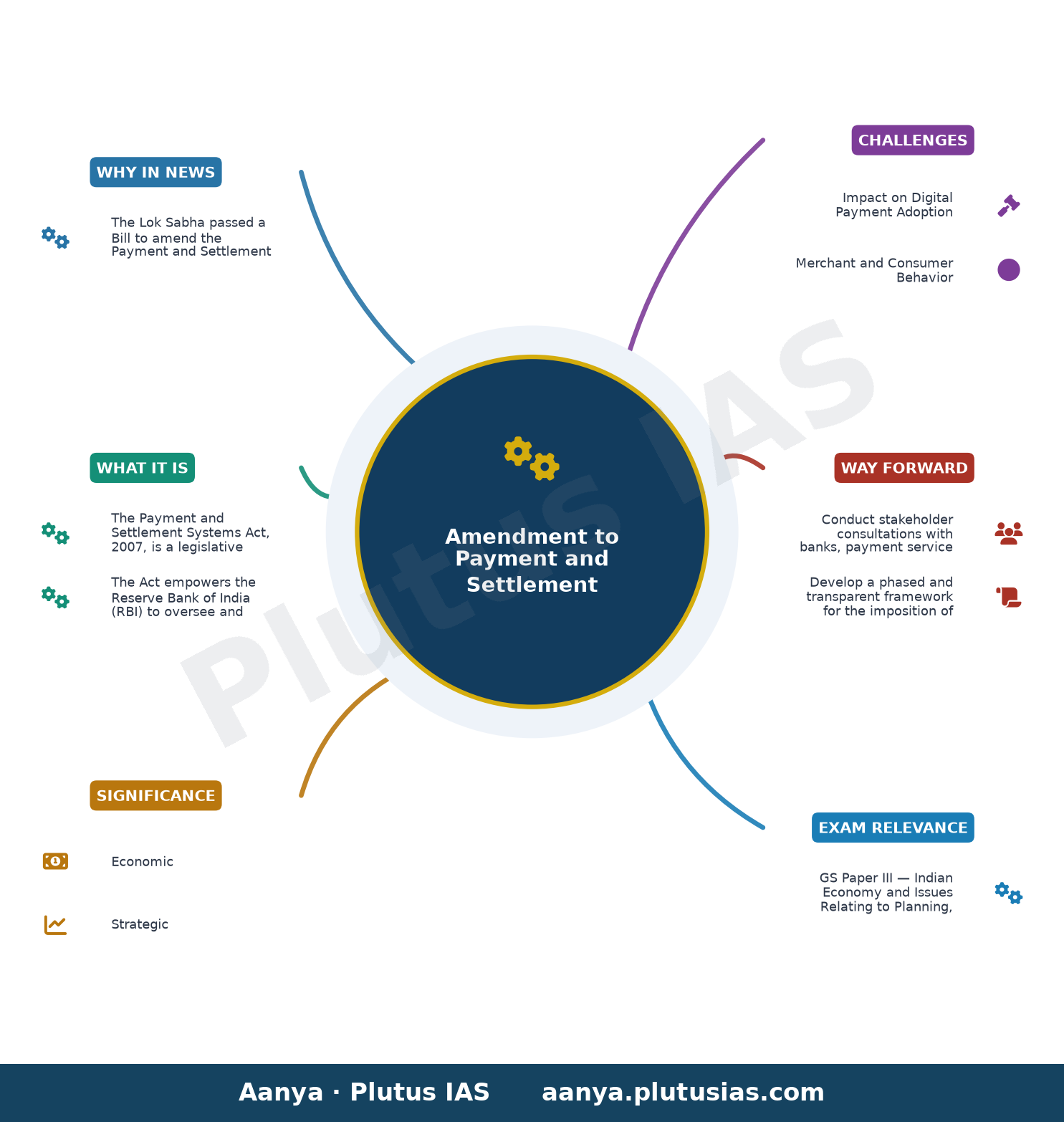
- GS Paper III — Indian Economy and Issues Relating to Planning, Mobilisation of Resources, Growth, Development and Employment
- Prelims: Merchant Discount Rate (MDR), Unified Payments Interface (UPI), Payment and Settlement Systems Act, 2007, Foreign Portfolio Investors (FPIs), Gross Domestic Product (GDP), digital payment ecosystem
- Essay: The role of digital public infrastructure in India’s economic transformation, Balancing fiscal sustainability with financial inclusion in public policy
Quick Revision: The amendment to the Payment and Settlement Systems Act, 2007, removes the zero-MDR framework for UPI transactions, potentially introducing charges for merchants.
Why is this in the news?
The Lok Sabha passed a Bill to amend the Payment and Settlement Systems Act, 2007 on 6 August 2026, which amends the Payment and Settlement Systems Act, 2007 to remove the legal prohibition on charging Merchant Discount Rate (MDR) on UPI transactions. This move, undertaken amid Opposition protests and without discussion, aims to introduce a revenue model for banks and payment service providers. The amendment reflects a strategic shift in India’s digital payment policy and foreign investment framework, with potential implications for consumers, merchants, and the broader financial ecosystem.
Background
- The Payment and Settlement Systems Act, 2007, was enacted to regulate and supervise payment systems in India, ensuring stability and efficiency in financial transactions.
- The zero-MDR framework for UPI transactions was introduced to promote digital payments and financial inclusion, exempting users and merchants from transaction charges.
- Real-Time Gross Settlement (RTGS) and National Electronic Funds Transfer (NEFT) systems have historically levied service charges, unlike UPI, which remained free.
- The Taxation and other Laws (Amendment) Bill, 2026, replaces an ordinance issued on 5 June 2026, which provided income tax exemptions to Foreign Portfolio Investors (FPIs) on interest income and capital gains from investments in Government Securities (G-Secs).
- The Bill also unlinks the Payment and Settlement Systems Act from the Income Tax Act, 2025, granting the government flexibility to modify the zero-MDR framework without legislative changes.
- The government’s stated objective is to create a predictable and attractive environment for global capital, manufacturing, and business investments in India.
What is the Payment and Settlement Systems Act, 2007, and the proposed amendment?
- The Payment and Settlement Systems Act, 2007, is a legislative framework that regulates payment systems in India, including digital payment modes such as UPI, IMPS, and cards, to ensure systemic stability and consumer protection.
- The Act empowers the Reserve Bank of India (RBI) to oversee and regulate payment systems, including the imposition of charges for services rendered by banks and intermediaries.
- The zero-MDR policy for UPI transactions was introduced to incentivize digital payments and reduce the cost burden on merchants and consumers, aligning with the government’s push for a cashless economy.
- The amendment removes Section 27 of the Act, which prohibited the levying of MDR on notified electronic payment modes, thereby enabling banks and payment service providers to charge fees for UPI transactions.
- The proposed changes aim to create a sustainable revenue model for banks and intermediaries, addressing the financial viability of the digital payment ecosystem, particularly in light of rising transaction volumes and infrastructure costs.
- The Taxation and other Laws (Amendment) Bill, 2026, replaces the June 2026 ordinance that provided I-T exemption to interest income and capital gains made by FPIs from investments in G-Secs.
- The government’s rationale includes enhancing the predictability of India’s regulatory environment to bolster investor confidence and economic growth.
Key Features
| Feature | Significance |
|---|---|
| Removal of zero-MDR provision for UPI | Enables banks and payment service providers to levy Merchant Discount Rate (MDR) on UPI transactions, potentially introducing charges for merchants. |
| Amendment to Payment and Settlement Systems Act, 2007 | Provides legal framework for the government to regulate and modify charges on electronic payment modes, including UPI. |
| Unlinking from Income Tax Act, 2025 | Decouples the regulation of payment systems from income tax provisions, allowing independent policy adjustments. |
| Exemption for RTGS and NEFT transactions | Maintains existing service charges for real-time gross settlement (RTGS) and national electronic funds transfer (NEFT) systems. |
| Provision for Foreign Portfolio Investors (FPIs) | Extends income tax exemptions to interest income and capital gains from investments in government securities (G-Secs). |
Why it Matters
Economic
- Introduces a revenue model for banks and payment service providers, ensuring sustainability of digital payment ecosystems.
- May influence consumer behavior and merchant pricing strategies if charges are introduced on UPI transactions.
- Enhances India’s attractiveness for global capital by providing tax certainty and regulatory predictability for offshore investors.
- Supports the monetisation of digital payment infrastructure without disrupting the existing free consumer experience.
Strategic
- Aligns with the government’s broader objective of fostering a predictable and business-friendly environment for domestic and international stakeholders.
- Strengthens the regulatory oversight of digital payment systems, ensuring compliance and stability in financial transactions.
- Balances the promotion of digital payments with the need for fiscal sustainability in the financial services sector.
Legal
- Amends the Payment and Settlement Systems Act, 2007, to grant the government flexibility in regulating electronic payment modes.
- Decouples payment system regulations from income tax provisions, reducing legislative interdependencies.
- Ensures legal clarity for the imposition of charges on UPI transactions, subject to government notification.
Challenges
1. Impact on Digital Payment Adoption
- Risk of reduced adoption of UPI if charges are introduced, potentially undermining the government’s push for a cashless economy.
- Possible shift of users to other payment modes if UPI becomes costly for merchants and consumers.
- Need for calibrated policy to balance revenue generation with the promotion of digital payments.
UPSC Link: GS3: Digital Economy
2. Merchant and Consumer Behavior
- Merchants may pass on MDR charges to consumers, leading to higher prices for goods and services.
- Small merchants, particularly in rural and semi-urban areas, may face disproportionate cost burdens.
- Potential resistance from consumer groups and digital payment advocates if charges are perceived as regressive.
UPSC Link: GS3: Inclusive Growth
3. Regulatory and Compliance Complexity
- Requires robust mechanisms to prevent misuse of MDR charges and ensure transparency in pricing.
- Need for clear guidelines on the quantum of charges and their applicability across different transaction types.
- Monitoring and enforcement challenges to prevent arbitrary or exploitative pricing by payment service providers.
UPSC Link: GS3: Financial Inclusion
4. Global Investment Attractiveness
- While tax exemptions for FPIs aim to attract capital, the broader regulatory changes must not deter long-term investment confidence.
- Need to ensure that the introduction of charges on UPI does not create a perception of policy instability among foreign investors.
UPSC Link: GS3: Foreign Investment
Challenges — UPSC Perspective
| Issue | Concern |
|---|---|
| Consumer adoption | Potential decline in UPI usage if charges are introduced, affecting digital payment penetration. |
| Merchant costs | Increased operational costs for merchants, particularly small and medium enterprises. |
| Policy calibration | Balancing revenue generation with the promotion of digital payments to avoid unintended consequences. |
| Regulatory oversight | Ensuring transparency and fairness in the imposition and collection of MDR charges. |
| Global investor sentiment | Maintaining India’s attractiveness for foreign portfolio investments amid regulatory changes. |
Way Forward
- Conduct stakeholder consultations with banks, payment service providers, merchants, and consumer groups to assess the impact of introducing MDR charges on UPI transactions.
- Develop a phased and transparent framework for the imposition of MDR charges, ensuring minimal disruption to digital payment adoption.
- Strengthen digital literacy campaigns to educate consumers and merchants about the potential changes and their rights.
- Enhance monitoring mechanisms to prevent exploitative pricing and ensure compliance with regulatory guidelines.
- Evaluate the long-term effects of the amendment on the digital payment ecosystem and adjust policies as necessary to maintain growth and inclusivity.
- Ensure that the tax exemptions for FPIs in G-Secs are effectively communicated to global investors to maintain capital inflows.
- Promote alternative digital payment modes, such as RTGS and NEFT, to diversify the payment ecosystem and reduce dependency on UPI.
UPSC Value Addition
Keywords for Mains Answer-Writing
Payment and Settlement Systems Act, 2007 · Merchant Discount Rate (MDR) · Unified Payments Interface (UPI) · Taxation and Other Laws (Amendment) Bill, 2026 · digital payments ecosystem sustainability · offshore funds and capital flows · Income Tax Act, 2025 · Financial sector regulation in India · monetary policy and transaction costs · electronic payment modes and banking revenue models
Concept Flow
Introduction of zero-MDR provision for UPI transactions → Amendment to Payment and Settlement Systems Act, 2007 to remove zero-MDR restriction → Potential introduction of MDR charges on UPI transactions by banks and payment service providers → Impact on merchant costs and consumer behavior → Possible shift in digital payment adoption and pricing strategies → Broader implications for digital economy and financial inclusion → Regulatory and policy adjustments to balance revenue generation and digital payment promotion
Prelims Practice Questions
Q1. Consider the following statements regarding the Payment and Settlement Systems Act, 2007 and the Taxation and Other Laws (Amendment) Bill, 2026:
1. The Amendment Bill seeks to remove the legal provision preventing banks from charging Merchant Discount Rate (MDR) on UPI transactions.
2. The Bill exempts UPI transactions from all service charges indefinitely.
3. The Bill amends the Income Tax Act, 2025 to provide tax exemptions for interest income and capital gains made by Foreign Portfolio Investors (FPIs) in Government Securities (G-Secs).
4. The Payment and Settlement Systems Act, 2007, currently prohibits any charges on electronic payment modes including NEFT and RTGS.
How many of the above statements are correct?
- Only one
- Only two
- Only three
- All
Answer: Only three — Statement 1 is correct as the Bill removes the legal barrier to charging MDR on UPI transactions. Statement 2 is incorrect because the Bill does not exempt UPI from charges indefinitely; it allows the government to introduce charges. Statement 3 is correct as the Bill replaces an ordinance providing such exemptions. Statement 4 is incorrect because NEFT and RTGS transactions already attract service charges.
Q2. Assertion (A): The Taxation and Other Laws (Amendment) Bill, 2026, aims to enhance the sustainability of the digital payments ecosystem by allowing banks to charge Merchant Discount Rate (MDR) on UPI transactions.
Reason (R): The removal of the zero-MDR framework is intended to create a revenue model for banks and payment service providers, ensuring the continuity and growth of digital payments in India.
Options:
A. Both A and R are true, and R is the correct explanation of A.
B. Both A and R are true, but R is not the correct explanation of A.
C. A is true, but R is false.
D. A is false, but R is true.
Answer: ? — Both the Assertion (A) and Reason (R) are factually accurate. The Bill’s primary objective is to enable banks and payment service providers to levy MDR on UPI transactions, thereby establishing a sustainable revenue model. The Reason (R) correctly explains the Assertion (A).
Q3. Match the following columns with reference to the Payment and Settlement Systems Act, 2007 and the Taxation and Other Laws (Amendment) Bill, 2026:
Column I
1. Merchant Discount Rate (MDR)
2. Unified Payments Interface (UPI)
3. Income Tax Act, 2025
4. Government Securities (G-Secs)
Column II
A. Electronic payment mode exempted from charges until the Amendment Bill
B. Tax exemption for FPIs investing in these instruments
C. Fee charged by banks on merchant transactions
D. Amended by the Bill to provide tax exemptions for FPIs
- 1-C, 2-A, 3-D, 4-B
- 1-A, 2-C, 3-B, 4-D
- 1-B, 2-D, 3-A, 4-C
- 1-D, 2-B, 3-C, 4-A
Answer: 1-C, 2-A, 3-D, 4-B — MDR (Column I-1) is the fee charged by banks on merchant transactions (Column II-C). UPI (Column I-2) was exempted from charges until the Amendment Bill (Column II-A). The Income Tax Act, 2025 (Column I-3) is amended by the Bill to provide tax exemptions for FPIs (Column II-D). Government Securities (Column I-4) are the instruments in which FPIs invest to avail tax exemptions (Column II-B).
Mains Practice Question
✍ Critically examine the rationale behind the removal of the zero-Merchant Discount Rate (MDR) framework for Unified Payments Interface (UPI) transactions through the Taxation and Other Laws (Amendment) Bill, 2026. How far does this amendment align with the broader objectives of financial inclusion and digital payment ecosystem sustainability? (15 Marks)
Approach: MODEL-ANSWER SKELETON:
1. **Introduction (2 marks)**: Define Merchant Discount Rate (MDR) and the zero-MDR framework for UPI transactions under the Payment and Settlement Systems Act, 2007. State the key provisions of the Taxation and Other Laws (Amendment) Bill, 2026, including its objective to enable banks and payment service providers to levy MDR on UPI transactions.
2. **Rationale for Removal of Zero-MDR (4 marks)**:
– **Revenue Sustainability for Banks and PSPs**: Explain the need for a viable revenue model to support the operational costs of digital payment infrastructure, citing the Reserve Bank of India’s (RBI) concerns about the sustainability of the zero-MDR regime.
– **Incentivising Innovation**: Argue that charging MDR could incentivise banks and fintech firms to invest in technological advancements and customer service improvements.
– **Market-Based Pricing**: Highlight the government’s push for market-determined pricing to reduce cross-subsidisation and align transaction costs with actual service provision.
3. **Alignment with Financial Inclusion (4 marks)**:
– **Impact on Small Merchants**: Discuss the potential adverse effects on small merchants, particularly in rural and semi-urban areas, who may face increased transaction costs, thereby discouraging digital adoption.
– **Consumer Behaviour**: Analyse how the introduction of MDR could lead to a shift back to cash transactions, undermining the government’s financial inclusion goals under initiatives like Jan Dhan Yojana and Digital India.
– **Digital Divide**: Examine the risk of widening the digital divide, where marginalised sections of society may be excluded due to higher transaction costs.
4. **Broader Objectives of Digital Payment Ecosystem (3 marks)**:
– **Government’s Vision**: Link the amendment to the government’s broader vision of a less-cash economy and the role of UPI in achieving this, citing data on UPI’s growth (e.g., 14.9 billion transactions in July 2026).
– **Global Competitiveness**: Discuss how the amendment aims to make India an attractive destination for global capital and fintech innovation, as stated by the Finance Minister.
5. **Critique and Way Forward (2 marks)**:
– **Alternative Models**: Suggest alternatives such as tiered MDR structures, subsidies for small merchants, or government-funded incentives to balance sustainability and inclusion.
– **Regulatory Safeguards**: Emphasise the need for regulatory safeguards to prevent excessive charges and ensure transparency in pricing.
**Balanced View**: Present both the pro-reform arguments (sustainability, innovation) and the anti-reform concerns (inclusion, consumer welfare) without taking an overtly partisan stance.
Source: Mint
Generated by AanyaAi for educational purpose.

- तमिलनाडु निजी विश्वविद्यालय संशोधन विधेयक 2026: विवाद क्यों? - September 21, 2026
- Tamil Nadu Private Universities Bill 2026: Key Amendments & Controversy Explained for UPSC - September 21, 2026
- स्वच्छ सागर सुरक्षित सागर 5.0: 15 लाख लोगों ने ली महासागर संरक्षण की शपथ, जानें पूरा विवरण - September 21, 2026

No Comments