


07 Aug Lok Sabha Passes Bill to Allow UPI MDR Charges: Key Implications for UPSC
✎ The Taxation and Other Laws (Amendment) Bill, 2026, seeks to amend the Payment and Settlement Systems Act, 2007, to enable the levying of Merchant Discount Rate (MDR) on UPI and RuPay transactions, potentially reintroducing a…
Subject Relevance — Where This Topic Fits
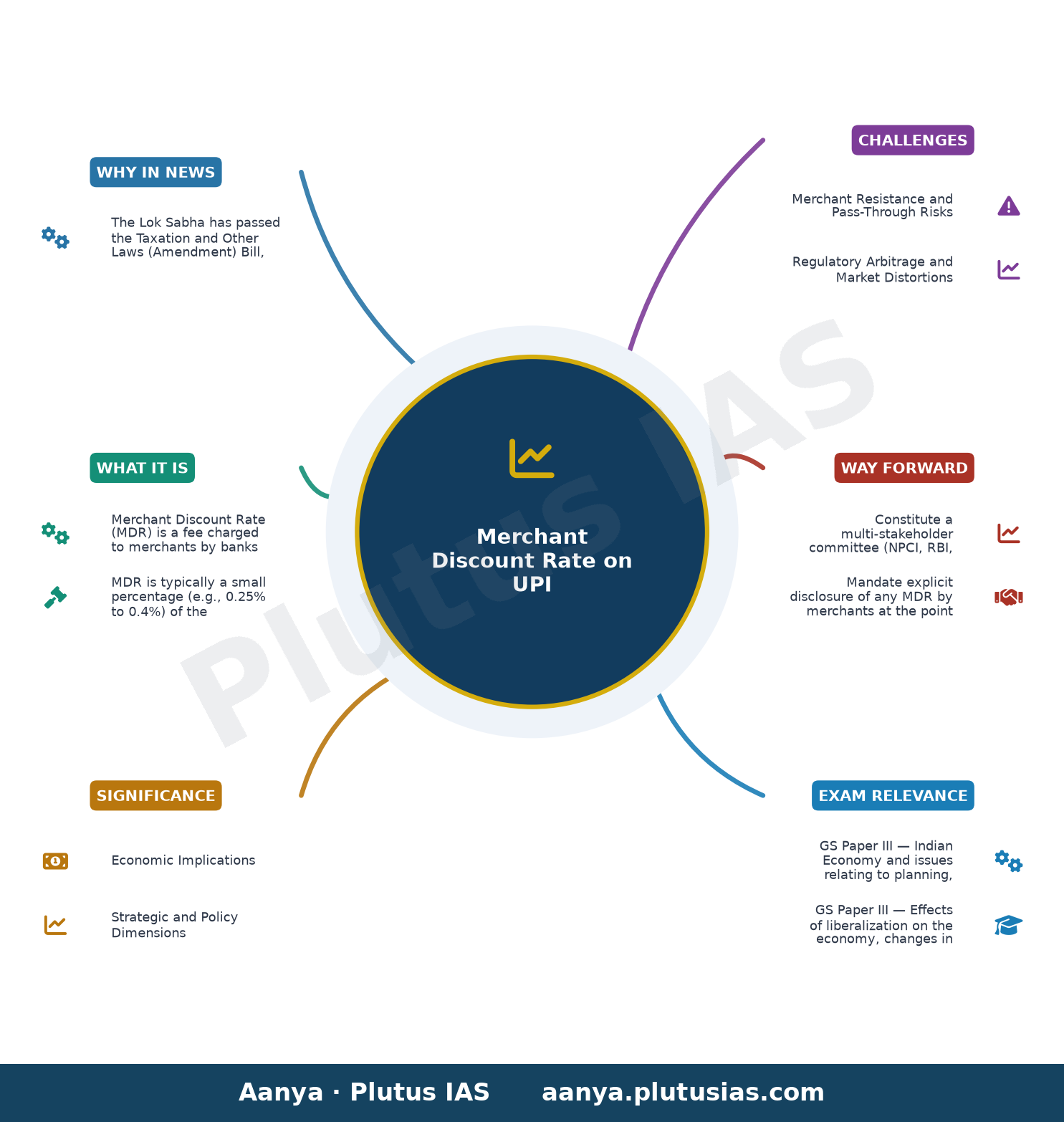
- GS Paper III — Indian Economy and issues relating to planning, mobilization of resources, growth, development and employment | GS Paper III — Effects of liberalization on the economy, changes in industrial policy and their effects on industrial growth
- Prelims: Merchant Discount Rate (MDR), Unified Payments Interface (UPI), Payment and Settlement Systems Act, 2007, Reserve Bank of India (RBI) guidelines on digital payments, Zero-MDR framework, NPCI (National Payments Corporation of India), Digital Payment Incentives Scheme
- Essay: The role of technology in transforming governance and public service delivery, Balancing innovation and affordability in financial inclusion
Quick Revision: The Taxation and Other Laws (Amendment) Bill, 2026, seeks to amend the Payment and Settlement Systems Act, 2007, to enable the levying of Merchant Discount Rate (MDR) on UPI and RuPay transactions, potentially reintroducing a small fee on merchants to sustain digital payment infrastructure.
Why is this in the news?
The Lok Sabha has passed the Taxation and Other Laws (Amendment) Bill, 2026, which seeks to amend the Payment and Settlement Systems Act, 2007, to remove the legal prohibition on levying Merchant Discount Rate (MDR) on UPI and RuPay card transactions. This legislative change is significant as it marks a potential shift from the zero-MDR policy, which has been in place since 2020, and aims to incentivize investment in digital payment infrastructure while addressing concerns about the sustainability of the current framework.
Background
- The zero-MDR policy on UPI transactions was introduced in 2020 to promote digital payments and reduce the cost burden on merchants, particularly small businesses, during the COVID-19 pandemic.
- The Payment and Settlement Systems Act, 2007, originally prohibited banks and payment service providers from charging MDR on electronic payment modes to ensure affordability and widespread adoption of digital payments.
- The Reserve Bank of India (RBI) and the National Payments Corporation of India (NPCI) have been instrumental in driving the adoption of UPI, which has become the world’s largest real-time payment system, processing over 10 billion transactions monthly.
- The government has consistently emphasized the need to reduce cash transactions to enhance transparency, formalize the economy, and curb tax evasion.
- The current framework has faced criticism from banks and fintech firms, which argue that the zero-MDR policy limits their ability to invest in infrastructure, innovation, and customer acquisition.
- The proposed amendment aligns with the government’s broader vision of a cashless economy and the Digital India initiative, which aims to integrate digital technologies into governance and public service delivery.
What is Merchant Discount Rate (MDR)?
- Merchant Discount Rate (MDR) is a fee charged to merchants by banks and payment service providers for processing digital transactions, including UPI, credit cards, debit cards, and RuPay cards.
- MDR is typically a small percentage (e.g., 0.25% to 0.4%) of the transaction value and is borne by the merchant, not the consumer, unless explicitly passed on.
- The fee is intended to cover the cost of infrastructure, transaction processing, and risk management for payment service providers.
- MDR rates vary depending on the payment mode, transaction value, and merchant category, with lower rates often applicable to UPI and RuPay transactions compared to international card networks.
- The zero-MDR policy, introduced in 2020, exempted merchants from paying any fee for UPI and RuPay transactions to encourage digital adoption, particularly among small businesses and informal sectors.
- The removal of the zero-MDR policy could incentivize banks and fintech firms to invest in expanding digital payment infrastructure, improving customer service, and developing innovative solutions.
- Critics argue that reintroducing MDR could increase the cost burden on small merchants, particularly in rural and semi-urban areas, and potentially slow down the adoption of digital payments.
- The government has proposed a cap on MDR rates for UPI and RuPay transactions, with rates ranging from 0.25% to 0.4% for transactions exceeding ₹2,000, to balance affordability and sustainability.
Key Features
| Feature | Significance |
|---|---|
| Removal of zero-MDR linkage with I-Tax Act | Decouples tax provisions from payment system regulations, granting the government flexibility to modify UPI/RuPay transaction charges without legislative constraints. |
| Merchant Discount Rate (MDR) applicability to merchants only | Ensures end-users (consumers) are not burdened with direct charges, aligning with the government’s objective of promoting digital payments without deterring adoption. |
| Provision for 0.25%-0.4% MDR on transactions >₹2,000 | Introduces a tiered fee structure to balance revenue generation for banks/fintechs while minimising impact on small merchants, with an overall ceiling to prevent excessive levies. |
| NPCI-led UPI and Services Steering Committee oversight | Maintains regulatory control over MDR implementation, ensuring phased and consultative decision-making post-Parliamentary approval. |
| Amendment to Payment and Settlement Systems Act | Enables the government to dynamically adjust transaction charges, fostering a responsive regulatory framework for evolving digital payment ecosystems. |
Why it Matters
Economic Implications
- Enhances revenue streams for banks and fintech firms, enabling reinvestment in digital infrastructure and innovation to improve UPI/RuPay service quality.
- Potential reduction in cross-subsidisation of digital payments, where banks currently bear transaction costs without commensurate revenue, improving financial sustainability.
- May incentivise banks to expand UPI adoption in tier-2/3 cities and rural areas by offsetting operational costs through MDR, bridging the digital divide.
- Risk of merchant pass-through of MDR to consumers, particularly for high-value transactions, which could dampen digital payment growth if not regulated strictly.
- Long-term impact on cashless economy goals may depend on consumer sensitivity to indirect charges and merchant pricing strategies.
Strategic and Policy Dimensions
- Demonstrates the government’s intent to balance innovation with fiscal prudence, using regulatory tools to sustain a competitive digital payments ecosystem.
- Aligns with global trends where MDR is a standard revenue model for payment processors (e.g., credit/debit card networks), ensuring parity with international practices.
- Highlights the evolving role of NPCI as a quasi-regulatory body, steering both market growth and consumer protection in digital payments.
- Raises questions about the government’s ability to preemptively address unintended consequences, such as merchant resistance or consumer backlash, without parliamentary debate.
Social and Consumer Impact
- Preserves the zero-cost benefit for end-users, a key driver of UPI’s mass adoption and financial inclusion, particularly for low-income segments.
- May disproportionately affect small merchants who lack bargaining power to absorb MDR, potentially increasing their operational costs.
- Could exacerbate digital payment disparities if MDR discourages adoption among price-sensitive consumers or merchants in informal sectors.
Challenges
1. Merchant Resistance and Pass-Through Risks
- Small merchants may resist MDR implementation due to thin profit margins, leading to either refusal of UPI/RuPay payments or covert price increases.
- Lack of transparency in MDR pricing could erode consumer trust, particularly if merchants do not disclose the fee explicitly.
UPSC Link: GS3: Digital economy – challenges of regulation
2. Regulatory Arbitrage and Market Distortions
- Risk of regulatory arbitrage where banks/fintechs exploit loopholes to impose higher MDR on specific transaction types or merchant categories.
- Potential distortion in competition between UPI and other payment modes (e.g., credit cards, wallets) if MDR is not uniformly applied across platforms.
UPSC Link: GS3: Financial sector regulation
3. Consumer Protection and Transparency Gaps
- Inadequate mechanisms to ensure merchants do not pass on MDR to consumers, violating the principle of zero-cost digital payments for users.
- Lack of grievance redressal for consumers facing indirect charges, as current frameworks focus on merchant-side compliance.
UPSC Link: GS3: Consumer rights in digital transactions
4. Infrastructure and Innovation Trade-offs
- Banks/fintechs may prioritise revenue generation over innovation if MDR becomes a significant income stream, potentially slowing down UPI feature upgrades.
- Regional disparities in digital infrastructure could widen if MDR revenue is unevenly distributed, favouring urban and high-volume merchant clusters.
UPSC Link: GS3: Digital public infrastructure
5. Parliamentary Scrutiny and Democratic Accountability
- Passage of the bill without discussion raises concerns about democratic oversight, particularly for a policy with wide-ranging economic and social implications.
- Absence of pre-legislative consultation with stakeholders (e.g., merchant associations, consumer groups) may lead to implementation challenges.
UPSC Link: Polity: Parliamentary functioning and accountability
Challenges — UPSC Perspective
| Issue | Concern |
|---|---|
| Merchant pass-through of MDR | Risk of indirect cost burden on consumers, undermining UPI’s zero-cost appeal. |
| Regulatory fragmentation | Potential inconsistencies in MDR application across payment modes, creating market distortions. |
| Consumer awareness deficit | Lack of clarity on MDR among users may lead to distrust or resistance to digital payments. |
| Small merchant exclusion | High MDR could marginalise small businesses, reducing their competitiveness against larger enterprises. |
| Infrastructure inequality | Uneven distribution of MDR revenue may exacerbate urban-rural digital divide in payment acceptance infrastructure. |
| Accountability mechanisms | Insufficient grievance redressal frameworks for consumers facing MDR-related disputes. |
Way Forward
- Constitute a multi-stakeholder committee (NPCI, RBI, merchant associations, consumer groups) to finalise MDR rates and caps, ensuring transparency and equity.
- Mandate explicit disclosure of any MDR by merchants at the point of sale, with penalties for non-compliance to protect consumer interests.
- Pilot MDR implementation in select districts with high UPI adoption to assess impact before nationwide rollout, incorporating real-time feedback.
- Strengthen the RBI’s oversight role to monitor MDR pricing and prevent anti-competitive practices, with periodic public disclosures.
- Develop a consumer education campaign to clarify MDR’s purpose, ensure awareness of rights, and mitigate resistance to digital payments.
- Incorporate MDR revenue-sharing models that incentivise banks/fintechs to invest in rural and semi-urban digital infrastructure.
- Establish a grievance redressal mechanism under the Consumer Protection Act for MDR-related disputes, ensuring swift resolution.
- Conduct a cost-benefit analysis post-implementation to evaluate the net impact on digital payment growth, merchant viability, and consumer welfare.
UPSC Value Addition
Keywords for Mains Answer-Writing
Digital Payment Ecosystem in India · Unified Payments Interface (UPI) · Merchant Discount Rate (MDR) · Payment and Settlement Systems Act, 2007 · Taxation and Other Laws (Amendment) Bill, 2026 · Reserve Bank of India (RBI) · National Payments Corporation of India (NPCI) · Digital Public Infrastructure (DPI) · Financial Inclusion · Regulatory Arbitrage · Fintech Sector · Electronic Payment Modes · Government of India’s Digital Push · Zero-MDR Framework · Payment Aggregators
Concept Flow
Digital Payment Adoption → Zero-MDR Policy → Revenue Constraints for Banks/Fintechs → Need for Sustainable Revenue Model → Introduction of MDR → Merchant and Consumer Impact → Regulatory Oversight by NPCI/RBI → Potential Market Distortions → Policy Refinement → Balanced Ecosystem
Prelims Practice Questions
Q1. Consider the following statements regarding the Payment and Settlement Systems Act, 2007:
1. It regulates all payment systems in India.
2. The Act empowers the RBI to determine the Merchant Discount Rate (MDR) for electronic transactions.
3. The Act does not link the levy of MDR to the Income Tax Act, 1961.
4. The Act provides for the establishment of the NPCI as the nodal agency for retail payments.
How many of the above statements are correct?
- Only one
- Only two
- Only three
- All four
Answer: Only three — Statements 1, 2, and 4 are correct. Statement 3 is incorrect as the Taxation and Other Laws (Amendment) Bill, 2026 proposes to remove the linkage between the Payment and Settlement Systems Act and the Income Tax Act.
Q2. Assertion (A): The government’s proposal to allow Merchant Discount Rate (MDR) on UPI transactions is aimed at incentivizing banks and fintech firms to invest in digital payment infrastructure.
Reason (R): The current zero-MDR framework has limited the ability of payment service providers to generate revenue for infrastructure development.
Options:
A. Both A and R are true, and R is the correct explanation of A.
B. Both A and R are true, but R is not the correct explanation of A.
C. A is true, but R is false.
D. A is false, but R is true.
Answer: ? — Both the Assertion (A) and Reason (R) are true, and R correctly explains A. The zero-MDR framework restricts revenue generation for banks and fintechs, necessitating the introduction of MDR to fund infrastructure and innovation.
Q3. Which of the following entities is responsible for overseeing the Unified Payments Interface (UPI) and steering its policy framework in India?
- A. Reserve Bank of India (RBI)
- B. Ministry of Finance
- C. National Payments Corporation of India (NPCI)
- D. Securities and Exchange Board of India (SEBI)
Answer: C. National Payments Corporation of India (NPCI) — The National Payments Corporation of India (NPCI) is the nodal agency responsible for overseeing the UPI and its policy framework, as mandated by the RBI.
Mains Practice Question
✍ The Taxation and Other Laws (Amendment) Bill, 2026 seeks to introduce Merchant Discount Rate (MDR) on UPI transactions, marking a departure from the zero-MDR framework. Critically examine the implications of this policy shift for the digital payment ecosystem in India, with reference to financial inclusion, innovation, and regulatory oversight. (15 Marks)
Approach: MODEL-ANSWER SKELETON:
1. **Introduction**: Briefly define UPI, MDR, and the zero-MDR framework. Mention the objectives of the Taxation and Other Laws (Amendment) Bill, 2026.
2. **Implications for Financial Inclusion**:
– Current zero-MDR framework has enabled widespread adoption of UPI, benefiting small merchants and low-income users.
– Introduction of MDR may lead to increased costs for merchants, potentially excluding small businesses from digital payments.
– Need to balance revenue generation for banks/fintechs with affordability for merchants.
3. **Impact on Innovation and Infrastructure**:
– MDR can provide revenue streams for banks and fintech firms, enabling investment in digital payment infrastructure.
– Potential for improved user experience, security, and interoperability.
– Risk of regulatory arbitrage if MDR is not uniformly applied across payment modes.
4. **Regulatory Oversight and Consumer Protection**:
– Role of RBI in regulating MDR rates to prevent exploitation.
– Need for transparency in MDR pricing and grievance redressal mechanisms.
– Comparison with global models (e.g., EU’s PSD2, Singapore’s regulatory sandbox).
5. **Conclusion**: Weigh the trade-offs between revenue generation for stakeholders and the need to sustain financial inclusion. Suggest measures such as tiered MDR rates or subsidies for small merchants to mitigate adverse effects.
Source: Times of India
Generated by AanyaAi for educational purpose.

- संयुक्त राष्ट्र पैनल ने AI एजेंटों की बढ़ती शक्ति पर सुरक्षा बढ़ाने की चेतावनी दी - September 21, 2026
- UN Panel Warns: AI Agents May Outpace Human Control Safeguards - September 21, 2026
- तमिलनाडु में मुर्गे की लड़ाई पर पूर्ण प्रतिबंध नहीं: डीजीपी कार्यालय ने मद्रास उच्च न्यायालय को बताया - September 21, 2026

No Comments