


06 Aug Lok Sabha Passes Bill to Allow UPI Transaction Charges: Key Implications for UPSC
✎ The amendment to the Payment and Settlement Systems Act, 2007, empowers the government to permit charges on UPI and other notified electronic payment modes, potentially ending India’s zero-cost digital payment era while aiming to…
Subject Relevance — Where This Topic Fits
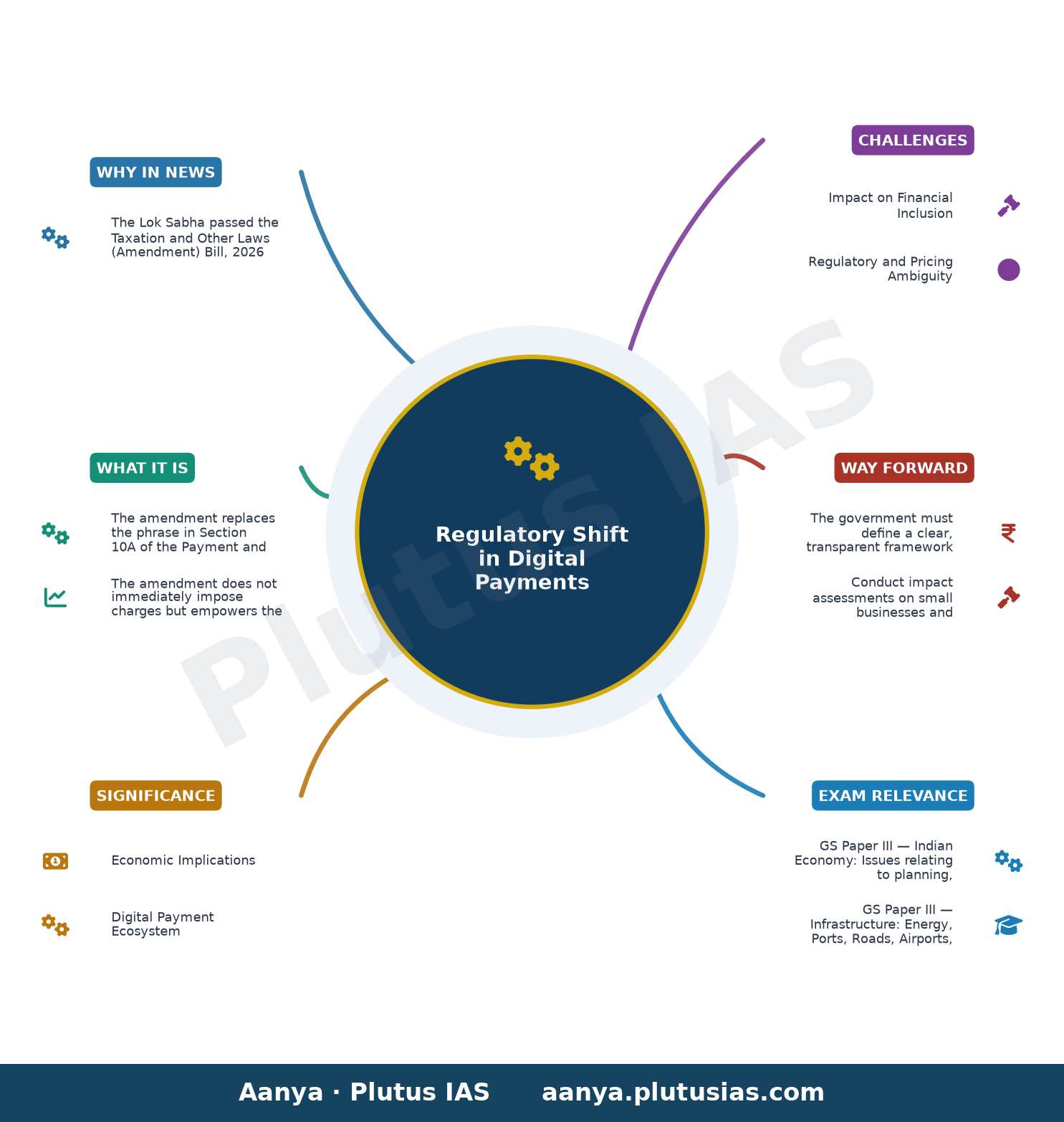
- GS Paper III — Indian Economy: Issues relating to planning, mobilization of resources, growth, development and employment; Inclusive growth and issues arising from it; Government Budgeting | GS Paper III — Infrastructure: Energy, Ports, Roads, Airports, Railways etc.
- Prelims: UPI, Merchant Discount Rate (MDR), Payment and Settlement Systems Act 2007, Section 10A, Section 269SU, BHIM-UPI, RuPay, RTGS, NEFT, digital payment ecosystem
- Essay: The paradox of financial inclusion and economic sustainability: Can digital payments remain free for all?
Quick Revision: The amendment to the Payment and Settlement Systems Act, 2007, empowers the government to permit charges on UPI and other notified electronic payment modes, potentially ending India’s zero-cost digital payment era while aiming to sustain the payments ecosystem.
Why is this in the news?
The Lok Sabha passed the Taxation and Other Laws (Amendment) Bill, 2026 on August 6, 2026, which amends the Payment and Settlement Systems Act, 2007 to empower the government to permit banks and payment service providers to levy charges on UPI and other notified electronic payment modes. This legislative move, undertaken without parliamentary debate due to Opposition disruption, marks a significant shift in India’s digital payments policy, hitherto characterized by zero-cost transactions under Section 10A of the Act. The amendment seeks to address the sustainability of the digital payments infrastructure by introducing revenue models for stakeholders while potentially altering the cost dynamics for consumers and merchants.
Background
- The Payment and Settlement Systems Act, 2007, was enacted to regulate payment systems in India, ensuring stability, efficiency, and consumer protection in electronic fund transfers.
- Section 10A of the Act explicitly prohibited banks and system providers from imposing any charges on electronic payments, fostering a zero-cost environment for digital transactions, including UPI.
- UPI, launched in 2016, has revolutionized retail digital payments in India, achieving over 140 billion transactions in FY 2025-26, with a transaction value exceeding ₹200 lakh crore, driven by its interoperability and zero-cost model.
- The Reserve Bank of India (RBI) and the Government of India have historically promoted digital payments as a tool for financial inclusion, reducing cash dependency, and enhancing transparency in transactions.
- Real-time payment systems like RTGS and NEFT have always levied service charges, creating an anomaly where UPI, despite being a real-time system, remained cost-free for users.
What are the key provisions and implications of the amendment to the Payment and Settlement Systems Act, 2007?
- The amendment replaces the phrase in Section 10A of the Payment and Settlement Systems Act, 2007, substituting the reference to ‘electronic modes of payment prescribed under Section 269SU’ with ‘one or more electronic modes of payment as the central government may, by notification, specify’. This grants the government the authority to designate electronic payment modes (e.g., UPI, IMPS, cards) for which charges may be levied.
- The amendment does not immediately impose charges but empowers the government to permit banks and payment service providers (PSPs) to levy Merchant Discount Rate (MDR) or other fees on UPI and other notified electronic payment modes.
- The proposed charges are intended to create a sustainable revenue model for banks, PSPs, and payment infrastructure firms, which have borne the cost of maintaining and scaling digital payment systems without direct monetization.
- The government’s approach emphasizes a ‘small charge’ model to balance financial sustainability with affordability, particularly for small businesses and consumers, though the exact quantum of charges remains unspecified and subject to future notifications.
- The legislative move aligns with global practices where digital payment systems often involve transaction fees, though India’s UPI model has been an outlier in its zero-cost approach.
- The amendment does not affect RTGS, NEFT, or IMPS, which already have service charges, thereby preserving the existing fee structure for these payment systems.
- The government’s intent is to ensure that the digital payments ecosystem remains robust, scalable, and self-sustaining, particularly as transaction volumes and infrastructure costs rise.
Key Features
| Feature | Significance |
|---|---|
| Amendment to Section 10A, Payment and Settlement Systems Act, 2007 | Removes the prohibition on levying charges for electronic payment modes, enabling banks and PSPs to impose fees on UPI and other notified digital payments. |
| Substitution of Section 10A language | Replaces the reference to Section 269SU (Income-tax Act) with a broader provision empowering the government to specify electronic modes for charge imposition via notification. |
| Merchant Discount Rate (MDR) flexibility | Allows banks and PSPs to levy MDR on UPI transactions, aligning digital payment charges with those of RTGS/NEFT systems. |
| Exclusion of Section 269SU compliance | Removes the requirement for large businesses to accept payments through specific electronic modes without charge, as the prohibition on MDR is lifted. |
| Revenue model sustainability | Aims to create a sustainable revenue stream for banks, PSPs, and infrastructure firms to support digital payment ecosystem development. |
Why it Matters
Economic Implications
- Introduces a revenue model for banks and payment service providers, addressing the cost of maintaining digital payment infrastructure.
- May incentivise banks to invest in payment technology and fraud prevention, enhancing system resilience.
- Potential to reduce cross-subsidisation of digital payments by banks, which currently bear the cost of UPI transactions.
- Could lead to a tiered pricing model, where high-volume merchants pay higher charges, affecting small businesses disproportionately.
Digital Payment Ecosystem
- Shifts the paradigm from free UPI transactions to a cost-bearing model, altering user behaviour and adoption rates.
- May accelerate the adoption of alternative payment modes (e.g., wallets, cards) if UPI charges become prohibitive.
- Raises questions about the future of UPI’s dominance in India’s digital payments landscape, given its near-universal adoption.
- Could prompt the government to introduce subsidies or exemptions for small merchants to mitigate adverse effects.
Policy and Governance
- Demonstrates the government’s intent to monetise digital public infrastructure, balancing innovation with fiscal sustainability.
- Highlights the need for transparent pricing mechanisms to avoid exploitation by payment service providers.
- Raises concerns about regulatory arbitrage, as the government retains discretion to specify which payment modes attract charges.
Consumer and Merchant Impact
- Potential increase in transaction costs for consumers, particularly in low-value, high-frequency transactions.
- Merchants may pass on charges to consumers, leading to higher retail prices or reduced profitability for small businesses.
- Could disproportionately affect low-income users who rely heavily on UPI for daily transactions.
Challenges
1. Impact on Financial Inclusion
- Risk of reduced UPI adoption among low-income and rural users due to perceived or actual cost barriers.
- May widen the digital divide, as those unable to absorb additional costs could revert to cash transactions.
- Potential to undermine the objectives of the JAM trinity (Jan Dhan, Aadhaar, Mobile) and PMJDY.
UPSC Link: GS3: Digital Payments and Financial Inclusion
2. Regulatory and Pricing Ambiguity
- Lack of clarity on the quantum of charges, leading to uncertainty among banks, PSPs, and merchants.
- Risk of cartelisation among payment service providers if charges are not competitively determined.
- Need for robust grievance redressal mechanisms to address disputes over charge imposition.
UPSC Link: GS3: Regulatory Frameworks for Digital Payments
3. Economic Disincentives for Small Businesses
- Small merchants may face higher operational costs, reducing their competitiveness against larger players.
- Could discourage digital adoption among small businesses, reversing progress in formalising the economy.
- May necessitate government intervention via subsidies or exemptions to protect vulnerable segments.
UPSC Link: GS3: MSMEs and Digital Transformation
4. Systemic Risks to UPI Ecosystem
- Potential fragmentation of the UPI ecosystem if charges lead to a shift towards alternative payment modes.
- Risk of reduced innovation in UPI-based solutions due to lower profitability for PSPs.
- May necessitate recalibration of the NPCI’s role in regulating and sustaining the UPI network.
UPSC Link: GS3: Payment and Settlement Systems
Challenges — UPSC Perspective
| Issue | Concern |
|---|---|
| Financial Inclusion | Increased costs may deter low-income users from adopting digital payments, reversing gains in financial inclusion. |
| Pricing Transparency | Ambiguity in charge imposition could lead to exploitation by payment service providers, eroding consumer trust. |
| Merchant Viability | Small merchants may face unsustainable cost burdens, reducing their digital adoption and competitiveness. |
| Regulatory Arbitrage | Government’s discretion to specify payment modes for charges could lead to inconsistent or arbitrary enforcement. |
| Systemic Stability | Fragmentation of the UPI ecosystem due to charge imposition may destabilise India’s digital payment infrastructure. |
Way Forward
- The government must define a clear, transparent framework for determining charges, including caps or tiered pricing to protect vulnerable users.
- Conduct impact assessments on small businesses and low-income users to identify sectors requiring targeted support or exemptions.
- Strengthen consumer protection mechanisms, including grievance redressal and dispute resolution, to address potential exploitation.
- Encourage competition among payment service providers by capping interchange fees or mandating competitive bidding for charge structures.
- Promote financial literacy campaigns to educate users on the benefits of digital payments despite potential charges, ensuring continued adoption.
- Collaborate with the NPCI to monitor the UPI ecosystem’s health post-implementation, addressing any systemic risks or fragmentation.
- Explore phased implementation, starting with high-value transactions, to mitigate immediate disruptions to user behaviour.
UPSC Value Addition
Keywords for Mains Answer-Writing
Payment and Settlement Systems Act, 2007 · Unified Payments Interface (UPI) · Merchant Discount Rate (MDR) · Digital payment ecosystem · Taxation and Other Laws (Amendment) Bill, 2026 · Section 10A of Payment and Settlement Systems Act, 2007 · Section 269SU of Income Tax Act, 1961 · Digital public infrastructure · Financial inclusion · Regulation of digital payments · Banking sector sustainability · Electronic modes of payment
Concept Flow
Legislative Prohibition on MDR (Section 10A, Payment and Settlement Systems Act, 2007) → Enables free UPI transactions. → Government Proposal to Amend Section 10A → Removes prohibition, allowing charge imposition. → Passage of Taxation and Other Laws (Amendment) Bill, 2026 → Substitutes Section 10A language, empowering government to specify payment modes for charges. → Implementation via Notification → Government identifies UPI and other electronic modes for charge levy. → Impact on Users and Merchants → Potential cost increase, affecting adoption and profitability. → Systemic Adjustments → Banks, PSPs, and NPCI recalibrate operations to align with new revenue model. → Policy Feedback Loop → Government assesses impact, adjusts charges or introduces exemptions as needed.
Prelims Practice Questions
Q1. Consider the following statements regarding the Payment and Settlement Systems Act, 2007:
1. Section 10A prohibits banks from imposing any charges on electronic payments.
2. The Act mandates large businesses to accept payments through RuPay debit cards and BHIM-UPI QR codes.
3. The Taxation and Other Laws (Amendment) Bill, 2026 seeks to remove the legal provision preventing banks from charging Merchant Discount Rate (MDR) on UPI transactions.
How many of the above statements are correct?
- Only one
- Only two
- All
- None
Answer: All — Statements 1 and 3 are correct. Statement 2 is incorrect as the requirement to accept payments through RuPay and BHIM-UPI QR codes is under Section 269SU of the Income Tax Act, 1961, not the Payment and Settlement Systems Act, 2007.
Q2. Assertion (A): The Taxation and Other Laws (Amendment) Bill, 2026 aims to introduce charges on UPI transactions to generate revenue for banks and payment service providers.
Reason (R): The Bill seeks to amend Section 10A of the Payment and Settlement Systems Act, 2007 to remove the prohibition on levying Merchant Discount Rate (MDR) on electronic payment modes.
Options:
A. Both A and R are true, and R is the correct explanation of A.
B. Both A and R are true, but R is not the correct explanation of A.
C. A is true, but R is false.
D. A is false, but R is true.
- A
- B
- C
- D
Answer: A — Both the Assertion (A) and Reason (R) are true. The Bill intends to generate revenue for banks and payment service providers by allowing charges on UPI transactions, and this is achieved by amending Section 10A to remove the prohibition on MDR levies.
Q3. Which of the following electronic payment modes is NOT explicitly mentioned in the context of the Taxation and Other Laws (Amendment) Bill, 2026?
A. Unified Payments Interface (UPI)
B. RuPay debit cards
C. NEFT
D. BHIM-UPI QR codes
- A
- B
- C
- D
Answer: C — NEFT is a real-time gross settlement system for fund transfers but is not explicitly mentioned in the context of the amendment to allow charges on UPI transactions. UPI, RuPay debit cards, and BHIM-UPI QR codes are explicitly referenced.
Mains Practice Question
✍ Critically examine the implications of the proposed amendments to the Payment and Settlement Systems Act, 2007, which seek to permit banks and payment service providers to levy charges on UPI transactions. In your answer, analyse the potential impact on financial inclusion, the digital public infrastructure, and the sustainability of the banking sector. Also, discuss the constitutional and policy dimensions of such a move. (15 Marks)
Approach: MODEL-ANSWER SKELETON:
1. **Context and Provisions**:
– Briefly state the purpose of the Taxation and Other Laws (Amendment) Bill, 2026, and its amendment to Section 10A of the Payment and Settlement Systems Act, 2007.
– Explain the removal of the prohibition on Merchant Discount Rate (MDR) for UPI transactions and other notified electronic payment modes.
2. **Impact on Financial Inclusion**:
– Discuss how the levy of charges may disproportionately affect small businesses, low-income users, and rural populations who rely on UPI for transactions.
– Reference the role of UPI in India’s digital public infrastructure (DPI) and its contribution to financial inclusion (e.g., Jan Dhan Yojana, Aadhaar-enabled payments).
– Cite data or reports (if available) on the usage of UPI among different socio-economic groups.
3. **Sustainability of the Banking Sector**:
– Argue the need for revenue models for banks and payment service providers to sustain digital payment ecosystems.
– Highlight the balance between affordability for users and the financial viability of payment infrastructure providers.
4. **Constitutional and Policy Dimensions**:
– Examine the constitutional validity of such a move under Article 300A (right to property) and the right to equality (Article 14).
– Discuss the policy rationale: Is this a step towards rationalising digital payment costs or a regressive measure that may deter digital adoption?
– Reference the government’s stance on promoting digital payments while ensuring sustainability.
5. **Comparative Perspective**:
– Compare India’s approach with global practices (e.g., Brazil’s MDR on card payments, EU’s PSD2 regulations).
6. **Conclusion**:
– Weigh the trade-offs between revenue generation for banks and the potential slowdown in digital adoption.
– Suggest safeguards (e.g., tiered pricing, exemptions for small transactions) to mitigate adverse impacts.
Source: The Hindu
Generated by AanyaAi for educational purpose.

- तमिलनाडु में बस किराए में संशोधन: सरकार को चार सप्ताह और समय मिला, उच्च न्यायालय का फैसला - September 22, 2026
- Madras HC gives Tamil Nadu 4 weeks to revise bus fares amid diesel price surge - September 22, 2026
- कुल्लू: NHPC की पार्वती-2 परियोजना के खिलाफ एफआईआर, 12 सदस्यीय जांच समिति गठित - September 21, 2026

No Comments