


07 Aug Lok Sabha Passes Data Centre Tax Amendment: Key Implications for UPSC
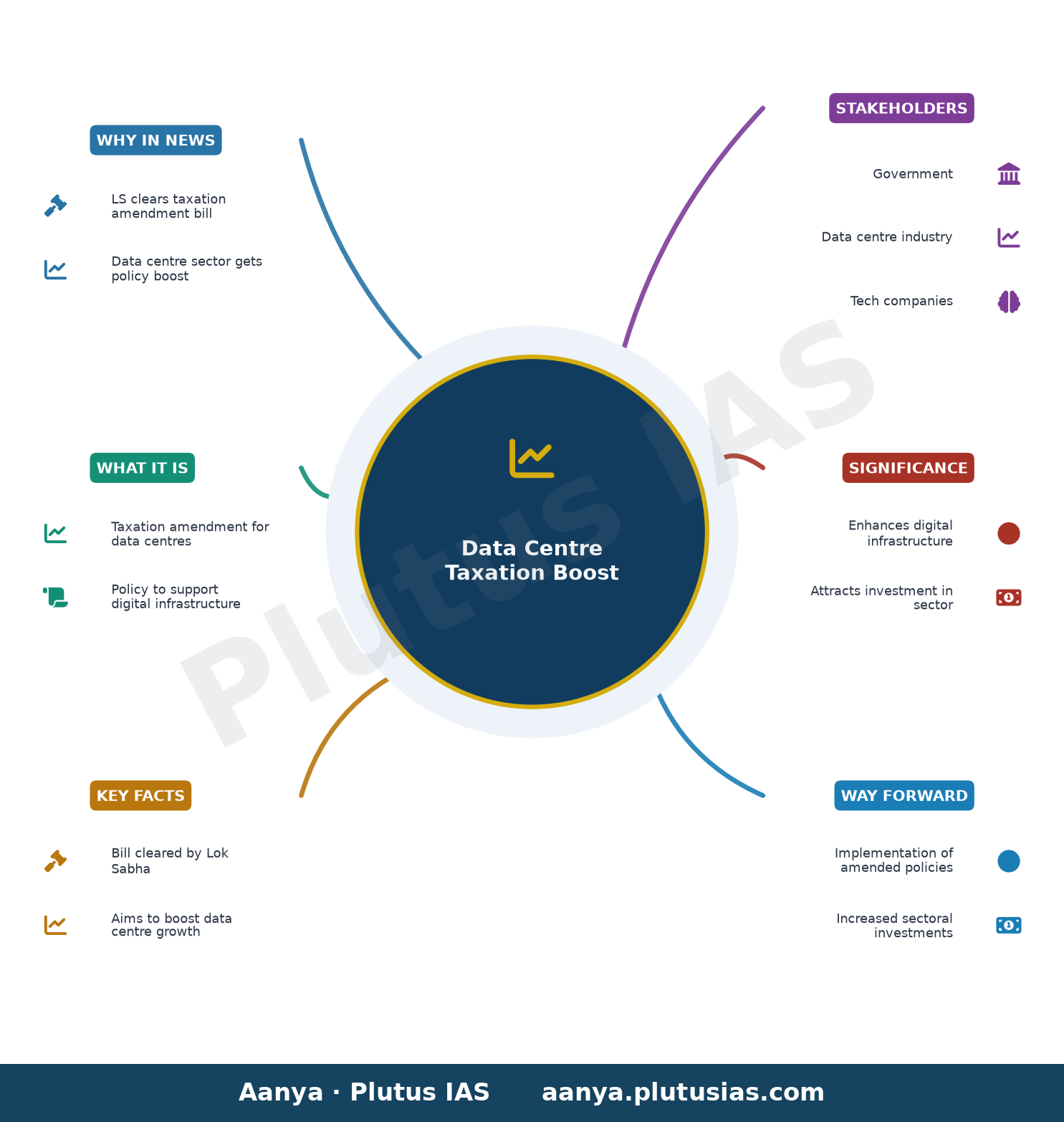
✎ Taxation amendment bill boosts data centre sector, enhancing digital infrastructure and attracting investments.
Relevance for UPSC & State PCS: Polity & Governance
The Lok Sabha’s recent clearance of the taxation amendment bill marks a significant policy boost for India’s burgeoning data centre sector, aligning with the government’s broader push to enhance digital infrastructure. The amendment, aimed at addressing long-standing tax ambiguities, introduces clarity on the Goods and Services Tax (GST) applicability for data centre services, including colocation, cloud computing, and related activities. This legislative move is expected to reduce compliance burdens, streamline tax structures, and attract greater private investment into a sector critical for India’s digital economy. For aspirants preparing for UPSC and State PCS examinations, this development underscores the interplay between fiscal policy and economic governance, particularly in sectors prioritized under initiatives like the Digital India campaign.
From a governance perspective, the amendment reflects the Centre’s intent to foster a business-friendly environment while addressing sector-specific challenges. Data centres, which serve as the backbone of India’s digital transformation, face high operational costs, including taxes on imported equipment and services. The bill’s provisions are likely to mitigate these costs by clarifying GST exemptions or reduced rates, thereby enhancing the sector’s competitiveness. For civil services aspirants, this highlights the importance of understanding how fiscal policies intersect with technological advancements and infrastructure development, a recurring theme in both prelims and mains examinations.
The policy shift also aligns with global trends, where countries are vying to attract data centre investments to bolster their digital sovereignty. India, with its vast talent pool and growing internet user base, stands to benefit significantly if the sector’s growth is accelerated through such reforms. For State PCS aspirants, this development is relevant in the context of federalism, as states may need to align their local policies with the Centre’s initiatives to fully leverage the economic benefits. Questions on cooperative federalism, tax reforms, and sectoral policies could emerge in interviews or descriptive papers, making this a pertinent case study.
Moreover, the amendment’s passage comes at a time when India is positioning itself as a global data hub, with initiatives like the India Data Accessibility Framework and the proposed Data Centre Policy in the pipeline. The Lok Sabha’s approval signals political consensus on the need for such reforms, which could pave the way for further legislative and executive actions. For UPSC aspirants, analyzing this bill in the context of India’s digital economy, GST reforms, and economic diplomacy would provide a nuanced understanding of governance challenges and opportunities. State PCS candidates, particularly those focusing on economic administration or IT policies, should note how such amendments can influence state-level investments and employment generation.
Source: Business Standard
Practice Questions
Q1. Which of the following is a key provision of the taxation amendment Bill passed by the Lok Sabha that benefits the data centre sector?
- Introduction of a 10% tax on data centre operations
- Exemption from Goods and Services Tax (GST) for data centre services
- Incentivization through tax holidays and reduced corporate tax rates for data centre investments
- Mandatory data localisation requirements for foreign data centre operators
Answer
Incentivization through tax holidays and reduced corporate tax rates for data centre investments — The taxation amendment Bill aims to boost the data centre sector by providing tax incentives, including tax holidays and reduced corporate tax rates, to attract investments and promote growth in the industry.
Q2. The Lok Sabha’s clearance of the taxation amendment Bill is expected to primarily impact which of the following sectors?
- Agriculture sector
- Automobile sector
- Data centre sector
- Healthcare sector
Answer
Data centre sector — The taxation amendment Bill specifically targets the data centre sector, as indicated by the context, to provide policy support and financial incentives for its development.
Generated by AanyaAi for educational purpose.

- तमिलनाडु में बस किराए में संशोधन: सरकार को चार सप्ताह और समय मिला, उच्च न्यायालय का फैसला - September 22, 2026
- Madras HC gives Tamil Nadu 4 weeks to revise bus fares amid diesel price surge - September 22, 2026
- कुल्लू: NHPC की पार्वती-2 परियोजना के खिलाफ एफआईआर, 12 सदस्यीय जांच समिति गठित - September 21, 2026

No Comments