


11 Aug Lok Sabha passes Kerala name change, co-op bills amid Opposition protest
✎ The procedure for altering a State’s name under Article 3 of the Constitution requires the President’s recommendation, State Legislature consultation, and parliamentary approval, followed by the President’s assent.
Subject Relevance — Where This Topic Fits
- GS Paper II — Parliament and State Legislatures — Structure, Functioning, Conduct of Business, Powers & Privileges and Issues Arising Out of these | GS Paper II — Constitutional Framework — Amendments to the Constitution
- Prelims: Lok Sabha, Rajya Sabha, Parliamentary procedures, Constitutional amendment, Co-operative Societies, State name change
Quick Revision: The procedure for altering a State’s name under Article 3 of the Constitution requires the President’s recommendation, State Legislature consultation, and parliamentary approval, followed by the President’s assent.
Why is this in the news?
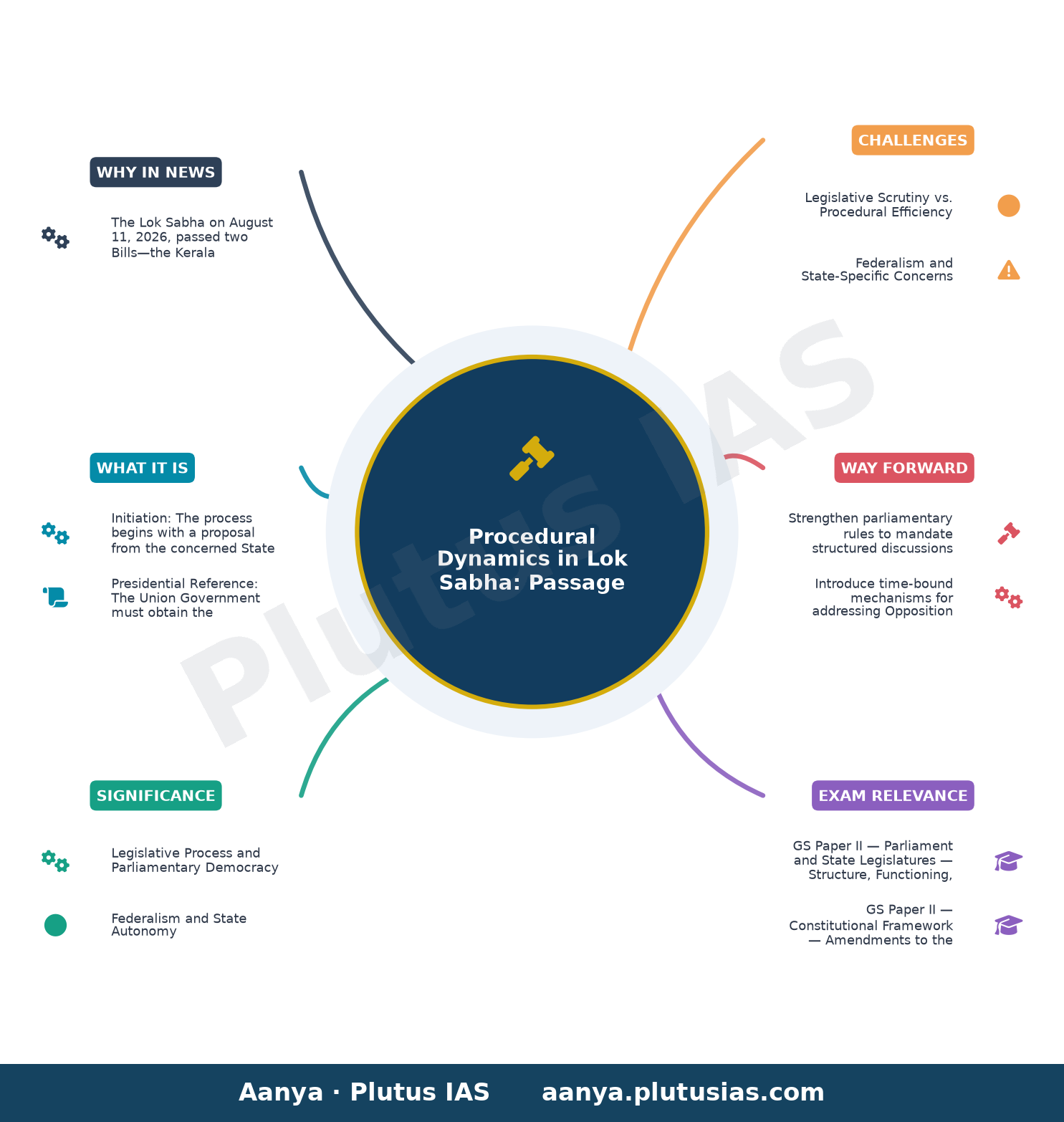
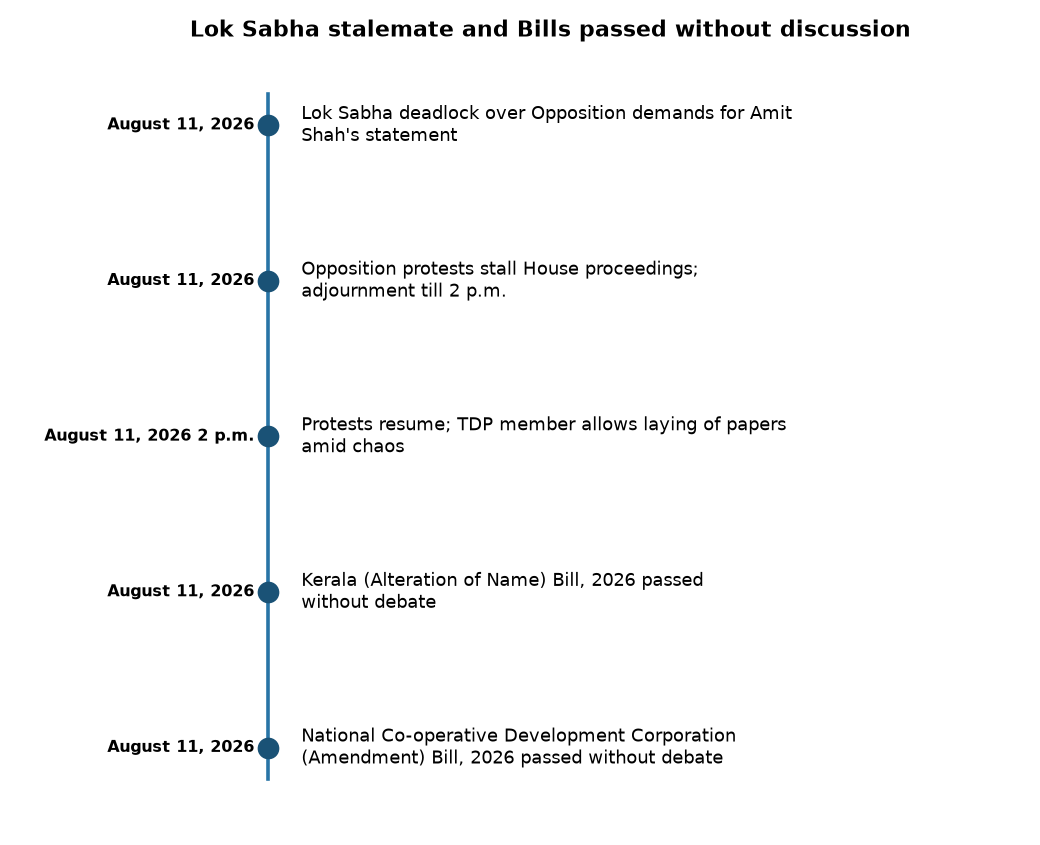
The Lok Sabha on August 11, 2026, passed two Bills—the Kerala (Alteration of Name) Bill, 2026 and the National Co-operative Development Corporation (Amendment) Bill, 2026—without discussion, amidst persistent disruptions by the Opposition over unrelated demands. This incident underscores the procedural challenges in legislative functioning, particularly the invocation of constitutional provisions for State name changes and the legislative framework governing co-operative societies.
Background
- The Constitution of India, under Article 3, empowers Parliament to alter the name of any State by law, provided the President’s recommendation is obtained and the State Legislature is consulted.
- The Kerala (Alteration of Name) Bill, 2026, seeks to rename the State of Kerala to ‘Keralam’, aligning with the Malayalam language’s official script and pronunciation.
- Parliamentary proceedings were disrupted by the Opposition, demanding a statement from the Home Minister on alleged use of force against student protesters and an investigation into alleged financial irregularities in the Ram Temple Trust.
- The Speaker of Lok Sabha adjourned the House twice due to persistent disruptions, reflecting the procedural gridlock in legislative business.
What is the procedure for changing the name of a State in India?
- Initiation: The process begins with a proposal from the concerned State Legislature or the Union Government, seeking to alter the name of a State.
- Presidential Reference: The Union Government must obtain the President’s recommendation under Article 3 of the Constitution, which is mandatory for any alteration of a State’s boundaries, name, or area.
- State Legislature Consultation: The State Legislature must be consulted, and its views are recorded. While the State Legislature’s consent is not legally binding, it is considered a matter of democratic propriety.
- Introduction of Bill: The Union Government introduces a Bill in Parliament to give effect to the proposed name change. The Bill must be passed by both Houses of Parliament.
- Presidential Assent: After parliamentary approval, the Bill receives the President’s assent, following which the name change is officially notified in the Gazette of India.
- Implementation: The name change is implemented administratively, and the State concerned is required to amend its official records, including the Constitution (Schedule) entries.
- Legal Safeguards: The process ensures that the name change does not alter the territorial integrity or administrative boundaries of the State, as per constitutional provisions.
Key Features
| Feature | Significance |
|---|---|
| Passage of Bills without discussion | Demonstrates procedural flexibility in the Lok Sabha under Article 107 of the Constitution, where Bills may be passed without debate in cases of urgency or consensus, though it raises questions about legislative scrutiny and democratic accountability. |
| State name alteration process | The Kerala (Alteration of Name) Bill, 2026, exemplifies the constitutional mechanism under Article 3 for altering the name of a State, requiring Parliamentary approval via a simple majority, reflecting federalism and administrative precision. |
| Co-operative sector amendments | The National Co-operative Development Corporation (Amendment) Bill, 2026, highlights the Union Government’s role in amending laws governing co-operative societies under Entry 43 of the Union List (Seventh Schedule), ensuring policy coherence in the sector. |
| Role of the Speaker | Speaker Om Birla’s adjournment and subsequent conduct of proceedings underscores the constitutional authority vested in the Speaker under Article 93 to maintain order and ensure legislative business proceeds, even amid disruptions. |
| Opposition’s procedural tactics | The Opposition’s strategy of adjournment motions and sloganeering reflects the use of parliamentary tools to stall proceedings, governed by Rules 369 and 374 of the Rules of Procedure and Conduct of Business in Lok Sabha. |
Why it Matters
Legislative Process and Parliamentary Democracy
- The passage of Bills without debate, while procedurally valid, raises concerns about the dilution of legislative scrutiny, particularly in matters of state nomenclature and sectoral amendments.
- The incident underscores the tension between legislative efficiency and democratic deliberation, a recurring theme in parliamentary functioning, especially during sessions marked by disruptions.
- The Speaker’s role in managing disruptions highlights the balance between maintaining decorum and allowing legislative business to proceed, a critical aspect of parliamentary governance.
Federalism and State Autonomy
- The Kerala (Alteration of Name) Bill, 2026, exemplifies the Union Government’s role in facilitating state-level administrative changes, reinforcing the cooperative federalism framework under the Constitution.
- The amendment to the National Co-operative Development Corporation Act demonstrates the Union’s legislative jurisdiction over co-operative societies, a subject under the Concurrent List (Entry 43), ensuring policy uniformity across states.
Institutional Functioning and Accountability
- The deadlock and subsequent passage of Bills without discussion reflect institutional challenges in maintaining productive legislative sessions, raising questions about the efficacy of parliamentary forums in addressing public grievances.
- The Opposition’s demand for a statement on specific incidents, while a legitimate parliamentary tool, highlights the need for structured mechanisms to address grievances without paralysing legislative business.
Constitutional Provisions and Procedural Flexibility
- The Constitution permits the passage of Bills without debate under Article 107, particularly in cases where the business of the House is disrupted, though this must be balanced against the need for thorough legislative scrutiny.
- The Speaker’s authority to adjourn the House under Rule 369 of the Lok Sabha Rules is a critical tool in maintaining order, but its frequent use may indicate systemic challenges in parliamentary conduct.
Challenges
1. Legislative Scrutiny vs. Procedural Efficiency
- The passage of Bills without debate risks undermining the principle of legislative scrutiny, as amendments and debates are essential for identifying flaws, ensuring transparency, and enhancing the quality of legislation.
- Frequent disruptions and adjournments may lead to a backlog of legislative business, delaying critical reforms and policy decisions, thereby impacting governance and public welfare.
- The lack of structured mechanisms to address grievances during parliamentary sessions may erode public trust in legislative institutions, as issues raised by the Opposition remain unresolved.
UPSC Link: Parliamentary functioning and legislative process
2. Federalism and State-Specific Concerns
- State-specific demands, such as the renaming of Kerala to ‘Keralam,’ require careful consideration to ensure that such changes do not inadvertently marginalise linguistic or cultural identities within the state.
- Amendments to laws governing co-operative societies must balance the need for national policy coherence with the autonomy of state-level co-operative institutions, as envisaged under the Constitution.
UPSC Link: Federal structure and co-operative federalism
3. Institutional Challenges in Parliamentary Governance
- The frequent use of disruptions and adjournments as tools of protest may normalise unproductive parliamentary conduct, undermining the institution’s role as a forum for debate and deliberation.
- The lack of structured mechanisms to address grievances during sessions may lead to a breakdown in communication between the government and the Opposition, further exacerbating legislative deadlocks.
UPSC Link: Parliamentary etiquette and institutional integrity
4. Constitutional and Procedural Ambiguities
- The ambiguity in the Constitution regarding the extent of the Speaker’s power to adjourn the House in cases of prolonged disruptions may require judicial or parliamentary clarification to prevent misuse.
- The lack of clear guidelines on the passage of Bills without debate may lead to inconsistencies in legislative practice, raising questions about the balance between efficiency and accountability.
UPSC Link: Constitutional provisions and parliamentary rules
5. Public Trust and Legislative Legitimacy
- The perception of legislative business being conducted without adequate scrutiny or debate may erode public trust in democratic institutions, particularly among younger citizens who rely on parliamentary forums for accountability.
- The inability to address pressing public grievances during parliamentary sessions may lead to a shift in public discourse towards extra-parliamentary avenues, such as protests or judicial interventions.
UPSC Link: Parliamentary democracy and public trust
Challenges — UPSC Perspective
| Issue | Concern |
|---|---|
| Lack of legislative scrutiny | Risks compromising the quality and transparency of laws passed without debate, potentially leading to unintended consequences or public dissatisfaction. |
| Frequent disruptions and adjournments | Undermines the productivity of parliamentary sessions, delays critical reforms, and erodes the institution’s credibility as a forum for debate. |
| Ambiguity in constitutional provisions | Creates uncertainty in the application of rules governing parliamentary conduct, particularly regarding the Speaker’s powers and the passage of Bills without debate. |
| Balancing federalism and centralisation | Requires careful navigation to ensure that Union-level amendments to state-specific laws do not infringe upon state autonomy or cultural identities. |
| Public trust in legislative institutions | May decline if parliamentary sessions are perceived as ineffective or unresponsive to public grievances, leading to a shift towards extra-parliamentary avenues for accountability. |
Way Forward
- Strengthen parliamentary rules to mandate structured discussions or select committees for Bills passed without debate, ensuring minimal scrutiny is maintained.
- Introduce time-bound mechanisms for addressing Opposition grievances during sessions, such as designated slots for discussions or adjournment motions, to prevent prolonged deadlocks.
- Clarify the constitutional and procedural boundaries of the Speaker’s powers to adjourn the House, possibly through judicial review or parliamentary amendments, to prevent misuse.
- Enhance transparency in the legislative process by mandating pre-legislative consultations or public feedback mechanisms, particularly for Bills with state-specific implications.
- Promote inter-party dialogue and consensus-building mechanisms to reduce reliance on disruptions as a tool for protest, fostering a more collaborative parliamentary culture.
- Encourage the use of parliamentary committees for in-depth scrutiny of Bills, even in cases where they are passed without debate, to ensure expert input and public accountability.
- Develop a code of conduct for parliamentary conduct, outlining acceptable and unacceptable practices during sessions, to maintain decorum and productivity.
UPSC Value Addition
Keywords for Mains Answer-Writing
Parliamentary procedures · Legislative deadlock · State name alteration · Constitutional amendment · Co-operative sector reforms · Lok Sabha functioning · Bill passage without debate · Parliamentary sovereignty · Legislative process · Institutional constraints
Constitutional & Policy Linkages
- [‘Article 3’, ‘Alteration of State names’]
- [‘Article 93’, ‘Speaker’s role in Lok Sabha’]
- [‘Seventh Schedule’, ‘Union and State List divisions’]
Concept Flow
Disruption in Lok Sabha proceedings due to Opposition protests → Speaker adjourns House to restore order → Bills moved for passage without debate → Procedural validity under Article 107 invoked → Passage of Kerala (Alteration of Name) Bill and Co-operative Amendment Bill → Questions on legislative scrutiny and democratic accountability arise → Broader implications for parliamentary functioning and federalism emerge.
Prelims Practice Questions
Q1. Consider the following statements regarding the process of altering the name of a State in India:
1. The Constitution of India empowers Parliament to alter the name of a State by a simple majority in both Houses.
2. The consent of the State Legislature is mandatory before Parliament can consider such a Bill.
3. The Bill for alteration of a State’s name must be introduced in the Rajya Sabha only.
How many of the above statements are correct?
- Only one
- Only two
- All three
- None
Answer: Only two — Statement 1 is correct: Parliament can alter the name of a State by a simple majority under Article 3 of the Constitution. Statement 2 is incorrect: The consent of the State Legislature is not mandatory; the Bill is introduced in either House of Parliament. Statement 3 is incorrect: The Bill can be introduced in either the Lok Sabha or the Rajya Sabha.
Q2. Assertion (A): The National Co-operative Development Corporation (NCDC) is a statutory body established to promote co-operative societies in India.
Reason (R): The NCDC operates under the administrative control of the Ministry of Cooperation, Government of India.
In the context of the above two statements, which one of the following is correct?
- Both A and R are true, and R is the correct explanation of A.
- Both A and R are true, but R is not the correct explanation of A.
- A is true, but R is false.
- A is false, but R is true.
Answer: A is true, but R is false. — Assertion (A) is true: The NCDC is a statutory body established under the National Co-operative Development Corporation Act, 1962. Reason (R) is also true: The NCDC functions under the Ministry of Cooperation. However, R does not explain A, as the statutory status of the NCDC is derived from the Act, not its administrative control.
Q3. Match the following Bills with their respective subjects:
Column I
A. Kerala (Alteration of Name) Bill, 2026
B. National Co-operative Development Corporation (Amendment) Bill, 2026
Column II
1. Renaming of a State
2. Amendment to a statutory body’s functioning
Select the correct match:
- A-1, B-2
- A-2, B-1
- A-1, B-1
- A-2, B-2
Answer: A-1, B-2 — The Kerala (Alteration of Name) Bill, 2026 pertains to the renaming of a State (Column I-A matches Column II-1). The National Co-operative Development Corporation (Amendment) Bill, 2026 pertains to amendments in the functioning of a statutory body (Column I-B matches Column II-2).
Mains Practice Question
✍ The passage of Bills without discussion in the Lok Sabha, amidst a legislative deadlock, raises critical questions about the efficacy of parliamentary procedures in a Westminster-style democracy. Critically examine the constitutional and institutional implications of such procedural deviations, with reference to recent instances. (15 Marks)
Approach: MODEL-ANSWER SKELETON:
1. **Constitutional Framework of Parliamentary Procedures**
– Article 107 and Article 108 of the Constitution: Conditions for introduction and passing of Bills.
– Article 118: Rules of Procedure in Parliament; Lok Sabha Rules of Procedure.
– Role of the Speaker under Article 93 and Article 178: Adjournment, prorogation, and suspension of members.
2. **Doctrine of Legislative Sovereignty and Deliberative Democracy**
– Parliament as the supreme law-making body under Article 79.
– Deliberative democracy: Importance of discussion, debate, and scrutiny in law-making (cited in S.R. Bommai v. Union of India, 1994).
– Procedural fairness and natural justice: Impact of bypassing debate on democratic legitimacy.
3. **Institutional Constraints and Contemporary Challenges**
– Rising instances of disruptions and adjournments in recent sessions (e.g., Monsoon Session 2026, Budget Session 2023).
– Role of opposition and government in maintaining decorum (Article 105 and Article 118(1)).
– Impact on legislative accountability and public trust in institutions.
4. **Comparative Perspective**
– Westminster model: Convention of ‘unopposed Bills’ vs. Indian practice of forced passage.
– Judicial stance: Supreme Court’s observations on parliamentary functioning (e.g., in In re: Article 370 of the Constitution, 2023).
5. **Way Forward**
– Strengthening parliamentary committees for pre-legislative scrutiny (e.g., Department-related Standing Committees).
– Institutional reforms: Time-bound discussions, digital platforms for dissent, and strict enforcement of Rules of Procedure.
– Role of the media and civil society in enhancing transparency and accountability.
Source: The Hindu
Generated by AanyaAi for educational purpose.


No Comments