


11 Aug Lok Sabha Passes Kerala Renaming Bill: Key Provisions & Implications
✎ The renaming of a state under Article 3 of the Constitution requires a parliamentary law with the President’s prior recommendation, while the NCDC Amendment Bill aims to enhance the governance and operational efficiency of…
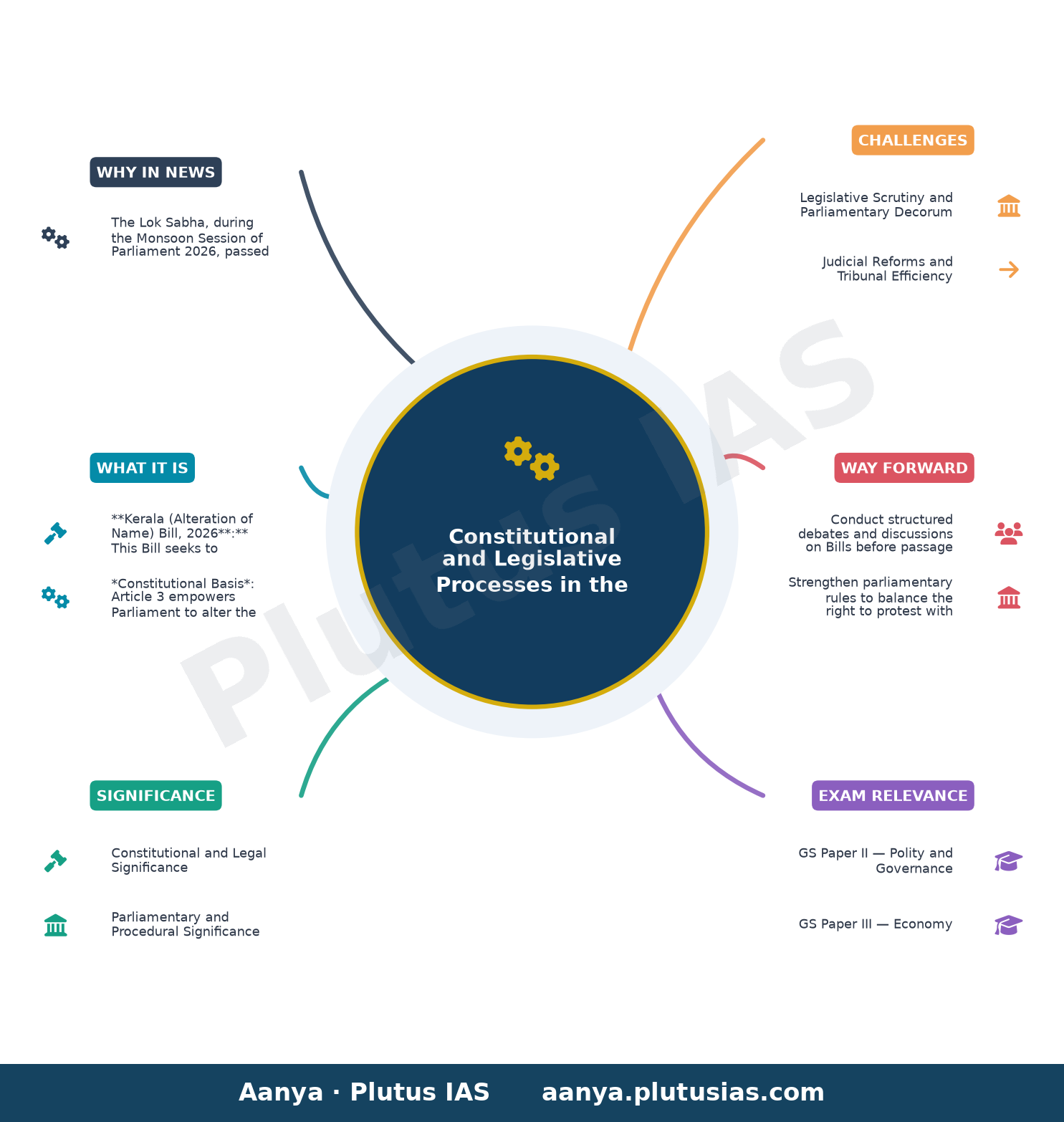
Subject Relevance — Where This Topic Fits
- GS Paper II — Polity and Governance | GS Paper III — Economy
- Prelims: Article 3 of the Constitution, State Reorganisation Act, 1956, National Co-operative Development Corporation (NCDC), Co-operative Societies (Amendment) Bill, Parliamentary procedures for passing Bills, Lok Sabha and Rajya Sabha procedures, Tribunal Reforms Bill, 2026
- Essay: The Role of Constitutional Amendments in Federal Governance, Co-operative Federalism and Economic Reforms in India
Quick Revision: The renaming of a state under Article 3 of the Constitution requires a parliamentary law with the President’s prior recommendation, while the NCDC Amendment Bill aims to enhance the governance and operational efficiency of India’s apex co-operative development body.
Why is this in the news?
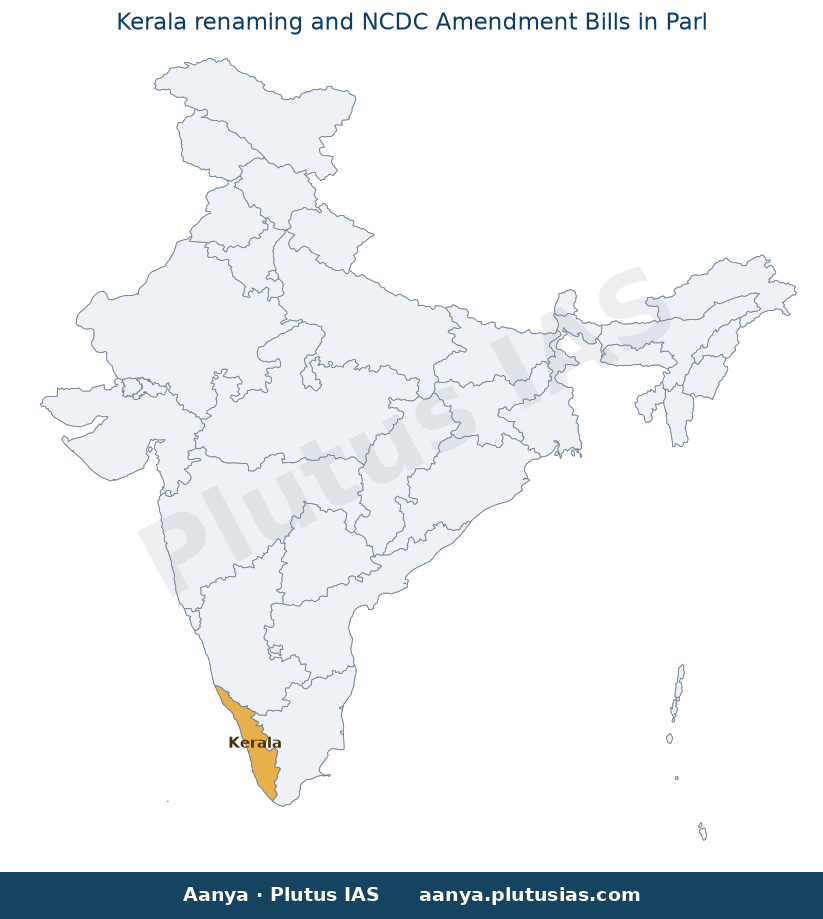
The Lok Sabha, during the Monsoon Session of Parliament 2026, passed the Kerala (Alteration of Name) Bill, 2026, renaming the state from ‘Kerala’ to ‘Keralam’ in Malayalam script, and the National Co-operative Development Corporation (Amendment) Bill, 2026, without debate amid Opposition protests. These legislative actions highlight the procedural aspects of state renaming under the Constitution and the evolving governance framework for co-operative societies in India.
Background
- The Constitution of India, under Article 3, empowers Parliament to alter the name of a State by law, following a prescribed procedure that includes the President’s recommendation and the state legislature’s views.
- The State Reorganisation Act, 1956, provided the legal framework for the reorganisation of states on linguistic and administrative grounds, though subsequent amendments and new laws have been enacted to address specific cases.
- The National Co-operative Development Corporation (NCDC), established in 1963, is the apex statutory body for promoting and developing co-operative societies in India, operating under the Ministry of Cooperation.
- Co-operative societies play a critical role in India’s economy, particularly in sectors like agriculture, dairy, and rural credit, necessitating periodic legislative updates to enhance their governance and accountability.
- Parliamentary procedures for passing Bills include introduction, debate, committee scrutiny, and voting, with the Lok Sabha and Rajya Sabha playing distinct roles in the legislative process.
- Recent legislative trends reflect a focus on streamlining governance, enhancing federal co-operation, and addressing sectoral reforms, as evidenced by the passage of multiple Bills during the Monsoon Session of 2026.
Key Legislative Actions: Kerala (Alteration of Name) Bill and NCDC Amendment Bill
- **Kerala (Alteration of Name) Bill, 2026**:** This Bill seeks to rename the state of Kerala to ‘Keralam’, reflecting its Malayalam linguistic identity. The procedure for altering a state’s name is governed by Article 3 of the Constitution, which requires a parliamentary law passed with the President’s prior recommendation. The state legislature’s views are also sought, though not binding, as per constitutional practice.
- *Constitutional Basis*: Article 3 empowers Parliament to alter the name of a State by law, provided the Bill is introduced with the President’s recommendation. This ensures federal co-operation and respects the linguistic and cultural identity of the state concerned.
- *Procedure*: The Bill must be passed by both Houses of Parliament and receive the President’s assent to become law. The state legislature’s views are typically sought through a resolution, though the final decision rests with Parliament.
- *Historical Context*: Kerala was formed in 1956 under the State Reorganisation Act, 1956, based on linguistic lines. The renaming to ‘Keralam’ aligns with the state’s official Malayalam script and cultural heritage.
- *Impact*: The renaming is symbolic and does not alter the state’s geographical boundaries or administrative structure but reinforces its linguistic identity.
- ***National Co-operative Development Corporation (Amendment) Bill, 2026**:** This Bill amends the National Co-operative Development Corporation Act, 1963, to enhance the governance, accountability, and operational efficiency of the NCDC.
- *Purpose*: The amendments aim to strengthen the NCDC’s role in promoting co-operative societies, particularly in rural and agricultural sectors, by providing greater financial autonomy, streamlined governance, and improved regulatory oversight.
- *Key Amendments*: The Bill likely includes provisions for enhanced funding mechanisms, stricter compliance norms, and greater transparency in the NCDC’s functioning, aligning with the government’s focus on cooperative federalism and economic reforms.
- *Governance Framework*: The NCDC operates under the Ministry of Cooperation, established in 2021 to promote the co-operative movement in India. The amendments seek to align the NCDC’s functioning with contemporary economic and governance needs.
- *Sectoral Relevance*: Co-operative societies contribute significantly to India’s economy, particularly in sectors like dairy (e.g., Amul), agriculture, and rural credit. The amendments aim to address challenges such as financial sustainability, governance gaps, and regulatory compliance.
- *Parliamentary Scrutiny*: The Bill was passed without debate in the Lok Sabha, reflecting procedural efficiency but also raising questions about the adequacy of parliamentary scrutiny in complex legislative matters.
Key Features
| Feature | Significance |
|---|---|
| Kerala (Alteration of Name) Bill, 2026 | Proposes the official renaming of the state of Kerala to ‘Keralam’ in the First Schedule of the Constitution, reflecting linguistic and cultural identity while adhering to constitutional procedures for state name alterations. |
| National Co-operative Development Corporation (Amendment) Bill, 2026 | Seeks to amend the NCDC Act, 1962 to enhance the governance, financial autonomy, and operational efficiency of the National Co-operative Development Corporation, aligning it with contemporary cooperative sector needs. |
| Process of Bill Passing Without Debate | Highlights the procedural aspect of legislative business where Bills are passed without discussion due to disruptions, raising questions about parliamentary decorum and the effectiveness of legislative scrutiny. |
| Opposition Protests in Lok Sabha | Demonstrates the role of Opposition in parliamentary democracy, where protests and slogans are used to draw attention to grievances, though such actions may impede legislative proceedings. |
| Tribunals Reforms Bill, 2026 (Rajya Sabha context) | Aims to reform the tribunal system by merging or abolishing certain tribunals to reduce multiplicity, enhance efficiency, and streamline dispute resolution mechanisms in line with judicial reforms. |
Why it Matters
Constitutional and Legal Significance
- The Kerala (Alteration of Name) Bill underscores the constitutional mechanism for altering the name of a state under Article 3 of the Constitution, which requires parliamentary approval via a simple majority.
- The NCDC Amendment Bill reflects the government’s focus on strengthening cooperative institutions as part of the broader economic agenda, given the cooperative sector’s role in rural development and employment generation.
- The Tribunals Reforms Bill addresses long-standing concerns about judicial delays and multiplicity of tribunals, aligning with the recommendations of the Law Commission of India and Supreme Court directives on judicial reforms.
Parliamentary and Procedural Significance
- The passage of Bills without debate due to disruptions highlights the challenges in maintaining orderly legislative proceedings, which is critical for the functioning of parliamentary democracy.
- The use of slogans and protests by Opposition members, while constitutionally permissible, raises questions about the balance between democratic expression and legislative productivity.
- The procedural efficiency of passing Bills without debate, though legally valid, may undermine the principle of informed parliamentary scrutiny and public accountability.
Economic and Social Significance
- The NCDC Amendment Bill is significant for the cooperative sector, which plays a vital role in India’s rural economy, particularly in agriculture, dairy, and credit cooperatives.
- The renaming of Kerala to ‘Keralam’ carries cultural and linguistic significance, reflecting the state’s identity and potentially boosting tourism and local pride.
Challenges
1. Legislative Scrutiny and Parliamentary Decorum
- The passage of multiple Bills without debate due to disruptions raises concerns about the quality of legislative scrutiny and the ability of Parliament to fulfill its oversight role.
- Ongoing protests and slogans disrupt parliamentary proceedings, highlighting the need for mechanisms to ensure decorum while allowing Opposition members to voice concerns.
- The lack of debate on critical Bills may lead to inadequate public discourse and limited scrutiny of their implications.
UPSC Link: Parliamentary Procedures and Conduct of Business
2. Judicial Reforms and Tribunal Efficiency
- The Tribunals Reforms Bill, while aimed at streamlining the tribunal system, faces criticism over potential dilution of judicial independence and representation concerns, particularly for marginalized communities.
- The issue of representation of Dalit and Adivasi communities in tribunals, as raised in the Rajya Sabha, underscores the need for inclusive judicial institutions.
- Allegations of corruption in tribunals, such as the NCLT, highlight the challenges in maintaining transparency and accountability in quasi-judicial bodies.
UPSC Link: Judicial Reforms and Tribunal System
3. Cooperative Sector Governance
- The NCDC Amendment Bill, while aiming to enhance the NCDC’s role, may face challenges in implementation due to the diverse and fragmented nature of the cooperative sector in India.
- Ensuring financial autonomy for NCDC without compromising accountability and transparency remains a critical challenge.
UPSC Link: Cooperative Societies and Rural Development
Challenges — UPSC Perspective
| Issue | Concern |
|---|---|
| Passage of Bills Without Debate | Undermines parliamentary scrutiny and public accountability, raising questions about the effectiveness of legislative oversight. |
| Representation in Tribunals | Potential underrepresentation of marginalized communities (Dalits, Adivasis) in tribunals, despite constitutional guarantees of equality and justice. |
| Judicial Independence vs. Reform | Risk of excessive executive control over tribunals, which may compromise their independence and impartiality. |
| Corruption in Tribunals | Allegations of waivers and favoritism in tribunals, such as the NCLT, erode public trust in the judicial system. |
| Cooperative Sector Fragmentation | Diverse and unorganized nature of cooperatives poses challenges for uniform governance and financial reforms. |
| Linguistic and Cultural Identity | While renaming states is a procedural matter, it may spark debates on identity politics and federalism. |
Way Forward
- Conduct structured debates and discussions on Bills before passage to ensure thorough scrutiny and public accountability.
- Strengthen parliamentary rules to balance the right to protest with the need for orderly proceedings, possibly through time-bound discussions.
- Enhance transparency and accountability in tribunals by implementing strict anti-corruption measures and ensuring representation of marginalized communities.
- Promote inclusive governance in the cooperative sector by aligning NCDC reforms with the needs of small and marginal cooperatives.
- Encourage state governments to engage in pre-legislative consultations to address concerns before Bills are introduced in Parliament.
- Establish a dedicated parliamentary committee to review the functioning of tribunals and recommend reforms based on ground realities.
- Foster a culture of constructive opposition in Parliament, where protests are complemented by formal mechanisms to voice grievances.
UPSC Value Addition
Keywords for Mains Answer-Writing
Constitutional amendment process · Article 3 of the Constitution · State Reorganisation Act, 1956 · Kerala Legislative Assembly · Lok Sabha legislative procedure · Bill passage without debate · Parliamentary democracy · Federalism in India · Co-operative federalism · National Co-operative Development Corporation (NCDC) · National Company Law Tribunal (NCLT) · Tribunals Reforms Bill, 2026 · Parliamentary sovereignty · Opposition protests in Parliament
Constitutional & Policy Linkages
- [‘Article 3: Alteration of State Names’, ‘Procedure for changing state names via parliamentary law.’]
- [‘Article 246: Distribution of Legislative Powers’, “Parliament’s exclusive power to legislate on state name changes under the Union List.”]
- [‘Seventh Schedule: Union List’, “Entry 12: Alteration of names of states falls under Parliament’s jurisdiction.”]
- [‘Article 14: Equality Before Law’, ‘Ensures non-discrimination in judicial appointments and tribunal representation.’]
- [‘Article 16: Equality of Opportunity’, ‘Mandates representation of marginalized communities in public employment, including tribunals.’]
Concept Flow
State government proposes name change → Parliament introduces Kerala (Alteration of Name) Bill, 2026 → Bill referred to Standing Committee on Home Affairs → Lok Sabha passes Bill without debate due to disruptions → Rajya Sabha considers and passes Bill → President gives assent → Name change notified in the Gazette of India. → NCDC established under NCDC Act, 1962 → NCDC Amendment Bill, 2026 introduced to address governance gaps → Bill passed without debate → Amendments notified, enhancing NCDC’s financial and operational autonomy. → Supreme Court and Law Commission recommend tribunal reforms to reduce multiplicity and delays → Tribunals Reforms Bill, 2026 introduced in Rajya Sabha → Concerns raised over judicial independence and representation → Bill referred to Select Committee for review → Final passage and implementation. → Opposition members stage protests in Lok Sabha → Disruptions lead to adjournments and lack of debate on Bills → Raises questions about parliamentary decorum and legislative scrutiny → Need for structured mechanisms to balance protest and productivity. → Allegations of corruption in tribunals (e.g., NCLT) → Calls for transparency and accountability in quasi-judicial bodies → Highlights challenges in maintaining public trust in the judicial system.
Prelims Practice Questions
Q1. Consider the following statements regarding the procedure for altering the name of a State in India:
1. The Bill for altering the name of a State can be introduced in either House of Parliament.
2. The Bill requires the prior recommendation of the Governor of the concerned State.
3. The Bill must be referred to the State Legislature for its views before introduction in Parliament.
4. The Bill becomes law only after it receives the assent of the President of India.
How many of the above statements are correct?
- Only one
- Only two
- Only three
- All
Answer: All — Statements 1, 2, and 4 are correct. Statement 3 is incorrect because the Constitution does not mandate a reference to the State Legislature before introduction of the Bill in Parliament, though such consultation may occur.
Q2. Assertion (A): The National Company Law Tribunal (NCLT) is a quasi-judicial body established under the Companies Act, 2013.
Reason (R): The NCLT was constituted to adjudicate matters related to insolvency, winding up, and other corporate disputes, thereby reducing the burden on civil courts.
Options:
A. Both A and R are true, and R is the correct explanation of A.
B. Both A and R are true, but R is not the correct explanation of A.
C. A is true, but R is false.
D. A is false, but R is true.
Answer: ? — Both the Assertion and Reason are true. The NCLT is indeed a quasi-judicial body established under the Companies Act, 2013 to handle corporate disputes, including insolvency, thereby reducing the burden on civil courts.
Q3. Match the following Bills with their respective subjects:
Column I (Bills) | Column II (Subjects)
—————-|——————
A. Kerala (Alteration of Name) Bill | 1. Co-operative sector reforms
B. National Co-operative Development Corporation (Amendment) Bill | 2. Renaming of a State
C. Tribunals Reforms Bill | 3. Judicial reforms and tribunal restructuring
D. Bankers’ Books Evidence Bill | 4. Banking sector evidence collection
Options:
A. A-2, B-1, C-3, D-4
B. A-1, B-2, C-3, D-4
C. A-3, B-4, C-1, D-2
D. A-4, B-3, C-2, D-1
Answer: ? — A-2 (Kerala (Alteration of Name) Bill pertains to renaming a State), B-1 (NCDC Amendment Bill pertains to co-operative sector reforms), C-3 (Tribunals Reforms Bill pertains to judicial reforms and tribunal restructuring), D-4 (Bankers’ Books Evidence Bill pertains to banking sector evidence collection).
Mains Practice Question
✍ The Parliament recently passed the Kerala (Alteration of Name) Bill, 2026, renaming the State as ‘Keralam’. In this context, critically examine the constitutional framework governing the alteration of names of States in India. Also, analyse the implications of such amendments on federalism and parliamentary sovereignty. (15 Marks)
Approach: MODEL-ANSWER SKELETON:
1. **Constitutional Framework**:
– Article 3 of the Constitution empowers Parliament to alter the name of a State by law.
– The Bill must be introduced in either House of Parliament; prior consultation with the State Legislature is not mandatory but may occur.
– The Bill requires the President’s assent to become law.
– Reference to the Governor of the State is not constitutionally mandated but is part of the legislative process.
2. **Procedure and Recent Example**:
– The Kerala (Alteration of Name) Bill, 2026, exemplifies the process where the Bill was introduced in Lok Sabha and passed without debate amid Opposition protests.
– The Bill’s passage highlights the procedural flexibility within Parliament’s legislative authority.
3. **Federalism Implications**:
– Alteration of a State’s name is a sovereign parliamentary power and does not require the State’s consent, reflecting the unitary bias in India’s federal structure.
– This power underscores the principle of parliamentary sovereignty over federalism, as the Centre can unilaterally alter State names without State concurrence.
– However, such amendments are typically preceded by consultations with the State Legislature to maintain cooperative federalism.
4. **Parliamentary Sovereignty**:
– The passage of the Bill without debate reflects the plenary power of Parliament to legislate on matters concerning States.
– This sovereignty is balanced by the requirement of the President’s assent, which acts as a constitutional check.
5. **Critique and Balance of Views**:
– Critics argue that such amendments undermine State autonomy and federal principles.
– Proponents contend that the power is necessary for national unity and administrative uniformity.
6. **Conclusion**:
– The constitutional framework provides a clear process for altering State names, balancing parliamentary sovereignty with federal principles.
– The recent example of Kerala’s renaming illustrates the procedural and political dynamics involved in such amendments.
Source: The Hindu
Generated by AanyaAi for educational purpose.

- मद्रास उच्च न्यायालय में ‘वेट्ट्री पयणम’ योजना को असंवैधानिक घोषित करने की मांग - October 4, 2026
- Gurugram’s groundwater extraction exceeds limit by 212%; HC seeks ban - October 4, 2026
- स्वतंत्रता सेनानी श्यामजी कृष्ण वर्मा की जन्म जयंती पर पीएम का श्रद्धांजलि - October 4, 2026

No Comments